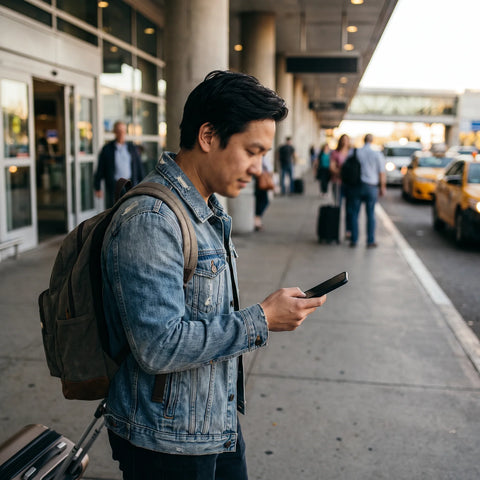
In short: an eSIM for seniors is a digital SIM card installed at home by scanning a QR code. It doesn't affect your Spanish number and avoids expensive roaming charges at your destination. It works on most newer mobile phones, activates in a minute, and lets you call family via WhatsApp from any country without looking for stores or unexpected charges on your bill.
Traveling after retirement is a fantastic plan, but the mobile phone aspect often deters people: QR codes, strange settings, and the fear of a skyrocketing roaming bill. The good news is that installing an eSIM is simpler than learning a new app, and with clear instructions, it can be done in a minute. This guide is designed for senior travelers: clear steps, how to call family, and why Spanish-language support makes all the difference when a question arises.
What is an eSIM and why is it for you?
An eSIM is a digital SIM card: instead of a plastic chip, it's a data plan installed on your phone from a picture (a QR code). For a senior traveler, it has three clear advantages: you don't have to open your phone or look for a pin, it won't get lost or damaged, and it avoids expensive roaming from your home operator.
The beauty of it is that you purchase it before you leave, calmly and from your couch, and when you arrive at your destination, it works automatically. You don't have to look for a store in a foreign airport or understand signs in another language. You keep your usual SIM card for calls from Spain, and the eSIM only provides internet wherever you go. If you want to understand the concept without technical jargon, start with our guide on what an virtual eSIM is, explained in plain language.
Peace of mind above all: the eSIM does not erase or affect your Spanish phone number. Your usual line remains active for receiving calls and SMS; the eSIM only adds the travel internet data.

Check if your phone is compatible
Before buying anything, a key step: not all phones support eSIMs. The quick rule is that most mid-to-high-end phones from recent years do (modern iPhones, recent Samsung Galaxy models, Google Pixel…), while very old or very basic models do not.
The easiest way to check: on an iPhone, dial *#06# on the call keypad; if a number called EID appears, your phone has an eSIM. On Android, go to Settings and look for "eSIM" or "add data plan." If you find it confusing, review the Settings menu carefully or ask a trusted person for help locating the "add eSIM" option; most modern phones don't hide it too much. Do it with time: if your phone doesn't support it, it's better to find out at home than at the airport.
Myths that hold many seniors back (and shouldn't)
There are quite a few ideas circulating among senior travelers that, while not entirely false, are poorly explained. Clarifying them upfront prevents unnecessary scares.
- "If I have the eSIM active, my Spanish operator will still charge me for roaming." No, if you configure it correctly. The trick is to tell your phone which line to use for data: in Settings, you select the eSIM as the data line and leave your Spanish SIM only for calls and SMS. If you don't change anything and the phone continues to use data via the Spanish line abroad, that's when expensive roaming charges will apply. Our guide on what data roaming is explains it clearly.
- "My phone is several years old, surely it's no good." It depends on the model, not the age itself: some phones from five or six years ago have eSIMs, and others recently purchased do not. If yours doesn't support it, the alternative is still a physical prepaid chip at your destination; in international chip vs. eSIM, we compare both so you can decide at your leisure.
- "The more gigabytes I buy, the better." Not always. If you're going on a two-week cruise with six short stops, most of the time you'll be sailing without coverage from any country; buying a huge plan to only use it in port is a waste of money. It's better to calculate the actual days on land.
- "The eSIM works for everything just like my home line." It works for data: internet, WhatsApp, maps, email. For traditional phone calls (dialing a number without using any app), your Spanish SIM still takes precedence, and those may incur extra charges depending on your plan.
And here's the part almost no brand tells you: if your trip is a weekend in Lisbon or a one-day Mediterranean cruise with your Spanish plan that already includes EU roaming, you don't need to buy anything. Save the eSIM for trips outside the European Union or for long stays, as that's where it really pays off.
Step-by-step installation, stress-free
Installing an eSIM comes down to scanning a photo and clicking accept. Ideally, do it at home, with WiFi and without rushing, a few days before you travel. This way, when you arrive at your destination, all you have to do is turn on your phone.
- Purchase the eSIM for the country or region of your trip. You will receive a QR code via email.
- With WiFi, go to Settings > Mobile Data > Add eSIM (or "Add plan") and scan the QR with your camera.
- Give the line a name, for example "Travel," to distinguish it from your Spanish SIM.
- Upon arrival at your destination, activate data roaming on that line and select it for mobile data. And that's it.
If you get stuck at any step, it's okay: it's normal the first time. Our guide on how to install an eSIM explains it slowly and with images. A tip: ask a child or grandchild to help you the first time; you'll see that it's done in five minutes, and for your next trip, you'll do it by yourself.

Calling and video calling family
The most important thing when traveling is being able to say "we've arrived safely." With an eSIM, you have internet, and with internet, you can make free calls and video calls via WhatsApp, which is what almost everyone uses now. You can see your grandchildren's faces from the other side of the world without paying an extra cent.
For normal phone calls (to a number, without apps), you still use your usual Spanish line, although these may incur charges depending on your plan. That's why, to talk to family, it's practical to use WhatsApp or video calls over the eSIM's data. If you need to make or receive actual phone calls during your trip, it's important to understand the difference between eSIM and traditional roaming, because not all eSIMs include that function, and your Spanish line still governs that.
Spanish support: your safety net
This is the difference that most reassures a senior traveler. Many cheap eSIMs only offer chat support in English, and when a question arises thousands of miles away, that's a problem. Being able to write in Spanish and get a quick response turns a moment of stress into something resolved in two messages.
| Situation | Without good support | With Spanish support |
|---|---|---|
| No internet upon arrival | English chat, waiting | Guided in your language instantly |
| Doubt during installation | You get stuck and give up | A message and you move forward |
| Run out of data | Don't know how to top up | They explain how in Spanish |
Before buying, always check that the provider offers Spanish-language support and, if possible, available 24 hours a day in case a problem arises in the middle of the night or in another time zone. It's the difference between feeling accompanied and feeling alone with a phone that won't cooperate.
Practical travel tips
With the basics covered, a few tricks will make your trip even more comfortable. The idea is to prepare your phone at home so you don't have to deal with anything at your destination.
- Download offline maps of your destination city on Google Maps before leaving; they work without data.
- Increase the font size on your phone in Settings to comfortably read messages and directions.
- Write down the emergency number of the country and keep your family's phone number handy just in case.
- If you are traveling as a couple or group, each phone needs its own eSIM; it is not shared between two phones like a pocket router. This way, no one depends on the other person having their phone on to have a map.
- Monitor battery life in areas with poor coverage, such as mountain villages or old neighborhoods with narrow streets: the phone uses more power searching for a signal. Carry a charger or a small external battery if the day is going to be long.
- Write down the PIN code of your Spanish SIM on a separate piece of paper, not just in your phone; if the phone restarts and asks for it, it's easy to draw a blank in front of the screen.
- If you are visiting children or grandchildren who live abroad, check beforehand how much your usual roaming costs for that long stay: it is almost always more worthwhile to get an eSIM for the destination country, whether it's the United States or any European country with the Europe eSIM if you are going to move between several.
A very common situation among retirees: a multi-week trip visiting several countries, like Colombia or Peru, combining big cities with rural areas with weaker coverage. If this is your case, it's a good idea to check specific destination guides like the one for eSIM for Colombia, because coverage varies greatly between Bogotá, Cartagena, and more rural areas, and it's better to know this before you leave, not in the middle of your trip.
And most importantly, don't be afraid of technology: the eSIM is designed precisely to simplify things. Once you use it for the first time, you'll wonder how you ever traveled before carrying chips and searching for card stores in every country.
Frequently Asked Questions
Is it difficult to install an eSIM if I'm not very tech-savvy?
No. It boils down to scanning a photo (a QR code) with your camera and tapping "accept," all done at home with Wi-Fi. The first time, ask a family member for help if you prefer, but most travelers do it themselves in five minutes. A good provider with Spanish support will assist you if you get stuck.
Do I lose my usual phone number when I get an eSIM?
No, not at all. The eSIM only adds internet data for your trip; your Spanish SIM and number remain active for receiving calls and SMS. You can have both lines working simultaneously on the same phone without any problems.
How do I call my family in Spain from abroad?
The most convenient and free way is via WhatsApp, with a call or video call using the eSIM's data. You'll see your family on screen at no extra cost. For regular phone calls, you'll still use your Spanish line, but those may incur charges depending on your plan, so WhatsApp is usually the best option.
What if something goes wrong while I'm traveling?
First, breathe: almost everything can be fixed by activating data roaming or selecting the eSIM as the data line. If not, contact the provider's support. That's why we recommend choosing an eSIM with 24/7 Spanish support: they guide you in your language, and you can resolve the issue in minutes without stress.
Do I need an eSIM if the hotel already has Wi-Fi?
Hotel Wi-Fi is great, but it only works indoors. Out on the street, in a museum, or looking for a restaurant, you'll be without connection or maps. The eSIM gives you internet everywhere, which is exactly when you need it most. You can use the hotel's Wi-Fi at night and the eSIM during the day to save data.
Do I need Wi-Fi throughout the trip for the eSIM to work?
No. Wi-Fi is only needed for the installation, before you leave home. Once set up, the eSIM works with mobile data in the country you're in, just like your regular SIM works in Spain. Hotel Wi-Fi is an extra for saving data, not a requirement.
Can I use the same eSIM on two phones or share it with my partner?
No, each eSIM is linked to a single device at the time of installation. If two people are traveling, each person needs to purchase and install their own eSIM on their own mobile phone. It's a small extra cost, but it prevents being without a map or WhatsApp if you get separated for a while at the destination.
Conclusion
An eSIM is the most convenient and secure way to have internet on your senior trips: it installs in a minute, doesn't affect your usual number, and lets you video call family for free. The key is to choose wisely and not travel alone with your phone. Opt for an eSIM with easy installation and Spanish support that can resolve any questions instantly.