In short: an eSIM for Serbia gives you internet as soon as you land in Belgrade, with coverage from Yettel, A1, or mts, and a fixed price before you fly. Since Serbia is not in the EU, your Spanish roaming plan doesn't apply: without a data plan, every MB is paid separately. It's installed with a QR code from home and coexists with your Spanish number.
If you're planning a trip to Belgrade or a road trip through the Balkans, an eSIM for Serbia connects you as soon as you land, with no airport queues or surprise charges. Serbia is not part of the European Union, so your Spanish "roaming like at home" plan does not apply here: without your own data plan, every MB can cost you an arm and a leg. In this guide, we'll tell you about real coverage, how many GB you need, what myths circulate on the subject, and how it compares to local SIMs.
What is an eSIM in Serbia and how does it work?
An eSIM is a digital SIM card installed by scanning a QR code, with no physical card to insert or remove. It works perfectly in Serbia as long as your mobile is compatible (iPhone XS or later, Google Pixel, Samsung Galaxy S20 onwards, and most recent high-end models). It's installed before you leave home and connects to Serbian networks as soon as you arrive in the country. You don't need to change your physical SIM or remove your Spanish number. If you've never used one and it sounds like Greek to you, our guide on what an virtual eSIM is explains it in simple terms.
The big advantage over roaming is that you know what you're paying beforehand. Serbia is outside the European roaming agreement, and that's where classic roaming costs skyrocket: to understand why, it's worth reading what data roaming exactly is and how it changes when you leave the EU. With an eSIM, you contract the GB you want at a fixed price, and your WhatsApp, Google Maps, and boarding pass work from minute one, without relying on the Nikola Tesla airport Wi-Fi while you look for the bus 72 stop that takes you to the city center.

Coverage and local operators
Serbia has three main operators: Telenor (now Yettel), A1 Serbia, and mts (Telekom Srbija). All three offer 4G in almost the entire country and 5G in Belgrade, Novi Sad, and Niš. A good travel eSIM relies on several of these networks, so your mobile automatically chooses the strongest signal wherever you are, without you having to do anything.
Urban coverage is excellent. On mountain routes to Zlatibor or Kopaonik, or in small towns, the signal drops to 4G or 3G, which is normal in rural areas of any country. For the vast majority of a tourist trip—city, restaurants, museums, transfers—you'll have plenty of data. A useful fact: Wi-Fi in hotels and cafes (traditional kafane) in Belgrade is usually fast and very common, so you can save mobile data for the street and leave heavy streaming for when you have Wi-Fi.
Tip: activate your eSIM and make sure "Data Roaming" is turned on for the data line before you take off. That way, when you land at Nikola Tesla Airport (Belgrade), you'll be connected without touching your phone, with your luggage on the conveyor belt and your taxi already located.
How many GB do you need for your trip?
It depends on how much you use maps, social media, and streaming. For normal tourist use—Maps, messaging, some Instagram, and looking up places—most travelers use between 1 and 3 GB per week. If you work remotely, make video calls, or upload a lot of stories, go for 5 GB or more. Here's a realistic guide:
| Traveler profile | Days | Recommended GB |
|---|---|---|
| Weekend in Belgrade | 2-3 | 1-2 GB |
| Serbia tourist route | 5-7 | 3-5 GB |
| Nomad / remote work | 10-15 | 10 GB or unlimited |
| Balkans road trip (several countries) | 10+ | regional plan |
If you run out, don't worry: you can top up data without buying a new SIM. Before deciding on a plan, take a look at these tips for saving data on your travel eSIM, such as disabling automatic app updates or lowering the quality of photos you upload while you're away. It's better to have a little too much than to run out of internet in the middle of Belgrade's old town.
eSIM vs local SIM vs roaming
You have three ways to get data in Serbia, and each has its moment. A local SIM is cheap in terms of GB but requires you to go to a store with your passport, communicate in Serbian, and change your physical card; additionally, by law, any Serbian prepaid card requires registration with an ID, so the in-store process is not optional. Your Spanish operator's roaming is convenient but, since Serbia is outside the EU, it's usually charged at a premium per MB: check the current price with your operator before you leave, because rates outside the EU change, and not all companies publish the fine print clearly. The eSIM hits the sweet spot: fixed price, online activation, and your Spanish number remains intact for bank SMS.
| Option | Advantage | Disadvantage |
|---|---|---|
| Travel eSIM | Ready before you fly, fixed price | Requires compatible mobile phone |
| Local Serbian SIM | Lots of cheap GB | Store, passport, change SIM |
| Spanish roaming | No setup needed | Very expensive outside the EU |
To better understand the difference between eSIM and roaming, or if you're considering carrying a physical spare chip just in case, compare options in international chip vs eSIM before deciding. That said, be honest with yourself about your itinerary: if you're only making a one-day stop in Belgrade on your way to somewhere else, it probably isn't even worth activating anything, as the airport and hotel Wi-Fi might be more than enough.
How to activate it step by step
The process takes a minute and is done from home with Wi-Fi. It's that simple:
- Check that your mobile supports eSIM (Settings > General > About, or dial *#06# and look for the EID).
- Purchase your Serbia eSIM and receive the QR code by email instantly.
- Scan the QR code: Settings > Mobile Data > Add eSIM.
- Label it "Travel" and set it as the data line.
- Upon landing, activate "Data Roaming" on that line, and you're good to go.
Do not delete your Spanish SIM: the eSIM coexists with it, so you continue to receive calls and SMS from your usual number while browsing with Serbian data. If this is your first time doing this and you want to see it with more screenshots, the general step-by-step guide on how to install an eSIM works equally well for Serbia as for any other destination; the process does not change.
Belgrade, Novi Sad, and the Balkans
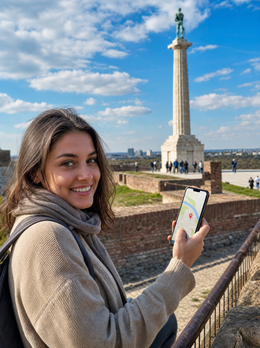
Belgrade is the star attraction: the Kalemegdan fortress at sunset, the bohemian Skadarlija district with its cobblestones and live music, and the nightlife of the splavovi (boat-discos moored on the Sava and Danube). With data in your pocket, you can navigate with Maps between Stari Grad and Novi Beograd without getting lost, and request a car by app without haggling with the taxi driver. One detail that surprises those coming from other European capitals: Uber has almost no real presence in Belgrade, so the app that rules is CarGo; install it with data before leaving the hotel so you don't get stranded looking for a taxi on the street at two in the morning.
Novi Sad, just over an hour by train from Belgrade, shines in summer for the EXIT festival inside the Petrovaradin fortress, with views of the Danube that deserve their own photo album. If your plan is a road trip through the Balkans—Serbia, Bosnia, Montenegro, North Macedonia—consider a regional eSIM instead of one per country; it saves you from installing several different eSIMs and changing data lines at each border. And if you combine Serbia with neighboring destinations already within the EU, a Europe eSIM might be more suitable for the part of the itinerary that is covered by community roaming. Each leg of the journey has its product; choose the one that covers your actual route, not the one that sounds grander.
Myths and what almost no one tells you
"Roaming in Serbia works like at home, just like in France or Italy." No. This is the most repeated mistake and the one that causes the most grief: Serbia is not in the EU or EEA, so the European price cap does not protect you here. Check it before you leave, not when you arrive and see the bill.
"With a Serbian eSIM, my entire trip through the Balkans is covered." It depends on the plan you buy. An eSIM designed only for Serbia may not provide coverage in Bosnia or Montenegro; if you are going to cross borders, check the exact coverage of the plan before paying for it, do not assume that "Balkans" means the same thing for all eSIMs.
"Near the border, I just lose coverage." In reality, the opposite can happen and be more expensive: in border areas, your phone sometimes connects to the strongest tower, even if it's from a neighboring country, and if that network is not included in your plan, you can enter roaming without realizing it. If you're going to be near a border, keep an eye on the network name that appears at the top of the screen from time to time.
"I need public Wi-Fi to save data, even from a random cafe." Open Wi-Fi in bars and stations is convenient, but it's also where you're most exposed if you do online banking or enter passwords. With an active eSIM, it's more worthwhile to use your own data for sensitive matters and leave public Wi-Fi for unimportant things; if you travel often and are concerned about this issue, we delve into it in more detail in eSIM, VPN, and travel privacy.
"If I buy a local SIM, I'll definitely save money." Sometimes yes, but consider the actual time: queuing at a Yettel or mts store in Belgrade, showing your passport, explaining what you want in English, and waiting for the line to be activated can easily take half an afternoon of your first day of travel. That time also has value.
Frequently asked questions
Does the eSIM for Serbia include calls?
Most travel eSIMs are data-only, not traditional voice minutes. You don't need them: with data, you can use WhatsApp, Telegram, or FaceTime for free calls and video calls. Plus, you keep your Spanish number on your physical SIM to receive bank SMS or important calls.
How much does roaming in Serbia cost with my operator?
As Serbia is outside the EU, roaming from Spanish operators is usually charged per MB or in expensive daily bundles, well above the European "like at home" price. Check the current price with your operator before traveling, as it varies by company and plan. That's why a data eSIM with a fixed price is much more cost-effective for a tourist stay.
Can I use the eSIM in several Balkan countries?
An eSIM only for Serbia works in Serbia. If you are going to cross into Bosnia, Montenegro, or North Macedonia, a regional Balkans plan or an eSIM per country is the logical choice. Check the plan's coverage before purchasing to ensure it includes your entire route.
Do I need to register the eSIM with my passport?
No. Unlike Serbian local SIMs, which by law require in-person registration with an identity document, the travel eSIM is purchased online without paperwork. You receive the QR code by email, scan it, and that's it: no stores, no queues, and no language barrier.
Does it work as soon as I land at Belgrade airport?
Yes, if you installed it before flying and left data roaming activated on that line. As soon as your phone comes out of airplane mode at Nikola Tesla airport, it connects to the Serbian network in seconds. That's why it's convenient to set it up at home with Wi-Fi, not at the boarding gate.
Can I share data via hotspot with my eSIM for Serbia?
Generally, yes, most travel eSIMs allow sharing a connection with another device as if it were normal mobile data, but some plans limit or restrict hotspot use. Check the specific conditions of the plan you purchase before assuming that you can also connect your laptop or tablet.
Conclusion
Serbia is a fantastic and affordable destination, but since it is outside the EU, it's advisable to sort out your data before taking off to avoid expensive roaming charges. An eSIM gives you coverage from local operators, a fixed price, and activation in a minute, without changing your number. Install your eSIM for Serbia before you fly and land in Belgrade already connected.