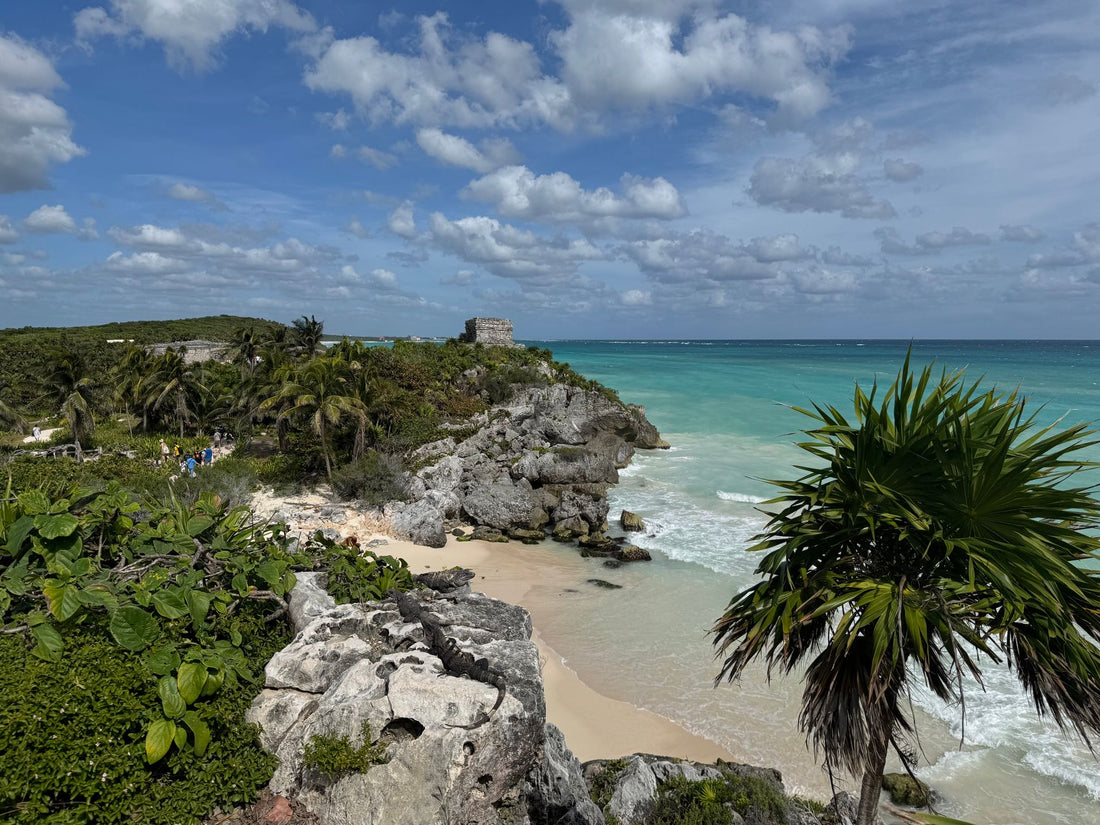
In short: the eSIM for Tulum is actually a Mexico eSIM that you activate upon landing in Cancun or the new Tulum airport. It provides stable 4G in town and on the highway, spotty signal in the beach hotel zone, and no coverage within cenotes and dense jungle. 5 GB should be more than enough for a 4-6 day getaway.
Is there a specific Tulum eSIM?
No, and it's important to make that clear from the start so you don't look for something that doesn't exist: operators don't sell an exclusive profile for Tulum. What you buy is a Mexico eSIM, valid throughout the country, and you use it the same way in Tulum as in Cancun, Playa del Carmen, or even if you end up going to Mexico City. The only thing you adjust according to your itinerary is the gigabytes and days of validity, not the profile itself.
The eSIM connects to Mexican networks — Telcel, Movistar, AT&T — and in practice, Telcel offers the best coverage in the Riviera Maya, with a noticeable difference over the other two in areas further from the coast. If your route combines Tulum with Cancun or Playa del Carmen, you don't need to buy anything additional: it's the same data, the same line, the same QR.

If you've never used an eSIM and want to understand what it is before buying anything, start with what an virtual eSIM is: in two minutes, it will be clear why you don't need to touch your phone's physical tray or wait for any delivery.
Hotel zone vs. town: where the signal is truly reliable
The short answer: in Tulum town and on federal highway 307, coverage is good, with stable 4G most of the time. In the beach hotel zone — that stretch of miles of boutique hotels and beach clubs nestled against the jungle — the signal is much more irregular and varies from one establishment to another.
Tulum has grown as a tourist destination faster than its telecommunications infrastructure could keep up, and this is most noticeable exactly where there are the most tourists: the beach strip. In the town center, you can browse without problems to order a taxi, check a restaurant menu, or book a last-minute tour. Things change as you move south, towards the Sian Ka'an reserve, where stretches without antennas are longer and some eco-friendly hotels have directly opted to minimize infrastructure by design.
A detail almost no one mentions: within the town, the La Veleta neighborhood — west of the main avenue, where many cafes and coworking spaces have opened in recent years — usually works well for a few hours of work before heading to the beach, precisely because it concentrates more businesses with stable connections than other streets in the historic center.
In crowded beach clubs — think of a Saturday at noon in any of the most famous clubs on Boca Paila road — you'll notice that even if your phone shows three or four bars, the actual speed drops because the cell is saturated with devices. This is not a problem with your eSIM or your operator: it's network physics, and it happens to any line, local or foreign, in the same place and at the same time.
Cenotes, ruins, and jungle: the coverage nobody promises you
The most visited cenotes — Dos Ojos, Gran Cenote, Calavera — are surrounded by thick jungle, so assume that inside you will have intermittent or directly no coverage. In the Gran Cenote parking lot, for example, you can usually get enough signal to buy a ticket or announce your arrival; once you go down to the swimming platform, next to the water, most phones lose signal.
At the Tulum ruins, with their unique beachfront location, the entrance and parking lot usually have decent signal, but within the archaeological site — especially towards the El Castillo viewpoint — it can drop significantly, partly because the site itself limits visible antennas for heritage preservation. On the way to Cobá, and certainly venturing into the Sian Ka'an reserve, there are long stretches with no operator coverage.
The rule is simple: the deeper you go into the jungle, the less signal you find, and no eSIM or physical card, no matter how good, can fix that. No technology creates antennas where there are none.
Traveler's tip: download offline maps of the Riviera Maya and save cenote and ruin tickets as screenshots or PDFs before leaving your hotel. That way, even if you lose signal in the middle of the jungle, you still have your route and ticket handy without relying on anything.
If you're also concerned about what happens to your passwords and bank accounts when your phone jumps between hotel and beach club Wi-Fi networks — some without even a password — it's worth taking a look at how to protect your privacy when traveling with an eSIM before connecting to the first open network you find.

Arriving connected via Cancun or Tulum airport
Most travelers still land at Cancun International Airport (CUN) and make the transfer by road to Tulum, between 90 and 120 minutes depending on traffic on highway 307. Others can now use Tulum airport (TQO), which is closer to the destination. In either case, with an eSIM installed from home, you arrive connected: activate data as soon as you land and you'll have internet ready for the ADO bus, an official taxi, or a rental car, without needing to look for a SIM card shop with your luggage in tow.
That road trip is much more enjoyable with GPS and music streaming running in the background, especially if you're driving a rental car and don't know the route or the speed bumps (the famous Mexican "topes," which appear without warning even on the federal highway). Arriving connected saves you the only tedious task of the first day: finding where to buy a local SIM card with jet lag and the airline counter still fresh in your memory. Actual activation, once connected to the Mexican network, takes about a minute from your phone's settings.
If you compare the cost of activating your Spanish operator's roaming for the entire trip versus a local eSIM, the difference is usually considerable; we detail this in eSIM vs. roaming, and if you want to understand what "data roaming" is exactly and why your company charges you for it, here's the full explanation.
How many GB you need based on your travel plan
Since in Tulum you'll spend quite a few hours without reliable coverage — cenotes, remote beaches, jungle stretches — actual data consumption is usually more moderate than people calculate before traveling. A good part of the day you'll be disconnected, by choice or due to lack of antennas, and that makes your plan last longer than expected. For a 4 to 6-day getaway, 5 GB is plenty if your usage is normal: maps, messaging, social media, and occasional streaming.
| Plan | Days | GB | Travel profile |
|---|---|---|---|
| Express | 3 | 3 GB | Beach, one cenote, and ruins |
| Getaway | 4-6 | 5 GB | Tulum + Playa del Carmen |
| Full Riviera | 7-10 | 8-10 GB | Tulum, Cancun, and Cozumel |
| Workation | 10+ | 12+ GB | Remote work and video calls |
And for a quick reference of where you'll spend that data and where you directly won't be able to spend it, this is the real picture on the ground:
| Area | Expected coverage | What to do |
|---|---|---|
| Tulum town / La Veleta | Good, stable 4G | Use it to book, order a taxi, work |
| Highway 307 and transfers | Good for most of the journey | GPS and streaming without issues |
| Hotel zone / beach clubs | Irregular, varies by hotel | Rely on accommodation's WiFi |
| Cenotes (inside) | Intermittent or none | Download tickets and maps beforehand |
| Ruins (site) | Variable, better at the entrance | Have your ticket saved offline |
| Cobá / Sian Ka'an | Long stretches with no signal | Notify your group before losing connection |
If your trip doesn't end in Tulum and you continue through more of the country, calmly size up the whole package: allocating more GB to city segments and less to beach and jungle days is the logical way to distribute the plan. To squeeze every gigabyte without overdoing it, these tricks to save data while traveling are designed precisely for itineraries with uneven coverage areas like this one.
How to install and activate your eSIM step by step
Installing the eSIM does not require removing your physical Spanish SIM, which stays in place and continues to receive bank verification SMS or the second factor for your apps. The eSIM only handles Mexican data, operating in parallel.
- Check that your mobile is eSIM compatible (most recent models are).
- Purchase the Mexico eSIM and receive the QR code via email in seconds.
- Scan it from your phone settings, connected to WiFi, before leaving home.
- Upon landing in Cancun or Tulum, activate the profile data and you're all set.
If you prefer to follow the process with screenshots instead of just relying on text, the guide on how to install an eSIM explains it screen by screen, taking nothing for granted. And if you're still wondering whether to also bring a spare physical chip "just in case," this comparison between international chip and eSIM helps you decide without getting confused with two lines at once.
Myths and what almost no one tells you
There are quite a few half-truths circulating about coverage in Tulum that should be debunked before you get disappointed or, on the contrary, unnecessarily worried.
"There's no coverage anywhere in Tulum." False, or at least exaggerated. The town and the main road work reasonably well; the problem is localized to the beach strip and natural areas, not the entire destination.
"I need a Tulum-specific eSIM, different from a Mexico eSIM." There's no such thing, and buying multiple eSIMs for the same country only complicates your life without adding anything: it's the same network, the same profile, the same operators.
"If I have an eSIM, I no longer need the hotel WiFi." In the beach hotel zone, precisely due to irregular coverage, the accommodation's WiFi usually works better for heavy tasks — uploading photos, long video calls, streaming in the room — and you leave the eSIM for when you're out and about. Combining both sources is more efficient than relying on just one.
"The more bars I see on my phone, the faster it will be." Not always. In a beach club at peak hour with dozens of tourists connected simultaneously to the same antenna, you can see full bars and still notice the network is slow: it's cell saturation, not a problem with your line.
A practical tip for those renting a car: on the stretch of highway 307 between Tulum and Cobá, it's advisable to take advantage of any gas station or intersection with good coverage to confirm your route or send a last message before heading inland, where the signal becomes much more intermittent for several consecutive kilometers.
When you DON'T need to buy an eSIM for Tulum
It's worth stating as frankly as the rest of the guide: you don't always need to buy extra data. If your layover in Mexico is only a few hours and you don't leave the airport, the airport's own WiFi will cover you amply; don't spend on a profile you won't use. If you're going to spend most of your trip inside an all-inclusive resort with decent WiFi and your plan is to barely leave the hotel, you also don't need additional gigabytes: the accommodation's WiFi handles the basics, and the rest of the time, honestly, you'll be by the pool without looking at your phone.
Where it clearly pays off is in everything else: moving between cenotes, coordinating a tour, using GPS on the road, ordering a taxi without relying on a restaurant's WiFi, or simply not having to ask for the router password every time you enter a new place.
Frequently Asked Questions
Is there good coverage in Tulum's beach hotel zone?
It's more irregular than in town. The highway and Tulum town have stable 4G, but the strip of hotels along the beach and towards Sian Ka'an experiences signal drops due to the surrounding jungle and scarce infrastructure in the area.
Does the eSIM work inside the cenotes?
Inside cenotes, surrounded by dense jungle, coverage is usually intermittent or non-existent, and this applies to any operator or type of line, not just the eSIM. Download offline maps and tickets before you go so you don't depend on a signal at that moment.
Can I use the same eSIM in Cancun, Playa del Carmen, and Tulum?
Yes. It's a Mexico eSIM valid throughout the country, so you use it in Cancun, Playa del Carmen, Cozumel, or Tulum with the same profile, as long as you have data balance remaining.
When should I activate the eSIM, before flying or upon landing?
Install it calmly in Spain using WiFi, but only activate data upon landing in Mexico, so that the day counter starts at the correct moment. Installing the profile does not consume your plan; data usage begins when you actually connect to the Mexican network.
Does the eSIM work for the road transfer from Cancun to Tulum?
Yes. On highway 307, there is coverage for most of the journey, so you'll have GPS and music streaming during the transfer. Only occasional stretches might be without signal.
Do I need multiple GB if I also visit Cobá or Sian Ka'an?
Not particularly, because precisely in those stretches you will be without coverage for a significant amount of time and therefore not consuming data. Actual usage is concentrated in the town, on the highway, and during times when WiFi is unavailable at the beach.
What if my phone doesn't support eSIM?
Check if your model is compatible before traveling; most smartphones from recent years are. If yours doesn't support it, the alternative is still a local physical SIM or your operator's roaming, both with the limitations we've already mentioned.
Conclusion
Tulum blends paradisiacal beaches, Mayan culture, and dense jungle, and it's precisely that jungle that makes coverage less continuous than in a big city. With an eSIM installed from home, you arrive connected from the airport and prepare important things — maps, tickets, routes — offline for excursions where there won't be antennas. Always carry your data with you and save maps and tickets before venturing into the jungle, and if your trip continues to another continent afterward, review your eSIM options for Europe before leaving, depending on where you're headed.