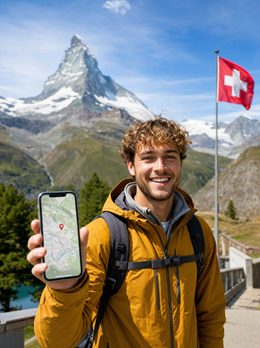
In short: Roaming in Switzerland exists (there's plenty of coverage), but your Spanish "free roaming" plan doesn't apply: Switzerland is not part of the EU or the European Economic Area, so using your phone line there is charged as an international zone and can be very expensive. The clean solution is a data eSIM: fixed price, no surprises.
This is the biggest concern for anyone planning a trip to the Alps: you cross half of Europe with your phone working just like at home, arrive in Zurich or Geneva, and suddenly your bill skyrockets. Here we tell you why this happens, how much it really costs, how to check your plan before you leave, and how to land with internet, without roaming, without stress.
Is there roaming in Switzerland? The short and long answer
Yes, there is roaming in Switzerland in the technical sense: your mobile phone connects without a problem to Swiss networks (Swisscom, Salt, Sunrise) and you'll have a signal even in many Alpine valleys and panoramic trains. The problem isn't the coverage; it's the price. Switzerland is not part of the European Union or the European Economic Area, so the "Roam Like At Home" regulation, which eliminated surcharges within Europe in 2017, does not cover it.
In other words: for your Spanish operator, Switzerland is a "third country" for tariff purposes. It can charge you separately for calls, SMS, and, above all, for data. And that's the mental trap that catches almost everyone.
Why isn't Switzerland included in EU roaming?
Many people assume that since Switzerland is surrounded by EU countries and is fully European geographically and culturally, their mobile phone will work just as it does in Lisbon or Berlin. This is the most common and most expensive mistake. The regulation that abolished surcharges only applies within the 27 EU countries plus Iceland, Liechtenstein, and Norway. Switzerland, along with Andorra, is outside this umbrella despite being in the heart of the continent.
The same applies to roaming in the UK after Brexit: geographically European, tariff-wise outside. That's why it's important to be clear about which countries have free roaming before packing your bags, because your operator's "Europe zone" doesn't match the map of Europe you have in your head. If you want to understand the basic mechanics, it will help to review what roaming is exactly and why it is billed differently depending on the destination.
Typical roaming prices in Switzerland by Spanish operator
In Switzerland, Spanish operators apply international zone rates outside the EU. As a general guide for 2026, browsing without an activated bundle usually costs several euros per 100 MB, and calls, several euros per minute. These are not official or fixed figures: each company has its fine print and updates it frequently, so always check your operator's official website for the exact data.
The important thing isn't to memorize a number, but to understand the order of magnitude so you don't get a shock. This table summarizes the type of structure you'll find:
| Operator (ES) | Data without bundle (approx.) | Call/min (approx.) | Optional daily bundle |
|---|---|---|---|
| Movistar | Several € / 100 MB | Several € /min | Yes, check official website |
| Vodafone | Several € / 100 MB | Several € /min | Daily pass available |
| Orange | Several € / 100 MB | Several € /min | Yes, depending on plan |
| Yoigo / MásMóvil | Several € / 100 MB | Several € /min | Variable |
| Switzerland data eSIM | Fixed price per GB, known in advance | Via apps (WhatsApp, etc.) | Not applicable: you pay in advance |
As you can see, a couple of videos or the map open for a while with the default rate can cost you the same as a nice dinner in Zurich. Some operators offer a "daily pass" for international zones that makes data cheaper, but it only pays off if you activate it correctly and know exactly what it includes. Check the current price on the official website before you leave; the ranges circulating online become outdated quickly.
How to check your plan before traveling to Switzerland
Before crossing the border, access your operator's customer area or call customer service and ask specifically about the "international zone outside the EU" for Switzerland. Ask for the price per MB and per minute, and if there is a specific daily bundle. Write it down before you travel, in black and white.
Don't rely solely on the welcome SMS you receive upon landing: it often arrives late, in German or French, or with a price you didn't expect. It's better to have the confirmed information from home. Before you leave, review this quick checklist:
- Check if your plan includes any complimentary international data days.
- Check the spending limit: by law, many operators cut off data when a certain amount is reached, but not all apply this outside the EU.
- Ask if you can contract a specific bundle for Switzerland before you leave.
- Write down the customer service number from abroad (it's usually a paid service).
- Take a screenshot of the prices they confirm to you: if the bill doesn't match later, this proof can help you make a claim.
The surprise bill: why it happens so often in Switzerland
The surprise bill in Switzerland occurs because your phone continues to consume background data even if you don't touch it: app updates, cloud backups, email, widgets, and maps. At international zone prices, this invisible consumption skyrockets and appears on the bill the following month, when there's no turning back.
There's also a curious geographical aggravating factor that almost no one tells you about: in border areas and many alpine valleys, your phone can mistakenly connect to a Swiss antenna while still in France, Italy, or Germany, or stay connected to a Swiss antenna when crossing back. These "stolen" minutes and megabytes are billed as Switzerland even if you think you're in the EU. This happens a lot on panoramic trains and cable cars that cross borders multiple times within a few kilometers.
The best defense is twofold: clearly understand how to avoid roaming with mobile settings and, above all, don't rely on your Spanish line for data. Deactivating automatic network selection and manually setting it when you are near a border avoids a good part of these phantom charges.
eSIM for Switzerland: the cheap and surprise-free solution
The simplest and most economical way to get internet in Switzerland is to buy a data eSIM before you travel. You install it by scanning a QR code in a minute, choose a GB plan for the days you'll be there, and pay a fixed price known in advance. No surcharges, no fine print, no surprises on your bill.
The great advantage over traditional roaming is peace of mind: you know exactly how much you're going to spend because you pay in advance, and your Spanish number remains active in the other slot to receive bank SMS or important calls. A data plan per country is well below the cost of the default international zone rate, and you don't have to do mental calculations every time you open your phone.
You can see the specific plans in our eSIM guide for Switzerland and directly buy the eSIM for Switzerland. If your trip is a route that touches several countries, an eSIM for Europe might be a better fit: there are regional plans that include Switzerland within their coverage, very useful for an alpine getaway that also passes through France, Italy, or Austria.
- Buy the eSIM and receive the QR by email.
- Scan it from your phone's settings (you need an eSIM-compatible phone). If it's your first time, the phone's assistant will guide you step-by-step in just five minutes.
- Activate it upon landing and keep your Spanish line's data turned off.
Tips for spending less data on your trip
Even if you have an eSIM with plenty of data, it's wise to use it carefully so that the plan lasts your entire trip. Switzerland has free Wi-Fi in many hotels, train stations, and cafes, so relying on those networks for heavy tasks greatly reduces your plan's consumption.
These habits make the difference between ending the week with plenty of data or running out halfway through your trip:
- Download city maps in offline mode before leaving the hotel.
- Disable automatic video playback on social media.
- Postpone photo backups to the cloud until you have Wi-Fi.
- Limit app updates to Wi-Fi networks in your phone's settings.
- Use messaging apps for calls instead of the traditional phone line.
With these gestures, a modest plan yields much more than it seems on paper. And if at any point you run short, recharging an eSIM is usually a matter of a couple of taps from the app itself, without having to go to a physical store or wait in line at Zurich or Geneva airport.
Myths and common mistakes about roaming in Switzerland
These are the most expensive beliefs, and what you really need to know:
"Since Switzerland is in Europe, my plan is the same"
The number one mistake. Geographical Europe and your plan's "EU zone" are not the same. Switzerland is outside the roaming agreement, period.
"With airplane mode and only activating Wi-Fi, I'm covered"
This works to avoid mobile data charges, but it leaves you out of communication on the street, on the train, or in the mountains, precisely when you most need a map or a digital ticket. An eSIM gives you the best of both worlds: cheap data always available and Wi-Fi when it's there.
"Buying a local SIM at the airport is cheaper"
Not always, and almost never more convenient. You have to find the store, show identification, change the physical card, and lose your number. You can set up the eSIM from home and land connected.
"The spending limit protects me no matter what"
Automatic cutoff by amount is designed for the EU. Outside of it, not all operators apply it the same way, so don't take it for granted as a safety net in Switzerland.
"Disabling data roaming is enough"
It helps, but a momentary lapse (activating it to check the map) can be enough to get you hooked on the expensive rate. The robust solution is not to rely on your Spanish line for data throughout the trip.
Frequently asked questions
Does Switzerland have free roaming with a Spanish plan?
No. Switzerland is not part of the EU or the European Economic Area, so your "free roaming" plan does not cover it. Browsing there with your Spanish line is billed as an international zone, at prices that can exceed several euros per 100 MB. It's sensible to contract a specific bundle or, better yet, use a data eSIM.
How much does it cost to use data in Switzerland with a Spanish operator?
It depends on the operator and your plan. Without an activated bundle, data in an international zone can cost several euros per 100 MB, and calls several euros per minute. These are indicative ranges that each company often changes, so consult the official website for the exact price before traveling.
Will my eSIM work as soon as I arrive in Switzerland?
Yes, if you installed it before you left. You scan the QR code at home (it takes a minute) and upon landing, you only need to activate the data for that line. We recommend keeping your Spanish line's data turned off to prevent it from connecting by mistake and incurring roaming charges.
Can I still receive calls on my Spanish number?
Yes. The eSIM is used only for data, so your main card or line remains active to receive calls and SMS, for example, your bank's codes. However, keep the data for your Spanish line turned off to avoid accidentally browsing with the roaming rate.
Why am I charged roaming from Switzerland if I was in France?
In border areas and Alpine valleys, your mobile can connect to a Swiss antenna while still in EU territory. That data is billed as Switzerland. To avoid this, manually set the network when you are near the border or use an eSIM with specific country coverage.
Will a Europe eSIM work for Switzerland, or do I need one specifically for Switzerland?
It depends on your trip. If you are only going to Switzerland, a Switzerland eSIM is usually the most suitable. If you are going to travel through several countries on the same route, check that the regional Europe plan includes Switzerland in its coverage (not all do) and, if so, a single eSIM will suffice for the entire journey.
Which mobile phones are compatible with eSIM?
Most mid-range and high-end smartphones from recent years (recent iPhones, Google Pixel, many Samsung Galaxy, etc.). Before purchasing the plan, check your phone's settings to see if you can "add eSIM" or consult the manufacturer to be sure.
Conclusion
Switzerland is fully European, but for mobile tariffs, it is a third country: your "free roaming" does not apply, and default prices are high. The good news is that a surprise bill is completely avoidable if you check your tariff before leaving and, above all, if you do not rely on your Spanish line for data. The cleanest option is to have a Switzerland eSIM installed and ready before landing: you pay a fixed price, you know exactly what you spend, and you arrive with internet, no roaming, no stress.