In short: To get connected in Dubrovnik, there is no exclusive city-specific SIM card. Instead, you purchase a Dubrovnik eSIM, which is actually a Croatian eSIM that covers the entire Dalmatian coast. You install it at home, activate it upon landing, and have data in a minute. For a short trip, 3-5 GB is sufficient.
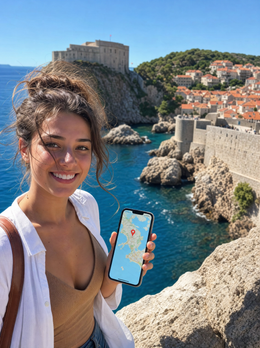
You land in Dubrovnik, or arrive by ferry from another island, and you want your map open, your city wall ticket handy, and WhatsApp working from the first second. With a Dubrovnik eSIM activated before leaving home, you’ll have data as soon as you step into the city: no roaming, no queues at a SIM card shop, and no stress. In this guide, you’ll see how many GB to bring based on your trip duration, what the coverage is like in the Old Town and on the islands, how to get from the airport to the city center connected, and why a city eSIM is purchased just like a country-wide one.
Is there an eSIM just for Dubrovnik?
No, and it's important to state that clearly from the start. There isn't an eSIM that covers only Dubrovnik: the card you buy is for Croatia and works across the entire Dalmatian coast, including the Old Town, Gruž port, Mount Srđ, and day trips to the islands. Searching for "eSIM for Dubrovnik" is simply a way to narrow down the trip, not a distinct product.
The difference is in focus, not technology. Someone visiting the city for three or four days doesn't want a monthly plan they won't fully use, but rather just enough data for their getaway. Dubrovnik is a very specific stop — city walls, cable car, Stradun, ferry to the Elafiti Islands — and data consumption can be easily estimated. That's why a short plan with a few gigabytes and a validity of one or two weeks makes sense. And there's an added advantage: if you later extend your trip to Split, Hvar, or Zadar, the same Croatian eSIM will still work without needing to buy anything new, which isn't the case with a physical card bought at a city kiosk. If you want the full country plan, you can find it on the Croatia eSIM page.
How many GB to bring based on your trip duration
For a weekend getaway to Dubrovnik, with maps, messaging, social media, and a few random videos, estimate around 1 GB per day. Three or four days are more than covered with 3-5 GB; a full week of sightseeing, photos, and browsing, with 5-7 GB. The key is to let your accommodation's Wi-Fi handle heavy usage overnight: streaming series, app downloads, and photo backups to the cloud.
These figures provide ample allowance because in Dubrovnik, you'll spend many hours walking along the city walls and narrow streets, where you'll mostly use maps and your camera, which consume little data. What really drives up data usage is video streaming and long video calls. If you watch anything at night, do it connected to your hotel's Wi-Fi, and your gigabytes will go twice as far. To refine your calculation based on your travel style, take a look at our guide on how much data you need for travel.
| Duration in Dubrovnik | Light usage (maps, chat) | Normal usage (social media, photos) | Heavy usage (video, photo uploads) |
|---|---|---|---|
| Weekend (2-3 days) | 1-2 GB | 3 GB | 4-5 GB |
| Short trip (4-5 days) | 3 GB | 5 GB | 6-8 GB |
| Full week | 5 GB | 7 GB | 10 GB or more |
If you run out of data halfway through your trip, it's not a problem: eSIMs can be topped up or you can buy a second plan, so start with a reasonable amount and only expand if you truly need it. A trick almost no one uses: download an offline map of Dubrovnik in Google Maps before you leave. It saves data and still works in areas where the signal is weak, like the inner sections of the city walls.
Coverage on the city walls, port, and Elaphiti Islands
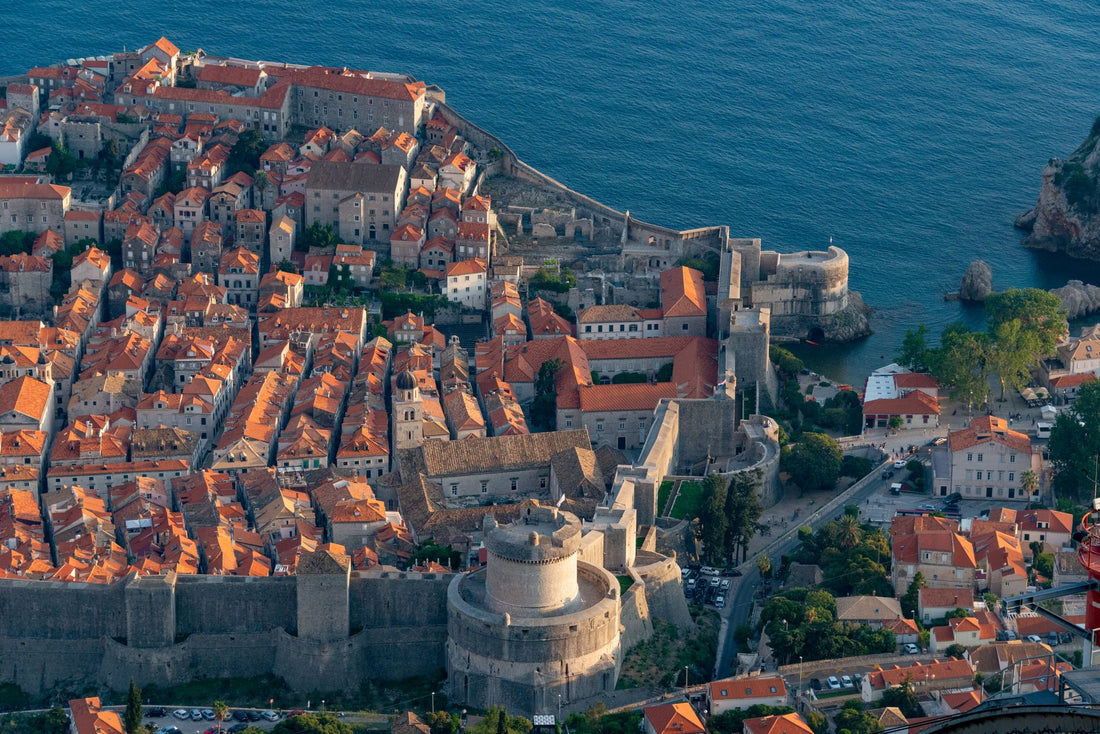
Mobile coverage in Dubrovnik's Old Town is good. The eSIM automatically connects to local networks — Hrvatski Telekom, A1, and Telemach — and you'll have 4G and, in much of the city, 5G, both on Stradun street and within the walled city and Gruž port, where ferries depart. Only in very narrow, enclosed sections under the city walls or between tight alleyways might the signal drop for an instant, quickly recovering once you emerge into an open space.
On the ferry to the Elaphiti Islands (Koločep, Lopud, Šipan) or during a trip to Lokrum, you'll maintain connection for much of the journey, as these islands are close to the coast. In open water, far from the dock, there might be occasional signal interruptions, which is normal for any operator. As Croatia is a member of the European Union, the network infrastructure is European standard, with a high density of antennas in tourist areas. If you're comparing with your home plan, you'll be interested in the real difference between eSIM and roaming, especially if you're deciding between sticking with your home plan or switching to digital data.
What if I continue north or cross into Montenegro?
This is one of the areas where the eSIM shines. If your plan is to combine Dubrovnik with Split, Zadar, or the Plitvice Lakes, the same Croatian eSIM works without any reconfiguration; you don't even touch your phone. The same card accompanies you through Split, Zadar, or wherever your coastal route takes you. However, be aware of a key geographical detail: to travel by road from Dubrovnik to the rest of Croatia, you cross a small section of Bosnia (Neum), and many travelers also go down to Kotor Bay in Montenegro. These countries are not included in the Croatian eSIM. If your route will cross borders, check out the eSIM for the Balkans, which groups several countries into one card, or a specific country plan if you are only going down to Kotor Bay for a day.
From Dubrovnik airport to the Old Town with data
Dubrovnik Airport (Čilipi, code DBV) is about 20 km from the Old Town, and having active data comes in handy for covering that journey by shuttle bus, taxi, or Uber. With the eSIM installed at home, as soon as you land and activate data roaming, your phone connects to the Croatian network in less than a minute. You leave the terminal already connected.
That detail makes all the difference. You can book your transfer, check the bus schedule to Pile Gate, or open a chat with your accommodation without relying on airport Wi-Fi, which almost always requires registration and is slow during peak hours. The recommendation is simple: leave the eSIM installed before you fly and activate data right after landing. We explain it step-by-step in the guide on when to activate your eSIM, before or after traveling. This way, you don't have to look for a SIM card shop as soon as you arrive, tired and with luggage in tow.
How to activate your eSIM step by step
Installing and activating an eSIM for Dubrovnik is a process that takes approximately one minute, and it's best done with Wi-Fi before your trip. Here's a summary:
- Check that your mobile phone is eSIM compatible. Most iPhones from the XS onwards and mid-to-high-end Androids are; if you're unsure, check your phone's settings or technical specifications before purchasing the plan.
- Purchase the Croatia plan and receive the QR code or installation code by email in a matter of minutes.
- Scan the QR code from your phone's settings to add the eSIM (Settings → Mobile Data → Add eSIM on iPhone, or the equivalent on Android).
- Upon arrival in Dubrovnik, select the eSIM as your data line and activate data roaming.
And that's it. You don't need to remove your physical SIM: your Spanish number remains available for calls and SMS while data travels through the eSIM. For detailed instructions with screenshots, see how to install an eSIM. A tip: do the installation at home calmly, not at the boarding gate at the last minute.
What almost no one tells you about getting connected in Dubrovnik
Beyond the obvious steps, there are details you only learn once you're there. These are the most common questions we get and the ones that help avoid surprises.
- The Wi-Fi in Old Town cafes is not your safety net. During high season, it's often saturated, and many establishments reserve it for customers. Your eSIM is more reliable than begging for passwords.
- Beware of the invisible Neum border. If you rent a car and drive along the coast towards Split, you'll cross a few kilometers of Bosnia. There, your Croatian eSIM will stop providing data until you return to Croatian territory. It's not a glitch, it's geography.
- Install the eSIM before you fly, yes, but don't activate data until you land. If you activate it in Spain, some plans start counting validity from that moment. Install it at home, activate it at your destination.
- Mount Srđ has good signal, but the cable car can be crowded. Book or buy your ticket online with your data before queuing: it will save you half an hour.
- Download your boarding pass and tickets offline. Don't rely on having perfect coverage at the exact moment you need to pass a checkpoint. Save PDFs to your phone.
- Unlimited data is not necessary. This is the most common trap: paying for a huge data plan "just in case." For a city break, you rarely use more than a few GB. If you're concerned about consumption, apply these tips to save data with your eSIM.
Dubrovnik eSIM vs. Croatia eSIM (and Europe)
The underlying question is: do I buy with the city in mind or the country? The answer depends on your itinerary. If your trip is only to Dubrovnik and its surroundings, a small plan with a few GB is logical and the cheapest option. If you are going to connect several Croatian cities, a plan with more data and more days of validity is better. And if Croatia is just one stop on a longer European trip — including Italy, Greece, or any other EU country — then you should look into a multi-country Europe eSIM, which covers dozens of countries with a single card.
| Your trip | Recommended option | Why |
|---|---|---|
| Only Dubrovnik, 2-5 days | Croatia eSIM, short plan (3-5 GB) | Just what you need, without overpaying |
| Route along the Croatian coast (Split, Zadar...) | Croatia eSIM, larger plan | A single card for the entire country |
| Dubrovnik + Montenegro or Bosnia | Balkans eSIM | Croatia alone does not cover these countries |
| Croatia within a European trip | Multi-country Europe eSIM | Dozens of countries with a single plan |
Choosing wisely helps you avoid two classic frustrations: running out of data mid-trip or paying for data and days you never get to use.
Frequently Asked Questions
Is there a specific eSIM for Dubrovnik?
Not as such. You buy the Croatia eSIM, which covers Dubrovnik and the entire Dalmatian coast. The advantage for a city break is choosing a short plan, with a few GB and one or two weeks of validity, instead of a monthly plan that would be overkill.
How many GB do I need for three days in Dubrovnik?
3 GB is more than enough for a long weekend if you use maps, messaging, social media, and some photos. Save video and large downloads for your accommodation's Wi-Fi, and those 3 GB will last you comfortably throughout your trip.
Will I have coverage on the Elaphiti Islands and the ferry?
Yes, for a good part of the journey, because the Elaphiti Islands are very close to the Dubrovnik coast. There may be occasional interruptions in open water, far from the dock, but this is normal for any operator, and the signal recovers as you approach land.
Does the eSIM work as soon as I land at the airport?
Yes, provided you installed it before flying. Upon landing at Dubrovnik airport, you just need to activate data roaming, and your phone will connect to the Croatian network in about a minute, without needing to find Wi-Fi or buy physical SIM cards.
Can I still use WhatsApp with my Spanish number?
Yes. The eSIM only provides data: your Spanish number remains active on the physical SIM for calls and SMS, and WhatsApp works normally over the eSIM data. You don't lose your line or have to change numbers in apps.
Will the Croatia eSIM work if I cross into Montenegro or Bosnia?
No. The Croatia eSIM only provides data within Croatia. If your plan includes Kotor Bay (Montenegro) or crossing the Bosnia section in Neum, you'll need an eSIM that covers those countries, such as a regional Balkans eSIM, or a specific plan for the country you visit.
Is it better to buy the eSIM before or upon arrival in Dubrovnik?
Better before. By purchasing it at home with Wi-Fi, you can install it calmly and leave the airport already connected, without relying on terminal Wi-Fi or finding a SIM card shop. Remember to install it before flying but only activate data when you land.
Conclusion
For Dubrovnik, you don't need a city-specific card, but rather a Croatian eSIM with a plan adjusted to your trip duration: 3-5 GB is more than enough for a typical getaway, with solid coverage on the city walls, Gruž port, and nearby islands. You install it at home in a couple of minutes and activate it upon landing in less than one. Buy your Croatia eSIM before flying and leave Dubrovnik airport already connected, with your Spanish number intact, no roaming, no queues, and no stress.