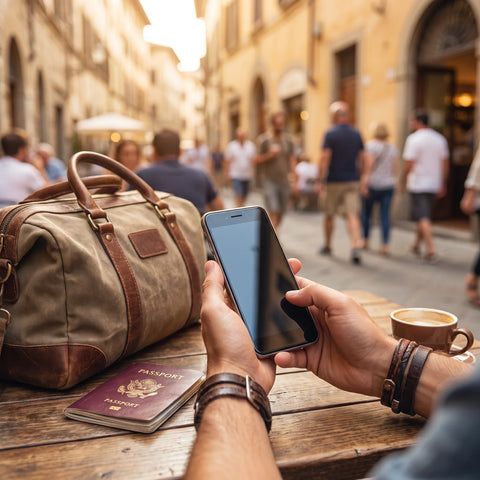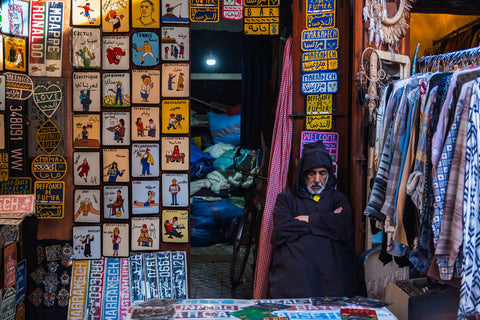

In short: the Europe and Morocco eSIM is a single data profile that covers the European countries on your route and Morocco at the same time, without changing cards when crossing the Strait. It's activated before you leave and starts automatically upon landing. It pays off when you split your days between both shores; if you only visit one side, a single-country eSIM is better.
If your route crosses the Strait and combines European cities with the magic of Morocco, a Europe and Morocco eSIM pack saves you the hassle of changing cards when going from Algeciras to Tangier. A single eSIM covers both sides of the trip, with data that starts as soon as you land and activation in 1 minute. Here we explain what it includes, for which routes it pays off, and when it's better than buying an eSIM per country.
What the Europe and Morocco pack includes
The pack combines European zone coverage with the Moroccan network in a single eSIM. Instead of installing a Europe plan and a Morocco plan, with this one you have both destinations under the same QR, the same data balance, and a single installation.
In practice, the pack covers the most common European Union countries on an Iberian route (Spain, France, Portugal, Italy...) and adds Morocco as a non-EU destination, which is usually excluded from normal European rates. The eSIM automatically connects to the best available network in each country, without you having to do anything when crossing the border. Plans are sold in data blocks and days, so you can choose according to your needs. If this is your first eSIM, keep in mind that the concept of "a card that doesn't need to be touched" is precisely what makes this type of multi-country pack convenient: you install it once and forget about it.

For which routes this pack is worth it
It pays off when your trip mixes at least one European country with Morocco on the same journey: a flight to Madrid or Malaga and then a ferry or flight to Tangier, Marrakech, or Casablanca. With a single plan, you cover both stages without buying anything midway or changing eSIMs at the airport.
Typical cases are clear. The classic road trip that starts in southern Spain and goes down to Morocco via the port of Tarifa. The European weekend layover before flying to Marrakech. Or the cultural itinerary that links Andalusia with the imperial Moroccan cities. In all of them, continuous data is important for mobile navigation, ordering a taxi, or translating on the fly. If, on the other hand, you only go to Morocco and don't visit Europe, a dedicated eSIM might suit you better; for that case, check our guide to internet in Morocco, with details on coverage and plans depending on the days you spend in the country.
Tip: Activate the eSIM the night before you leave while you have Wi-Fi. This way, when you land in the first country, you'll only have to turn on data and you'll be connected, without looking for a network at the terminal.
Coverage and operators in each area
Coverage relies on the local networks of each country. In Europe, the eSIM connects to major operators with extensive reach, offering 4G and 5G in urban areas of Spain, France, or Italy. In Morocco, the connection uses national networks, mainly Maroc Telecom, Orange Maroc, and Inwi, which provide good coverage in major cities and tourist hubs.
Where expectations need to be adjusted is in rural and mountainous areas of Morocco. In the High Atlas, the Merzouga desert, or some inland roads, the signal may drop to 3G or disappear at times, just as it would with any local card. In Marrakech, Fez, Rabat, or Casablanca, you'll have no problem browsing, using maps, or making video calls. The advantage of the pack is that the eSIM automatically selects the best available network, so you don't have to configure anything when switching from one operator to another.
| Area | Main Networks | City Coverage | Rural Coverage |
|---|---|---|---|
| Spain / Portugal | Main EU Operators | Excellent 4G/5G | Good 4G |
| France / Italy | Main EU Operators | Excellent 4G/5G | Acceptable 4G |
| Morocco (cities) | Maroc Telecom, Orange, Inwi | Good 4G | 3G/variable |
| Morocco (Atlas/desert) | Maroc Telecom | — | Limited |

Multi-country pack vs. buying per country
The classic dilemma: Is a Europe and Morocco pack better, or two separate eSIMs? It depends on how you split your days. If you spend similar time in each area, the pack wins in convenience and is usually more cost-effective than buying two separate plans with their minimums.
Buying per country makes sense if the trip is very unbalanced: two weeks in Morocco and only one night layover in Madrid. In that case, a powerful Morocco eSIM and virtually no Europe might fit better. But when the itinerary splits the days, managing a single plan avoids running out of data right when you cross the border or paying for two activations. If your route ends up being only in Europe and you don't cross into Morocco, a Europe eSIM without the Moroccan extra you won't use will be more beneficial. To decide with numbers, here's a quick comparison:
- Europe and Morocco Pack: one installation, one balance, automatic country change. Ideal for mixed routes.
- Two eSIMs per country: more data control per zone, but two QRs and two activations. Better if one destination dominates the trip.
- European regional eSIM + roaming: the worst combination; roaming in Morocco from a European rate skyrockets.
How much data you need for this route
For a mixed week-long trip with normal use (maps, messaging, social networks, and some video), 5 to 10 GB is usually enough. If you're going to share the connection with your partner's phone or use a lot of streaming, move to the higher end or get a rechargeable plan.
Actual consumption depends on your habits. Browsing and using WhatsApp consumes little; watching series or uploading videos to social networks eats up data quickly. A good rule of thumb is to estimate about 500 MB to 1 GB per day for tourist use and adjust according to the trip. If you usually share internet with other devices, activate the hotspot wisely, as it multiplies consumption. And if you want to extend your plan without running short, reading our tips for saving data on your travel eSIM will help. When in doubt, it's cheaper to start with a medium plan and recharge than to buy too much.
How to activate it before leaving
Installation is the same as any eSIM: you receive a QR by email, scan it from your phone settings with Wi-Fi, and the plan is ready. The eSIM activates automatically when you arrive in the first country and detects a network, so you can prepare it at home without using data.
The step-by-step process is simple: first, check that your phone is compatible, install the profile by scanning the QR, label it "Morocco Trip" to avoid confusing it with your main line, and keep the data for that eSIM active when you land. Your Spanish number will still work for calls and texts if you keep your primary SIM. If this is your first time, follow our guide on how to install an eSIM and verify beforehand that your phone supports it by checking the device's compatibility settings. The entire process, including scanning, takes no more than 1 minute.
What almost no one tells you about this pack
There are a couple of circulating ideas that are not entirely accurate. The first: thinking that free data roaming within the European Union also covers Morocco because "it's nearby." This is not the case: Morocco is not part of the EU, so your Spanish data roaming rate stops applying as soon as you cross, and that's where some bills skyrocket without warning when you get home. If you want to understand the difference between EU roaming and what awaits you outside it, we have a comparison of eSIM vs. roaming that clarifies when each option is worthwhile.
The second thing almost no one mentions: if your route passes through Ceuta or Melilla, even if you are still in Spanish territory, your mobile phone might connect to a Moroccan network due to antenna proximity, and you could inadvertently activate international roaming even if you haven't crossed any border. If you are going to be in those cities, check which operator is active on your mobile before using data with your usual line.
On the ferry between Algeciras and Tangier, coverage usually disappears for a stretch of the journey while the ship is in international waters; this is not an eSIM fault, it happens to any line, local or foreign. And in the medina of Fez or the blue alleys of Chefchaouen, the signal drops significantly due to the narrowness and coverage of the streets: download the offline map of the area before entering, because looking for coverage there by wandering around is a waste of time.
And when this pack is NOT suitable, to be clear: if your European stop is a single day in a city with good hotel or airport Wi-Fi and the bulk of your trip is Morocco, don't force the full pack. You'll probably be better off with a Morocco-only eSIM and relying on Wi-Fi for that single day in Europe. The pack wins when you genuinely need mobile data on both sides, not just as a "just in case" cushion.
Frequently asked questions
Does the same eSIM work in Spain and Morocco without changing anything?
Yes. The pack is designed precisely for that: the eSIM detects the network of each country and connects automatically when crossing from the European zone to Morocco. You don't have to scan another QR or change plans; just keep the data for that eSIM on throughout the trip.
Does it cover all of Morocco or just the major cities?
It covers the entire country through national networks, with very good signal in Marrakech, Fez, Rabat, Casablanca, and Tangier. In rural areas of the Atlas or the desert, coverage may drop to 3G or become intermittent, just like with any local Moroccan card.
Can I use the pack only for Morocco if I don't end up visiting Europe?
You can, but it's not the most efficient. If your trip is solely to Morocco, a dedicated eSIM for the country will be more beneficial. The pack makes sense when you combine at least one European country with Morocco on the same route.
Do I keep my WhatsApp number with this eSIM?
Yes. WhatsApp is associated with your usual number, not the data eSIM. By installing the pack as a secondary data line, you continue to receive WhatsApp messages and calls with your usual number while browsing with the eSIM.
What happens if I run out of data midway through my trip?
You can top up the same plan or buy a new data block from your mobile, without needing another physical card. That's why it's advisable to choose a rechargeable plan if you're unsure about data consumption for a long route between Europe and Morocco.
Does the eSIM work on the ferry between Algeciras and Tangier?
For most of the journey, yes, but there's a section in international waters where there's no coverage from any operator, not even with a local Moroccan card. It's normal to lose the signal for a few minutes halfway through the crossing and regain it as you approach port.
Do I need another eSIM if I also visit Ceuta or Melilla?
You don't need another eSIM, but be careful: in those cities, your mobile might connect to a Moroccan network due to antenna proximity, even if you are still in Spanish territory. Check in your settings which operator is active before using data, to avoid paying for roaming where you shouldn't.
Conclusion
The Europe and Morocco pack is the convenient option for routes crossing the Strait: a single eSIM, a single balance, and automatic country switching, without cards or double activations. It pays off when you split your days between both areas and want continuous data from the moment you land.
If your next trip connects European cities with Morocco, get your connection sorted from the first minute with the Europe and Morocco eSIM and forget about searching for a network when crossing the border.