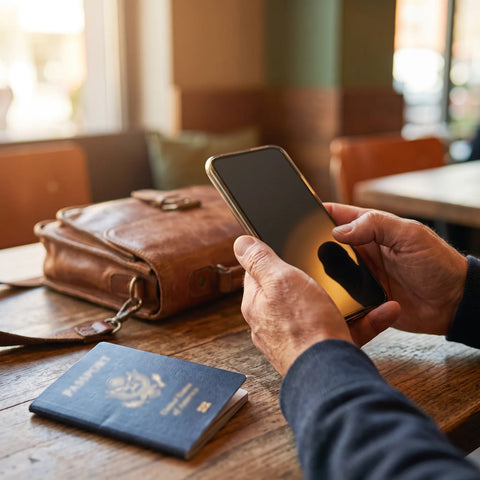
In short: For a 30-day trip to Europe, a 30-day Europe eSIM with 30-50 GB covers most itineraries without the need for top-ups. It's more economical and convenient than chaining together short plans, and guarantees internet—without roaming, queues, or surprises—in over 30 European countries with a single purchase before you leave.
Is a one-month eSIM for Europe worth it?
If you're planning a long trip to Europe—whether it's an Interrail trip, a campervan road trip, or a month of remote work from different cities—the question of connectivity is inevitable: should I buy a local SIM in each country, look for Wi-Fi all the time, or get a 30-day European eSIM?
The short answer: a 30-day eSIM wins in almost all scenarios. Here's why:
- No queues at local operator stores: buy online before you leave and receive the QR instantly.
- No physical SIM card change: keep your Spanish number active to receive calls and SMS from your bank.
- Predictable price: pay once, with no surprise extra charges at each border.
- Immediate coverage: when crossing from France to Italy or from Germany to Austria, the network changes automatically without you having to do anything.
- Real savings vs. roaming: even the European roaming plans from Spanish operators usually have more restrictive data and speed limits than a dedicated eSIM.
Is there any scenario where it's not worth it? If your "30 days" in Europe are actually 10 days in Greece and 20 days working remotely from Lisbon with good fixed Wi-Fi, perhaps a smaller plan or a local Portuguese SIM might be cheaper. But for the traveler constantly crossing borders, the monthly eSIM is the smartest option.
How much data will you use in 30 days in Europe?
Thirty days is a long time. Data consumption varies greatly depending on the type of traveler, but here's an estimate broken down by profile:
| Traveler profile | Daily consumption | Total 30 days | Recommended plan |
|---|---|---|---|
| Light tourist (maps + photos) | 500 MB - 1 GB | 15-30 GB | 20-30 GB |
| Moderate user (active social media) | 1-2 GB | 30-60 GB | 40-50 GB |
| Digital nomad (partial remote work) | 3-5 GB | 90-150 GB | Unlimited |
| Content creator | 5-10 GB | 150-300 GB | Unlimited + hotspot |
The biggest "data eaters" on a long European trip are:
- Google Maps in navigation mode: ~300 MB/hour when you don't have offline maps
- Uploading Instagram stories/reels: 50-200 MB per video in HD
- Streaming on Netflix/YouTube: 1-3 GB/hour depending on quality
- Zoom video calls: 600-1,500 MB/hour
- Automatic photo backup to the cloud: can add several GBs per day if not configured
Key tip: disable automatic backup for Google Photos or iCloud while using mobile data and only do it when connected to Wi-Fi. It can save you 5-10 GB in a month.
One-month plans vs. multiple short-term plans
This is the comparison we get asked about the most. Is a 30-day plan better, or several 7-10 day plans chained together?
Single 30-day plan: advantages
- One single purchase, one single QR, no management during the trip
- Price per GB usually lower than with short-term plans
- No risk of running out of data between one plan and the next
- More convenient for road trips with variable itineraries
Multiple short-term plans: advantages
- More flexibility if your main destination changes
- You can adjust data according to the stage of the trip
- Useful if part of the trip is spent in an apartment with included Wi-Fi
- Option for those who are unsure how many days they will be away
The verdict
For a trip of exactly or approximately 30 days across multiple countries, the monthly plan wins. The price per GB is usually more competitive than adding several short-term plans, and the convenience of not having to do anything during the trip is priceless.
If you're traveling less than 20 days or will spend time in one place with good Wi-Fi, consider if a 15-day plan plus a top-up might be more suitable.
You can explore all options in our eSIM for Europe section, filtered by duration and data size.
30-day Europe eSIM: which specific plan is best?
Within the catalog, you have three options designed for a month on the continent, and choosing between them is not just a matter of price: it's a matter of itinerary. The generic Europe eSIM covers the most common destinations of a classic Interrail trip—France, Italy, Germany, Spain, Netherlands—and is the simplest option if your route stays within Western and Central Europe without straying too far off the map.
The Europe 30 Countries eSIM is the most suitable for the typical Interrail or road trip traveler who crosses several EU borders without venturing into unconventional destinations. It's the one we recommend by default for a standard month of travel across the continent, which is the most common scenario for this guide.
If your itinerary ventures into the Western Balkans, a less common Baltic country, or more than one of the "unusual" destinations we mention in the next section, the Europe 33 Countries eSIM adds coverage margin and prevents the shock of arriving in a country and discovering your plan doesn't work there. It costs a bit more, but for a whole month moving across unconventional borders, that margin is usually worth it.
And here's a tip you'll rarely get in a store: if your "month in Europe" is actually 25 days in Spain and a weekend getaway to Lisbon, you don't need any of the three plans above. A Spain eSIM with occasional roaming, or even your national tariff, will be simpler and cheaper. The Europe plan is designed for those who truly cross borders frequently, not for those who spend most of the month in a single country.
European countries and coverage you should know about
Not all "Europe plans" cover the same countries, and there are some surprises that can ruin your trip if you don't check beforehand.
Countries always included (standard EU zone)
Germany, France, Italy, Spain, Portugal, Netherlands, Belgium, Austria, Greece, Poland, Czech Republic, Hungary, Romania, Bulgaria, Croatia, Slovakia, Slovenia, Estonia, Latvia, Lithuania, Luxembourg, Malta, Cyprus, Denmark, Finland, Ireland, and Sweden.
Countries usually included but worth checking
- Switzerland: not EU but most European eSIMs include it
- Norway and Iceland: EEA, generally included
- United Kingdom: post-Brexit, varies greatly by provider
- Albania, North Macedonia, Serbia, Montenegro, Bosnia: Western Balkans, frequently excluded
- Turkey: rarely included in Europe plans
- Georgia and Armenia: never in standard Europe plans
⚠️ Important for Balkan travelers: if your road trip includes Bosnia, Serbia, or Kosovo, check the covered countries before buying. For these destinations, you might need to supplement with our selection of international eSIMs with wider coverage.
5G coverage in Europe
5G is already available in major cities in Germany, France, the United Kingdom, Italy, and Spain. In Eastern European countries and rural areas, you will still be on 4G LTE, which is perfectly sufficient for any tourist use.
Tips for managing data on a European road trip
A month of travel across several countries tests your data management. These habits make the difference between reaching day 30 with plenty of data or running out in week 3:
1. Download offline maps by region
Google Maps allows you to download entire regions. Download the countries you're going to visit before you leave or when you're on Wi-Fi. An offline map of France takes up about 400 MB but saves you hundreds of MB of real-time navigation.
2. Configure photo backup to "Wi-Fi only"
Both Google Photos and iCloud have this option. Activate it from day one. If you take 100 photos a day in RAW or 4K video, automatic backup can consume your plan in days.
3. Use Spotify or podcasts in offline mode
For long train or car journeys, download playlists on Wi-Fi. Streaming music consumes ~150 MB/hour, which adds up significantly over 30 days of travel.
4. Check consumption weekly
On iOS: Settings → Mobile Data → Usage. On Android: Settings → Networks → Data usage. Set an alert at 50% and 80% of the plan to avoid surprises.
5. Take advantage of quality Wi-Fi when available
Airbnbs with good Wi-Fi, co-working spaces, and cafes in large cities are opportunities to do the heaviest tasks: uploading videos, long video calls, large downloads. Save mobile data for when you're on the go.
6. Smart tethering
If you're traveling in a group and sharing a car, designate one device as a hotspot during journeys to consume less data overall. A single device sharing a connection consumes less than four phones independently searching for a signal.
To delve deeper into the difference between these technologies, read our comparison of eSIM vs. traditional roaming, and if you want to squeeze every GB out of your plan, don't miss our tricks for saving data with an eSIM while traveling.
Myths and details almost no one tells you about the 30-day eSIM in Europe
Myth 1: "more GB is always better". This isn't true if you're going to be traveling a lot by train and public transport: most major stations (Gare du Nord in Paris, Milano Centrale, Berlin Hauptbahnhof) have decent free Wi-Fi, and a good number of European high-speed trains also offer it on board. Paying extra for an "unlimited" plan when your actual pattern is that of a light nomad is a waste of money.
Myth 2: "the eSIM activates automatically upon landing". Not exactly. You need to install the profile (scan the QR) with available Wi-Fi — at home, before leaving, is most convenient — and then manually activate the data line the first time you want to use it at your destination. If you leave it until you arrive at the airport and there's no open Wi-Fi there, you won't be able to install it until you find a network.
The detail that surprises almost everyone: roaming within roaming. If your plan includes, for example, France, and you take a train or ferry that briefly crosses an uncovered country — some journeys through the Balkans cross more than one border in a few hours — your phone might try to connect to a network in that country, leaving you without service for a few minutes until you return to covered territory. This isn't a plan failure: the phone searches for the strongest available signal, not the "correct" one for your contract.
If your month in Europe includes a stopover in the United States — increasingly common for routes combining remote work across several continents — keep in mind that no Europe plan covers the US: you'll need to purchase a separate eSIM for the United States for those days, and activate it just before landing there to avoid starting the validity counter prematurely.
A phone that heats up and loses battery for no apparent reason is usually a symptom of searching for a network in areas with weak coverage. In isolated Alpine valleys or certain rural areas of the Balkans, if you notice your phone heating up and the battery draining quickly without actively using it, try putting it in airplane mode for a couple of minutes and then reactivating it: this almost always solves it, because it breaks the constant signal search loop.
Conclusion
A 30-day Europe eSIM plan with 30-50 GB is the smartest solution for long trips across the continent. It covers all 27 EU countries plus the main destinations in the European Economic Area, eliminates the hassle of managing multiple SIMs, and offers a very competitive price per GB compared to chained short-term plans.
The key to success: buy before you leave, configure your phone properly to avoid wasting data on automatic backup, and always have offline maps as a backup. With that, a month in Europe with fluid internet is completely within reach.
Ready for your month in Europe without worrying about internet?
View eSIM plans for Europe →Frequently asked questions about the 30-day eSIM for Europe
Does a 30-day eSIM work in all European countries?
It depends on the plan. Europe eSIMs usually cover the 27 EU countries plus Switzerland, Norway, Iceland, and the United Kingdom. Always check the list of included countries before purchasing, especially if you are going to countries like Albania, Serbia, or North Macedonia, which are not always covered.
Is a 30-day eSIM worth it, or is it better to buy short-term plans?
For trips longer than 15 days, a 30-day plan is usually more economical and convenient. You avoid managing multiple eSIMs, and the price per GB is typically lower than with 7-day plans. For shorter trips involving many countries, 15-day plans offer better value for money.
How many GB do I need for 30 days traveling in Europe?
For a month of travel with moderate usage (maps, messaging, social media), estimate between 20-30 GB. If you work remotely or stream frequently, increase to 40-50 GB or consider an unlimited plan. The highest consumption usually comes from work video calls.
Can I use the Europe eSIM for remote work for a month?
Yes, but you'll need a plan with enough data. Zoom or Teams video calls consume between 600 MB and 1.5 GB per hour. To work 4 hours a day for 30 days, you'll need at least 70-180 GB, or an unlimited plan with stable speed.
Does the Europe eSIM work in the United Kingdom after Brexit?
Many Europe eSIMs do include the UK in their coverage, but it's not automatic as it was before Brexit. Explicitly check that the plan includes the UK before purchasing if you plan to visit London or other British cities.
What eSIM do I need if my 30-day trip combines Europe with a layover in the United States?
Europe eSIM plans do not cover the United States. If your itinerary includes a few days there, purchase a separate eSIM for the United States and activate it only when you land on American soil, so you don't waste validity days of your European plan while you are still outside of it.
Can I install the Europe eSIM before leaving home?
Yes, and it's recommended. Install the profile (scan the QR) using Wi-Fi at home a few days before you fly; this way, you arrive in Europe with the line already ready, and you only need to activate data upon landing. Consult our step-by-step installation guide if this is your first eSIM.