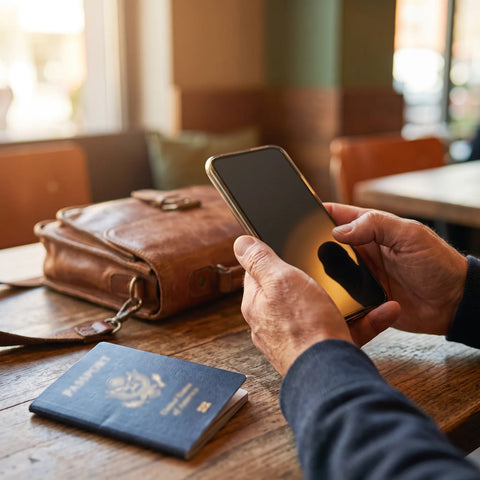
In a nutshell: for Interrailing across Europe you need data in several countries at once, and an eSIM for Interrail Europe solves this with a single multi-country plan: no swapping SIMs at every border and no expensive roaming outside the EU. For a two-week route, 10-15 GB is usually enough.
Interrailing means crossing five or six countries in two weeks, and every border is a chance to run out of data just when you're looking for the next platform. With a Europe eSIM you cover the whole route with a single SIM, without swapping SIMs in each country or getting hit by roaming surprises. In this guide we'll explain how much data you need, how to pick the right plan, and why a multi-country eSIM is the perfect companion for your Interrail ticket.
Why an eSIM for Interrail?
A Europe eSIM gives you data in dozens of countries with a single plan, so you cross from France to Italy or from Austria to Czechia without touching a thing: your phone reconnects automatically to the local network in each destination. No buying SIMs at every station, no paying your carrier's sky-high roaming when you leave the EU for Switzerland or the Balkans.
Interrail is, by definition, a cross-border trip. One morning you wake up in Amsterdam and by evening you're having dinner in Cologne; the next day you're in Prague. With a physical SIM from a single country, you're left without data or stuck on expensive roaming for half the route. The Europe eSIM solves this from the start because it covers all those countries at once. Plus, being digital, you already have it installed before you leave home and it activates in 1 minute when you land or board your first train.

How much data you need for your route
For a two-week Interrail trip, most travelers get by just fine with 10-15 GB. You'll use data mostly for maps, train schedules, booking apps, messaging, and some social media; leave heavy streaming for the hostel Wi-Fi. If you plan to share lots of photos or videos, go up to 20 GB to be safe.
The key thing about Interrail is that you spend many hours on trains with free Wi-Fi, which cuts down your actual mobile data usage quite a bit. Your eSIM data is mostly used in cities: finding your accommodation, checking walking routes, translating a menu, or sharing your location with travel buddies. With normal map and messaging use, 1 GB lasts you between three and five days.
| Duration | Recommended data | Traveler profile |
|---|---|---|
| 1 week | 5-8 GB | Light use: maps and chat |
| 2 weeks | 10-15 GB | Normal use, some social media |
| 1 month | 20-30 GB | Heavy use, photos and video |
| Long summer | Renewable plan | Interrailer with no fixed return ticket |
If you want to fine-tune the estimate based on your style, check out our guide on tips to save data with your eSIM while traveling. And if your route spans several weeks or covers many Eastern European countries, take a look at our Europe eSIM plan for 30 countries.
A Europe eSIM vs a SIM per country
Buying a local SIM in every country you visit sounds cheap until you add up the time wasted, the language barrier in the store, and the cards you throw away half-used. A Europe eSIM gives you one plan, one price, and zero hassle at borders — priceless when your route changes on the fly.
The comparison is simple: a per-country SIM only makes sense if you're staying many days in a single destination. On an Interrail trip, where you hop every day or two, a multi-country eSIM wins hands-down for convenience and is often cheaper than your carrier's roaming. If you want to see the savings in detail, we have a comparison of eSIM vs traditional roaming and another on physical international SIM vs eSIM.
Interrailer tip: install the eSIM at home on wifi and have it ready. On the day you start your route, you just activate it — no hunting for a phone shop with your backpack on.

How to activate it before you leave
Installation takes about a minute and is done from home. You buy the Europe plan, receive the QR code by email, scan it with your phone connected to wifi, and the eSIM is installed. You can schedule data activation for the day your trip starts, so you don't use anything before then.
Here's the step-by-step process:
- Check that your phone is eSIM-compatible (almost all recent models are).
- Buy the Europe plan with the GB you need for your route.
- Scan the QR you receive by email or install it with one tap.
- Activate the data when you arrive and check that the local network appears.
If you have questions about the process, follow our guide on how to install an eSIM step by step. And if you're still not clear on how data roaming works between countries, we explain it in what data roaming is — the reason your eSIM automatically switches networks at every border without you doing a thing.
Connectivity tips on the train
Many European high-speed trains offer wifi, but it's slow and drops out in tunnels and rural areas. That's why the eSIM is your safety net: when the train wifi fails, your mobile data is still there to check the connecting platform or report a delay. Download offline maps of the cities before you leave to save data.
A few habits that make a difference on the road:
- Offline maps: download them on wifi the night before; they use a lot of data if you grab them on the go.
- Downloaded tickets: save train QR codes and reservations on your phone in case you lose coverage in an underground station.
- Share your hotspot: if you're traveling in a group, one person can hotspot for the rest on short stretches.
- Data saver mode: turn it on in photo and cloud apps so they don't upload videos over mobile data.
If you're traveling with others and want to share a single eSIM, turning on the hotspot from the phone that has it installed works just like with any SIM — just watch that data usage doesn't spike if everyone streams video at the same time from the same device.
There are stretches where the signal disappears even with the best plan in the world, and it's good to know before you're caught looking for the connecting platform. The Eurostar goes several minutes without coverage from any carrier while crossing the Channel Tunnel; the same happens in the Gotthard Base Tunnel in Switzerland, and in much of the corridor between Munich and Verona, which runs through the Alps in long tunnels. In large underground stations, like Vienna's Nordbahnhof or some platforms at Zurich HB, the signal also takes a few seconds to return when you come back to the surface. It's not a fault of your eSIM or the local carrier — it's tunnel physics, and it happens to any SIM. Keep your tickets and itinerary downloaded and don't rely on your phone right in those stretches.
Typical Routes and Their Coverage
The most popular Interrail routes combine central and eastern Europe: Paris, Munich, Vienna, Prague, Budapest. A Europe eSIM covers all these destinations using the local network in each country, so you'll have data in France just as you do in Czechia or Hungary. Mediterranean itineraries (Italy, Croatia, Greece) are also covered.
One detail to watch: some classic route countries, like Switzerland or the Balkans, aren't always included in the free EU roaming you get with your local carrier, but they are covered by a good, broad Europe eSIM plan. Check that the plan you buy includes every country on your itinerary before you leave. If your route heads down toward the Adriatic or includes many southeastern countries, you'll want to look directly at the Europe eSIM plan with coverage in 33 countries, which expands the destination list compared to the standard plan and avoids surprises right at the border you least expect.
Common Interrail eSIM Myths and Mistakes
This is where most people slip up, and it's almost never their fault: these are details the carrier's website doesn't explain well.
Myth: "All Europe eSIMs cover the same countries." Not true. Basic plans usually cover the European Union just fine, but Switzerland, the UK, non-EU Balkans (Serbia, Bosnia, Albania...), or Turkey are sometimes left out or require a different plan. If your Interrail route goes through any of those countries, check the exact country list of the plan before you pay; don't assume "Europe" means the same thing on every card.
Myth: "If the train has Wi-Fi, I don't need data." Onboard Wi-Fi gets saturated when the carriage is full, and in mountain or rural sections it often doesn't work at all. Plus, many train Wi-Fi portals ask you to register with an email every time you connect, which is a hassle if you just want to check a map for two minutes. Your eSIM is the one that won't let you down.
Myth: "I have to turn something on or off every time I cross a border." No. Once the plan is activated, your phone automatically selects the best local network in each country; you don't touch a thing. If you notice it's stuck on a weak signal, just toggle airplane mode off and on for a moment so it searches again.
And here's the tip that actually saves you money: if your Interrail trip is short and stays within the European Union (for example, a weekend from Spain to France, or a week through Italy and Austria), your own local plan already includes roaming data within the EU at no extra cost under European regulations. In that case, don't buy anything: save your money for the part of the trip that really needs it, like Switzerland, the UK, or the non-EU Balkans, where your carrier's roaming charges skyrocket and an eSIM is well worth it.
Frequently Asked Questions
Will a single eSIM work for all the countries on my Interrail trip?
Yes, if you buy a broad Europe eSIM plan. It covers dozens of countries using the local network in each one, so you cross borders without changing SIMs or configuring anything. Just check that your itinerary (including Switzerland or the Balkans) is on the plan's country list.
How many GB do I need for a two-week Interrail trip?
Between 10 and 15 GB is more than enough for normal use of maps, schedules, messaging, and social media. Since you'll spend many hours on trains with Wi-Fi, your actual mobile data usage will be lower. If you share lots of photos or videos, go up to 20 GB to have a buffer.
Will I have data on the train too?
Yes, as long as there's mobile coverage in the area the train is passing through. Train Wi-Fi is usually slow and fails in tunnels, so the eSIM is your safety net. Download maps and tickets offline for areas with no signal.
Can I activate the eSIM on the day my route starts?
Yes. Install the eSIM at home using Wi-Fi and schedule the data activation for the day you start your trip. That way you don't use up plan time early and you arrive with everything ready. Activation takes 1 minute and you won't need to find a store when you get there.
Is it cheaper than my carrier's roaming?
On a multi-country route, almost always. Roaming outside the EU (Switzerland, Balkans) is expensive, and a Europe eSIM covers all those countries with a single price. Only a local SIM per country competes for long stays in a single destination, which is rare on an Interrail trip.
Do I need to do anything when crossing each Interrail border?
No, nothing. Your phone automatically detects the local network of the country you're in and connects to it. If it ever gets stuck on a weak signal right after crossing, toggle airplane mode off and on for a few seconds so it searches for the best available signal again.
What if my Interrail route includes the United Kingdom?
The United Kingdom is not part of the European Union, so it's not included in free European roaming and isn't always covered by eSIM plans designed only for the EU. Before you buy, check that the Europe eSIM plan you choose explicitly includes the United Kingdom in its country list; if your route goes through London or York, this detail makes all the difference.
Conclusion
Interrail is about crossing borders almost daily, and that's where a Europe eSIM shines: one plan, all countries covered, and zero hassle at every station. Install it at home, activate it when you start your route, and forget about hunting for phone shops with your backpack on. Travel with a Europe eSIM and have data on your entire train route from the first platform to the last.