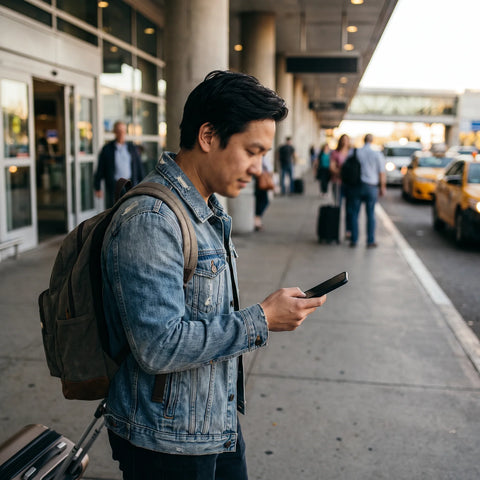
In short: to navigate the Fez medina without getting lost, it's best to arrive with active data. An eSIM for Fez is actually a full Morocco eSIM: it connects you as soon as you land at Fez-Saïss airport, avoids roaming charges outside Europe, and provides GPS support to help you find your way through the medina's alleys.
Fez has one of the largest and most labyrinthine medinas in the world: thousands of nameless alleys where getting lost is almost a rite of passage. That's why having an eSIM for Fez with data from the moment you land isn't a luxury; it's what saves you from going around in circles. In this guide, we'll tell you how coverage works within the medina, how many GB you'll need for your trip, and how to get everything activated before you take off.
Do you really need data to get around Fez?
Yes, more than in almost any other city in Morocco. The Fez el-Bali medina does not allow cars and is a labyrinth of narrow alleys where GPS is your best ally. An eSIM gives you that data from the moment you land, without having to look for a store or change cards.
The classic Fez experience is to end up "lost with style": it's fine for a while, but when you want to get back to the riad or arrive at a specific time, having a live map on your phone changes everything. With a connection, you can track your position in real time even if the map approximates the streets, notify your accommodation to pick you up at a known gate in the wall, or ask for help via WhatsApp. If you've never used this technology, review what a virtual eSIM is and how it works beforehand to arrive fully prepared.

Coverage within the medina and the tanneries
Mobile coverage in Fez is good in open areas (the new city, Fez el-Jedid, the surroundings of Bab Bou Jeloud) and somewhat more irregular in the heart of the medina, where narrow alleys and high walls can occasionally cause the signal to drop. You won't be completely incommunicado, but you will notice slower sections in covered passages.
The solution is simple and highly recommended in Fez: download the medina map offline before entering. This way, GPS still locates you even if you temporarily lose data, and you regain connection when you emerge into a square or wider street. At viewpoints like the one overlooking the Chouara tanneries, with views of the colorful vats, the signal usually works without problems.
Traveler's tip: In the Fez medina, it's common for young people to offer to "guide" you to the exit in exchange for a tip. With your downloaded map and backup data, you can find your way on your own and decide calmly whether or not you want that help.
How many GB for a getaway to Fez
Fez is usually visited in 2-3 days, often as part of a longer trip through Morocco. Data consumption is moderate if you take advantage of the riad's Wi-Fi at night, although intensive map use within the medina adds a bit more than usual. This reference will guide you:
| Travel Profile | Days | Estimated Data |
|---|---|---|
| Short getaway (map and messaging) | 2-3 days | 1-3 GB |
| Fez as part of a Moroccan itinerary | 7-10 days | 5-8 GB |
| Intensive use (social media and video) | 7-10 days | 8-12 GB |
GPS and WhatsApp consume less data than people think; what really drives up consumption is video and stories. If you're traveling in a group, you can share a line by activating the hotspot and adding some extra margin. To make the most of each GB (and avoid running out on your last day in the medina), check out these tips for saving data on your trips.

It's a Morocco eSIM, not just Fez
It's important to be clear on this to avoid confusion when buying: there isn't an exclusive Fez plan, but rather a Morocco eSIM that works across the country's entire network, including the imperial city. And that fits perfectly with how travel is typically done here.
Almost no one goes only to Fez: it's common to combine it with Chefchaouen, Meknes, the desert gates of Merzouga, or complete the loop in Marrakech. With a single eSIM for Morocco plan, you have coverage throughout your route without changing eSIMs or contracting anything extra, covering Fez and the rest of the country with the same profile. If you're torn between this and buying a physical card upon arrival, you can find a complete comparison in international chip vs. eSIM.
And if your return isn't direct—many routes involve a long layover in Spain or continue through Portugal, France, or another European country before heading home—you won't need Moroccan coverage for that part of the trip: our eSIM for Spain or the multi-country eSIM for Europe are better suited there, each designed for its respective area.
Myths and what almost no one tells you about eSIM in Fez
Upon exiting the Fez-Saïss terminal, you'll see Maroc Telecom, Orange, and inwi stalls offering Moroccan prepaid SIMs. It seems cheaper on paper, but in practice, you have to show your passport, fill out a registration form, and sometimes wait in line with the flight still heavy in your legs. If you're only staying two or three days, that time is hardly worth it compared to getting off the plane with your eSIM already working.
Moroccan physical SIM vs. eSIM: what's more worthwhile
| Aspect | Moroccan physical SIM | Morocco eSIM | Roaming from Spanish operator |
|---|---|---|---|
| Registration with passport | Yes, mandatory | No | No |
| When you have data | Depends on the queue at the airport or store | Ready before leaving home, active upon landing | Immediate, no management needed |
| If you continue your trip to another country | You have to repeat the process with another card | Depends on the contracted plan | Cost skyrockets outside the European Union |
| Your Spanish number | Goes unused in the second slot or must be removed | Remains active for calls and SMS | Active without touching anything |
If you want to understand why traditional roaming costs skyrocket as soon as you leave the European Union, the complete explanation can be found in what data roaming is.
Another common myth: "I already have Wi-Fi at the riad, I don't need anything else." Only half true. Many riads in the medina give you the password at check-in, so during the journey from the airport and while you're looking for the correct gate in the wall, you'll be without your own coverage. And once inside, the Wi-Fi usually reaches the central courtyard well but weakens in the rooms on the upper floors, typical of traditional houses with thick walls.
A detail not found in guides: if you get lost, Bab Boujloud—the blue and green gate separating the medina from the Fez el-Jedid area—is a reliable landmark for recalibrating your GPS, as it's in an open area where the signal usually recovers quickly. Mentally use it as "north" when the map starts jumping between covered alleys.
And it must be said honestly: if your visit to Fez is a one-day organized excursion from Marrakech or Chefchaouen, with a guide and transportation included, you may not need to contract anything extra—many tours have Wi-Fi in the minibus and the guide is connected. The eSIM makes sense when you're moving around on your own, at your own pace, and eager to get lost in the medina without depending on anyone.
Activating the eSIM upon landing at the airport
Fez-Saïss Airport (FEZ) is small and located about 15 km from the city, so you'll want data to arrange a taxi or transfer to the medina, where many riads are not accessible by car. The process, prepared at home, takes just a few minutes:
- Before flying, with Wi-Fi, purchase and install the profile using the eSIM installation guide.
- Label the line as "Morocco" to distinguish it from your own.
- Upon landing at FEZ, disable airplane mode and activate the eSIM data.
- Keep your Spanish number active for bank SMS, but with data off on that line.
- Check the Moroccan network and download the offline medina map.
Before purchasing, confirm that your phone is eSIM-compatible by checking your model's network settings. Most recent models are.
eSIM vs. roaming in Morocco
Morocco is outside of European roaming, so simply using your Spanish rate can be expensive: as it's outside the European Union, the cost of data roaming skyrockets compared to what you pay when traveling within the EU, and many operators don't even include it in their usual flat rates. On a three-day getaway, enjoying getting lost in the medina (and constantly using your map), that bill quickly adds up.
The eSIM turns this around: you pay a fixed plan upfront, you know what you're spending, and there are no surprises upon your return. Always check the current price on the product page before buying. If you want to see more details, we have a comparison of eSIM vs. roaming that makes it clear. For a trip to Fez, where you'll rely heavily on your map, the eSIM is the sensible option.
Frequently asked questions
Does GPS work within the Fez medina?
Yes, though with nuances. GPS locates you even with a weak signal, and with data, you see the map in real-time. In covered alleys, the position might be approximate, which is why it's best to download the map offline: this way, you can continue to orient yourself even if you temporarily lose data.
Does the same eSIM work for Chefchaouen and the desert?
Yes. It's not an exclusive Fez plan, but for all of Morocco. The same eSIM provides coverage in Chefchaouen, Meknes, or on the way to the Merzouga desert, connecting to the available network in each area. In rural sections, the signal can be irregular, so carry downloaded maps.
Can I message the riad via WhatsApp if I get lost?
Yes. With active data, WhatsApp works to message your accommodation and share your location. Many riads in the medina are accustomed to coming out to meet guests at a known gate in the wall if you let them know, which is much easier if you're connected.
Do I need to register the line with my passport?
No. When purchasing an eSIM online, there's no need to present your passport or register the line at a store, as is usually required with local Moroccan prepaid SIMs. You buy, install the profile, and activate it upon landing, without paperwork or queues.
How long does it take to connect upon arrival in Fez?
Around one minute. If you already have the profile installed from home, as soon as you turn off airplane mode and activate the eSIM data at Fez-Saïss airport, your phone will connect to the Moroccan network in seconds.
Can I install the eSIM without Wi-Fi at Fez airport?
It's better not to risk it. Profile installation (which is not the same as activation) requires an internet connection, so do it at home with your Wi-Fi before flying. Once installed, activating it at Fez-Saïss airport no longer depends on having Wi-Fi: it connects directly to the Moroccan data network.
What if my phone doesn't support eSIM?
Then you'll need a physical alternative: a local Moroccan prepaid SIM, with the corresponding passport registration, or roaming from your Spanish operator, which is more expensive. Check your model's compatibility carefully before traveling, not while queuing at the airport.
Conclusion
In Fez, connection is what separates a magical afternoon getting lost in the medina from an hour of anxiety trying to find your way out. An eSIM gives you data from the airport, reliable backup GPS, and a fixed price without roaming. And remember: the plan covers all of Morocco, not just the city. Arrive with your Morocco eSIM ready and get lost in Fez with peace of mind.