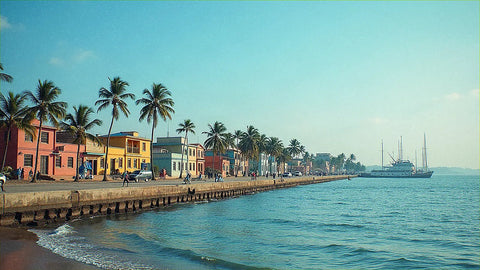

In short: an eSIM for Guinea gives you mobile data in Conakry and the rest of the country from the moment you land, without registering your passport at a local shop or paying your Spanish mobile plan's roaming fees, which are not covered by European regulations in Guinea. It's installed before you fly and activated upon arrival.
Guinea Conakry is not a mass tourism destination, and that's noticeable in everything: in logistics, in the language, in how the street works. If you're going for work, cooperation, or because you've veered off the usual West African route, running out of data on your first day in Conakry isn't just a minor inconvenience; it's a real problem when you need a map, a contact, or a bank verification code. An eSIM for Guinea installed before you leave removes that uncertainty: you arrive at Ahmed Sékou Touré Airport, activate your data, and you'll have internet while you negotiate a taxi to the city center.
Is an eSIM for Guinea worth it?
For the vast majority of travelers, yes, and not just for convenience. Guinea uses the Guinean franc (GNF) and French as its administrative language, so arriving with active data from the first minute means you can use a translator, call a trusted taxi, and orient yourself in a city that, if you don't know it, is quite disorienting. Conakry stretches along a long, narrow peninsula, with heavy traffic that makes any journey take longer than you expect; having a working map without relying on finding Wi-Fi is the difference between arriving calmly or driving around in circles.
The second compelling reason is that Guinea is outside the European Union, so your Spanish roaming plan does not apply here as it would in France or Portugal. Outside the EU, roaming is billed separately by your operator and usually escalates quickly as soon as you browse a bit. It's good to understand this difference well before leaving; we explain it in detail in the guide on what data roaming is and, if you want to directly compare the two options, in eSIM vs. roaming.
The other advantage, more practical, is that you save yourself the paperwork. Buying a physical SIM in Guinea involves registering your passport at an official point of sale, sometimes including a photo, and depending on that store's opening hours. With an eSIM, that process disappears: the profile is purchased online, installed via QR, and doesn't require you to show up anywhere. If you're still unclear on what exactly an eSIM is and how it differs from a physical card, the guide on what a virtual eSIM is clarifies it in five minutes.

Operators and actual coverage in the country
The Guinean mobile market is dominated by Orange Guinée and MTN Guinée, with Cellcom as the third operator with a smaller footprint. Orange and MTN offer the best coverage in the country, and a travel eSIM automatically connects to the local operator with the best signal at any given moment, so you don't have to choose or configure anything manually.
In Conakry and the regional capitals (Kankan, Labé, N'Zérékoré), 4G signal is reasonable in urban centers, though it's important not to assume it remains consistent across all neighborhoods: in peripheral areas and in the Madina market, the capital's largest and always crowded, the network gets saturated during peak hours and speeds drop considerably even with coverage.
Outside major cities, the landscape truly changes. In the Fouta Djallon region, with roads winding up and down mountains towards Labé and Dalaba, there are unpaved sections where the signal disappears for several kilometers at a time. If your route includes waterfalls, hiking, or inland villages, expect to lose coverage at times: this is normal in such terrain, not a fault with your eSIM.
Practical tip: before leaving Conakry for the interior, download an offline map of the entire route and save emergency contacts and your accommodation address in an offline note. In Fouta Djallon, the signal comes and goes, and having everything accessible without data will save you real trouble.
If your West Africa itinerary includes nearby countries, keep in mind that each country needs its own eSIM: there isn't one that covers the entire region unless it's explicitly multi-country. For the closest neighbor, check out the Guinea-Bissau eSIM if your route crosses the border.
eSIM or local SIM: what suits you best
A local physical SIM might be cheaper if you only look at the price per gigabyte, but the process of getting one in Guinea comes with real friction: you have to locate an official point of sale (not just any street vendor will do), register your passport, sometimes wait for activation, and top up in Guinean francs with banknotes you haven't exchanged. For a trip of one or two weeks, that lost time on the first day doesn't outweigh the savings.
The eSIM, on the other hand, works as soon as you land: you install it in Spain at your leisure, before checking in, and only activate it when you arrive in Conakry. You don't depend on finding an open store or the vendor having the correct SIM in stock for your phone model. If you're going to be in the country for months for work or cooperation, then a local line with a monthly plan and your own Guinean number might be worthwhile; for short stays, the eSIM almost always wins for convenience, not just price.
There's a third option that many people don't know about: the international prepaid chip sold by some Spanish operators for use in several countries. This is not the same as a local eSIM and doesn't offer the same native coverage, and it usually ends up being more expensive for the volume of data you need on such a trip.

How many GB do you need for Guinea?
Consumption depends primarily on whether you make video calls and how much you rely on hotel Wi-Fi. In Conakry, most mid-range accommodations have Wi-Fi, though not always stable, so the eSIM usually serves as the primary network rather than a complement.
| Travel Profile | Approximate Data | Typical Duration | What it covers |
|---|---|---|---|
| Short business trip | 3-5 GB | up to 7 days | Email, maps, messaging, some brief video calls |
| Two-week stay | 8-10 GB | 10-15 days | Daily use with regular video calls |
| Cooperation or long project | 15-20 GB or renewable | 21-30 days | Intensive use, several video calls per day |
One detail almost no one considers when calculating: WhatsApp and email use very little data, but a one-hour video call consumes several hundred megabytes without you noticing, and if you also share your live location for safety, map consumption increases more than it seems. If you're low on data, disable automatic app updates and cloud photo uploads while you're away; you can rely on specific tricks in the guide on how to save data with an eSIM while traveling.
Price: what to expect compared to roaming
We're not going to give you a fixed price table here, because prices change frequently, and it's honest to check the current price of each plan directly on the product page before buying. What we can tell you with certainty is the fundamental comparison: international roaming from a Spanish operator in a country outside the EU like Guinea usually skyrockets as soon as you browse normally for a few days, whereas a data eSIM with a fixed plan gives you a predictable cost from the beginning, with no surprises on your bill when you return.
If your route through the region doesn't end in Guinea, also consider the return leg: many flights have layovers in Europe, and if you have hours to kill at a European airport before your final connection, it's not worth activating your plan's roaming just for that wait.
How to activate it in less than a minute
The process is the same as for any travel eSIM, and it's best to do it calmly before you leave, not in the boarding queue.
- Purchase your eSIM plan for Guinea and receive the QR code by email.
- Go to Settings > Mobile Data > Add eSIM and scan the code with your camera.
- Leave the profile installed but deactivated until you land in Conakry.
- Upon arrival, activate the eSIM's mobile data and its internal roaming in settings.
If this is your first time installing an eSIM, the step-by-step process with screenshots is in the guide on how to install an eSIM. Do it with stable Wi-Fi at home; don't rely on the Wi-Fi at the departure airport, which is often crowded and fails just when you need it most.
Myths and what almost no one tells you before going to Guinea
"My roaming plan in Europe also covers Guinea." No. Guinea is not part of the European Union, so the "free" roaming you use in France or Italy does not apply here: your operator will bill you separately and usually at a much higher price than in the EU. Confirm this with your company before you leave if you are not sure.
"All mobile phones have eSIM." Not true. Many mid-range models sold in Europe do, but there are exceptions, and some unlocked phones sold outside the EU have the feature blocked by the manufacturer or original operator. Check your specific model's compatibility before purchasing; don't assume that "it's new, it must have it."
"With an eSIM, I don't need anything else." An eSIM provides data, not extra privacy or security on public Wi-Fi networks in hotels or airports, which in Guinea, as in many destinations, are not always well protected. If you're going to connect to shared Wi-Fi to save data, review the guide on eSIM and VPN for private travel.
"If I have coverage in Conakry, I'll have it throughout the country." This is the most common mistake for those unfamiliar with the terrain. Guinea has very varied geography, and the difference between the signal in the capital and on a mountain road in Fouta Djallon is enormous. Plan for periods without coverage as normal, not as a malfunction.
"I'll activate the eSIM as soon as I buy it, so it's ready." Better not. If you activate the plan before you fly, you start consuming validity days from that moment, even if you're not in Guinea yet. Install the profile at home, but leave data activation for when you've already landed.
Frequently asked questions
Do I need to register my passport to use an eSIM in Guinea?
No. Unlike the physical Guinean SIM, which requires passport registration at an official point of sale, the travel eSIM is purchased online and activated via QR without any in-person process. This saves you queues and ensures you have data working from the moment you arrive at the airport.
Is there good coverage outside Conakry?
In regional capitals like Kankan or Labé, yes, with reasonable 4G from Orange or MTN in the urban center. In rural areas, mountain roads, and regions like Fouta Djallon, the signal drops to 3G or disappears in unpaved sections. Download offline maps if your route strays from the main cities.
Can I make regular calls with an eSIM in Guinea?
Most travel eSIMs are data-only, so traditional voice calls are not included. The usual alternative is to call via WhatsApp or video call using the eSIM's data, which works normally in cities and doesn't charge you minutes from your Spanish plan.
Is an eSIM cheaper than my Spanish operator's roaming in Guinea?
In practice, an eSIM almost always pays off more. Roaming outside the European Union is not limited by European price regulations, so it usually skyrockets as soon as you browse normally. Check the current price of your eSIM plan and compare it with your operator's roaming tariff before deciding.
Does the eSIM for Guinea also work in Guinea-Bissau or Equatorial Guinea?
No. These are three distinct countries, each with its own operator network and its own eSIM. The eSIM for Guinea covers Guinea Conakry. If your route crosses into Guinea-Bissau, you need its specific plan, and Equatorial Guinea operates with completely different operators.
What happens if my flight has a layover in another country before arriving in Guinea?
The Guinea eSIM does not provide coverage during a layover if the transit country is not included in the plan. If you're going to spend hours at a European airport before your flight to Conakry, consider activating data for that segment separately instead of consuming days of your Guinean eSIM's validity prematurely.
Can I use the Guinea eSIM when I return to Spain?
There's no point in doing so: the plan is designed to be used within Guinea and its validity is limited in days. Upon landing back, switch to your usual Spanish line or, if you're still traveling in Europe, consider an eSIM for Spain or the country where you continue your journey.
Conclusion
Guinea is a destination that requires some planning, and connectivity is one of the pieces that makes everything else easier: maps, translation, contact with home and with those waiting for you in Conakry. Forget about local SIM registration and out-of-EU roaming that skyrockets without warning: prepare your eSIM for Guinea before flying to Conakry and land with internet ready from the first minute on the tarmac.