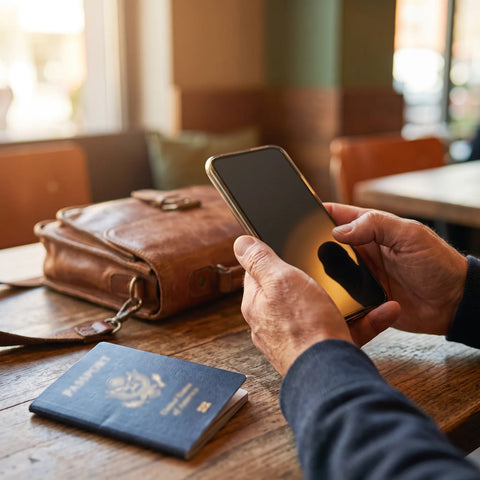
Quick Answer: Yes, a data eSIM for Europe is the best solution for your InterRail trip. It works in all countries covered by the pass without changing SIMs, activates in minutes from your phone, and is much cheaper than your carrier's roaming. A 10–20 GB plan comfortably covers 2–4 weeks of travel.
What is InterRail and why do you need internet on your trip?
If you're reading this, you probably already know what InterRail is: the train pass that allows you to travel through 33 European countries with complete freedom. You get on a train, get off in another city, and repeat. It's the most epic (and economical) way to do a classic European backpacking trip.
But there's something many travelers don't think about until they're already on the platform: how will I get internet?
InterRail gives you access to the European rail network, but it doesn't include mobile data. And when you're hopping from country to country—France, Italy, Germany, Spain, Portugal, Austria—you need internet for almost everything:
- Booking mandatory train supplements (yes, many high-speed trains require reservations even with an InterRail pass, and they sell out).
- Google Maps and navigation in unfamiliar cities.
- Booking or Hostelworld to find accommodation on the go.
- Checking train schedules in real-time with Railplanner or the official InterRail app.
- Sharing your trip with family and friends.
- Translating menus, signs, and conversations in non-English speaking countries.
Without internet, traveling on InterRail becomes extremely complicated. The good news is that the solution exists, is cheap, and fits in your phone: it's called eSIM.
A European eSIM gives you data in all countries on your InterRail route without physically touching your SIM card. It's technology already integrated into most modern smartphones (iPhone XS onwards, Google Pixel 3 onwards, Samsung Galaxy S20 onwards) that, in the context of multi-country travel, changes everything.
eSIM vs local SIM for InterRail — the key comparison
When it comes to having data on an InterRail trip, you have several options. Let's compare them honestly:
| Option | Multi-country Coverage | Estimated Cost | Convenience | Recommended |
|---|---|---|---|---|
| Regional Europe eSIM | 30–40 countries ✅ | View price / 10–30 GB | Maximum ⭐⭐⭐⭐⭐ | ✅ Yes |
| Local SIM per country | 1 country ❌ | View price × N countries | Low ⭐⭐ | ❌ No |
| Home operator roaming | Varies ⚠️ | variable price/day or limited | Medium ⭐⭐⭐ | ⚠️ EU only |
| Hotel and cafe WiFi | N/A | Free | Very Low ⭐ | ❌ Add-on only |
| Rented Pocket WiFi | Limited | €8–15/day | Low ⭐⭐ | ❌ No |
Why does the regional eSIM win hands down?
On a typical InterRail trip, you might visit between 5 and 12 countries in 2–4 weeks. Buying a local SIM in each country would mean looking for a phone shop as soon as you arrive, struggling with the language, wasting time, and spending double or triple. And if your Argentinian, Mexican, or Colombian operator's roaming only works within the European Union, you'll have problems when you arrive in the UK, Switzerland, Turkey, or Norway — all included in the InterRail pass but outside the EU.
A PuraSIM Europe eSIM installs in 5 minutes from your home, activates automatically upon landing, and works seamlessly as the train crosses borders. Period.

How much data do you need for an InterRail trip (real calculation)?
This is the million-dollar question. The honest answer: it depends on your travel style. But here are some real numbers so you can plan without running out (or overpaying).
First, the approximate daily consumption of an active backpacker:
| Activity | Consumption per hour / session | Estimated daily usage |
|---|---|---|
| Google Maps navigation | ~5 MB/hour | ~20–30 MB |
| WhatsApp / Telegram (text + photos) | ~5–15 MB/hour | ~50–100 MB |
| Instagram (scrolling + stories) | ~150 MB/hour | ~200–400 MB |
| Railplanner App / train schedules | ~2 MB/query | ~10–20 MB |
| Online bookings (Booking, Hostelworld) | ~10 MB/session | ~20–40 MB |
| Google Translate with camera | ~5 MB/session | ~15–30 MB |
| Video calls (FaceTime, WhatsApp) | ~200–300 MB/hour | ~300–600 MB |
Summary by traveler profile:
- Light use (maps, messages, bookings without social media): ~200–400 MB/day → 5–8 GB for 2 weeks
- Normal use (all of the above + Instagram, photos): ~500–700 MB/day → 10–15 GB for 2 weeks
- Intensive use (streaming, daily video calls, TikTok): ~1–2 GB/day → 20–30 GB for 2 weeks
Our recommendation for most InterRail backpackers: a 10–15 GB plan is the sweet spot. Enough to stay connected without running out of data halfway through Germany. If you want to play it safe, take a look at our guide on how much data you need for travel for a more detailed calculation.
For long trips of more than a month, you should also check our post on eSIM for Europe for 30 days, where we cover the best plans for extended stays.
The best InterRail countries and their eSIM coverage
The InterRail Global Pass covers 33 countries, from Portugal to Turkey. Here we give you the details of the most popular destinations among Latin American backpackers and what the eSIM coverage is like in each one:
France — Paris, Lyon, Marseille, Nice
France is the central hub of InterRail. Many travelers start or pass through Paris. 4G/LTE coverage is excellent throughout the high-speed rail network (TGV). In rural areas it may decrease, but main routes are 95% covered.
Star train: Paris–Barcelona on the TGV (requires supplement reservation). Having it done from your phone before arriving is essential.
Italy — Rome, Florence, Venice, Milan, Naples
Italy is the favorite destination for many Interrailers. The Trenitalia network covers the entire country, and the Frecciarossa high-speed trains connect the main cities in record time. LTE coverage is very good in cities; on the coasts of Cinque Terre or in Sicily it can be more irregular.
Special tip: In Italy, supplements for Frecciarossa and Frecciargento are mandatory and sell out quickly in high season. Without internet on your phone, you'll miss trains or pay double at the ticket office.
Germany — Berlin, Munich, Hamburg, Cologne
Germany has a dense rail network with Deutsche Bahn (DB). 4G coverage improves every year, although there are still dead spots on some regional stretches in rural areas. Berlin and Munich have 5G coverage in most areas.
Fun fact: Platform tickets in Germany cannot be bought on the train — you need the DB Navigator app or a printed QR. Internet on your phone = no fine.
Spain — Madrid, Barcelona, Seville, Granada, San Sebastián
The Spanish AVE network is one of the fastest in the world. Madrid–Barcelona in 2h30 or Madrid–Seville in 2h20. Excellent 4G coverage on all high-speed corridors. Spain is also very welcoming for backpackers with incredible hostels and lower prices than northern Europe.
Portugal — Lisbon, Porto, Faro, Évora
Portugal completes the perfect circle of InterRail in Southern Europe. The rail network is more modest than the Spanish one, but it covers the main destinations. Lisbon and Porto have excellent 4G/5G coverage. In the Alentejo and interior Algarve it can be more irregular.
Important note: Portugal–Spain can be done by train (Lisbon–Madrid), although the frequency is limited. It's worth booking in advance from the app.
Austria, Switzerland, Czech Republic and more
InterRail also covers wonders like Vienna, Prague, Budapest, Krakow, Amsterdam, Brussels, and Istanbul. eSIM coverage is excellent throughout Central and Western Europe. In the Balkans and Turkey it can vary more, but most regional eSIMs also include roaming data there.
If you travel to multiple countries in a short time, check our guide on cheap eSIM for backpackers in Europe to find the best plan for your route.
How to activate your eSIM before leaving
One of the most common mistakes travelers make: trying to install the eSIM at the airport or once in Europe. Don't do it. The installation process requires a stable WiFi connection, and if you lose the QR or there's a problem, you're in trouble with your flight looming.
Here's the correct step-by-step process:
- Buy your Europe eSIM at least 24–48 hours in advance from PuraSIM. You will receive the QR by email instantly.
- Verify that your phone is eSIM compatible (iPhone XS/XR or later, Samsung Galaxy S20 or later, Pixel 3 or later, Xiaomi 13 or later). If in doubt, check our compatibility page.
- Go to Settings > Mobile Data > Add eSIM (on iPhone) or Settings > Connections > SIM card manager (on Samsung/Android).
- Scan the QR with your phone's camera when prompted by the system.
- Set the eSIM as your data line (you can keep your physical SIM for calls and SMS if needed).
- Activate roaming data for the eSIM — this is essential and many forget it.
Do you have questions about whether the eSIM works in airplane mode during the flight? Read our article on eSIM and airplane mode — spoiler: you can activate WiFi without affecting the eSIM.
Once in Europe, the eSIM automatically connects to the local operator with the best signal. Changing countries does not require any action on your part: the phone detects the available network and connects itself. It's literally plug-and-play for your InterRail trip.
Practical tips for managing data on the train
Trains are the natural habitat of the Interrailer, and there are a few things you can do to make the most of your data and avoid running out of GBs at the most inconvenient time:
1. Download offline maps before each city
Google Maps allows you to download full city maps for offline use. Download your destination city while you still have WiFi at the hostel. This way you can navigate the streets without spending a single MB.
2. Use the Railplanner app in offline mode
The official InterRail app, Railplanner, works offline to check schedules and routes. Sync it with WiFi when you can to get updated train data, and use it without data during your journeys.
3. Save bookings in offline mode
When you make a train supplement reservation (mandatory on many AVE, TGV, and Frecciarossa trains), download the ticket PDF or take a screenshot. Don't rely on the app loading the ticket in an area with poor coverage.
4. Activate data saver on Instagram and YouTube
If you're going to use social media during your journeys, activate the data saver option in each app. On Instagram it reduces consumption by 40%; on YouTube, lowering the quality from HD to 480p divides consumption by 4.
5. Share data with travel companions
If you're traveling in a group, one of you can activate the personal hotspot to share data. However, consumption multiplies — in that case, a 20–30 GB plan is more advisable.
6. Take advantage of WiFi at large stations
Major European train stations (Paris Gare du Nord, Rome Termini, Berlin Hauptbahnhof, Madrid Atocha) offer free WiFi. Take advantage of your waiting times to download content or sync apps and save your data for when you need it most.
7. Monitor your usage
On both iOS and Android, you can see exactly how much data each app consumes. Check it every 2–3 days to know if you're doing well with data or need to moderate your usage. It's easy to be surprised by Instagram's consumption on a long train day.

Conclusion: eSIM + InterRail, the perfect combination for the modern backpacker
Traveling through Europe on InterRail is a life-changing experience. Crossing borders while you sleep, waking up in a new city, getting lost in medieval streets that weren't on the plan... All of that is magical. But it's also stressful if you don't have internet when you need it.
A regional eSIM for Europe eliminates that stress at its root. No queues in phone shops, no changing SIMs in every country, no surprise roaming bills when you return home. You buy it online, install it at home, and it works the moment you set foot in Europe.
For a 2-week InterRail trip, we recommend a 10–15 GB plan. For 3–4 weeks or if you're glued to your phone, upgrade to 20–30 GB. For trips longer than a month, check out our long-term plans for Europe.
Ready for your next worry-free InterRail data trip?
Get your eSIM for Europe now
Coverage in +30 countries · Instant activation · No surprise roaming
See eSIM Europe plans →Frequently asked questions about eSIM and InterRail
Does the eSIM work in all InterRail Pass countries?
Yes. A regional eSIM for Europe covers between 30 and 40 countries, including all destinations available on the InterRail Global Pass: France, Italy, Germany, Spain, Portugal, Austria, Switzerland, Netherlands, Belgium, Czech Republic, Hungary, Poland, Croatia, Greece, Turkey, and many more. The eSIM automatically switches to the local operator with the best signal each time you cross a border, without you having to do anything.
How many GB do I need for 2 weeks of InterRail?
For 2 weeks of active InterRail travel, most backpackers are comfortable with 10–15 GB. That covers maps, messaging, accommodation and train bookings, and moderate social media use. If you make daily video calls home or use Instagram and TikTok a lot, go up to 20 GB. If you only use your phone for essentials (maps and bookings), 5–8 GB may be enough. Check our data calculator for travelers for a personalized estimate.
Can I use an eSIM and InterRail Pass on the same trip?
Absolutely, and in fact, it's the perfect combination. The InterRail Pass is your train ticket; the eSIM is your internet connection. They are totally independent products that work wonderfully together. In fact, having internet with your eSIM makes the InterRail Pass much more useful: you can check schedules, make supplement reservations, and find accommodation all in real-time from your phone.
Where do I activate the eSIM for InterRail, before or during the trip?
Always before leaving home, with a stable WiFi connection. eSIM installation requires scanning a QR code and downloading the network profile, which needs internet. Once installed, the eSIM activates automatically when you arrive in Europe and detects available networks. You don't need WiFi or to do anything special: it just works. Trying to install it at the airport or at your destination can cause problems if there are coverage issues or problems with the download process.
Is a regional eSIM for Europe or an eSIM per country better for InterRail?
For InterRail, the regional eSIM for Europe is clearly the best option. Visiting 5, 8, or 10 different countries with individual eSIMs per country would be complicated, expensive, and a logistical headache. With a regional eSIM, you have coverage across Europe with a single plan and a single price, and the network change between countries is completely automatic. It only makes sense to buy an eSIM per country if you are staying for a long time in a single destination (more than 2–3 weeks in the same country). For the typical multi-destination InterRail trip, the regional always wins.