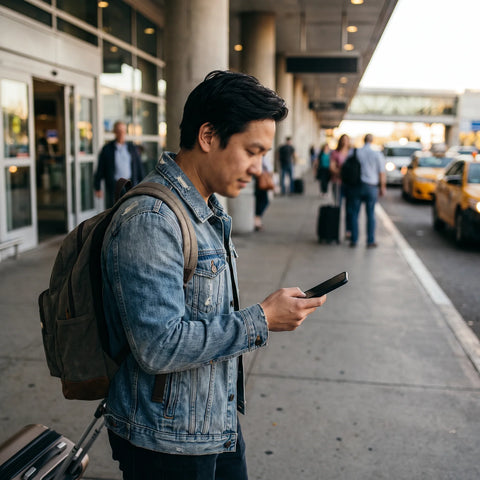
In short: an eSIM for Erasmus gives you mobile data in your destination country from day one, without roaming and without bill shock, while your Spanish SIM remains active for your bank, Bizum, and family. It's installed before you fly, lasts the entire course with top-ups, and is usually more cost-effective than roaming outside the EU.
You're going on Erasmus for several months, and the question is always the same: how to have mobile internet from day one without blowing your budget or losing your home number. The short answer is a data eSIM that coexists with your Spanish card: you keep your line for banks and WhatsApp, and you browse with cheap local data. In this guide, I'll tell you how to set it up properly for an entire semester.
What is an eSIM and why it's perfect for Erasmus
An eSIM for Erasmus is a digital data plan that you install on your mobile without a physical card: you browse with the local network of your destination country for weeks or months, and your Spanish SIM remains inside for calls and SMS. It's the cleanest way to have stable internet from the moment you land.
Compared to buying a prepaid SIM in the country (queues, paperwork, sometimes they ask for a residence document) or paying for daily roaming, the eSIM is activated from your sofa at home. You install it before you leave, scan a QR, and when you arrive, it connects automatically. For a student who will be abroad for a whole semester or the entire academic year, this saves real time and money. With over 200 destinations in the catalog, it doesn't matter if your Erasmus is in Italy, Germany, Poland, or Portugal: there's a plan for your city. If you've never used an eSIM and it sounds like Greek to you, in what is a virtual eSIM you'll find the explanation from scratch, without technical jargon.

Keeping your Spanish number while studying abroad
Yes, you can keep your Spanish number intact. The eSIM only provides data; your Spanish card stays installed and active to receive bank SMS, verification codes, and calls from home. On your mobile, you choose which line uses data (the eSIM) and which line manages calls and messages (your usual SIM).
This is crucial for Erasmus: for months you will need your number for your banking app, for Bizum, for university two-factor authentication, and for your family to call you without dialing strange prefixes. Leave your Spanish SIM in "calls and SMS only" mode to avoid data roaming charges, and set the eSIM as the default data line. This way you browse cheaply but remain reachable on your usual number. If you're not sure what exactly you're avoiding, take a look at what data roaming is: understanding how your operator charges outside Spain helps you avoid surprises on your first billing statement.
Tip: before you leave, disable data roaming for your Spanish card in Settings. This way, only the eSIM will use data, and you'll avoid surprise charges for a video loading in the background.
How much data an Erasmus month consumes
An Erasmus student uses more data than a tourist: daily maps, online classes, video calls home, series at home, and a lot of WhatsApp. Here are approximate monthly figures to help you calculate your plan without overspending or running short.
| Student Profile | Approx. Monthly Usage | Recommended Plan |
|---|---|---|
| Economical (lots of university and home Wi-Fi) | 3-5 GB | Small monthly top-up plan |
| Medium (maps, social media, some video outside home) | 8-12 GB | Standard monthly plan |
| Intensive (streaming and video calls with mobile data) | 15-20 GB or more | Large plan or abundant data |
The advantage of the eSIM is that you can top up on the go without changing cards: if you run short one month, you add gigabytes from the app. For long stays, looking directly at the eSIM data plan for Europe is usually better than buying individual weeks each time your gigabytes run out.

Long-stay eSIM vs. your operator's roaming
Many Spanish operators include roaming in the EU, but with fine print: there's a limit of gigabytes for roaming, and once exceeded, an extra charge per GB that can be very high. For a weekend, it doesn't matter; for an Erasmus of four or five months, that limit is quickly exhausted.
- Operator roaming: convenient at first, but with a data limit in the EU and high cost if you exceed it. Outside the EU (for example, an Erasmus in the UK or Turkey) the cost per GB skyrockets and should be avoided from day one; always check the current price with your operator before you leave.
- Long-stay eSIM: a plan designed for weeks or months, with abundant data and top-ups. Fixed price, no bill surprises.
If your destination is not in the EU, the eSIM stops being an option and becomes almost mandatory to avoid ruining yourself. And even if it's within the EU, having a separate plan frees up your Spanish tariff's quota. This doesn't just apply to the classic Erasmus: if your mobility is through Erasmus+ with partner universities outside Europe (there are agreements with the United States, for example), the logic is the same, except there your Spanish tariff's roaming directly covers nothing. For those cases, you have the eSIM for the United States plan ready before checking your luggage.
How to activate it before flying
The classic mistake is to leave the eSIM for the destination airport without Wi-Fi. Do it the other way around: install it at home with your Wi-Fi a few days before. Installation takes about 1 minute and you just need to scan a QR.
- Buy the plan for your Erasmus country and receive the QR by email instantly.
- With Wi-Fi at home, go to Settings and add the eSIM by scanning the QR.
- Label it "Data" and leave your Spanish SIM as "Primary" for calls.
- Activate eSIM data usage only when you land; until then, use Wi-Fi.
First, check that your mobile is eSIM compatible (almost all recent models are). If you get confused with the installation, the guide on how to install an eSIM step-by-step explains it with screenshots for iPhone and Android.
Tips to stretch your data during the course
An Erasmus lasts many months, so optimizing data makes the difference between topping up little or paying too much. These habits will extend your plan without you feeling like you're "skimping" on connection.
- Download offline maps of your city and your weekend trip destinations.
- Download series and music on your home or library Wi-Fi to watch them later without data.
- Limit automatic video playback on Instagram, TikTok, and YouTube.
- Check which apps consume the most in Settings and cut off their background data.
- Use your mobile as a hotspot only when necessary, not continuously.
There's a longer list of habits with specific screenshots in how to save data with an eSIM on a trip, especially useful in the first month when you still don't know how much you actually spend. And if you travel to other countries on weekends from your Erasmus city (very common during Easter holidays, when half the residence goes away for a long weekend), don't buy a new eSIM for each short getaway: consider a regional plan that covers several countries at once. In eSIM for traveling during Easter you'll find ideas for destinations and how to organize your data for that specific week.
Common mistakes: what almost no one tells you
Beyond theory, there are things you only discover when you've been abroad for a couple of months. Here are the most common mistakes among Erasmus students that you can avoid with two minutes of foresight.
- Accidentally setting the eSIM as the "primary" line on your phone. If you activate the eSIM as primary, some banking or verification apps start sending SMS to the wrong line, and you can't validate a payment. Always leave your Spanish SIM as the primary line for SMS and calls, and the eSIM only as the data line: it's a checkbox in Settings that changes in ten seconds, but if you don't touch it, it can complicate your first card payment from abroad.
- Not checking your bank app's messenger before leaving. Many Spanish banks require SMS or push notification confirmation the first time you make a purchase from a new country. If your Spanish SIM runs out of data and call coverage because you deactivated everything too early, that SMS won't arrive, and the purchase will fail. Test a small payment with the active eSIM data before you actually need it.
- Thinking that the Wi-Fi in the residence or apartment is reliable at all times. In many European university cities, shared Wi-Fi gets saturated during peak hours of online classes or assignment submissions, precisely when you need it most. Having your own data on the eSIM is what saves you from missing a tutoring video call due to a choppy network.
- Using geo-localized content that is not available in your Erasmus country. Some streaming platforms or the university itself detect the country by IP and change the catalog or directly block access to content intended for Spain. This is where an eSIM combined with a VPN can solve more than one headache, especially if you need to access Spanish procedures or banking that verifies from a national IP.
- Comparing only the price and not the fine print of roaming. Not all operators treat roaming within the EU the same: some limit speed after exceeding the data cap instead of charging extra, others cut it off directly. Faced with this uncertainty, the eSIM gives you a fixed gigabyte figure that you know beforehand, and for budgeting an entire course away from home, that's worth more than saving a couple of euros in the first month.
Frequently Asked Questions
Can I use the same eSIM for the entire Erasmus course?
Yes. You buy a long-stay plan for the destination country and top it up when you run out of gigabytes, without changing cards or QR. Many students start with a monthly plan and add data depending on the month they have more video activity or trips.
Do I lose my Spanish number if I get an eSIM?
No. The eSIM only provides data, and your Spanish card remains installed and active for calls and SMS. You keep your number for the bank, Bizum, and your family. You only need to deactivate data roaming on the Spanish SIM to avoid accidental roaming charges.
Does the eSIM work if my Erasmus is outside the EU?
Yes, and that's where you save the most. In destinations outside the European Union, your operator's roaming charges skyrocket, while a local eSIM for the country gives you data at a fixed price. Coverage is available in over 200 destinations, both within and outside Europe.
How many gigabytes do I need per month during an Erasmus?
It depends on your usage, but an average student uses between 8 and 12 GB per month relying on mobile data outside the home. If you have good Wi-Fi at home and university, 3-5 GB might be enough. For constant streaming and video calls, calculate 15-20 GB or more.
When should I install the eSIM, before or upon arrival?
Install it at home with Wi-Fi a few days before flying; installation takes about 1 minute. Then activate data usage only when you land. This way, you arrive with everything ready and don't depend on finding Wi-Fi at an unknown airport.
What happens if I run out of data halfway through the month?
You won't be left without anything: you top up the same eSIM from the app or website, without having to scan any QR again or touch the installation. It's the same mechanism you would use to add credit to a prepaid card, but applied to gigabytes, and the plan remains active while you top up.
Can I have both the eSIM and the Spanish SIM active at the same time on the same phone?
Yes, that's what a dual SIM phone is for (one physical and one eSIM, or two eSIMs in newer models). This is exactly the setup you need for Erasmus: one line for data in the country where you're studying and the other for calls and SMS from Spain, both functioning simultaneously without having to choose.
Conclusion
A well-connected Erasmus starts with the basics: cheap local data from day one and your Spanish number intact for everything important. A long-stay eSIM gives you both without queues, without paperwork, and with top-ups when you need them. Install it before you fly and land already connected to focus on what matters: enjoying your course abroad.