In short: an eSIM for groups and organized tours allows each person to install their data plan before leaving and arrive connected from landing, without queues or physical SIMs. For large groups or tours, an eSIM per person is the most practical option; for groups of 2-4 friends who always go together, sharing data via hotspot also works.
Organizing connectivity for an entire group is one of those details that are forgotten until someone asks, "And how do we get internet there?" With an eSIM for groups and organized tours, the problem disappears: each person carries their data plan activated from home and no one has to rely on finding Wi-Fi or buying a SIM at the airport. In this guide, we'll tell you how to set it up correctly, whether you're four friends or guiding a tour of twenty people.
Why an eSIM is so suitable for groups
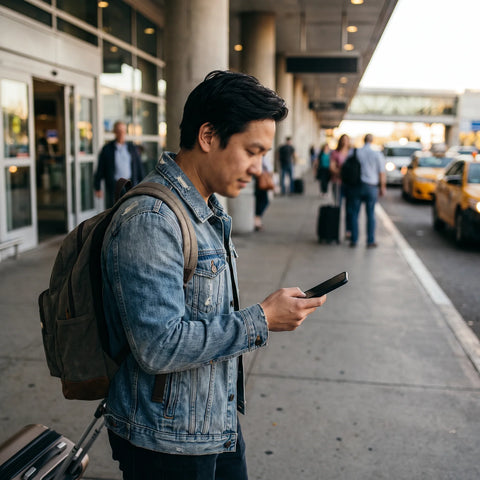
For a group trip, an eSIM works because each member installs it on their own phone before leaving and activates it in 1 minute upon arrival. No one wastes time in queues, there's no need to distribute physical cards or remember codes, and everyone lands connected at the same time. It's the simplest option to keep the group from getting separated.
Think of the typical airport scene: twenty people looking for a local operator's counter, each handing over their passport, with waits and varying prices. With an eSIM, that doesn't happen. Each traveler arrives with their plan ready, and the guide can start the transfer without delays. Additionally, with everyone connected, it's much easier to coordinate meeting points via group chat, share locations, or announce a schedule change. If it's someone's first time using it, it's advisable to read about what a virtual eSIM is beforehand to have a clear understanding.

One eSIM per person or data sharing
There are two ways to connect a group: each person having their own eSIM, or one or two people carrying data and sharing it via hotspot. The per-person option is the most robust and convenient; sharing is worthwhile for small groups that always stay together, but it leaves the group dependent on a single mobile and its battery.
Each model has its logic depending on the type of trip:
| Model | Ideal for | Advantage | Disadvantage |
|---|---|---|---|
| One eSIM per person | Tours, large groups, families | Everyone autonomous and connected | More plans to manage |
| Data shared via hotspot | 2-4 people together | Only one large plan is paid for | Depends on one battery and one phone |
If you opt for sharing, the person acting as the hotspot for the group needs a plan with plenty of GB and an external battery, and should carefully monitor consumption: our guide on tips for saving data on your mobile has specific ideas to stretch the plan without running out halfway through the trip. For family trips, it's also worth noting that children generally use much less data than adults, so it's not necessary to allocate the same plan to everyone.
How much data to calculate for the group
The most common mistake is running short on data. Normal tourist use (maps, chat, social media, some photo uploads) is around 1 GB every 2-3 days per person. If the group shares many photos, makes video calls home, or uses their phone for work, the number quickly increases.
As a rough guide per person for a one-week trip:
- Light use (maps and messaging): 1-2 GB.
- Medium use (social media and photos): 3-5 GB.
- High use (video, streaming, video calls): 7-10 GB or more.
For an organized trip, a light to medium profile is usually sufficient, as hotels offer Wi-Fi for large downloads. If someone is going to act as a hotspot for the rest, calculate their plan as the sum of everyone's consumption, not just one person's: this is the most common miscalculation among first-time group organizers.
Organizer's tip: allocate an extra GB per person than calculated. It's inexpensive and prevents anyone from running out of data on the last day, just when travel photos are most often shared.

Myths about group eSIMs (and when you don't need to buy one)
When it comes to organizing connectivity for several people at once, a few misconceptions circulate. It's important to debunk them before someone gets confused at the airport or, worse, overpays for something they didn't need.
Myth: "If my Spanish plan includes roaming, we're all set." It depends on where you're going. Within the European Union, roaming is usually included at no extra cost, so if the group is spending a weekend in Lisbon or a short Interrail through France and Italy, there's no need to buy anything: check your plan conditions first before spending on an eSIM you won't need. Things change once you leave the EU: that's where roaming costs skyrocket and it stops being worthwhile, and that's precisely the scenario where it makes sense for everyone to carry their destination eSIM. For longer routes through several EU countries, an Interrail of two or three weeks for example, it is worth looking at a plan like the Europe eSIM, which covers several countries with a single profile without having to buy a different one at each border.
Myth: "The whole group has to buy the same eSIM or the same amount of GB." Not at all. Each person can choose the plan that suits them based on how they'll use their phone: someone who will be working from the destination or making video calls needs significantly more GB than someone who will only take photos and check the group chat. Everyone remains connected to the same data network even if they each have a different sized plan.
Myth: "The person least comfortable with their mobile doesn't need their own eSIM, they can just follow the group." This is a common temptation to save money, especially with an older group member, and it usually ends up being costly. If that person gets separated for a moment—in a shopping mall restroom, looking at a shop window, waiting at a museum entrance—they can't message the group or receive others' locations. It's better to simplify the installation for them in advance (activate the eSIM for them at home, leaving only the step of connecting upon arrival) than to leave them without coverage to save on a small plan.
How to prepare before leaving
Preparation makes the difference between a connected group and chaos at the boarding gate. All important matters are resolved at home, with Wi-Fi and time.
- Confirm compatibility: Ask everyone to check if their phone supports eSIM before buying anything.
- Purchase in advance: Each person buys their destination plan a few days in advance.
- Install the profile at home: Downloading the eSIM with home Wi-Fi avoids problems upon arrival.
- Don't activate it yet: Have it ready but activate it at the destination, to avoid wasting plan days.
- Save the QR and support info: Note down the 24/7 Spanish-language support contact in case anyone has questions.
To ensure no one is left out due to an incompatible phone, share with the group the guide on how to install the eSIM step by step, which also reviews which models support it. This step prevents most disappointments.
Tips for guides and organizers
If you are the one organizing the trip, you play a key role in ensuring everyone arrives connected. A good guide does not buy eSIMs for others, but provides clear instructions in advance. Sending a message a week beforehand with the steps and a link to the guide avoids the vast majority of problems.
Some practices that work very well on tours:
- Create a chat group and ask everyone to test it before leaving, so you confirm they have data.
- Recommend a specific GB plan based on the days and planned activity type.
- Remind them to activate the eSIM upon landing, not before, to make the most of all days.
- Have a Plan B: one or two people carry extra data to share in a pinch.
This approach also fits corporate trips or incentives, where it's also advisable to protect the privacy of the group's connection: the guide on VPN and privacy while traveling explains how to do this without complications. And if the group travels through several countries on the same route, this comparison of international chip versus eSIM helps decide what each person should carry.
A real example: group in South Korea
Tours and group trips to Asia are among those that benefit most from eSIMs, because local transportation and apps assume you have active data from the moment you leave the airport. In a group heading to Seoul and Busan, for example, the first surprise is usually that Google Maps falls short in the Korean subway: you also need to have Naver Map or Kakao Map downloaded, and to install and use them, you need to have data already active on the airport bus, not an hour later searching for hotel Wi-Fi. If the group separates for a while to shop in Myeongdong or Hongdae, having each person carry their own eSIM (and not depend on a single companion's hotspot) is what prevents the classic "I can't find you, I'm not getting your location" in the middle of a street with thousands of people.
The same pattern repeats in any destination with a lot of independent movement within the group: as soon as the itinerary leaves gaps for people to disperse—a market, an optional excursion, a free afternoon—the one-eSIM-per-person model goes from being a convenience to being the only way to keep everyone in sight.
Common mistakes that ruin connectivity
Knowing common pitfalls saves you from experiencing them firsthand. Most are major and can be avoided with a bit of planning from the group.
These are the most common ones on organized trips:
- Leaving it for the last day: buying the eSIM at the airport, without Wi-Fi and in a hurry, is asking for trouble.
- Putting everything on one phone: if the hotspot runs out of battery, the entire group loses data.
- Calculating too few GBs: actual consumption always exceeds what's planned when photos and videos are shared.
- Not checking compatibility: discovering at the destination that a phone doesn't support eSIM leaves that person stranded.
With these points under control, the group travels worry-free. If you're backpackers or on a long route stopping at several hostels, the same principles apply: eSIM installed before leaving, GBs calculated with a margin, and a Plan B in case someone's phone fails halfway through.
Frequently asked questions
Can an entire group use the same eSIM?
Not with the same profile at the same time. Each person needs their own eSIM on their mobile phone. What is possible is for one person with a lot of data to share their connection via hotspot for two or three companions who always stay together, although this leaves the group dependent on a single battery.
Is one eSIM per person or sharing cheaper?
It depends on the group size. For large groups or tours, one eSIM per person is the most convenient and avoids bottlenecks. For groups of two to four people who stay together, sharing a large plan via hotspot can be cost-effective, provided the sharer has enough battery and data.
How many GBs does each person need on an organized trip?
For normal tourist use for one week, 3 to 5 GB per person is usually enough, as hotels generally have Wi-Fi for large downloads. If there will be video calls or streaming, estimate 7-10 GB. Add an extra GB margin to avoid running short on the last days.
Does the guide have to buy the group's eSIMs?
Not necessarily. Ideally, each traveler buys and installs their own eSIM at home following the instructions sent by the organizer in advance. The guide can recommend a specific plan and have extra data to share in a pinch, but each person manages their own plan.
Are all the group's eSIMs activated at once?
Each person activates theirs upon landing, and since the process takes 1 minute, in practice, the entire group gets connected almost at the same time. The important thing is not to activate them before leaving to avoid using up plan days before actually being at the destination.
What if someone in the group has a phone that doesn't support eSIM?
They will need an alternative: a physical local SIM card purchased upon arrival, or their own roaming plan if they have one. It is much better to know this at home, by checking the phone model and region in advance, than to discover it in the check-in line when there is no time to react.
Can the group cross from one country to another with the same eSIM?
It depends on the plan chosen. Some eSIMs cover several countries in the same area, such as the entire European Union, with a single profile, while others are designed for a single destination. If the group's itinerary passes through more than one country, it is advisable to check beforehand whether the plan covers the entire route or if a new one needs to be activated when crossing each border.
Conclusion
Connecting an entire group is easier than it seems: an eSIM per person installed at home, well-calculated GBs, and clear instructions from the organizer are enough to ensure no one is without internet. This way, the trip starts without queues or surprises, and everyone can coordinate from minute one. Choose your group's destination plan and arrive with connectivity ready for everyone in 1 minute.