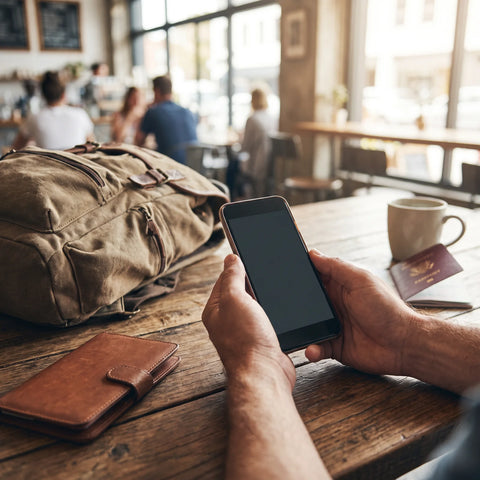
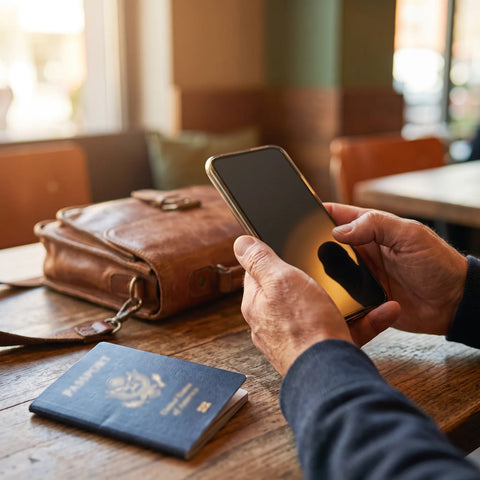
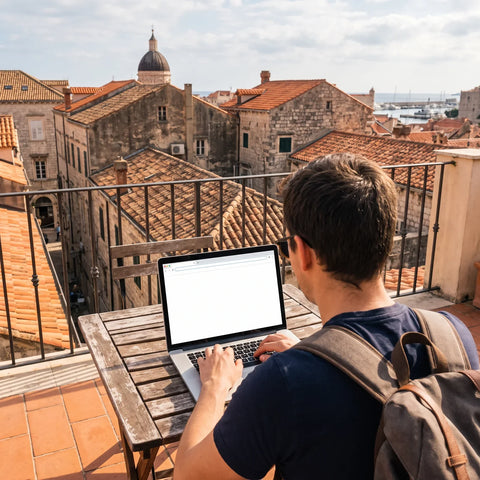
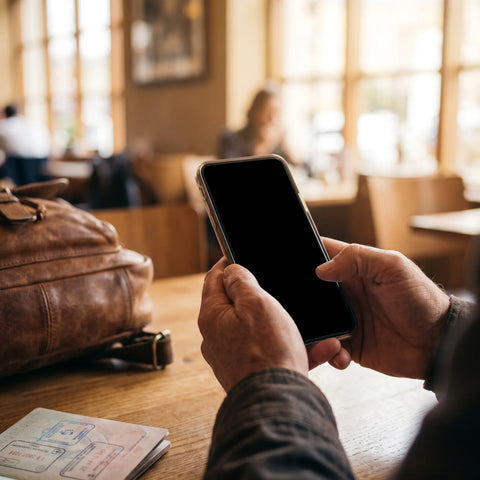
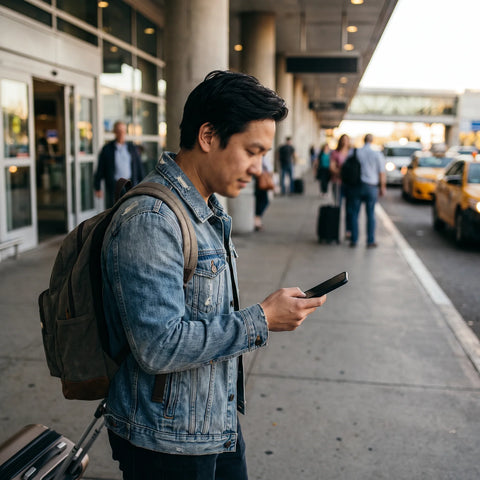
In short: an eSIM for your honeymoon allows you to land with data on both phones from the first minute, without roaming or surprise bills when you return. It’s installed before you leave Spain with a QR code, each of you has your own data line, and you decide when to truly disconnect and when to upload your travel photos.
A honeymoon is the only trip where you want both things at once: to get away from the world and not miss a single photo. That's the beauty of an eSIM for your honeymoon: it's not a physical card you have to search for at the airport or roaming that unexpectedly skyrockets; it's a digital profile you download before the wedding and that waits to be active as soon as the plane touches down.
What exactly is an eSIM (for those who are unclear)
If this is the first time you've heard the term, an eSIM is a SIM card without a physical card: a profile installed by scanning a QR code that coexists with your Spanish line without touching it. There's no need to remove anything from your phone or wait for a mail delivery. We explain it in more detail in what is a virtual eSIM, but for your honeymoon, remember the important part: you buy it from your couch, install it in five minutes with Wi-Fi, and it travels with you without you having to think about it anymore.
Why it makes sense for a honeymoon trip
Because it unites what truly matters on a honeymoon: connection when you want it, silence when you don't. After all the money and nerves it took to organize the wedding, the last thing you need is a roaming bill for several hundred euros waiting for you when you return from the trip of a lifetime. With the eSIM installed before you leave, that risk disappears completely: you pay a fixed price for the data you contract, period.
But there's something less obvious that also matters: by having guaranteed data from the moment you land, you don't depend on the hotel's Wi-Fi to book a last-minute restaurant, call a car, or send your family your location if something goes wrong. In destinations where hotel Wi-Fi is slow or nonexistent, this makes the difference between a minor inconvenience and a truly bad time.

Two phones, two eSIMs: how to organize it without arguing
The formula that causes the least friction as a couple is simple: each person installs their own eSIM on their phone. This way, neither depends on the other for data, you can separate for a while without a problem (one stays reading by the pool, the other goes out to explore the town), and both arrive connected at the meeting point. It also avoids the classic "pass me the internet, it's gone" in the middle of dinner.
If you prefer to save money, one alternative is for one person to have more data and share it via hotspot with the other phone. It works reasonably well at the hotel or on short trips, but it uses up a lot more battery and forces you to stay physically close, which you might not always want on a honeymoon. Before deciding on one option or the other, make sure both phones support eSIM and you know how to install it: the process is detailed step-by-step in how to install an eSIM, and it's best to do it the week before the trip, not the night before with suitcases half-packed.
A truly effective idea: create a shared album on your phone before leaving home and upload both your photos there. With data on both phones, it syncs automatically, without having to pass the phone around or send folders via WhatsApp when you return.
Disconnecting without completely disappearing
Disconnecting doesn't have to mean being incommunicado, and in fact, it's almost never what people truly want on their honeymoon. The beauty of having eSIMs on both phones is that you set the rules, not the operator or the coverage. A balance that works well in practice:
- Truly silence work: disable notifications for work emails and noisy groups on the first day, not halfway through. A "I'm out until day X" message before leaving saves unnecessary messages.
- A daily window, not all day: set aside a specific time, like morning coffee or before bed, to check messages and upload photos. The rest of the time, phone in your pocket.
- Family at ease with little effort: a short message upon arrival at each place prevents them from calling worried late at night, especially if you're going to destinations with a big time difference.
- Selective airplane mode: you can turn off mobile data whenever you want to be alone with each other and reactivate it with a tap whenever you feel like it.
Having a connection, paradoxically, helps you disconnect better: knowing you can communicate at any time, you put your phone aside without the anxiety of "what if something happens and they can't reach me?".

How much data will you actually need?
It primarily depends on how much you upload photos and videos at the moment, not just the number of days. As a rough guide per person and phone:
| Travel Style | Data per person/day | Example in 10 days |
|---|---|---|
| Almost total disconnection (occasional photos, no social media) | Light use | Low consumption |
| Normal use (photos, some social media, maps) | Moderate use | Medium consumption |
| Very connected (daily videos, stories, video calls) | Intensive use | High consumption |
The hotel Wi-Fi will relieve a good part of your consumption, especially if you upload heavy albums at night from your room. A couple's trick that works well: activate photo and video backup only when you're connected to that Wi-Fi, so high-resolution videos don't eat up the data plan you have for moving around during the day. And if one of you tends to make long video calls to family, keep that in mind when choosing data, because live video is, by far, what consumes the most of everything you do with your phone on the trip. To make the most of every gigabyte without falling short, this guide on tricks to save eSIM data on your trip has very specific adjustments (which apps consume in the background, how to limit the upload quality of photos) that make a difference on a long trip.
Honeymoon destinations and which eSIM each one needs
The most suitable eSIM changes depending on the type of honeymoon you've planned, and this is where it's worth being specific instead of giving generic advice. If the plan is a trekking adventure, for example a route combining Cusco with Machu Picchu, coverage on the Inca Trail itself is irregular due to the terrain, so what matters is not how much data you have but having a stable connection in Cusco and Aguas Calientes to manage everything (tickets, trains, reservations) before entering an area without signal; we cover this in detail in the guide to eSIM for Peru and Machu Picchu.
If your honeymoon is more about colonial cities and Caribbean beaches, with Cartagena de Indias as the star stop, coverage in the historic center and the Rosario Islands is generally good, although it's advisable to have active data before moving between neighborhoods because the streets of the old town can be confusing even with a map. We detail this in eSIM for Colombia (Medellín, Bogotá, Cartagena).
For a European honeymoon spanning several countries in two weeks (Italy, Greece, a couple of days in Portugal), it doesn't make sense to buy an eSIM per country: you'll benefit from a single profile that covers the continent, so you won't be changing cards every time you cross a border. That's where the Europe eSIM comes in. And if the destination is the United States, whether it's a road trip along the west coast or a getaway to Hawaii, the United States eSIM keeps you connected from the first immigration queue, which is usually when you most need to consult your rental car reservation.
However, here's the advice almost no one gives you: if your honeymoon includes a short stopover in an EU country (e.g., one night in Lisbon before flying to a long-haul destination), don't buy anything for that part. Your Spanish plan already includes roaming data within the EU at no extra cost, so spending on an eSIM for 18 hours in Portugal is a waste of money. Save your purchase for the actual destination.
eSIM or roaming: which to use for each leg of the journey
The most common question is whether you really need a new eSIM or if your Spanish line's roaming will suffice. The short answer: within the European Union, roaming is already included and nothing else is needed. Outside the EU, Spanish operators' roaming usually skyrockets as soon as you activate data, and that's where the eSIM comes in handy with a fixed and predictable cost. The full comparison, with what's behind each term, is in eSIM vs roaming, and it's advisable to read it before deciding which to use for different parts of your trip.
Myths and what almost no one tells you before your honeymoon
There are a few ideas circulating about eSIMs for honeymoons that should be debunked before you leave:
- "If I buy a lot of data, I don't have to worry about anything." Half true: what usually fails is not running out of data, but not having installed the profile before leaving home. The eSIM needs Wi-Fi to download, so doing it at the origin airport with public Wi-Fi is the best time, don't leave it for when you land.
- "With one of us connected, we're all set." On paper, yes, but in practice, a honeymoon has moments when you'll be separated (a spa, an optional excursion, a last-minute purchase for the other), and that's when having only one phone with data is noticeable. It costs little for each person to have their own.
- "The resort Wi-Fi is enough, I don't need anything else." In many beach resorts, Wi-Fi only reaches the pool area or lobby well, and drops out in the room or on the private beach, which is where you'll want to upload the most photos. Mobile data covers exactly that gap.
- "Since I have the eSIM, I no longer need any physical backup card." For the vast majority of destinations, this is true, but in some specific countries with their own restrictions, it's worth checking beforehand; if you're debating whether to also carry a physical backup chip, find out in advance if that specific destination requires it before ruling it out.
- "The more travel days, the more gigabytes you have to buy proportionally." Not always: you usually consume more on the first and last day (airport photos, hotel photos, messages to family), and less on the days in between if there are plans with less digital social life (a cruise, a long excursion without coverage). Buying "in bulk" by the number of days often leaves unused gigabytes.
Errors that ruin connection (and mood) on your honeymoon
To ensure nothing mars your trip, it's wise to avoid these common mistakes:
- Installing the eSIM upon arrival, without Wi-Fi: The profile needs a connection to download the first time. Do it from home or from the airport Wi-Fi before boarding.
- Leaving your Spanish SIM roaming on: Turn off data for your usual line as soon as you land outside the EU, to avoid a bill shock from a couple of hours of oversight.
- Buying data for the entire trip on the same profile without distributing it: If you're passing through two different areas (e.g., beach and then a city with more map usage), it sometimes works better to distribute consumption rather than spend it all in the first few days.
- Not checking beforehand that both phones support eSIM: Some unlocked models from outside Europe have the feature blocked by the original operator. Check in advance, not the night before traveling.
With these points covered, the technical side disappears, and all that's left is to enjoy. And if something goes wrong anyway, PuraSIM offers 24/7 support in all languages via email and WhatsApp, so someone is always there, no matter your destination or the time of day.
Frequently Asked Questions
Do we each need an eSIM, or is one enough for both of us?
The most convenient option is one per person: each phone has its own data, allowing you to separate during the day without losing communication. If you prefer to save money, one person can share via hotspot with the other, although this uses more battery and requires you to be physically close.
Does the eSIM allow us to truly disconnect from work?
Yes, because you control when you use data, not the other way around. You can mute work emails from day one and activate the connection only during a daily window for messages and photos. Having data available, in fact, helps you disconnect better because it removes the anxiety of being unreachable.
When should we install the eSIM, before or upon arrival at the destination?
Always before leaving home, with Wi-Fi. The profile is downloaded only once and needs a connection to activate; if you leave it for the destination airport or hotel, you depend on that Wi-Fi working well precisely when you are most in a hurry.
How much data will we use uploading photos and videos from the trip?
It depends on whether you upload just occasional photos or daily videos and stories: video is, by far, what consumes the most. Hotel Wi-Fi will relieve a good part of your consumption if you schedule heavy backups for the night, connected to that network.
Do we keep our Spanish number throughout the trip?
Yes. The travel eSIM acts as an additional data line, and you can leave your Spanish SIM active only for calls and SMS (e.g., bank codes) with its data turned off to avoid roaming charges outside the EU. This way, you keep your usual number at no extra cost.
What if our honeymoon involves several different countries?
If the route is within Europe, a single profile covering several countries avoids the hassle of changing eSIMs at each border. If you combine very different continents (for example, a long stopover outside Europe before the final destination), it's usually better to activate the profile for each zone separately, just before entering it.
Do we also need a physical backup chip in case something goes wrong?
For most destinations, it's not necessary: the eSIM is sufficient and avoids the hassle of finding a point of sale in a country you don't know. In some very specific destinations with their own restrictions, it might be advisable to also carry a physical backup option; it's worth checking in advance if your itinerary includes such a country.
Conclusion
A well-connected honeymoon is one that allows you to disconnect at your own pace: two phones with their own data, photos that upload themselves to a shared album, and zero roaming surprises when you get home. Choose one eSIM per person, install it before leaving with Wi-Fi, and adjust the data to the type of trip you've planned, not the number of days on the calendar. With over 200 destinations in the catalog and 24/7 support in all languages via email and WhatsApp, the only plan left for you to improvise is where to have dinner on the first night.