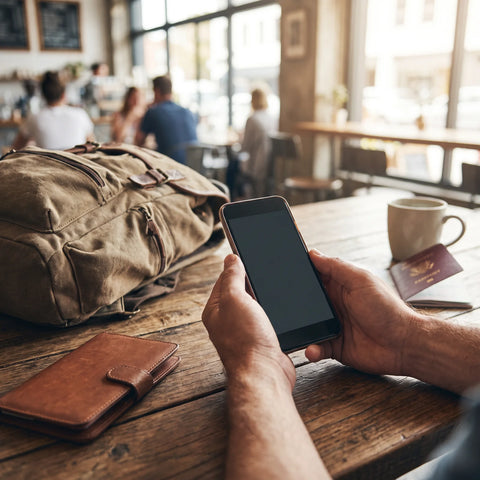
In short: an eSIM for Bali gives you internet the moment you land in Denpasar, with no physical SIM cards or queues: it's installed via QR before you travel, covers all of Indonesia on the Telkomsel, Indosat and XL networks, and avoids the roaming charges that send your bill through the roof outside the EU.
Landing in Bali and being able to call a taxi, open the map toward Ubud or upload your first photo of the rice terraces without relying on hotel Wi-Fi is easier than you think. With a Bali eSIM you have data active the moment you touch down at Denpasar airport, with no hunting for physical SIM card shops or paying extortionate fees. In this guide we walk you through everything you need to know to get connected in Indonesia: which networks work, how many gigs to buy, how to install the QR and what to keep in mind once you're on the island.
Why you need data in Bali and Indonesia
Bali is one of those destinations where being connected is the difference between a smooth trip and one full of friction. The distances between the touristy south and the interior are long, directions are confusing, and many restaurants, villas and excursions are booked online. Without data you're stuck with Wi-Fi, which in cafés and accommodations is usually unreliable.
With your own connection you can call a Grab or Gojek (the local ride-hailing apps), translate menus, convert prices from rupiah to dollars and stay in touch with home. It's also key for safety: sharing your location when you're on mountain roads or crossing to Nusa Penida gives peace of mind. An eSIM removes that moment of landing and being cut off while you hunt for Wi-Fi. Before you leave, it's worth understanding what a virtual eSIM is and how it differs from a physical SIM, because the switch is simpler than it seems.
Coverage and networks: Telkomsel, Indosat and XL
Indonesia has several mobile carriers, and signal quality depends a lot on which one your eSIM connects to. The undisputed leader is Telkomsel, which offers the best coverage in the country, including rural areas, small islands and mountain routes. It's the most reliable network for anyone planning to venture off the usual tourist trail.
Behind it are Indosat Ooredoo and XL Axiata, with a very strong presence in Bali's urban and tourist areas (south of the island, Ubud, Canggu) and often a better price per gig. For a trip focused on the classic spots, they're more than enough. Most travel eSIMs rely on these three networks to give you the best signal available at any given moment.
| Network | Coverage | Best for |
|---|---|---|
| Telkomsel | Excellent, including rural areas and islands | Long routes, Nusa Penida, inland areas |
| Indosat | Very good in cities and south Bali | Standard tourist trip |
| XL Axiata | Good in urban and tourist areas | Stays in the south and budget-friendly pricing |
PuraSIM eSIMs cover Indonesia with 4G/5G on the main networks, so you get speed for maps, video and video calls in the places you'll actually be.

How many GB you need based on your trip
Getting the right amount of data saves you from overpaying or running out mid-trip. Usage depends on your style: if you mostly use your phone for maps, messaging, and the occasional photo, you'll use little; if you stream, upload lots of videos, or work remotely from a café in Canggu, you'll need quite a bit more.
As a reference for Bali, moderate usage is around 1 to 1.5 GB per day. These are approximate ranges based on trip length:
- Short trip of 5–7 days: 5 to 10 GB is usually enough for normal tourist use.
- Trip of 10–14 days: 10 to 20 GB for maps, social media, and frequent video calls.
- Long stay or digital nomad: 30 GB or more, or high‑data plans depending on weeks.
If in doubt, always round up: the Wi‑Fi at your accommodation will help stretch the gigs, but running out of data on the road is worse. To make the most of every gig without falling short, check out our guide on tips to save data on your trips with eSIM, with specific advice for maps, video, and messaging.
Tip: download the offline maps of Bali in Google Maps before leaving your hotel. It greatly reduces data usage and you still have navigation even if the signal is weak in jungle areas.
How to activate your eSIM with QR step by step
Activating an eSIM is quick and requires no technical knowledge. Ideally do it at home, on Wi‑Fi, before traveling, leaving data activation for when you land in Denpasar. First check that your phone is eSIM compatible (most iPhones from the XS onward and recent Android phones are).
The process with PuraSIM is as follows:
- 1. Buy your plan for Indonesia and receive the QR code by email within minutes.
- 2. On your phone, go to Settings > Mobile Data > Add eSIM (or Add Data Plan).
- 3. Scan the QR with the camera and confirm the profile installation.
- 4. Label the line (e.g. "Bali Trip") and leave your main line for calls.
- 5. When you arrive in Bali, activate the eSIM data and turn off roaming on your home line to avoid surprises.
The QR installs in 1 minute and the connection starts automatically when it detects an Indonesian network. If you want to better understand the difference with traditional carrier plans, our comparison of physical international SIM vs eSIM may help, especially useful if your route includes several Southeast Asian countries.
Coverage by area: Ubud, Seminyak, Canggu, and more
Bali's visitors are concentrated in very different areas, and it's good to know what to expect from coverage in each. In the tourist south the signal is excellent almost always, so you'll have no issues at the most popular spots.
- Seminyak and Canggu: beaches, beach clubs, and cafés for digital nomads. Very solid 4G/5G coverage; ideal for remote work.
- Ubud: the cultural heart, among rice paddies and jungle. Good signal in the center; in remote villas it may drop, where Telkomsel performs better.
- Uluwatu: cliffs, surf, and the famous temple. Decent coverage, with some weak spots in hidden coves.
- Nusa Penida: island with spectacular landscapes like Kelingking Beach. Signal is more irregular: take downloaded maps and, if possible, a strong network.
- Temples (Tanah Lot, Besakih, Lempuyang): usually have enough coverage to book tickets and share photos.
If your plan includes islands and jungle areas, prioritize a connection with good rural network. If your route continues to Oceania, take a look at our guide to eSIM for Australia and New Zealand, very handy for those combining Bali with the next leg of their trip.
Practical tips: visa, rupiah, scooter, and health
Beyond connectivity, there are details worth knowing before you set foot in Indonesia. Your eSIM will help you handle almost all of them from the first minute.
- Visa on arrival: travelers from Spain can get a tourist visa on arrival (Visa on Arrival), usually valid for 30 days and extendable. Always check the official requirements and passport validity before you leave.
- Currency: the Indonesian rupiah (IDR). Carry cash for markets and warungs, and having data lets you convert prices instantly so you don't get lost in all those zeros.
- Scooter: the most popular way to get around. You need an international driving permit and a helmet; use your phone's GPS with data and drive carefully — traffic is chaotic.
- Health: drink bottled water, watch out for ice in unreliable places, and bring travel insurance. With data you can find 24h clinics and pharmacies if anything comes up.
Having internet from the moment you land makes these formalities trivial: you book the visa online, order your ride, and find the ATM without stress.
Prices: traditional roaming vs eSIM
This is where an eSIM really shines. Data roaming outside the European Union with most Spanish carriers can skyrocket to several euros per megabyte or per day, which on a trip to Bali easily turns into three-digit bills. Before traveling, it's worth understanding what data roaming is and why it gets so expensive outside Europe.
With an eSIM you pay a fixed, known price for your gigabytes — no surprises on your bill. PuraSIM plans start from 1.49 $, cover 200+ destinations, work without roaming, include hotspot to share data with your partner or laptop, and offer support in English 24/7.
| Option | Approximate cost | Bill risk |
|---|---|---|
| Roaming from your carrier outside the EU | Very high per day/MB | High, no control |
| Local physical SIM in Bali | Cheap, but you have to buy it on the spot | Low, with hassle and time |
| PuraSIM eSIM | From 1.49 $, fixed price | None, you pay upfront |
The difference is clear: a local SIM is cheap but means queuing with your passport, while an eSIM connects you before you leave the airport with no paperwork. The savings compared to roaming can be hundreds of euros on a two-week trip.
Myths and common mistakes with eSIM in Bali
There are some ideas floating around about eSIMs in Indonesia that are worth clearing up before they complicate your trip.
- "If I buy one for Indonesia it only works in Bali": false. Data plans cover the whole country, so if you hop to Java, Lombok, or take a boat to Nusa Penida, the eSIM keeps working on the same networks without having to buy anything new.
- "It's cheaper to buy a physical SIM from a vendor at the airport": at the exit of the arrivals terminal at Ngurah Rai airport, there are stalls selling local SIMs at prices well above what that same card costs at a Telkomsel store in the city. Compare before accepting the first offer; to see the real cost difference versus roaming from your carrier, it's worth looking at the numbers calmly and not with your luggage in hand.
- "With the eSIM I'll receive my bank's SMS just like with my regular line": not necessarily. Most travel eSIMs are data-only, with no dedicated number for SMS or calls. If your bank sends codes by SMS, leave your home line active (even without data) so you can receive them, and use the eSIM only for internet.
- "The Wi-Fi at my villa in Ubud or my hotel will be enough": in villas among rice paddies and in areas like Sidemen or Munduk, Wi-Fi cuts out during tropical storms — frequent and sudden in the rainy season. Having your own data means you won't be left without connection just when you need it most, for example to order a Gojek back under a downpour.
And here's the honest part: if your plan is a three-day getaway to an all-inclusive resort in Nusa Dua, with decent Wi-Fi in the room and no plans to move around much, you don't need to spend on a large eSIM; a small plan for the essentials (maps and WhatsApp) will be plenty. Save the big gigs for trips where you'll really be moving around, hopping between cafés without Wi-Fi, or working from the street. The installation, by the way, is the part you should worry about least: if you've never done it, the step-by-step is in how to install an eSIM, and it takes about as long as the plane takes to reach the boarding gate.
Frequently Asked Questions
Does the eSIM work as soon as I land in Bali?
Yes. If you install the profile before you travel and activate data when you arrive, the eSIM automatically connects to the Indonesian network as soon as it picks up a signal at Denpasar airport.
Will I keep my WhatsApp number with the eSIM?
Yes. The eSIM only provides data; your number and messaging apps keep working normally over that connection without changing your main line.
How many GB should I buy for a week in Bali?
For typical tourist use over 5 to 7 days, 5 to 10 GB is usually enough. If you stream a lot or work remotely, go up to 15-20 GB or more.
Is the eSIM better than buying a local SIM on arrival?
The eSIM connects you before you leave home with no queues or paperwork. A local SIM can be slightly cheaper per gigabyte, but it requires registering your passport at a store when you land.
Does coverage reach Nusa Penida and rural areas?
Signal is more patchy in rural areas and small islands. Telkomsel is the network with the best reach; download offline maps for those stretches just in case.
Is my phone compatible with eSIM?
Most iPhones from the XS onward and recent Android phones (mid-to-high range) support eSIM. Check in your settings or on the manufacturer's website before buying the plan.
Does the Indonesia eSIM work for tourists only visiting Bali?
Yes. Even if you search for it as an "Indonesia eSIM for tourists," the plan is the same: it covers the whole country on the Telkomsel, Indosat, and XL networks, so it works just as well if your trip is only to Bali or if you add other islands.
Conclusion
Traveling to Bali with an eSIM means landing connected, ordering your ride instantly, and forgetting about surprise roaming bills. We've seen why data is essential in Indonesia, which networks offer the best coverage (with Telkomsel leading the way), how many gigabytes to buy, how to install the QR code in a minute, and how to save compared to roaming. With PuraSIM you get 200+ destinations, plans from $1.49, activation in 1 minute, and support in English 24/7. Choose your eSIM for Indonesia for Bali and prepare your trip with everything under control. For planning excursions and official procedures, also check the official Indonesia tourism site.