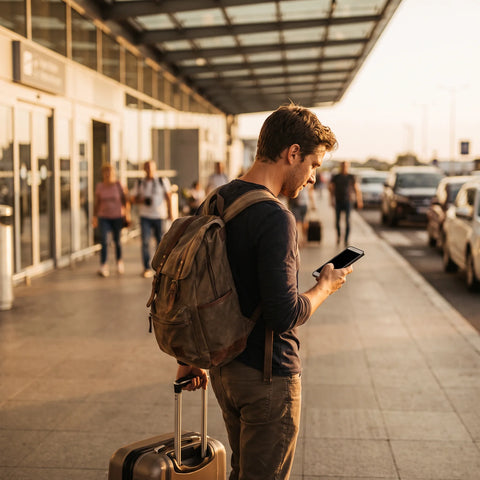
Before landing in Denpasar, the question is always the same: how to get internet in Indonesia from the very first minute, especially if you're going to Bali. You need it to order a Grab at the airport, open Google Maps among rice paddies, or show your accommodation QR code. The country is better connected than you might think—there's 4G in practically all of Bali and 5G in Jakarta and the south of the island—but the ways to connect don't cost or work the same. Here I compare the five real options—roaming, Wi-Fi, pocket Wi-Fi, local SIM card, and eSIM—so you can choose wisely and without surprises.
Internet in Indonesia and Bali: the quick answer
In Indonesia, you have five ways to connect: roaming (the most expensive), hotel Wi-Fi (limited), pocket Wi-Fi (an extra device), a local SIM card from Telkomsel, XL or Indosat (very cheap, but requires passport registration), and eSIM (the fastest and simplest). For a tourist trip to Bali, the eSIM wins.
It's good to have the general picture from the start. Indonesia is a country of over 270 million inhabitants with three major operators—Telkomsel, XLSMART (a merger of XL Axiata and Smartfren), and Indosat/IM3—and a mobile network that reaches anywhere there's tourism. In Bali, that means solid 4G across the entire southern strip, in Ubud, and on the most visited beaches. The problem isn't coverage: it's choosing the wrong entry point. Many people land with roaming turned on "just to check the map" and that oversight ends up costing more than a week's dinners. Others join the queue at Ngurah Rai and pay three times the street price for a SIM. The difference between options lies in price and paperwork, not signal strength.
Roaming from Spain: convenient but expensive
Roaming means doing nothing: you turn on your phone when you land in Bali and your Spanish operator connects you via the Telkomsel or Indosat network. It's the most convenient thing in the world, and that's why it's the favorite trap for the unwary traveler: Indonesia is outside the European Union, so the "Roaming like home" tariff doesn't apply, and expensive daily packages return.
Estimated figures from major Spanish operators:
- Daily bundles from €7 to €12 per day with limited data (500 MB - 1 GB) and extras at exorbitant prices.
- Without a contracted bundle, rates exceeding €3-6 per MB. A three-minute video in the taxi and you're already in triple-digit figures.
- Some operators don't even include Indonesia in their "world" packages.
Do the math: two weeks in Bali with a €9 daily bundle is €126 for a few gigabytes. With a local alternative, you'll have plenty of data for a fifth of that. I break down the numbers in how much international roaming costs and in eSIM vs. roaming. If you're staying more than two or three days, disable data roaming before you take off and have another connection method ready.
Hotel, café, and beach club Wi-Fi
Bali is the digital nomad capital of the world, so Wi-Fi is everywhere: hotels, villas, warungs, Canggu cafés, Ubud co-working spaces, and Seminyak beach clubs. Almost all provide it for free, and in many places, it works really well. As a complement, it's excellent: for uploading photos, making long video calls, or working for a bit, use Wi-Fi and save data.
The problem is relying solely on it. The real drawbacks:
- There's no Wi-Fi on the street, and in Bali, you spend your day outdoors: on a scooter, in a taxi, at a temple, waiting for the boat to Nusa Penida. Exactly when you need the map most.
- Grab and Gojek—essential for getting around—require data at the moment of ordering the vehicle and during the journey.
- Power outages are common in Uluwatu or the Gilis, and with them, the router goes out.
- The Wi-Fi in a beach club with 300 people inside runs at its own speed: slow.
- These are open networks: never enter bank details without a VPN.
Wi-Fi is a good ally, but it's not a connection plan. Treat it as an extra, not your primary network, and always have your own mobile data for the rest of the day.
Pocket Wi-Fi: the portable router
Pocket Wi-Fi is a 4G router with a battery and an Indonesian SIM inside, which creates your own Wi-Fi network for multiple devices. It's rented by the day (in Bali, they'll bring it to your hotel or deliver it to the airport) and usually costs €4-8 per day, with a deposit and sometimes insurance for loss.
It has an honest use case: groups or families. If four of you are traveling and always together, a shared router can be cheaper than four individual plans. It also works if your phone is old or if you need to connect a laptop and tablet at the same time.
Now for the drawbacks, which are significant in Indonesia:
- It's one more device to charge: the battery lasts between 6 and 10 hours, and on a trip to Ubud, it will run out by mid-afternoon.
- If the group splits up—and in Bali, you will separate: one to surf, another for a massage—only one person will have internet.
- You have to pick it up and return it, with specific times, deposits, and the risk of losing or getting it wet.
I compare it in depth in eSIM vs. pocket Wi-Fi. For a solo traveler or a couple, it's almost never worth it: you pay more and carry around an unnecessary gadget.
Local Indonesian SIM: Telkomsel, XL, and Indosat
The local SIM card is the cheapest option on the market, and that needs to be stated clearly. The big three:
- Telkomsel (simPATI/By.U): the most extensive and reliable network, the only one that holds up on islands and in rural areas. Used by almost everyone in Bali.
- XLSMART (XL Axiata + Smartfren): aggressive pricing and huge bundles; good in cities and southern Bali.
- Indosat / IM3: good balance of price-coverage, widely used in Java and Jakarta.
At an official store or Indomaret, a 30 GB package for €6-8 is normal, and there are 80-100 GB bundles for just over €12. Prices are out of this world compared to roaming.
The trick is where you buy it. At Ngurah Rai (Denpasar), there are counters offering the same card for €15-25: pure resale, taking advantage of the fact that you've just landed and don't have rupiah. And in high season, the queue is long.
Golden rule in Bali: a local SIM is cheap at the official Telkomsel store in town, not at the airport counter. If they sell it to you after customs, you're almost certainly paying double or triple.
And then there's the paperwork, which here is no minor procedure. We'll look at it in the next section.
The fine print: passport, KTP, and IMEI registration
Indonesia requires every prepaid SIM card to be registered: it must be linked to an identity. Indonesians do this with their KTP (national ID) and family number; foreigners, with their passport, which the seller enters into the operator's system. That's why you shouldn't buy loose SIMs at street stalls without registration: either they won't work, or they'll be registered with someone else's KTP.
There are two more details that surprise many people:
- Card limit: the same document can only register about three lines per operator.
- IMEI registration: Indonesia blocks foreign mobile phones not registered on its networks. As a tourist, operators grant access for a maximum of 90 days when you buy a tourist SIM; if you stay longer, you must register the IMEI at customs—an airport procedure that, for phones worth more than USD 500, can incur taxes close to 40% of the declared value.
For two weeks, none of this is a big deal, but it does mean time, paperwork, and a patchy English conversation with the seller. It's exactly the kind of friction you don't want on your first day of vacation.
eSIM: the option I recommend
An eSIM is a virtual card: the chip is already soldered inside your mobile, and you just need to download a data profile. If you have an iPhone XS or later, a Galaxy S20 or later, a Pixel 3 or later—or almost any recent mid-to-high-end phone—your device already supports it. I explain it in what an eSIM is.
Applied to Indonesia, this is what changes:
- You buy it from home, in English, without relying on a counter or being understood.
- No passport or KTP registration at the destination: the profile comes pre-activated.
- Connects to local networks (Telkomsel and Indosat), so you have the same coverage as an Indonesian.
- You keep your Spanish number with Dual SIM: WhatsApp, bank SMS, and calls still come through while data uses the Indonesian plan.
- You land and it works. No queues at Ngurah Rai and no changing tiny chips on top of your luggage.
The downside? It costs a bit more than a local bundle bought in a village shop. In return, you save the paperwork, the airport resale, and the risk of running out of data on the first day. That peace of mind is worth much more than the difference. For details, see the eSIM guide for Indonesia.
Comparison of all options
Here are all the options, with estimated prices for a typical two-week trip to Bali. These are approximate market figures, not specific offers: they serve to show the order of magnitude, which is what matters.
| Option | Estimated Cost (14 days) | Advantage | Disadvantage |
|---|---|---|---|
| Spanish Roaming | €100-170 (daily bundles) | No action required | Very expensive and limited data |
| Hotel / cafe Wi-Fi | €0 | Free and fast at accommodation | No connection on the street |
| Pocket Wi-Fi | €60-110 + deposit | Multiple devices simultaneously | Battery, pick-up and return |
| Local SIM (store) | €8-15 | Cheapest on the market | Passport, registration, IMEI, physical store |
| Local SIM (airport) | €15-30 | Available upon arrival | Resale, queues, inflated price |
| Travel eSIM | €10-30 depending on GB | Install from home, works upon landing | Requires compatible mobile |
What stands out: roaming is between five and ten times more expensive than any local alternative, and pocket Wi-Fi only pays off when shared among several people. The real battle is between the local card and the eSIM. And what decides there isn't the price—both are cheap—but how much you value your time upon arrival.
Coverage: Bali, Jakarta, Lombok, Gili, and remote areas
The signal is better than many expect, but uneven. The actual map, area by area:
- South Bali (Kuta, Seminyak, Canggu, Jimbaran, Nusa Dua): excellent 4G with all three operators and Telkomsel 5G in Denpasar, the airport, and parts of Canggu and Seminyak. Canggu is the nomadic capital of Asia, and it shows.
- Ubud: reliable in the center, Monkey Forest, and main roads. Weakens on the Campuhan Ridge Walk, in the Tegallalang rice paddies, and at secluded temples. Here it's 4G, don't expect 5G.
- Uluwatu: good in the town and beach clubs; patchy in coves and cliffs.
- Jakarta and Java: the best network in the country, with 5G in much of the capital.
- Nusa Penida and Lembongan: 4G in tourist spots and dead zones on the western cliffs. Telkomsel dominates.
- Gili and Lombok: 4G in Gili T and in Senggigi/Kuta Lombok. In the late afternoon/evening, when the boats arrive, the network gets saturated.
- Flores, Komodo, Raja Ampat, interior of Sumatra: here there are real gaps. Only Telkomsel reaches many places, and on boats, there's no signal for hours.
If you go off the beaten track, choose an option that relies on Telkomsel and download offline maps. Coverage is good, but it's not infallible outside the south.
How much data do you really need
The million-dollar question. People tend to overbuy gigabytes out of fear, and in Bali with Wi-Fi at the accommodation, actual consumption is modest. Here are the approximate consumption figures per hour of mobile use:
| Activity | Approximate Consumption | Typical Use in Bali |
|---|---|---|
| Google Maps / navigation | ~5 MB/hour | Riding a scooter to Uluwatu: almost none |
| WhatsApp (text and voice) | ~10-20 MB/hour | Connected all day: irrelevant |
| Grab / Gojek | ~10 MB/trip | 4 trips a day: 40 MB |
| Instagram / TikTok | ~500-800 MB/hour | This is where your data really goes |
| Video streaming (HD) | ~1.5-3 GB/hour | Save it for hotel Wi-Fi |
| Video call | ~500 MB/hour | Better from accommodation |
| Upload 20 photos to the cloud | ~100 MB | Disable automatic upload |
With those numbers, my recommendation for Bali: 5 GB for a week of normal use (maps, messaging, some social media) and 10-12 GB for two weeks. If you watch reels by the pool or plan to work from the island, jump to 20 GB or more. And a tip that saves half: disable automatic photo backup with mobile data. That's where 80% of most travelers' gigabytes evaporate.
Local card vs. eSIM: which to choose
Final showdown. Both options are good and cheap; what changes is the value of your time.
| Criterion | Local Indonesian SIM | Travel eSIM |
|---|---|---|
| Price (14 days) | €8-15 in store; up to €30 at the airport | €10-30 depending on GB |
| Purchase | Upon arrival, in a physical store, with a queue | From home, in 5 minutes |
| Registration | Mandatory with passport + IMEI | None |
| Your Spanish number | Lost if your phone is single-slot | Remains active with Dual SIM |
| Coverage | Direct local network (Telkomsel, XL, IM3) | The same local networks |
| Transaction Language | Indonesian / basic English | Spanish |
| Top up more data | Go to another store or deal with an app | From your phone, instantly |
My summary: if you're traveling in Indonesia for more than a month and don't mind the paperwork, a local card is more cost-effective and you'll have a useful Indonesian number. For the typical 10-20 day trip to Bali, an eSIM is the most logical option: you save the queue, registration, and airport resale, and still pay a fraction of what roaming would cost. The full analysis, in eSIM vs. local SIM, with all the nuances case by case.
Frequently asked questions
Does the internet work as soon as I land in Bali?
Yes. With an eSIM installed from home, you activate data when you land at Ngurah Rai and connect without leaving the terminal. With a local SIM, you'll have to queue, register your passport, and wait 10-20 minutes.
Do I need a passport to buy a SIM in Indonesia?
Yes. Indonesia requires all prepaid cards to be registered: locals use their KTP and foreigners use their passport, which the vendor enters into the operator's system. With a travel eSIM, you skip this step: the profile is already activated.
What is IMEI registration and does it affect me as a tourist?
Indonesia blocks unregistered foreign phones from its networks. When buying a tourist SIM, operators grant access for a maximum of 90 days. If you stay longer, you have to register the IMEI at customs, with taxes if the phone is worth more than $500 USD.
How much coverage is there in Gili Islands and Nusa Penida?
There's 4G in the tourist areas of both, with Telkomsel being the most reliable network. In Gili Islands, it gets saturated in the late afternoon/evening when the boats arrive. In Nusa Penida, there are dead zones on the western cliffs.
How many GB do I need for two weeks in Bali?
Between 10 and 12 GB is enough for normal use: maps, WhatsApp, Grab, social media, and some photos, relying on your accommodation's Wi-Fi. If you watch a lot of videos, go up to 20 GB and disable automatic photo uploads.
Is the SIM at Denpasar airport expensive?
Quite. At Ngurah Rai counters, you pay €15-€30 for packages that cost €8-€12 at a Telkomsel store or an Indomaret. It's reselling, taking advantage of the fact that you've just landed and don't have rupiahs.
Can I keep my Spanish number while using the internet in Indonesia?
Yes. With an eSIM and Dual SIM, your Spanish line remains active for calls, bank SMS, and WhatsApp, while data goes through the Indonesian plan. With a single-slot physical card, you'll have to remove your Spanish SIM.
Can I use data in Lombok, Java, or Komodo with the same plan?
Yes. Indonesian plans cover the entire country, not just Bali: Jakarta, Java, Lombok, Gili Islands, Flores, or Komodo are all within the same coverage. However, in remote areas and on boats, there may be no signal from any operator.
Conclusion
Getting internet in Indonesia is easy and cheap if you sort it out before leaving home. Hotel Wi-Fi is a supplement, not a plan; roaming only pays off for a single day; pocket Wi-Fi makes sense for a group; and a local SIM is unbeatable in price, as long as you accept the queue, passport registration, and the IMEI issue. For those landing in Bali with two weeks ahead, my bet is clear: install the eSIM from home, keep your number with Dual SIM, and leave the airport ordering a Grab from your phone, without queues or reselling. Once you've decided, check plans and days on the Indonesia eSIM and get your trip ready in five minutes.