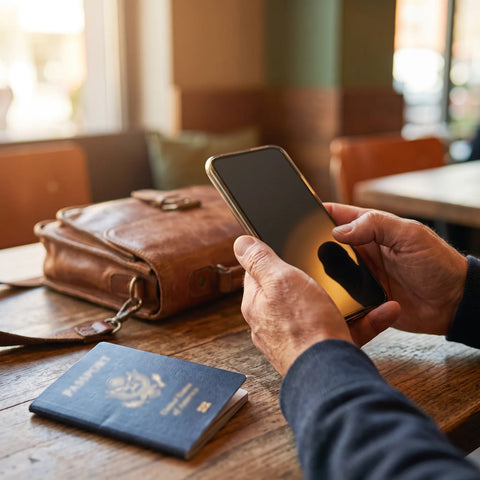
In short: an eSIM for Beijing connects you as soon as you land at the airport, without passport registration or queues at a store. If the carrier routes traffic outside of China, you also regain access to Google Maps, Gmail, and WhatsApp. There isn't a Beijing-only plan; you purchase an eSIM for all of China, with 3-5 GB for a weekend getaway and a VPN installed before you fly.
Is an eSIM for Beijing worth it?
Beijing is a city to get lost in on purpose, but not to lose your connection. Between the Forbidden City, the hutongs, and a trip to the Great Wall, you'll need your phone to translate, navigate, and order a taxi. A traveler-ready eSIM for Beijing gives you data as soon as you land and, if chosen well, keeps your usual apps safe from the Great Firewall.
A travel eSIM connects to the Chinese network as soon as you land at Beijing Capital (PEK) or Daxing (PKX) airport, without passport registration or store queues. You buy online, scan the QR code, and arrive with internet ready. If you've never installed one, the complete step-by-step guide is available at how to install an eSIM, and it's best to do it at home, with Wi-Fi, before heading to the airport.
The alternative is unpleasant: paying your Spanish carrier's roaming fees, which skyrocket as soon as you leave the European Union, or struggling with a local Chinese SIM that requires in-person passport registration and, on top of that, suffers the same blocks as the rest of the country. If you want to understand why traditional roaming is so expensive outside of Europe, we break it down in what is data roaming, comparing both options head-to-head. All you need is a mobile phone compatible with eSIM, which is common in any iPhone or Android from recent years.

Coverage in the city and on the Great Wall
Within Beijing, coverage is excellent: stable 4G and 5G in the Forbidden City, Tiananmen Square, the Temple of Heaven, the hutongs of Nanluoguxiang, and the entire subway system, which is extensive and will be your best friend for getting around such a sprawling city. You'll primarily rely on data for the camera translator—menus rarely have English, even in tourist areas—and for taxi apps like Didi, which works better in Beijing than trying to hail a cab on the street.
The classic question is about the Great Wall. In the most visited tourist sections, such as Mutianyu or Badaling, there is decent mobile coverage because they are set up for tourism and receive buses all day. In more wild and isolated sections, such as Jiankou, the signal drops as soon as you move away from the parking lot, and it's advisable to have the route downloaded beforehand. A good data plan covers your bus or car journey from the city center, photos, and sharing your location with the group if you separate for a while on the wall.
If your trip connects several Asian regions—perhaps you're heading to Seoul or Busan after China—take a look at our guide to eSIM for South Korea before deciding how many plans to purchase, because combining them might be better.
Traveler's tip: Download the Beijing map on Google Maps while you have Wi-Fi at your hotel. Outside, with the Great Wall in the background and no coverage, you'll be grateful to be able to follow the route without using data or relying on a signal that doesn't reach.
The Great Firewall and VPN
Beijing is the capital, but it doesn't escape censorship. The Great Firewall blocks Google, YouTube, Instagram, Facebook, WhatsApp, and many services you take for granted on any other trip. This is the point where your connection choice determines your entire trip: with the wrong SIM, you'll be unable to notify home or check the map.
A travel eSIM whose traffic routes outside the country restores access to these apps, because technically you browse as if you were connected from another location. Even so, the golden recommendation is clear: install and activate a VPN before landing, because downloading it once inside China is almost impossible—app stores are also filtered. With an eSIM plus VPN, you'll have Maps, online banking, and messaging working without relying on luck. In eSIM, VPN, and travel privacy, we explain how to combine both layers without them interfering with each other or draining your battery by mid-afternoon.
To avoid being out of touch with home in the meantime, also review how to make WhatsApp operational from Spain before leaving and test it with mobile data, not just hotel Wi-Fi, to ensure that the eSIM plus VPN combination really works.

GBs depending on your trip length
Data consumption in Beijing is typical for a big city: maps, translator, social media, and an occasional video to send home. For a short trip, you don't need a huge plan, but you do need enough margin so you're not rationing data precisely when you need it most, like in the security line at the Forbidden City. The quick answer: between 3 and 5 GB for a long weekend covers most travelers.
| Travel plan | Days | Recommended GB | Typical use |
|---|---|---|---|
| Express getaway (maps and chat) | 2-3 days | 3 GB | Maps, Didi, menu translator |
| Complete city break with Wall visit | 4-5 days | 5 GB | Adds photos, social media, and short video calls |
| Long stay or remote work | 1 week or more | 10 GB or unlimited | Work email, constant VPN, occasional streaming |
Trick: download music, podcasts, and episodes at the hotel for the long bus ride to the Wall and save mobile data for the day's essentials. If you want to fine-tune the amount based on usage type instead of guessing, in how to save data with an eSIM while traveling, we explain it with specific tricks, such as disabling automatic app updates and lowering the resolution of uploaded photos.
Beijing eSIM or all of China
There is no "Beijing-only eSIM": for mobile network purposes, China is a single country, so you purchase a China plan that covers the capital and any other city equally. Searching for Beijing is fine for finding the information you need, but the product you contract is always for all of China.
What you do decide is how much of a plan to buy. If you only visit Beijing, a few GBs and a few days will be more than enough. If your trip links Beijing, Shanghai, and perhaps Xi'an, choose a more generous plan in terms of GBs or days of validity. To see it all together, the eSIM for China is the canonical option that covers the entire mainland. If your route includes Hong Kong or Macau, keep in mind that these are technically different networks and you might want to contract them separately. And if you extend your trip to Japan or South Korea, the eSIM for China, Japan, and South Korea saves you from buying three separate plans.
When you DON'T need an eSIM in Beijing
It must be stated with the same clarity as the recommendation to buy: if your layover in Beijing is only a few hours and you don't leave the airport's international zone, you don't need anything; airport Wi-Fi is usually enough to check emails or be notified of a delay. It also won't benefit you if you're going to be in an international chain hotel with reliable Wi-Fi the whole time and your plan doesn't include trips out into the city, although this is unrealistic on a trip to Beijing because the fun is in going out.
And if your Spanish operator already includes reasonable roaming in China within your tariff—something uncommon but not impossible in some business or long-term plans—compare before buying anything: you might already have the problem solved without spending an extra euro. Outside of these specific cases, for the normal traveler who wants to move around, translate, and not depend on hotel Wi-Fi, an eSIM is the option with the least friction.
Myths and what almost no one tells you
More myths circulate about China than almost any other destination, and some of them can ruin your first day if you believe them blindly.
- "With eSIM, you don't need a VPN": partly false. Many travel eSIMs route traffic well and you can usually use Google or WhatsApp without a VPN, but it's not an absolute or permanent guarantee: blocking policies change, so keep a VPN installed as a safety net, not a last-minute option.
- "Hotel Wi-Fi is more reliable than eSIM": in Beijing, the opposite is true. Many hotels, even international chains, apply their own content filtering over the building's Wi-Fi. Your mobile data via eSIM often gives you more leeway than reception Wi-Fi.
- "Everyone in Beijing speaks some English": in tourist areas, you'll find bilingual signs, but in a neighborhood restaurant or when talking to a taxi driver outside of apps, a camera translator is no longer a luxury and becomes the tool that saves dinner.
- "With unlimited data, I no longer need to download anything offline": in Jiankou or in some deeper subway sections, the signal simply doesn't reach, no matter what plan you have. The offline map isn't a Plan B; it's part of Plan A for any excursion outside the city center.
- "If the eSIM works in the hotel, it will work throughout the city": coverage inside large buildings and deep subways can vary compared to the street. Don't take it for granted just before descending to a platform without having already saved the route you need.
Mistakes that ruin your connection
Many problems in Beijing are not about coverage, but about configuration or not preparing in advance. Avoiding these failures saves you the unpleasant experience of landing without internet in a country where you can't improvise as easily as in Europe.
- Forgetting the VPN: install and test it in Spain; you won't be able to download it once inside China.
- Installing the eSIM without Wi-Fi upon arrival: do it calmly at home and leave only data roaming ready to activate upon landing.
- Accidentally turning on roaming for your Spanish SIM and getting a roaming bill that ruins the trip before it even starts.
- Not checking phone compatibility before buying the plan; not all models, especially those imported outside the EU, have an active eSIM.
- Trusting that "I'll figure it out there" with the VPN or any messaging app: there, without access to filtered app stores, it's already too late.
If Beijing is just the start of a longer trip across the continent, also check our eSIM guide for Australia and New Zealand if that's your next stop, and make sure before buying that the plan and coverage you choose are still up-to-date, as these details change quite frequently.
Frequently asked questions
Can I use Google and WhatsApp in Beijing with an eSIM?
Yes, if your travel eSIM routes data outside of China. When browsing as international roaming, apps like Google Maps, Gmail, or WhatsApp usually work without the Great Firewall's blocking. As a backup, have a VPN installed and activated from Spain, in case the coverage of these apps falters at any point.
Is there coverage on the Great Wall?
In tourist sections like Mutianyu or Badaling, there's usually acceptable mobile signal because they receive constant tourist traffic. In isolated sections like Jiankou, coverage drops as soon as you move away from the parking lot, so download the offline map at your hotel before heading out. For the bus journey and photos, a good data plan will cover you amply.
Do I need to register my passport for the eSIM?
No. The local Chinese SIM requires in-person passport registration at a store, but a travel eSIM is activated online without any paperwork. You buy the plan, receive the QR code by email, scan it, and arrive in Beijing with internet ready, no queues or paperwork.
How much data do I use on a weekend getaway to Beijing?
With maps, menu translator, some social media, and messaging, a weekend in Beijing can be managed with 3 to 5 GB. If you share data with companions or upload many high-quality videos and photos, it's better to go directly for a 10 GB or unlimited plan for peace of mind while traveling.
Does the Beijing eSIM also work for Shanghai or Xi'an?
Yes. You don't buy an eSIM per city, but for all of China, and that covers Beijing, Shanghai, Xi'an, and the rest of the country with the same network. Just make sure to contract enough GB and days for your entire trip, especially if you add several cities to your itinerary.
Do I need a separate VPN or does the eSIM already include it?
The eSIM and VPN serve different functions. The eSIM gives you data connection; the VPN is the extra layer that reinforces access to apps blocked by the Great Firewall. Treat them as two separate steps in your preparation, not as if one replaces the other, and install both before leaving Spain.
What happens if my eSIM stops working in the middle of my trip?
First, check that data roaming for the eSIM line is activated in your phone's settings, which is usually the simplest fault to fix. If the problem persists, restart your phone and verify that you don't also have your Spanish SIM with roaming turned on competing for the connection, because sometimes the phone prioritizes the wrong network.
Conclusion
Beijing calls for a phone that works without surprises: to translate menus, follow the route to the Wall, and contact home without relying on sporadic Wi-Fi. The recipe is simple: eSIM installed at home, VPN activated before landing, and GBs adjusted to your actual days on the street, not a generic calculation. Get your eSIM for China ready before you fly and let the only unexpected things on your trip be the good ones.