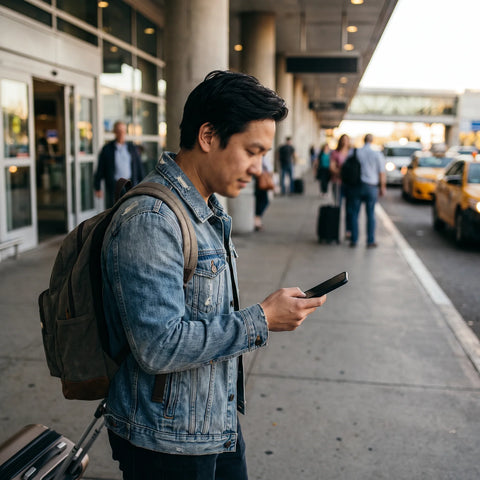
In short: to use WhatsApp for free abroad with an eSIM, you only need active mobile data: install the eSIM before you leave, activate it upon landing, and WhatsApp will work just like at home, with your same number, without roaming, and without relying on hotel or airport Wi-Fi.
The question almost everyone asks before a trip is simple: will I be able to text and call on WhatsApp without being hit with a 15-euro-a-day roaming charge? The short answer is yes, as long as you have mobile data working at your destination. An eSIM is, currently, the fastest and cheapest way to achieve this without touching your domestic line or depending on a local café having a Wi-Fi password.
This guide gets straight to the point: what exactly you need, how to activate it, how much data WhatsApp actually uses, what myths circulate on the subject, and what mistakes travelers make again and again.
What you need to use WhatsApp for free abroad
WhatsApp is not a "free" app in the literal sense: it uses mobile data or Wi-Fi to send messages, make calls, and video calls. The free part is that it doesn't incur traditional SMS or international call charges; it only consumes the connection you've already contracted. So the real question isn't "how do I use WhatsApp for free?" but "how do I get cheap data abroad so WhatsApp works smoothly?" That's where the eSIM comes in. With a local or regional data profile installed on your phone, WhatsApp behaves exactly as it does at home: instant messages, voice notes, calls, and video calls, all over data, with no additional cost for the app's use itself.
All you need is: an eSIM-compatible phone (most mid-range and high-end phones from 2019-2020 are), an eSIM with active data at your destination, and to understand that your WhatsApp number does not change when you install a new eSIM, because WhatsApp is linked to your phone number, not to the physical or virtual SIM card you use for data.
Roaming, public Wi-Fi, or eSIM: which option is best for WhatsApp
There are three common ways to have WhatsApp working outside your home country, and they are not equivalent. Before deciding, it's worth understanding what data roaming is exactly and why your domestic operator bills it the way it does.
Roaming with your usual operator still works within the European Union at no extra cost thanks to the "roam like at home" regulation, so if you're going to France, Italy, or Portugal for a weekend, don't buy anything: your domestic plan already covers you, and adding an eSIM there would be a waste of money. The problem arises outside the EU: Morocco, Turkey, the United States, any country in Latin America or Asia. There, your operator's roaming charges skyrocket, billing per megabyte, and bill surprises are the norm, not the exception.
Public Wi-Fi (hotels, airports, cafes) is free but unreliable: it gets saturated during peak hours, requires email registration, and in some hotels only covers common areas, not the room. For an important video call, it's a gamble.
The eSIM fills the gap: local or regional data at a cost that doesn't vary based on your consumption within your plan, activation in minutes, and coverage from the moment you step off the plane at your destination. To better understand the technical differences, we have a dedicated comparison between eSIM and roaming that's worth reading if you're traveling outside Europe.
| Option | WhatsApp works | Typical cost | Weak point |
|---|---|---|---|
| EU Roaming (domestic plan) | Yes, no management required | Included in your plan | Only covers EU/EEA countries |
| Roaming outside the EU | Yes | Cost skyrockets per MB | Unpredictable bills |
| Public Wi-Fi (hotel, cafe) | Yes, if coverage is available | Free | Unstable, not always available when out and about |
| Data eSIM (PuraSIM) | Yes, at any time | Fixed plan, no roaming | Needs to be purchased and activated before leaving |
| Local physical SIM | Yes | Variable depending on country | Lose your domestic line while in use |
If you're wondering whether a physical SIM bought upon arrival at the airport is better, we've thoroughly compared international SIMs vs. eSIMs: the key difference is that with a physical SIM, you sacrifice your main line (no calls or SMS to your domestic number while it's in use), whereas an eSIM is installed as a second data line and your physical SIM remains active, ready to receive that important call or SMS.

How to activate your eSIM to have WhatsApp working upon landing
The process is the same as for any other data use, but here are the steps specifically designed to ensure WhatsApp doesn't fail you when you need it most: as soon as you get off the plane.
Before leaving home
- Purchase the eSIM for your destination (or region, if you're traveling to multiple countries) from purasim.com.
- Install the profile by scanning the QR code you receive via email. Do this with Wi-Fi; never wait until you're at the departure airport with checked luggage and in a hurry to board.
- In your phone settings, set the eSIM as your data line and leave your physical SIM as your primary line for calls and SMS. This way, you don't touch your usual number.
- Do not activate data roaming on the eSIM yet: install it and leave it on standby until you land, so the plan's validity doesn't start running prematurely.
If this is your first time installing an eSIM and you want step-by-step instructions with screenshots for your phone model, we have a complete eSIM installation guide that covers iPhone and Android.
Upon landing
- Deactivate airplane mode.
- Go to Settings → Mobile Data and activate data roaming specifically for the eSIM line (it's a different switch than for your physical line, don't confuse them).
- Wait 1-2 minutes for the phone to pick up the local network. If it doesn't connect, turn airplane mode off and on once more.
- Open WhatsApp. If you had the app closed, it will sync automatically in seconds; there's no need to re-verify the number if it was already registered on the phone.
Your WhatsApp number does not change
This causes confusion every year around this time: installing a new eSIM does NOT force you to re-verify WhatsApp or lose your chats. WhatsApp identifies your account by the associated phone number, and that number continues to reside on your physical SIM (or on your primary eSIM, if you use an eSIM as your sole line). The travel data eSIM is, for all intents and purposes, invisible to WhatsApp: it merely provides the internet channel through which your messages travel.
How much data WhatsApp consumes on a trip
Text messages and short voice notes use very little data; they are the lightest usage. Voice calls consume quite little per minute, much less than most people imagine. Video calls are what really make the difference: the more people participate in a group video call and the longer you keep the camera on in good quality, the higher the consumption, especially if you also share your screen.
To make a moderate data plan last your entire trip without stress, the most effective adjustment is within the app itself: in WhatsApp, go to Settings → Storage and data → Network data usage and disable automatic download of photos and videos when you are using mobile data (leave it active only with Wi-Fi). This change, which almost no one touches, is responsible for a good part of unnecessary consumption in family groups that constantly forward videos.
If you also want to maximize your plan throughout your itinerary, we have compiled several specific tricks to save data with an eSIM while traveling, designed not only for WhatsApp but for all phone usage.
What almost no one tells you about WhatsApp and eSIMs
WhatsApp is not available in the same way in all countries. In China, it is directly blocked by the state firewall; neither with local data nor with hotel Wi-Fi will it work without the help of a VPN, and even then the result is inconsistent. In the United Arab Emirates and some other Gulf countries, WhatsApp voice and video calls are restricted by local operators: text messages work perfectly, but the call simply doesn't connect. If your route includes any of these destinations, it's better to know this before relying on a video call to announce your safe arrival. We have a specific guide on when to use a VPN with your eSIM while traveling that clarifies this point in more detail, including the fine print about which countries block what.
Having two active lines simultaneously can play a trick on you if you don't configure it correctly. If you leave data roaming activated on your domestic physical SIM as well (by oversight, not by choice), your phone might alternate between the two networks or, worse, your domestic operator might start billing you for roaming in parallel to what you're already paying for the eSIM. The simple trick: deactivate data roaming on your physical line and only allow roaming for calls/SMS, and leave data roaming on only for the eSIM.
In-flight Wi-Fi is not useful for verifying WhatsApp if you change phones mid-flight. It seems anecdotal, but it happens: someone loses their phone or changes it during the trip and needs to re-verify WhatsApp with an SMS code. If at that moment you only have eSIM data (without the ability to receive SMS, because many data-only eSIMs don't come with their own number), you won't be able to receive the verification code via SMS and will have to use the call verification option, which can be complicated if the destination country restricts VoIP calls. Always keep the option of receiving the code on your domestic physical line as a backup plan.
Group video calls drain the battery more than data. Many people reduce video quality thinking they're saving data, but what they'll actually notice more is that the phone heats up and the battery drains faster with the front camera on for minutes on end, something to consider if you're going to spend the day outside the hotel without a charger nearby.
Common mistakes when using WhatsApp with an eSIM abroad
- Activating the eSIM too early. If you activate it at home "to test," you start consuming the plan's validity days before traveling. Install it at home, activate it upon landing.
- Not checking coverage for the exact destination. A regional eSIM for Europe covers the continent, but if your route includes a stopover or excursion to a country outside that coverage (for example, jumping from Europe to Morocco on a cruise), you will need an additional plan for that segment.
- Relying on airport Wi-Fi for the first important call. This is precisely the moment of highest traffic and worst performance for the entire airport network.
- Not informing people at home about the time change before the first video call. It's not a technical problem, but it's the number one reason for failed video calls due to "no one answering."
- Leaving the app unupdated for months. Older versions of WhatsApp have more compatibility issues with certain 5G networks, especially in countries with recent infrastructure like South Korea.

Frequently Asked Questions
Do I need Wi-Fi to use WhatsApp abroad, or can I use an eSIM?
An eSIM works perfectly. WhatsApp functions the same with mobile data as with Wi-Fi: messages, calls, and video calls. Wi-Fi is just an alternative when you don't want to use data, not a requirement.
Can I make WhatsApp calls and video calls with an eSIM without paying roaming fees?
Yes. By using a local or regional data eSIM, you are not roaming with your domestic operator, so there are no roaming fees to pay. You are using the country's network as if you were a local data customer.
Will I lose my WhatsApp number if I install a new eSIM?
No. Your WhatsApp account is linked to your phone number, not to the SIM (physical or eSIM) you use for data. As long as you keep that number on your phone, your chats, groups, and contacts remain intact.
How much data does WhatsApp use during a trip?
Text messages and voice notes consume very little. Voice calls are also light. Video calls, especially group calls or those with the camera in high quality, are what increase consumption the most. Disabling automatic photo and video downloads over mobile data (in the app's own settings) significantly reduces usage without you noticing a difference in its use.
Does WhatsApp work the same in all countries, or are there restrictions?
It's not the same everywhere. In China, it's blocked by the state firewall and you would need a VPN, with unreliable results. In some Persian Gulf countries, like the United Arab Emirates, WhatsApp calls and video calls are often restricted by local operators, although text messages work without problems.
What happens if I run out of data in the middle of a video call?
The call will be cut off or the quality will degrade significantly. If you know you have an important video call scheduled, check your remaining data balance in your customer area beforehand, and if you're running low, purchase a top-up in advance instead of risking running out mid-call.
Is it better to use a local physical SIM or an eSIM for WhatsApp abroad?
For WhatsApp specifically, an eSIM is usually more convenient because it doesn't force you to remove your physical SIM from your phone: you continue to receive calls and SMS to your domestic number while having local data for WhatsApp in parallel. With a physical SIM, while it's in use, your domestic line is out of service unless you have a phone with a dual physical slot.
If your itinerary crosses several regions, the key is to plan your coverage before you leave: within the same zone with a combined plan (for example, several countries within the Europe plan), a single plan serves for the entire route, and you only need an additional plan if you jump to a different region mid-trip. Whatever your destination, PuraSIM has plans for over 200 destinations and 24/7 support in all languages via email and WhatsApp if anything doesn't go as expected during activation.