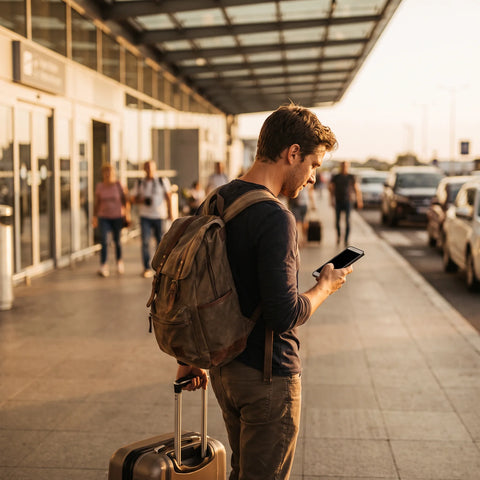
In short: with a PuraSIM data eSIM, you can call Spain from abroad for free via WhatsApp, FaceTime, or Telegram, without voice roaming. If you want to keep your Spanish number, activate it in Dual SIM mode: within the EU, it's included in your plan; outside the EU, the cost skyrockets.
It's one of the most frequently asked questions among those going abroad for a few weeks or months: how do I call my family, my bank, or a friend in Spain without relying on operator roaming? The good news is that today the answer almost always involves the internet, not the traditional voice network. You land, activate your data eSIM, and you already have everything you need to talk to Spain without thinking about minutes or country-specific rates.
Your options for calling Spain from abroad
Before going into detail, it's good to have a clear overview. There are basically two ways: use the internet (via your data eSIM) or use an operator's traditional voice network. The first is free or almost free in most cases; the second depends on your plan and where you are traveling.
| Method | How it works | Approximate cost |
|---|---|---|
| WhatsApp (voice or video) | Uses your eSIM data | Free, only consumes data |
| FaceTime (iPhone/Mac) | Uses your eSIM data | Free, only consumes data |
| Telegram (voice) | Uses your eSIM data | Free, consumes less data than WhatsApp |
| Voice roaming within the EU | Your physical Spanish SIM, traditional network | Included in your plan (Roam Like at Home) |
| Voice roaming outside the EU | Your physical Spanish SIM, traditional network | Cost skyrockets: check current rates with your operator |
| Skype or other VoIP credits | Uses your eSIM data to call landlines/mobiles | Low cost per minute, depending on contracted credit |
For almost any traveler, the first row of that table solves the vast majority of calls: family, friends, video calls with the work team. The other options are for specific cases that we'll see below.
Call for free over the internet: the option you'll almost always use
Your PuraSIM Spain eSIM—or whichever you have active depending on your destination—gives you mobile data connection abroad. With that connection, any VoIP app works exactly as it would at home. You don't need Wi-Fi, you don't need to activate anything special with your Spanish operator, and the person in Spain doesn't need to make any adjustments.
WhatsApp: the simplest option
This is what most people will use, simply because it's already installed and everyone knows how to use it. You open the chat, tap the call or video call icon, and you're good to go. The person receiving the call in Spain doesn't pay anything either: WhatsApp calls are free for both ends, no matter where they are.
FaceTime, if you have an iPhone or Mac
If both you and the person in Spain use Apple devices, FaceTime usually provides the best audio and video quality of the three options. It works just like WhatsApp: it consumes your eSIM data, with no additional cost beyond the data plan you already have contracted.
Telegram, the lightest option for data usage
If your data plan is tight or you're in an area with weak coverage, Telegram usually uses fewer megabytes per minute of call than WhatsApp. It's not the most widely used app in Spain, so make sure the person on the other end has it installed before relying on it for an important call.
In all three cases, the data consumption of a voice call is low—we're talking about a few megabytes per minute—and that of a video call is higher, but still perfectly manageable within a normal travel data plan. If you're concerned about spending too much data on calls and other daily apps, this article on how to save data with your eSIM while traveling has specific tricks that do make a difference, especially for long video calls.
Calling with your Spanish number: when Dual SIM makes sense
If your mobile supports Dual SIM (physical Spanish SIM + active data eSIM), you can keep your Spanish line operational for calls and SMS while using the eSIM only for internet. This is the configuration we recommend if you want to remain reachable on your usual number, for example, for your bank to call you or not to miss verification SMS.
Within the European Union
Thanks to the "Roam Like at Home" data roaming regulations, if you travel within the EU, your Spanish plan behaves as if you were at home: calls to Spanish numbers are charged as national calls, usually included in your minute allowance. No surprises here: this is the most convenient situation to continue using your physical SIM for voice.
Outside the European Union
This is where you need to be careful. Outside the EU, most Spanish operators apply international roaming rates for voice calls, and the cost can escalate quite quickly depending on the destination. There isn't a single valid figure for all operators or all countries: you should check your operator's current rates before making or receiving voice calls outside the EU. This is precisely the scenario where switching to WhatsApp or FaceTime makes the difference between a reasonable bill and a nasty surprise when you return.
If you're not sure about the real difference between relying on your operator's roaming or a data eSIM, this comparison of eSIM vs. traditional roaming explains it in detail, including why roaming outside the EU is often expensive even with pre-contracted data and voice "bundles."
How to set it up on your phone: step by step
The configuration is the same whether you are going to Spain from abroad or leaving Spain with your number active; only which SIM you make physical and which eSIM changes.
- Install the eSIM before traveling. Scan the QR code or use direct installation with a Wi-Fi connection, at home, calmly. Here is the complete eSIM installation guide step by step if it's your first time.
- Configure the eSIM as the data line. In your phone settings, go to line management and set the eSIM as the default mobile data line.
- Keep your physical SIM active only for calls and SMS. You don't need to deactivate it: just make sure it's not the one using data, this way you avoid accidental data roaming and unexpected bills.
- Verify that WhatsApp, FaceTime, or Telegram use mobile data and not just Wi-Fi, in each app's settings, so calls also work outside Wi-Fi areas.
- Activate Wi-Fi Calling if your operator allows it, as an additional backup when you have Wi-Fi available but weak mobile coverage.
Prefixes and correct format for dialing Spain
A common—and avoidable—mistake is dialing the wrong prefix, which simply results in the call not going through. Here are the correct formats:
| Situation | Correct format | Example |
|---|---|---|
| Calling a Spanish mobile | +34 6XX XXX XXX or +34 7XX XXX XXX | +34 612 345 678 |
| Calling a Spanish landline | +34 9XX XXX XXX or 8XX | +34 912 345 678 |
| Emergencies in Spain | 112 (direct number, no prefix) | 112 |
The "+34" replaces the "00 34" that was previously used to dial from abroad; on most modern phones, simply holding down the "0" when typing the number will bring up the "+" symbol. If you save your Spanish contacts with the +34 prefix from the beginning, you will avoid errors when calling from any country.
When it's best to use your physical SIM instead of the eSIM for calls
The data eSIM and VoIP apps cover most calls, but there are specific situations where the physical Spanish SIM is still the best option, or even the only one:
- Bank verifications and SMS codes. Many Spanish banks still send codes via SMS or call your main number directly, not messaging apps.
- Transactions with the Spanish administration. Some procedures require identity confirmation by calling your registered number, not via WhatsApp.
- Real emergencies. The emergency number is dialed using the traditional voice network; do not rely on a VoIP app in an emergency.
- Contacts who don't use messaging apps. This is not common in Spain, but if someone doesn't have WhatsApp or FaceTime, the only option is a traditional call or a Skype-like credit.
That's why Dual SIM—eSIM for data, physical SIM in standby mode for voice—is usually the most complete combination: you cover everyday use via the internet and keep the traditional network as a backup for important matters.
Common mistakes and what almost no one tells you
Beyond the obvious, there are a series of details that are usually learned the hard way. Here are the ones that really make a difference:
- Don't turn off your physical SIM completely "to save money." If you deactivate it completely, you stop receiving verification SMS and important calls. You just need to make sure it's not the data line: it can remain "awake" for voice without costing you anything in roaming if you don't use it to make calls.
- WhatsApp doesn't work the same in all countries. It is blocked or restricted at certain times in some Middle Eastern countries and in China. If your destination is one of these, have Telegram or FaceTime installed as an alternative before you leave, not when you already need it.
- Accidental data roaming is the most common surprise on the bill. If your phone automatically selects the physical SIM for data at some point—for example, after a reboot—it can consume data roaming from the Spanish operator without you realizing it. Check the "default data line" setting as soon as you land.
- Video calls consume significantly more data than voice calls. If you're low on data, prioritize voice calls over long video calls, or save them for when you have Wi-Fi available.
- Save the QR or installation data of your eSIM in an accessible place without internet—a screenshot, for example—in case you need to reinstall it and your only internet access at that moment is precisely the eSIM you need to reinstall.
- If you travel through several countries on the same trip, a regional eSIM can save you more than one installation. Check out the Europe eSIM if your route crosses several borders within the continent.
Quick comparison: free vs. paid
| Scenario | Best option | Why |
|---|---|---|
| Calling family or friends in Spain | WhatsApp / FaceTime / Telegram | Free, good quality, only requires eSIM data |
| Video call for work from the EU | WhatsApp / FaceTime or included EU roaming | Both free or included; use the one with better coverage |
| Calling a Spanish bank from outside the EU | Physical SIM, voice roaming | The bank calls your main number, not VoIP apps |
| Calling a Spanish landline without WhatsApp | Skype or other VoIP credit | WhatsApp only calls other WhatsApp users |
| Real emergency abroad | Local emergency number, voice network | Don't rely on apps or data in an emergency |
Frequently Asked Questions
Do I need Wi-Fi to call via WhatsApp, or does it work with the eSIM?
It works perfectly with your eSIM data, no Wi-Fi needed. The eSIM provides you with mobile data abroad, and WhatsApp uses it exactly as it would use your connection in Spain.
Does the person in Spain who receives my WhatsApp call pay anything?
No. WhatsApp calls are free for both ends, both for the caller and the receiver, no matter where they are.
Can I call a landline in Spain with WhatsApp?
Not directly: WhatsApp only allows you to call other WhatsApp users. To call a Spanish landline, you need a VoIP service with credit, such as Skype, or to use your physical SIM with roaming.
How do I call Spain from abroad with my Spanish number if I have Dual SIM?
Simply dial the normal number: if you are within the EU, your plan treats it as a national call thanks to the included roaming. Outside the EU, check your operator's voice roaming rates beforehand, as the cost can be high.
What prefix do I use to call a Spanish mobile from abroad?
The prefix +34 followed by the nine-digit number, without the initial 0 that is sometimes added in documents. For example, +34 612 345 678 for a mobile.
Does WhatsApp work in all countries to call Spain?
In the vast majority of countries, yes, but it is blocked or restricted at certain times in countries like China and some in the Middle East. If your destination is one of these, have Telegram or FaceTime as an alternative.
Which SIM does WhatsApp use to call if I have an eSIM and a physical SIM at the same time?
WhatsApp uses data, not the voice line. Therefore, it will use the SIM configured as the default data line on your phone, which will typically be your eSIM if you have set it up that way in your settings.