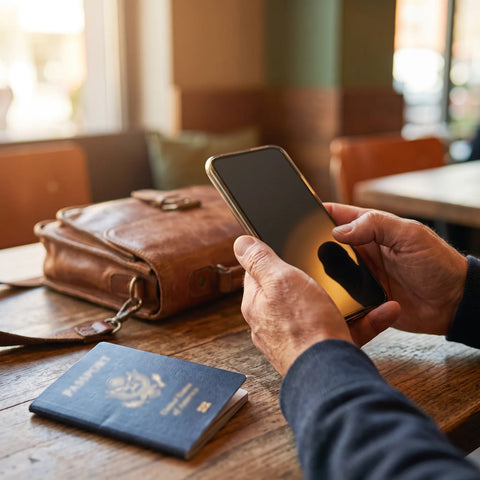
In short: to have internet in Seoul from the moment you arrive, you need an eSIM for Seoul, which is actually a South Korea eSIM valid throughout the city and the country. You activate it before flying, leave Incheon with 5G working, and keep your Spanish number for WhatsApp. No physical cards or queues.
Seoul is one of those cities where you notice the difference of having data from the moment you step foot in the terminal. Korean 5G is one of the fastest in the world, the subway has signal underground in almost all stations, and much of daily life—from paying at a convenience store machine to ordering a taxi—assumes you are connected. If you arrive without data, it's not that you'll have a bad time: it's that Seoul will feel half-speed. Here's everything you need to know before activating your eSIM and landing at Incheon.
What is an eSIM for Seoul and why you don't need to look for a store
An eSIM is a digital SIM card installed via software, without plastic or a tray. You scan a QR code, the data profile is saved on your phone, and that's it: no need to go to any airport counter or remember to remove your Spanish SIM with a paperclip. If you've never used one and want to understand the mechanism thoroughly before traveling, our guide on what an virtual eSIM is explains it without technical jargon.
The advantage over your Spanish operator's roaming isn't just the price: it's that you decide how much data you contract and when it activates, with no surprises on your bill when you return. If you want to understand exactly what your company charges you for data outside the EU, the explanation is in what data roaming is, and if you prefer to see a direct comparison, eSIM vs. roaming shows the numbers side by side.
Incheon Airport: with data as soon as you land
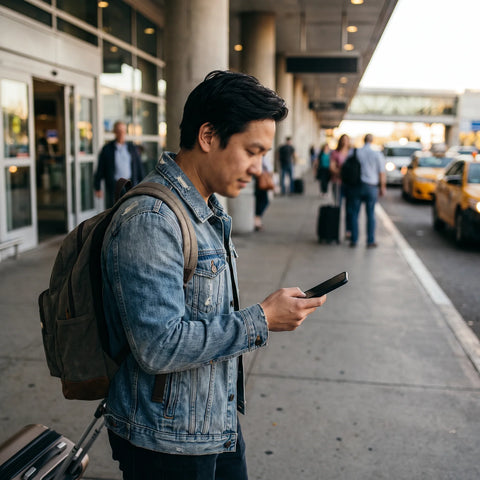
Most international flights to Seoul arrive at Incheon International Airport (ICN), one of the world's highest-rated airports, located about an hour's drive from the city center. From there, you can reach the city by AREX train (there's an express version and a much cheaper local version) or by one of the limousine buses that serve various neighborhoods. With your eSIM already installed before takeoff, you'll be connected during that first leg: you can buy your AREX ticket from your phone, check the exact route to your hotel, and let people know you've arrived without relying on airport Wi-Fi, which works well but doesn't always cover every corner of the terminal.
There's a detail almost no one considers: if your itinerary includes a regional flight from Japan or China, you might land at Gimpo (GMP) instead of Incheon. Gimpo is much closer to the center—about 30-40 minutes—and has fewer physical SIM card services at the airport itself, so arriving with an active eSIM avoids a real problem: unlike Incheon, Gimpo doesn't always have a phone counter open at all hours. Many flights to Seoul also land in the early morning, when Incheon's physical card counters aren't even open, and only vending machines are left, with longer queues than they appear in photos.
Korean 5G: why it's worth using data here
South Korea is among the countries with the fastest mobile networks on the planet, and in Seoul, 5G is virtually ubiquitous: you can download maps, upload videos, and make video calls without noticeable lag. A serious travel eSIM relies on Korean networks, so you can take advantage of that infrastructure without paying resident rates or depending on limited roaming agreements.
This changes the experience compared to other destinations: in Seoul, you won't "ration" data for fear of losing signal; quite the opposite, you'll likely consume more than you expect because the speed encourages it. If you're someone who uploads live video or makes long video calls, budget your data package with some margin: the temptation is real here, and the bottleneck isn't the network; it's your data plan.
Coverage by neighborhoods: Gangnam, Myeongdong, the subway, and palaces
Coverage in Seoul is almost complete, even underground, which is still uncommon in many European capitals. Here are the places where you'll use it the most:
- Gangnam: A modern district with a strong signal for maps, shopping, and comparing restaurants on the fly.
- Myeongdong: A shopping and street food area where you'll want to translate menus and compare prices quickly, cart by cart.
- Seoul Subway: Features public Wi-Fi and mobile coverage on platforms and in much of the tunnels, which is unusual outside of East Asia.
- Bukchon and the Palaces (Gyeongbokgung, Changdeokgung): Traditional neighborhoods with good signal for audio guides and finding the correct entrance, which isn't always obvious at Gyeongbokgung.
- DMZ area: If you take a day trip to the border, keep in mind that coverage can be more irregular in certain sections of the route due to security reasons. Don't expect to be connected throughout the entire journey as you would in downtown Seoul.
Tip: In Korea, many apps and services assume you're always connected—payment, maps, transportation. Having stable data isn't a luxury; it's what makes the city work for you just as it does for a local.
How many GB do you need for Seoul?
Seoul is often the main part of a trip to Korea, lasting 3 to 5 days or more, sometimes including excursions to Busan or Jeju. With such good 5G, it's easy to use more data than expected, so plan with some margin. This table gives you a reference based on your usage:
| Days in Seoul | Light usage (maps, messaging, basic social media) | Medium-to-heavy usage (video, live streams, streaming) |
|---|---|---|
| 3 days | 2-3 GB | 5 GB |
| 5 days | 4-5 GB | 8 GB |
| Seoul + rest of Korea | 6-8 GB | 12 GB or unlimited |
If you upload a lot of videos or do live streams, aim for the higher column or consider an unlimited data plan: running out of data on your last day in Myeongdong, just when you need it most to compare shops, is one of the most avoidable travel mishaps. If you also want to maximize every gigabyte without overspending, the guide on how to save data while traveling offers specific tips that also work in Korea, such as disabling automatic app updates or lowering video quality on social media.
eSIM for Korea, not "for Seoul": how it works for the entire country
Let's clarify the most common question: city-specific eSIMs do not exist. Coverage is organized by country, so for Seoul, you'll use a South Korea eSIM, which will also work in Busan, Jeju, or any other stop on your itinerary. A single plan covers your entire Korean trip, with no need to buy anything extra when changing cities. If your trip extends beyond the capital, our guide on eSIM for South Korea, Seoul, and Busan provides a complete overview to size your plan according to your route.
And if your return to Spain involves another destination, or if after Korea you continue your journey through Europe or the United States, you don't need to wait until you arrive to sort it out: at PuraSIM, we also have eSIM for Europe and eSIM for the United States ready to activate before each leg, just as you did with the Korean one.
Essential apps in Korea (and one you won't be able to fully use)
With stable internet, navigating Seoul feels almost like a local. These are the apps you'll be most grateful to have installed before you leave:
- Naver Map or KakaoMap: Google Maps works only partially in Korea because the country's regulations restrict the export of detailed cartographic data outside its borders; turn-by-turn navigation and many walking routes fail. Naver Map and KakaoMap are what everyone there uses, and it's wise to have them downloaded and set to English before landing.
- Papago: Naver's translator, significantly more refined than generic apps for Korean, ideal for handwritten menus and signs.
- Transportation apps: Both Naver Map and KakaoMap calculate real-time metro and bus routes with high accuracy, including transfers.
- Messaging: You'll keep WhatsApp with your Spanish number because the eSIM only handles data, not voice or SMS. For those, you'll continue to use your regular line.
Here's a nuance almost no guide mentions: apps like KakaoT (the go-to app for ordering taxis) or Kakao Pay often require SMS verification to a Korean phone number for registration, and some payment functions require a local bank account or ID. With data, you'll be fine for everything else, but to order a taxi, you might end up hailing one on the street or using Uber, which has more limited coverage in Seoul than in other capitals. This isn't an eSIM flaw: it's how these specific apps are built, and it's good to know before relying on them late at night.
Myths and what almost no one tells you before going to Seoul
There are a few ideas circulating about connectivity in Korea that are worth debunking before they complicate your trip:
- "I need a Seoul-specific eSIM": No such thing exists. It's a country eSIM, as we've seen, and it works in any Korean city.
- "Google Maps works like in any other country": Not in Korea. It's one of the few destinations where you'll have to learn to use another map app from day one, not as a backup but as your primary one.
- "It's faster to buy a physical SIM at the airport": It might seem so, but between finding the right counter, the queue, and the ID paperwork, activating your eSIM before flying saves you that entire time, especially if your flight lands in the early morning.
- "With data, I can use any Korean app without problems": As seen with KakaoT and Kakao Pay, some local apps require a Korean phone number or local bank account for specific functions. The eSIM solves your internet needs, not the identity verification for services designed for residents.
- When NOT to contract too much: If your stopover in Seoul is short—less than a day—and you plan to stay in the Incheon area (which has decent free Wi-Fi throughout the terminal), you probably don't even need to activate an eSIM for that leg. And if your stay is two or three quiet days, without uploading videos or making long calls, a small package from the lower end of the table above will be plenty: there's no need to jump straight to the largest plan "just in case."
Before you fly: compatibility and activation
A couple of preliminary steps prevent unpleasant surprises on the day of your flight. First, confirm that your device supports eSIM (most phones from recent years do, but it's worth checking calmly, not at the boarding gate). Second, install the profile with Wi-Fi at home, not at the departure airport in a last-minute rush. If you want the full step-by-step guide, how to install an eSIM explains everything without taking anything for granted, from scanning the QR to activating the data plan on the day you land.
Frequently Asked Questions
Do I need a specific eSIM for Seoul, or will a South Korea eSIM work?
A South Korea eSIM will work. There are no city-specific eSIMs; coverage is organized by country, so the same plan you use in Seoul will work in Busan, Jeju, or any other stop on your Korean itinerary.
Which airport do I arrive at in Seoul, and how do I get to the city center?
The main entry point is Incheon International Airport (ICN), located about an hour's drive from the city center; some regional flights from Japan or China arrive at Gimpo (GMP), which is closer to the city. From both, you can reach the city by AREX train or bus. With your eSIM already activated, you'll have data as soon as you land to buy your ticket and find your way to the hotel.
Is it true that Korea has one of the best 5G networks in the world?
South Korea is among the countries with the fastest mobile networks on the planet, and 5G is widely available in Seoul. With an eSIM that uses Korean networks, you can browse at high speeds, with maps, video, and video calls experiencing virtually no lag.
How many gigabytes do I need for a week in Seoul?
For five days of light usage, 4-5 GB should be plenty; if you also stream video or go live, budget 8 GB. If your week includes trips to Busan or Jeju, it's better to opt for a country plan with more margin, between 8 and 12 GB, or even unlimited data.
Does Google Maps work well in Seoul?
Not entirely. Due to a Korean legal restriction on the export of detailed mapping data, Google Maps fails on turn-by-turn navigation and many walking routes. Naver Map and KakaoMap are the apps locals use and the ones you should download.
Can I order a KakaoTaxi or pay with Kakao Pay using only an eSIM?
Your eSIM provides internet, but some Korean apps like KakaoT or Kakao Pay require SMS verification to a Korean number or a local bank account for certain functions. It's common to end up hailing taxis on the street or using Uber, which has more limited coverage in Seoul than in other cities.
Will the same eSIM work if I visit Busan or Jeju in addition to Seoul?
Yes. As it's a country-specific eSIM and not city-specific, the same plan covers Seoul, Busan, Jeju, and any other point on your Korean itinerary without needing to buy anything extra when changing cities.
Conclusion
Seoul rewards those who arrive connected: lightning-fast 5G, subway with underground signal, and apps that assume you're always online. A South Korea eSIM hooks you up to all of this from the moment you leave Incheon (or Gimpo), without physical cards or early morning queues. Activate it before you fly, and land with internet ready to buy your AREX ticket, open Naver Map, and let people know you've arrived. Choose your Korea eSIM, set it up calmly before your flight, and let Seoul move at the speed it's accustomed to.