In summary: If you're wondering what happens if your eSIM data runs out, the answer is simple: you lose internet access, but you won't be charged extra or continue to spend money unknowingly. The connection cuts off abruptly, and you can get it back in a minute by topping up your plan or installing a new eSIM from your phone.
You're in the middle of a trip, you open Google Maps to find your hotel, and the screen just keeps thinking. Nothing loads. You check WhatsApp: nothing comes through there either. What happens to almost everyone sooner or later has happened to you: you've run out of data. The good news is that this isn't a disaster, you won't get a surprise charge, and the solution takes literally as long as it takes to order a coffee. In this guide, we tell you exactly what happens when you run out of data on your eSIM, how to get out of trouble immediately, and, most importantly, how to prevent it from catching you again with your suitcase in hand and no map.
What exactly happens when your eSIM data runs out?
When you consume all the gigabytes on your prepaid eSIM, something very specific happens: you lose internet access, that's all. Apps won't load, messages won't come through via mobile data, Maps will be blank. And here's the important part: you won't be charged an extra cent. There's no surprise bill because there's no bill. Your plan simply becomes "empty," waiting for you to add more gigabytes.
This is a huge difference compared to traditional roaming. With traditional physical SIM roaming, you could keep browsing without realizing it and see your bill skyrocket when you got home. With a prepaid eSIM, you pay upfront, and when it runs out, it runs out: not a single euro more. It's a clean cut, not a money leak. If you want to fully understand this comparison, we have a guide dedicated to the differences between eSIM and roaming that breaks it all down.
Another detail that confuses many people: even if you run out of data, your phone still has network coverage. The antenna is still there, the signal too; the only thing missing is the contracted data traffic. And if your plan also included calls or SMS with your own number, those services can continue to work even if the data package is at zero. It's not that your phone turns off or your eSIM "breaks": it has simply used up its quota.
How to check how much data you have left before you run out
The best way to avoid being stranded is to monitor your consumption a little in advance. You can do this from your phone's settings, although the most reliable data is usually in your eSIM account, where you see the real-time balance and not a system estimate.
- On iPhone: Settings > Mobile Data > tap your eSIM plan to see what has been consumed in the period.
- On Android: Settings > Connections > Data usage > select the corresponding eSIM.
- In your PuraSim account: the updated balance, without relying on the phone's internal counter, which sometimes mixes your main SIM's usage with your eSIM's and gives you a misleading number.
A warning about your phone's counter: it almost never resets itself at the beginning of the trip, so the number you see might include usage from weeks ago. That's why it's a good idea to learn how to check how much data you have left on your eSIM from the correct source. And if you notice you're running low, it's a good idea to apply some tricks to save data abroad before it's too late.
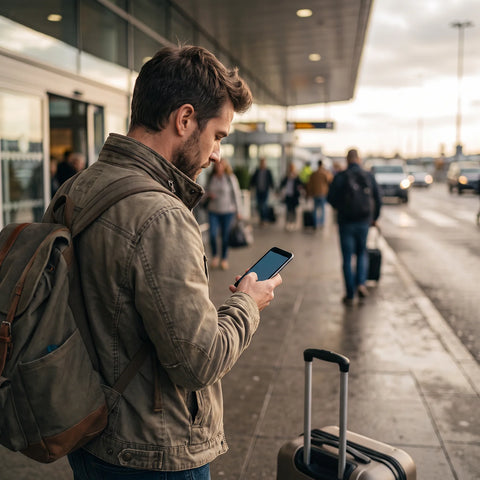
Traveler's tip: set a mental alert (or a note on your phone) when you drop below 20% of your gigabytes. Topping up with plenty of margin is much more convenient than doing it with your suitcase rolling through the airport and no city map.
I've run out of data: how to get internet back now
Okay, it's happened: you're at zero. Don't panic. You have two paths, and both can be resolved from your phone in less than a minute, without stepping into a store or looking for someone who speaks your language.
- Top up your existing plan: if your eSIM is rechargeable, you add more gigabytes to the same installed profile. No need to scan a new QR or reconfigure anything. You continue with the same plan, just refilled.
- Buy and install a new eSIM: you add another plan on top. iPhones and most modern Androids can store several eSIMs at once, so you can have several stored and activate the one you need at any time.
Which to choose? If your plan allows top-ups, that's the fastest and most convenient way: that's how a rechargeable eSIM works and why it pays off. If you've suddenly run dry and want the exact step-by-step on how to refill it, see how to top up an expired eSIM plan. And if you prefer to start fresh with a different destination or simply more gigabytes, here's how to buy an eSIM online in a couple of taps. In any case, the connection is usually ready approximately one minute after payment, with no paperwork or waiting.
The only real requirement is that you need a temporary connection to complete the purchase. If you are completely without data, use the Wi-Fi at your hotel, the airport, a cafe, or a restaurant. That's enough to pay; as soon as you're done, the plan activates, and you'll have internet wherever you are again.
Top up your plan or buy a new eSIM: which is best for you?
Since it's not always clear which of the two options suits you best, here's a quick comparison to help you decide in two seconds:
| Situation | Best option | Why |
|---|---|---|
| You're still in the same country or area, and your plan is rechargeable | Top up your current plan | No reinstallation; you add gigabytes to the profile you're already using, and everything stays the same |
| You're changing destinations (another country or region) | Buy a new eSIM for the new destination | You need coverage for that area; you install the appropriate plan and activate it |
| Your current plan does not allow top-ups | Buy a new eSIM | This is the only way; your phone can store several eSIMs without a problem |
| You want more margin all at once for the rest of your trip | Either, depending on your preference | Topping up is faster; buying again lets you choose a larger plan |
If you're torn between refilling what you have or starting a new plan, think about where you'll be in the coming days: same place, top up; change of country, new eSIM.
Tips to prevent it from happening again
Running out of data is almost always due to two things: either you underestimated how many gigabytes you'd need, or there are apps consuming much more than you imagine in the background. These habits will save you a lot of trouble and make a few gigabytes go a long way:
- Download offline maps of your destination before you leave. Google Maps allows you to save entire areas and navigate without using a single megabyte. This is probably the biggest saving of all.
- Cut background consumption of apps you don't need while traveling: automatic updates, cloud backups, videos that play automatically on social media.
- Save Wi-Fi for heavy tasks: uploading photo albums, long video calls, downloading a series for the flight. Do that at the hotel or cafe; use data for maps and chat.
- Activate data warnings in your phone settings, so it alerts you when you reach a certain limit and doesn't catch you by surprise.
- Lower the streaming quality on Spotify, YouTube, or Instagram. On a mobile screen, you'll barely notice the difference, and the savings are huge.
With just a few of these habits, a few gigabytes go much further than they seem, and the shock of running out won't happen again.
What almost no one tells you about running out of data
Beyond the obvious, there are details you only learn by traveling (or making mistakes). These are the ones that make a difference:
- WhatsApp can "revive" with a second of Wi-Fi. If you're without data but pass through an open Wi-Fi zone, take advantage to send your location or notify that you're offline. You don't need mobile data for this, just temporary Wi-Fi.
- GPS works without data. Few people know this: your phone's location chip still locates you even if you're at zero gigabytes. With offline maps downloaded, you can navigate perfectly without a single megabyte. Running out of data doesn't mean losing your way.
- Recharge before the last bar, not after. The classic mistake is to wait until you are exactly at zero. If you recharge when 15-20% is left, you still have data to complete the payment without having to scramble to find Wi-Fi.
- Have a "backup" plan for long trips. If you're going away for weeks, calculating everything precisely is risky. Many seasoned travelers carry a regional eSIM with plenty of margin precisely so they don't have to constantly monitor their data usage.
- Exhausted data and expired data are not the same thing. A plan can run out of gigabytes early, but it can also expire by date even if you have data left over. Always check the validity period, not just the balance.
What NOT to do to avoid making the problem worse
When the internet stops working, the temptation is to mess with things frantically. Be careful with these classic mistakes that often make things worse:
- Do not delete the eSIM thinking it's broken. If you delete it, in many cases it cannot be reinstalled, and you would lose the plan forever. Delete it only when you are sure you will no longer use it, never in the middle of a bind.
- Do not activate your Spanish SIM's roaming in desperation. You could end up paying expensive roaming fees, which is exactly what you wanted to avoid. If you're not sure if it's on, check it in your main line's mobile data settings first.
- Do not restart your phone ten times before checking your balance. Many times "it's not working" simply means you've run out of gigabytes. Restarting does not create data out of thin air.
Now then: if you've topped up and it still doesn't work, then it's time to check the settings. In the guide on eSIM data not connecting abroad, you'll find a step-by-step diagnosis to rule out typical APN or data line switching issues.
How much data do you really need to avoid running short?
To avoid repeating the scare, it helps to have a realistic reference. A leisure traveler who uses maps, messaging, some social media, and normal browsing usually needs between 1 and 2 GB per week. If you use a lot of video, video calls, or share your connection with a laptop, that figure quickly skyrockets. This table gives you an honest orientation (these are general estimates, your actual consumption depends on your habits):
| Traveler profile | Typical usage | Estimated consumption |
|---|---|---|
| Light | Maps, WhatsApp, some web browsing | ~500 MB - 1 GB / week |
| Medium | Social media, photos, daily browsing | ~1 - 3 GB / week |
| Heavy | Video, video calls, tethering | ~5 GB or more / week |
Golden rule: if in doubt, it's better to have too much than too little. An extra gigabyte costs little; running out of a map in an unfamiliar city costs much more in stress. To refine the calculation based on your travel days and type of getaway, see how much data you need for travel. And if your destination is a large one, a regional plan with plenty of margin will save you from needing top-ups: for example, an eSIM for Europe if you're visiting several countries on the same trip.
Frequently Asked Questions
What happens if my eSIM data runs out?
You simply lose internet access: apps won't load, and messages won't come through via mobile data. But you won't be charged extra or continue consuming unknowingly. The plan remains empty until you top up or install a new eSIM. Network coverage remains active; the only thing missing is data traffic, which you regain within a minute after topping up.
Will I be overcharged if I use all my gigabytes?
No. Being prepaid, you pay upfront, and when it runs out, it stops working without generating any charges. This is the great advantage over traditional roaming, where you could continue spending money without realizing it. With eSIM, spending is always under control because there's no bill that skyrockets.
Can I top up without scanning another QR code?
If your eSIM is rechargeable, yes: you add gigabytes to the same profile you already have installed, without scanning anything new. If you buy a different eSIM, it installs as a separate plan, and you choose which one to activate. Both options are usually ready within about a minute after completing the payment.
Can the eSIM be topped up without an internet connection?
You need a temporary connection to complete the purchase: the Wi-Fi at your hotel, the airport, or a cafe will work. Once paid, the plan activates as soon as you have network again. That's why it's advisable to top up before you run completely out of data and without nearby Wi-Fi to rely on.
Should I delete the old eSIM when data runs out?
There's no need and it's not advisable to do so lightly: if you delete it, in many cases you won't be able to reinstall it and you would lose the plan. If it's rechargeable, keep it and add gigabytes. Delete it only when you are completely sure you will no longer use it and know how to do it correctly.
Do I still have coverage and GPS if I run out of data?
Yes. Your phone maintains network coverage even if data has run out, and GPS works the same because it doesn't depend on the internet. If you downloaded offline maps for your destination, you can continue navigating without using a single megabyte. Running out of data doesn't leave you disoriented if you're even minimally prepared.
How long does it take for the internet to come back after topping up?
Normally about a minute after you complete the payment. In most cases, reconnection is automatic; if it takes longer, activating and deactivating airplane mode usually forces the phone to pick up the new data. If, after topping up, it still doesn't work, check your mobile data settings and the eSIM's APN.
Conclusion
Running out of data in the middle of a trip is not a drama: there are no surprise charges, and the solution is just a tap away. By monitoring your balance and topping up with a little margin, you'll always stay connected. And next time, choose a plan with plenty of gigabytes and travel calmly: with a PuraSim eSIM, you'll have internet back in a minute, without queues or paperwork. Land with internet, without roaming, and without stress.