In short: To save data abroad without being stranded mid-trip, three things are needed: a local eSIM activated before you leave, correctly configured mobile data saving settings (not the default ones), and knowing when the hotel's Wi-Fi is sufficient and when you need your own data. Don't buy extra "just in case."
Almost everyone who travels outside Spain has the same feeling: data runs out faster than expected, and they're never quite sure why. It's not that you use your phone more than at home. It's that when roaming, your phone silently does a lot of things that you don't notice in Spain because your home Wi-Fi pays for them: syncing photos, updating apps, preloading videos you don't even watch all the way through. This guide is about that: real tricks to save data abroad, not the usual list of "download offline maps" repeated without explaining how.
Why data consumption soars as soon as you leave Spain
At home, your mobile is connected to Wi-Fi most of the day: on the sofa, at work, in bed. All the heavy stuff—photo backups, system updates, app downloads—happens there, without you noticing. Abroad, if you activate your eSIM and stick with the factory settings, that same background traffic starts eating up your mobile data GBs without you even touching your phone once.
The clearest example: you leave the hotel in the morning, your phone detects that there's no Wi-Fi, and if you have automatic upload to iCloud Photos or Google Photos activated, it starts uploading the previous night's photos in the background as soon as it detects available mobile data. If you shot 4K video, that's several hundred MBs outside your control in the first hour of roaming. The same thing happens with automatic app updates: if your App Store or Google Play is set to update "always," it can launch a 200-300 MB update for an app you won't even open that day.
Add to that social media, which preloads video before you even scroll to it, and you have the real explanation of why a plan that "should last" falls short. If you want to see in detail what specific activity consumes the most (video, maps, messaging, social media), there's a useful breakdown in this article on mobile data consumption by activity.
Practical tricks that actually save data (not the usual generic ones)
Everyone says "download offline maps." It's true, but it's not enough. These are the specific settings, with the exact path on your phone, that make a real difference:
- Low Data Mode only on your eSIM line (iOS): In Settings → Mobile Data, tap your travel eSIM line and enable "Low Data Mode." The good thing about having the eSIM as a separate line from your physical SIM is that you can restrict only that line without touching the rest of your phone's settings.
- Data Saver on Android: Settings → Network & Internet → Data usage → Data Saver. Turn it on and add only the apps you truly need always active (Maps, WhatsApp) to the unrestricted app list.
- Disable automatic photo and video download for WhatsApp: Settings → Storage and Data → Media Auto-download, and uncheck "When using mobile data" for photos, audio, and videos. In an active family group, this alone can save you several hundred MBs on a week-long trip.
- "Use less data" on Instagram and TikTok: Both apps have this option in their settings menu (on Instagram, under Account → Cellular Data Use). This drastically reduces the quality of preloaded video in the feed.
- Lower streaming quality on Netflix and Spotify before you leave: On Netflix, profile → App Settings → Download/Playback Quality, choose "Data Saver." On Spotify, set streaming quality to "Normal" or, even better, download playlists at home with Wi-Fi.
- Turn off automatic app updates: In the App Store, iPhone Settings → App Store → disable "App Updates" under mobile data. In the Play Store, Settings → Network preferences → Auto-update apps → "Over Wi-Fi only."
- Pause automatic photo upload to the cloud: In Google Photos or iCloud Photos, look for the "upload only with Wi-Fi" option. This is the most silent data leak of all because it happens without you even opening the app.
- Download the offline map for the specific area, not the entire country: In Google Maps, search for the city, tap your profile picture → Offline maps → Download offline map, and adjust the box to the actual area where you'll be moving. Note: voice navigation works offline, but searching for restaurants or seeing real-time traffic definitely requires data.
- Restrict background app refresh per app, not in bulk: On iOS, Settings → General → Background App Refresh. Don't disable it entirely (it breaks useful notifications); uncheck it only for social media and games.
- Activate the browser's own data saver: Chrome has a "Lite" mode on some Android devices that compresses pages before loading them. There's no equivalent in Safari, but closing tabs that remain loading in the background helps more than it seems.
How much each thing consumes (so you're not flying blind)
Not all apps weigh the same, and knowing which ones are heavy helps you decide what to save for hotel Wi-Fi and what to freely use with your eSIM:
| Activity | Approximate consumption | Best with |
|---|---|---|
| WhatsApp (text only) | Very low | eSIM data, no problem |
| Google Maps (voice navigation) | Low | eSIM data |
| Video calls (WhatsApp, FaceTime) | Medium-high | Wi-Fi if it's going to be long |
| Social media with video (Instagram, TikTok) | High | Wi-Fi, or "use less data" mode |
| Video streaming (Netflix, YouTube in HD) | Very high | Wi-Fi whenever you can |
| Uploading photos/videos to the cloud | High and constant | Wi-Fi, disable automatic upload while roaming |
| App and system updates | Very high | Wi-Fi, never mobile data |
If you want a complete breakdown by social network type and time of day for consumption, it's covered in detail in this article on social media and daily data consumption.
Hotel Wi-Fi or eSIM data: when to use each
The rule that really works isn't "use Wi-Fi whenever you can": the Wi-Fi in many mid-range hotels is slow, shared among dozens of rooms, and sometimes requires a login that expires every two hours. If you need to send a large file or make an important video call, often your mobile data is faster and more stable than the hotel Wi-Fi, especially in saturated tourist areas.
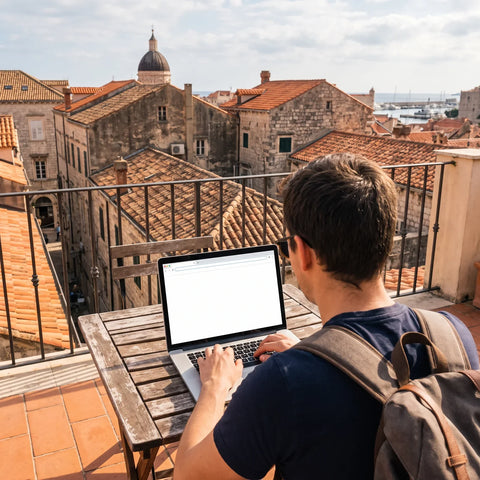
A more useful criterion: use Wi-Fi for everything that can be planned (updates, daily photo uploads, watching a series in the room) and mobile data for everything that happens on the go and you need immediately (maps, messages, confirming a reservation, paying for something). And keep the physical environment in mind: in historic centers with narrow streets and thick stone buildings — the medina of Fez, the old town of Dubrovnik, the Jewish quarter of Prague — the mobile signal weakens much more than you'd expect due to covered alleys or arcades. Download the offline map for that specific area before entering, because neither Wi-Fi nor data will be much help there.
How many GB to buy (and when you don't need to buy anything)
Here we need to be honest: you don't always need a data eSIM. If you live in Spain and are going for a weekend to Paris or Lisbon, your Spanish plan already includes "home-like" roaming within the EU: don't buy anything, use your usual line and save the money for something else. Where a local eSIM does make sense is outside the EU — the United States, Morocco, Thailand, any destination where your Spanish operator's roaming is expensive or simply doesn't exist — or within the EU if you're going to be away for many weeks and prefer not to depend on your operator not changing roaming conditions while you travel.
Regarding the amount of GB: buying extra "just in case" is not free and is almost never fully utilized. For a week-long trip with normal use (maps, messaging, some social media, no streaming series), a modest plan is usually more than enough if you apply the saving tricks in this article. If you're going to work remotely, make long video calls, or need a hotspot for your laptop, then it's advisable to go for a plan with more margin. The difference between a data eSIM and an eSIM with calls also matters in deciding the right plan: we explain it in this comparison between data eSIMs and eSIMs with calls.
If your destination is within Europe, check out the eSIM plans for Europe; for the United States, where Spanish operator roaming is usually expensive or limited, you have the eSIM plans for the United States.
Myths and common mistakes that make you spend more data than necessary
There are widespread ideas about data saving that, in practice, save nothing or even complicate the trip:
- "Closing all apps saves data": This is not true. An app that is completely closed may take longer to reconnect and resync all at once when you open it, costing more than if it had stayed in the background with the right restrictions in place. What saves data is restricting what each app can do in the background, not constantly killing it.
- "The more GBs I buy, the more at ease I'll be": Buying too much doesn't save you money, it just makes you spend money you won't use. The right plan depends on the actual trip, not an exaggerated safety margin. If you're torn between two sizes, apply the tips in this guide first, then decide.
- "Airplane mode with Wi-Fi activated uses no data": True for mobile data, but if you have cloud synchronization active, as soon as you leave that Wi-Fi and disable airplane mode, everything pending will download or upload at once using mobile data. Check what was "in queue" before leaving the Wi-Fi.
- "eSIM and physical SIM cannot coexist without problems": Yes, they can, and that's precisely what allows you to keep your Spanish number active for SMS and calls while using the eSIM only for data, without changing physical cards. It's one of the less explained advantages of eSIM over traditional roaming; you can read more about it in this comparison between eSIM and roaming.
- "Data roaming and eSIM are the same thing": Not exactly, and confusing them leads to incorrect phone configuration. Here we clarify: what is data roaming.
What to do before leaving home
Most data problems abroad are solved before getting on the plane, not during the trip. Install the eSIM calmly with Wi-Fi at home — the process takes a few minutes if you follow the steps in order, something we detail in this eSIM installation guide — but don't activate it yet: having it installed and inactive does not consume plan validity. Take advantage of those previous days, with home Wi-Fi, to do all app and operating system updates, download offline maps of the specific cities you're going to visit, and download any playlists or series you want to watch without relying on data. That way, when you activate the eSIM upon landing, your phone won't have any "pending tasks" to do at your expense.
Frequently Asked Questions
How can I save data abroad without giving up normal mobile usage?
By configuring your eSIM line's data saving mode before you leave, disabling automatic photo uploads and automatic app updates, and reserving hotel Wi-Fi for heavy usage (streaming, backups, updates). With these three settings, a modest GB plan usually lasts the entire trip without you noticing daily restrictions.
Which apps consume the most data when I travel?
Those that play video with autoplay (Instagram, TikTok, YouTube) and those that sync with the cloud in the background (Photos, iCloud, Google Photos). WhatsApp in text-only mode and Google Maps voice navigation consume much less than people think.
Is downloading an offline map enough to avoid data consumption with Google Maps?
For point-to-point voice navigation, yes. But searching for a new restaurant, viewing real-time traffic, or checking public transport schedules still requires a connection. Download the offline map as a base, but expect to use some data for on-the-spot searches.
Can I have my Spanish SIM active at the same time as the data eSIM?
Yes. Most modern phones allow you to have your physical Spanish SIM for calls and SMS while using the eSIM exclusively for data. You just need to make sure that the default data line is the eSIM, so you don't accidentally use your Spanish operator's expensive roaming.
What happens if I run out of data before the trip ends?
You can buy a top-up or a new plan from the customer area without having to reinstall anything. It applies in a few minutes. That's why it's advisable to check your consumption mid-trip instead of waiting to run out of data at the worst possible moment.
For a short trip within Europe, is it worth buying a data eSIM?
Almost never. If you have a Spanish plan with EU roaming included, you already have "home-like" data at no extra cost during that weekend in Rome or Amsterdam. A travel eSIM makes more sense outside the EU or on long trips where you prefer not to depend on your usual operator's roaming conditions.
Does data saving mode affect notifications or WhatsApp?
It shouldn't, if configured correctly: both on iOS and Android you can exclude specific apps (like WhatsApp) from data saving restrictions so they continue to receive messages normally, even if other apps have limited background traffic.
Activate your eSIM before you leave and arrive connected from landing, without roaming and without surprises.
See eSIM plans →