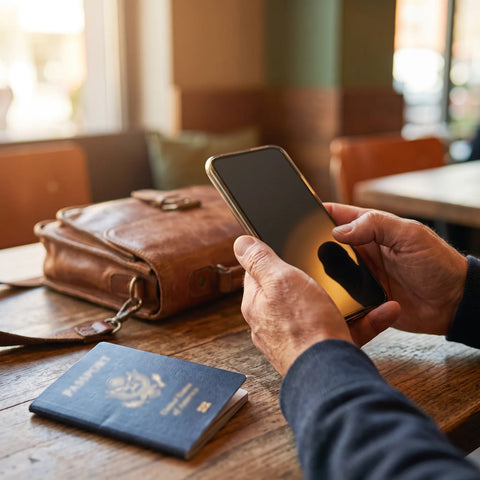

In short: The eSIM for the Gulf region is a data pack that covers the United Arab Emirates, Qatar, Bahrain, Kuwait, Oman, and Saudi Arabia with a single profile, without changing eSIMs when crossing borders. It pays off if you visit two countries on the same route; for a single destination, the individual country plan is usually cheaper.
If your trip strings together Dubai, Doha, and perhaps a getaway to Oman or Bahrain, buying an eSIM for each country is an unnecessary hassle. The eSIM for the Gulf region is a single pack that covers several Persian Gulf countries with one profile and one activation, ideal for multi-country routes and long layovers. In this guide, you'll see which countries it includes, for which itineraries it pays off, and when a country-specific plan is better.
What is the Gulf Region eSIM?
It's a travel eSIM with a regional plan that works in several Persian Gulf countries simultaneously. Instead of a profile for each country, you install just one, and you remain connected when you cross from the Emirates to Qatar or Oman, without changing anything or buying again. It activates in a minute and shares GBs among all countries in the pack.
The beauty of the regional format lies in convenience and continuity. A trip through the Gulf often mixes layovers in Dubai with short visits to other emirates or neighboring countries, and changing eSIMs at each border is cumbersome, especially if you're traveling for work with a tight schedule. With the regional pack, your data allowance travels with you: you land in any of the included countries, and your phone connects to a local operator without you doing anything. It's the same philosophy as a multi-country international chip, but without changing physical cards or relying on the local operator to sell eSIMs to foreigners. If you're still weighing this format against a physical card, our comparison of international chip vs. eSIM breaks down the real differences, beyond the marketing.

Which countries does the pack cover?
The Gulf Region pack covers the Gulf Cooperation Council (GCC) countries: United Arab Emirates, Qatar, Oman, Bahrain, Kuwait, and Saudi Arabia. With a single plan, you can browse in any of them, sharing the same GBs, without having to buy a different eSIM when changing countries.
In practice, this aligns with most itineraries in the area. Dubai and Abu Dhabi (Emirates) are almost always the gateway; from there, many travelers jump to Doha (Qatar), take a nature getaway to Oman, or combine work layovers in Bahrain and Kuwait. Saudi Arabia is also included in the pack, which is increasingly useful now that the country has opened up to tourism. If your trip is to a single Gulf country and you won't cross any borders, first consider the individual plan for that specific destination in the catalog: it usually offers a better cost. But as soon as your itinerary touches two or more countries, the regional pack wins hands down, because you buy once and forget about it until you land back home.
Coverage and local operators (table)
The eSIM connects to the networks of major operators in each country, which in the Gulf have excellent 4G/5G coverage in cities and tourist areas. This table gives you an idea of where you'll connect in each destination in the pack. Capitals and airports are well covered; deep desert is where the signal drops, as in any country.
| Country | Capital | Main operators | Tourist area coverage |
|---|---|---|---|
| United Arab Emirates | Abu Dhabi | Etisalat (e&), du | Excellent 5G |
| Qatar | Doha | Ooredoo, Vodafone Qatar | Excellent 5G |
| Oman | Muscat | Omantel, Ooredoo | Good in cities |
| Bahrain | Manama | Batelco, stc, Zain | Excellent |
| Kuwait | Kuwait City | Zain, stc, Ooredoo | Excellent |
| Saudi Arabia | Riyadh | stc, Mobily, Zain | Good / excellent |
An important note about the area: in some Gulf countries, calling apps like WhatsApp or FaceTime may have voice restrictions. Data and text messaging work normally, so there's no problem for chatting and browsing. If you need to make work video calls and want to understand what margin you have with alternative apps, the guide on VPN and privacy while traveling explains what is reasonable to expect and what legal limits should be respected at your destination.

Regional pack vs. buying per country
The rule is simple: if you visit only one country, the individual plan is usually cheaper; if you visit two or more, the regional pack wins in price and convenience. Buying four separate eSIMs for a route through four countries is more expensive and requires changing profiles at each border, with the risk of running out of data in between.
Beyond price, the pack avoids friction. With individual eSIMs, you have to remember to activate the correct one upon landing in each country, and if one runs out just as you cross, you're left without communication at the worst possible moment. The regional pack distributes a single pool of GBs among all destinations, so you manage a single balance and a single validity. The downside is that if you only end up visiting Dubai, you'll have paid for coverage you didn't use. That's why it's important to decide based on the actual itinerary, not "just in case": if your route touches two or more countries, the Gulf Region eSIM is the safe bet. To compare the cost-convenience logic against other options, take a look at eSIM vs. roaming: compared to traditional roaming from a Spanish operator, which is extremely expensive in these destinations outside the European Union, the savings on a multi-day trip are significant.
Quick rule: one country, individual plan; two or more Gulf countries, regional pack. And always cheaper than your home operator's roaming, which in these destinations tends to skyrocket because they are outside the European Union.
For which routes and itineraries does it pay off?
The pack shines on itineraries that combine multiple stops. The classics are the Dubai + Doha route (very common due to Gulf airline layovers), the Emirates + Oman combo to add city and nature, or business trips that touch three or four capitals in a week. In all of them, a single profile saves you time and money.
Consider these typical scenarios: you have a long layover in Doha on your way to Asia and take the opportunity to explore the city, so you need data for that day without buying an entire Qatar eSIM; or you have back-to-back meetings in Dubai, Manama, and Kuwait City and don't want to bother changing cards on every short flight. It also works well for cruises in the Gulf that dock in several countries. On the other hand, if your plan is a whole week in Dubai without leaving the Emirates, a country-specific plan will probably be more cost-effective; in that case, don't overpay for regional coverage you won't use.
Installation, activation, and tips
Installation is identical to any travel eSIM: you buy the pack, receive the QR or link, install the profile with Wi-Fi before you leave, and activate it upon landing. You turn on data roaming and are browsing in less than a minute. You don't have to reinstall anything when crossing between countries in the pack: the same profile continues to work.
Three tips to make the most of the pack in the Gulf. First, install at home with Wi-Fi and activate only upon arrival, so that the plan's validity starts counting at your destination and not before. Second, check that your phone is eSIM-compatible before purchasing; almost all recent mid-to-high-end phones are. And third, if you're going to be there for weeks or linking many countries, calculate your GBs carefully: in the Gulf, you'll mostly be using maps, translators, and messaging, with some video peaks. If you're unsure how much you'll consume or want to stretch your GBs without overspending, the guide on tips to save data on your trips with eSIM has specific advice that also applies in the Gulf. And as in any destination outside the EU, activate the plan calmly at the airport and check that the local network appears before leaving the terminal.
Myths and what almost no one tells you
There's a lot of noise around how connectivity really works in the Gulf, and some of these myths can ruin your first day if you don't know them before leaving home.
Myth: "if I have data, I can make video calls via WhatsApp or FaceTime without further ado." This is not about your eSIM or how much coverage you have. In the United Arab Emirates and other countries in the pack, voice calls via certain apps are limited at the network level by the local operator, regardless of the data provider you use. Messages, photos, and browsing work perfectly; video calls via that specific app are another story, and you won't fix it by changing eSIMs. If this part of the trip worries you, read up on it calmly before leaving in the guide on VPN and privacy when traveling.
Myth: "it's better to buy a physical SIM when I arrive, it's surely cheaper." In practice, buying a local SIM at Dubai or Riyadh airport involves queuing, having your passport handy, and sometimes justifying the reason for your trip; during peak season, you can easily lose half an hour you didn't have. With the eSIM, you have it installed from the comfort of your home and active the moment you land.
What almost no one tells you: the signal in the desert is not about the eSIM, it's about physical coverage. If you're going on an excursion to the Empty Quarter, to the Wahiba sands in Oman, or on a night safari outside Dubai, download the offline map and the camp's address before leaving the city. Even the best network in the world won't reach there, no matter what eSIM you have.
What almost no one tells you: activate before ordering your first Careem or Uber. These apps require precise geolocation from the very first second, and without active data the moment you leave the terminal, it will be difficult to request a ride to your hotel. Install the profile at home with Wi-Fi, but activate data roaming as soon as you disembark, not when you're on the sidewalk with your luggage.
What almost no one tells you: if your route includes Saudi Arabia with an electronic tourist visa, for some checks and digital procedures during your trip, it's advisable to have active data to avoid relying on airport Wi-Fi, which can be overloaded during peak hours. You don't need to contract anything separately: Saudi Arabia is already included in the same Gulf pack.
If you've never installed an eSIM and want a general step-by-step before arriving at the airport, the guide on how to install an eSIM is useful for this trip and any other. And if you're interested in understanding the underlying technical difference between this and what your Spanish operator does when you activate roaming, we explain it without jargon in what is data roaming.
Frequently Asked Questions
Which countries does the Gulf Region eSIM include?
The pack covers the Gulf Cooperation Council (GCC) countries: United Arab Emirates, Qatar, Oman, Bahrain, Kuwait, and Saudi Arabia. With a single profile, you can browse in all of them, sharing the same data allowance, without buying a different eSIM when changing countries.
Is the regional pack or an eSIM per country more worthwhile?
It depends on your route: if you only visit one country, the individual plan is usually cheaper; if you are going to two or more Gulf countries, the regional pack wins in price and convenience, because you don't change profiles at each border and you manage a single balance for the entire trip.
Do WhatsApp and video calls work in the Gulf?
Data and text messaging work normally. However, in some Gulf countries, voice calls via apps like WhatsApp or FaceTime may have local restrictions. For chatting, browsing, and using maps, you won't have any problems with the eSIM.
Do I stay connected when crossing from the Emirates to Qatar or Oman?
Yes. The regional pack keeps the same profile active in all included countries, so when you land in another Gulf country, your phone automatically connects to a local operator. You don't need to reinstall or activate anything new as long as you have balance and validity.
When do I activate the Gulf eSIM?
Install the profile at home with Wi-Fi and activate it only when you land in the first country on your route. This way, the plan's validity starts counting at your destination and you don't use up data prematurely. In a minute, with data roaming turned on, you'll be browsing.
Do I need to contract anything separate for Saudi Arabia?
No. Saudi Arabia is part of the same GCC pack, so if your itinerary includes the country, you don't need to buy anything additional: the profile you already have installed connects to local operators as soon as you land.
What happens if I run out of GBs in the middle of my trip through the Gulf?
You can extend the plan or add an additional pack without reinstalling anything: the profile you already have active remains valid, you just add more data to the same eSIM. To avoid running short, calculate your GBs considering the country where you will spend the most time and whether you will primarily use maps and messaging or also video.
Conclusion
For a route that connects Dubai, Doha, Oman, and so on, the Gulf Region pack is the most convenient option and almost always the cheapest compared to buying per country. A single profile, a single activation, and data that travels with you across borders. If your itinerary touches two or more Gulf countries, activate the Gulf Region eSIM and don't worry about changing cards at every airport.