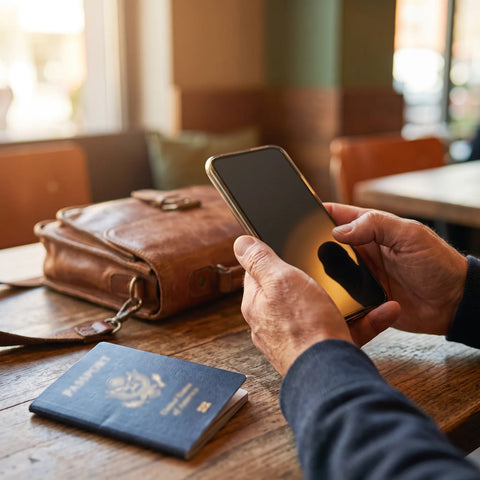
In short: an eSIM for Oman gives you local mobile data as soon as you land in Muscat, without expensive roaming and without looking for physical SIM card stores. It activates from your phone in minutes, works well in Muscat, Nizwa, and Salalah, and for a week-long trip, about 5-7 GB is usually enough. Check the current price before buying.
What is an eSIM for Oman and why you'll be thankful for it when you land
Oman is not a "Wi-Fi on every corner" destination. It's a country of mud forts, hidden wadis among mountains, and roads that stretch into the desert for hours. Precisely for this reason, arriving without data is one of the worst ways to start a trip: no Maps to get out of Muscat airport, no way to confirm your riad reservation, no way to notify whoever is picking you up. An Oman eSIM solves just that, and it does so before you even pass passport control.
An eSIM is, in essence, a SIM card that doesn't exist in physical format. It's a digital profile installed on your phone via a QR code that coexists with your usual line without occupying the physical tray. If you've never used one, we explain it in more detail in what an eSIM is. The underlying idea is simple: you land with internet, no roaming, no stress, and you decide on the fly how much you want to depend on it.
In this guide, we'll get practical: what real coverage you can expect between Muscat, Nizwa, and Salalah, how many GB you need depending on your type of trip, how to activate it step-by-step, the difference between eSIM, local physical SIM, and your operator's roaming, and the mistakes we often see repeated trip after trip.
Coverage in Oman: Muscat, Nizwa, Salalah, and the desert wadis
Mobile coverage in Oman is highly concentrated in urban centers and major tourist corridors. In Muscat, the capital, and its metropolitan area, the 4G signal is consistent: it works well for navigation, messaging, social media, and video calls without constant interruptions. Nizwa, with its fort and famous Friday souk, also has good urban coverage, as does Salalah, in the south, especially relevant if you travel during the khareef season.
The important nuance comes outside these cities. Oman is a country of long distances between points of interest, and much of its appeal lies precisely in sparsely populated areas: the wadis (the riverbeds and canyons that fill with turquoise water among mountains), the Wahiba Sands desert dunes, or the mountain roads to Jebel Shams. In these sections, the signal can weaken, drop to 3G, or disappear in the most isolated spots. This is not an eSIM failure: it's the country's topography.
| Area | Typical Coverage | What to do |
|---|---|---|
| Muscat and metropolitan area | Stable 4G, good for all uses | Use it normally, including real-time navigation |
| Nizwa (city center) | Stable 4G | No special precautions |
| Salalah (city center) | Stable 4G, somewhat more variable during khareef | Have an offline map downloaded in case the monsoon affects the signal |
| Wadis and canyons (Shab, Bani Khalid, etc.) | Limited or intermittent | Download the offline route before going down to the wadi |
| Desert (Wahiba Sands, Rub al Khali) | Very limited or non-existent in sections | Book an excursion with a guide or a vehicle with satellite communication if you venture off the tourist circuit |
| Mountain roads (Jebel Shams, Jebel Akhdar) | Irregular, improves in villages | Have plenty of gas and water: signal isn't the only thing that's scarce |
To maximize coverage, PuraSIM eSIMs for Oman connect to available local networks through roaming agreements, seeking the best signal in each area rather than relying on a single operator. If you want to understand how this works under the hood, we explain it in what data roaming is.

Oman eSIM vs. roaming from your usual operator
This is probably the question that can save you the most money in the article. International roaming from European and Latin American operators in a destination like Oman often activates "data package outside the EU" rates that quickly skyrocket, with low daily limits and reduced speeds once you exceed them. Before traveling, it's advisable to check the current price directly with your operator: in many cases, you'll find that the cost does not outweigh an eSIM.
The practical difference between the two options:
- Traditional roaming: usually bills in data blocks with thresholds that, when exceeded, slow down the connection or incur additional charges. It depends on your home operator's policy, not the local network.
- PuraSIM eSIM for Oman: you contract the GB you need for your trip, at a cost designed for tourist use, with activation in minutes from your phone.
If you want to delve deeper into the technical comparison and the cases where roaming still makes sense (very short trips, for example), we have a dedicated guide: eSIM vs roaming. The short answer for Oman: if you stay more than two or three days, the local eSIM usually comes out ahead, both in cost and connection speed.
Data SIM for Oman: eSIM, local physical SIM, or roaming?
If you're searching for "Oman data SIM," it's probably because you're considering another classic option: buying a physical SIM from a local operator as soon as you land. Oman has two main operators, Omantel and Ooredoo, with sales points at Muscat airport and in major city shopping centers. It's an option that works, but it comes with friction that many travelers prefer to avoid:
- You have to wait in a physical queue, sometimes tired after a long flight.
- You need to carry your passport, and depending on the point of sale, fill out registration forms.
- It occupies your phone's SIM tray, which means taking out your usual card or being without your home line while using the local one.
- If your flight lands outside business hours, the counter might be closed.
The eSIM eliminates these frictions because it's purchased and installed before leaving home: you arrive with the profile already loaded and only have to activate data upon landing. If you've never thoroughly compared both options, here's the complete analysis: international chip vs eSIM. For most travelers to Oman – stays of one to two weeks, normal use of maps and social media – the eSIM is the option with the least friction and most control over spending.
How many GB do you need for your trip to Oman?
The question we get asked the most. The short answer: for a typical one-week trip, moving between Muscat, Nizwa, and a few excursions to the wadis, 5-7 GB is usually sufficient. The long answer depends on how you use your mobile phone.
| Usage Type | Approximate Daily Consumption | Activity Example |
|---|---|---|
| Basic | 300-500 MB | Occasional maps, WhatsApp, a few quick searches |
| Moderate | 800 MB - 1.5 GB | Continuous GPS navigation, social media, photos, and a few short videos |
| Intensive | 2-4 GB | Remote work, video calls, streaming, high-quality content uploads |
If you're going to drive a lot on your own—and in Oman, this is common, as many of the best places are only accessible by car—assume that GPS navigation in the background consumes data constantly, even with the screen off. Add to that if your plan is to rent a 4x4 and explore wadis on your own for several days.
If you're running low, it's no problem: PuraSIM plans allow you to top up data without changing eSIMs or going through the entire activation process again. You can see the available plans for Oman on this Oman eSIM plans page.
How to activate your eSIM for Oman step by step
The process is identical whether you do it before leaving home or if you leave it for the airport, and it takes no more than five minutes:
- Purchase your plan for Oman at purasim.com. You will receive the activation QR code by email.
- Install the eSIM profile: on iPhone, Settings → Mobile Data → Add Data Plan; on Android, Settings → Connections → SIM Manager (the exact path varies slightly depending on the manufacturer).
- Scan the QR code or manually enter the activation data if your home operator blocks the camera for this use.
- Set the PuraSIM eSIM as your default data line, leaving your usual SIM only for calls and SMS if you wish to keep it active.
- Activate data roaming specifically within the eSIM settings: this is a step many people forget and is the most common reason for "my eSIM isn't working" upon arrival.
You can install the eSIM days before your trip without fear of "using it up": data consumption doesn't start until you actually activate it at your destination. If you prefer a visual guide with screenshots for each operating system, you can find it in how to install an eSIM.
Before purchasing, check your phone's compatibility. Most iPhones from XS onwards, Samsung Galaxy from S20 onwards, and Google Pixel from 3 onwards support eSIM. You can verify this in Settings → General → About: if your model is compatible, the "eSIM" or "Add Data Plan" option will appear among the line options.

Common mistakes when using an eSIM in Oman (what almost no one tells you)
Beyond the basic steps, there are a series of details that make the difference between arriving calmly or spending the first day struggling with your phone:
- Don't confuse "installing" with "activating." You can have the eSIM profile installed on your phone weeks before your trip without it consuming a single MB. The counter starts when you activate data roaming for that line, so installing in advance is free and saves you stress at the airport.
- Airplane mode with Wi-Fi on is not the same as having data. In Oman, outside of hotels and some cafes, open public Wi-Fi is scarce. Don't assume you'll "get by on Wi-Fi" outside Muscat.
- Navigation apps consume battery and data even in the background. If you're going on long road trips, bring a car charger: running out of battery in the middle of a desert stretch is more inconvenient than running out of data.
- Digital entry forms might require a connection before landing. If your country requires any prior digital process, it's advisable to have it resolved with the plane's Wi-Fi or before leaving, rather than relying on the eSIM activating at the exact moment of landing.
- If you use public Wi-Fi networks in tourist areas, especially for payments or banking, an extra layer of protection is worthwhile. We explain it in eSIM and travel privacy.
- GPS works without data, map apps don't always. Your phone's GPS chip locates your position even if you don't have coverage; what needs data is to download the map or recalculate the route. That's why downloading the Oman map offline before going down to a wadi solves much of the problem, even if you lose signal.
Connectivity tips for your trip through Oman
With the eSIM sorted, these are the adjustments that really make a difference on the ground, especially if your itinerary combines city and nature:
- Download offline maps of Muscat, Nizwa, Salalah, and the wadi area you plan to visit before leaving your hotel. Google Maps and Maps.me allow you to save entire regions.
- Share hotspot wisely. If you're traveling in a group and plan to share a connection from a single phone, consumption quickly skyrockets. Reserve it for when it's truly needed, not as a permanent car Wi-Fi.
- Take advantage of accommodation Wi-Fi for heavy downloads—videos, app updates, photo backups—and save mobile data for navigation and messaging during the day.
- Carry a power bank. Constant GPS navigation on long road trips is one of the things that consumes the most battery while traveling, even more than taking photos.
- If you're going during the khareef season in Salalah, keep in mind that the monsoon can occasionally affect the signal in the most exposed coastal areas; it's not typical, but it's advisable not to rely completely on the connection during those days.
For general tips that work in any destination, not just Oman, we have a specific guide on how to save data with an eSIM while traveling.
Frequently asked questions about eSIM for Oman
When should I activate the eSIM for Oman?
You can install the profile on your phone before leaving home, without it consuming any data. The actual activation – the moment your plan starts counting – is up to you: you can do it as soon as you land in Muscat or configure it to activate automatically upon detecting a local network, depending on the setting you choose on your phone.
Is my phone compatible with eSIM for Oman?
Most smartphones manufactured from 2018-2019 onwards are: iPhone XS and later, Samsung Galaxy S20 and later, Google Pixel 3 and later, and many more recent models from other brands. Check in Settings → General → About by looking for the "eSIM" or "Add Data Plan" option.
What's the difference between an eSIM and a physical data SIM in Oman?
A physical SIM is purchased upon arrival, usually at Muscat airport or at Omantel or Ooredoo stores, and requires a passport, queuing, and occupying your phone's SIM tray. An eSIM is purchased and installed online before traveling, doesn't occupy a physical tray, and can be ready without relying on business hours upon landing.
How much does roaming in Oman cost with my usual operator?
It varies greatly depending on the operator and country of origin, so the most reliable way is to check the current price directly in your company's app or website before traveling. Typically, roaming outside regional agreements (like the EU) is significantly more expensive than purchasing a local eSIM designed for tourists, especially if the trip lasts more than a couple of days.
Can I keep my usual phone number while using the eSIM in Oman?
Yes. The eSIM occupies a separate line from your physical SIM, so you can keep your usual SIM active for calls and SMS while using the PuraSIM eSIM only for data. You don't have to choose between being reachable and having local internet.
What happens if I run out of data in Oman?
You won't suddenly lose coverage: you can purchase a top-up from the PuraSIM app or customer panel, and it will be applied to the same eSIM within minutes, without needing to reinstall anything or buy a new plan from scratch.
Does the eSIM work throughout Oman, including wadis and the desert?
It works wherever the local network reaches, which is good in Muscat, Nizwa, and Salalah, but becomes intermittent or disappears in sections of wadis and the desert due to the country's topography itself, not because of an eSIM limitation. For these areas, the recommendation is to download an offline map before getting out of the car.
Activate your eSIM before you leave and arrive connected from the first moment, without roaming and without airport queues.
View eSIM plans for Oman →