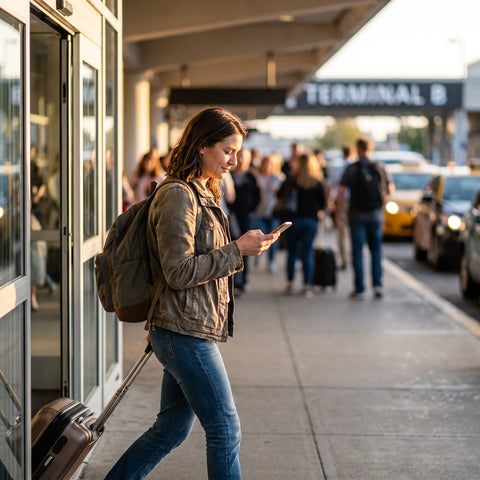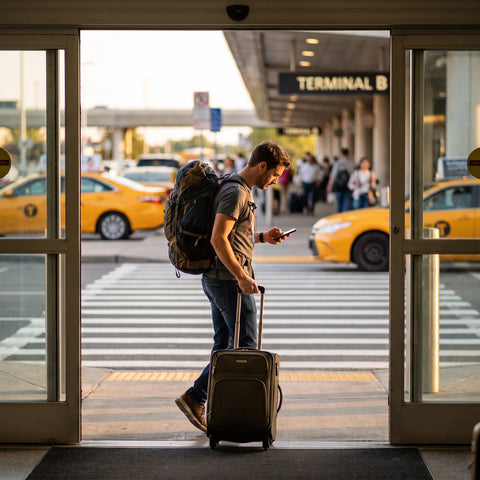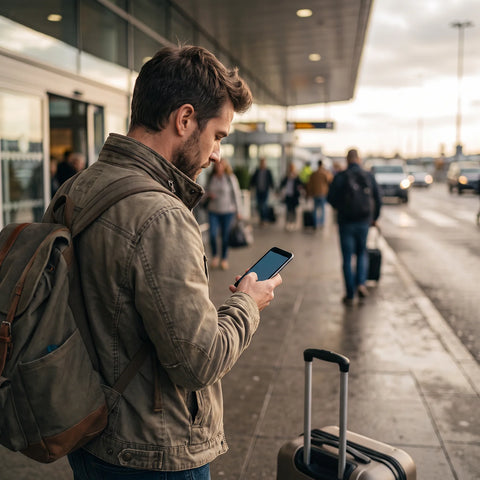
In short: a tourist SIM card in Spain (or any destination) is still a valid option, but for most travelers, an eSIM is more convenient: you activate your data before landing, with no queues or counters, and the price is now on par with local tourist SIMs. A physical SIM only wins if you need a local number or your phone doesn't support eSIM.
Tourist SIM card vs. eSIM: the short answer
For most travelers, an eSIM is more convenient than the traditional tourist SIM card: you connect as soon as you land without looking for a counter, without registering your passport, and without removing your Spanish card from your phone. A physical tourist SIM only pays off in a couple of very specific scenarios, which we'll look at in more detail below.
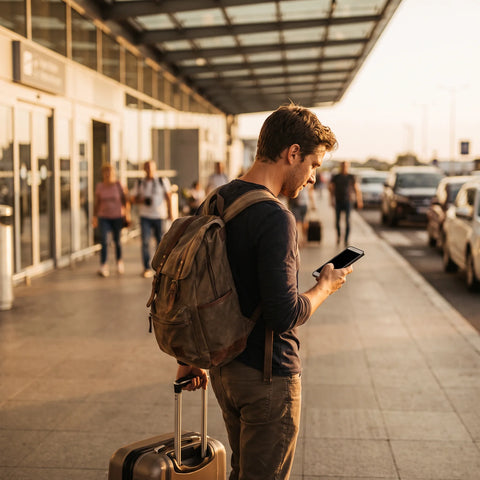
The most noticeable difference is the time and hassle on the first day of your trip. With a tourist SIM, you have to locate the store or operator counter, wait in line, show your passport, and wait for them to activate your line, sometimes with your luggage in tow and eager to get to the hotel. With an eSIM, you get everything ready from home, calmly, and arrive already browsing. In terms of price, they are now very similar, and often an eSIM is cheaper than a SIM specifically designed for tourists that they offer you right after you leave the terminal.
What each one is
Before comparing prices, it's important to understand what you're buying in each case, because they are not the same, even though they solve the same problem: having data abroad.
A tourist SIM card (which you'll see in English as tourist SIM or tourist SIM card) is a physical card from a local operator that you buy at the airport, a kiosk, or a phone store in the destination country. It comes with a number from that country and you usually pay for a tourist plan with a certain amount of GB and specific days. To use it, you have to take out your usual SIM, keep it safe, and insert the new one into your phone's tray.
An eSIM is a digital SIM: there's no plastic to insert, it's installed on your phone by scanning a QR code and coexists with your Spanish card without needing to remove it. You buy it online before traveling, at any time and from anywhere, and activate it when you land. It's an international chip in digital format: if you want to see that comparison in more detail, in international chip vs. eSIM we break it down point by point.
Real price of each option
Price is no longer the clear advantage of the local SIM it once was years ago. Tourist SIMs sold at the airport often carry a margin designed for tourists arriving in a hurry, while eSIMs bought online can be compared calmly, with plans starting from ~0.85 $ (indicative) depending on the destination and GB contracted.
| Aspect | Local tourist SIM | Travel eSIM |
|---|---|---|
| Starting price | Tourist price, sometimes inflated | From ~0.85 $ (indicative), comparable |
| Where to buy | Airport or store in the country | Online, before or during the trip |
| Paperwork | Passport and operator registration | None |
| Local number | Yes | No (data, apps, and VoIP yes) |
| Keep your Spanish SIM | Yes, with risk of losing it | Not necessary, eSIM coexists with it |
| Time until data is available | From arrival, including queue | Minutes, already installed from home |
For the same amount of GB, the eSIM often matches or beats the price and saves you the extra cost of the counter. And compared to your Spanish operator's roaming, both options win hands down: check eSIM vs roaming to see the real difference in euros, especially if traditional roaming can skyrocket in certain countries. An important nuance: when buying a tourist SIM at the airport, you can't always compare plans calmly, because the seller offers you their own and little else; online, on the other hand, you choose exactly the GB and days you need, without paying extra for a package you won't use.
Where to buy a tourist SIM: airports and stores
A very common question before traveling is whether you'll find a counter with tourist SIM cards waiting for you at every airport. The honest answer is no: not all airports have a mobile operator stand in the arrivals area, and those that do are not always open at all hours. In small airports, on early morning flights, or in secondary terminals, it's easy to arrive and find no one selling tourist SIMs.
Outside the airport, tourist SIMs are also sold in official operator stores in the city center, in some newsstands, and in large supermarkets, depending on the country. The problem is that this means traveling without data, looking for addresses and opening hours, precisely when it's most convenient to have a connection to get around.
This is where the eSIM completely changes the approach: it doesn't depend on whether or not there's a counter at your arrival airport, because you buy it online from anywhere and activate it whenever you want. There's no such thing as a "physical eSIM" sold at a stand: it's a digital profile that you install yourself, so it doesn't matter if you land at three in the morning in an empty terminal. If it's your first time installing one, the step-by-step guide is in how to install an eSIM.
Convenience and lost time on the first day
This is where the eSIM gains even more distance. With a tourist card, the first day of your trip is spent on logistics: finding the store, waiting in line, registering with your passport, carefully changing the card so you don't lose yours, and waiting for your line to be activated. If you land at night or in a small airport, there might not even be a counter open.
With an eSIM, all that disappears. You install the profile with Wi-Fi before leaving home, with plenty of time, and when you land, you simply activate the data: internet in 1 minute. You don't handle tiny plastic cards with cold hands from the plane, you don't risk your Spanish SIM at the bottom of a backpack, and you don't depend on store hours or stock availability. For a short weekend or a layover, that convenience can be worth more than a few cents difference in price.
Tip: only keep your physical Spanish SIM in a safe place if you end up using the tourist one. With an eSIM, you don't even touch it, so there's no risk of losing your usual card during your trip.
Coverage and local number
In terms of coverage, both options rely on local operators, so the signal is practically similar. The tourist SIM uses the network of the specific operator that issues it; a good eSIM routes through the local networks available in that country. In well-connected destinations, you won't notice a real difference in quality between the two.
The genuine advantage of the tourist SIM is still the local phone number: if a bank, a delivery app, or a service in the country requires a local mobile number to send you a verification SMS, the local SIM solves this directly. A data eSIM does not provide a country number, although it does work for WhatsApp, internet calls, maps, and payments, which cover the vast majority of a normal tourist's needs. For specific procedures that require a local SMS, it's the only real difference worth considering.
Common mistakes and what almost no one tells you
There are several ideas circulating about tourist SIMs and eSIMs that don't quite hold up when you look closely. Here are a few, along with tricks that do make a difference and almost no one explains.
- Myth: "a tourist SIM always has better coverage than an eSIM." This is not true: in most cases, both use the same local networks in the country, because a travel eSIM also connects to real operators on the ground.
- Myth: "all airports sell eSIMs at a counter." There's no such thing as a physical eSIM at a stand: since it's digital, you buy it online before you arrive, so it doesn't depend on whether the airport has an open store or not.
- Hidden gem: install the eSIM profile at home, using your Wi-Fi, one or two days before you fly. This way, you avoid depending on airport Wi-Fi (often slow or requiring registration) precisely when you're in the biggest hurry.
- Hidden gem: if your phone supports dual eSIM, carry a backup profile in case you run out of GB halfway through your trip, without having to look for a store at the last minute.
- Hidden gem: on public Wi-Fi networks in airports and hotels, it's wise to be careful, whether you have a tourist SIM or an eSIM. Basic travel privacy helps more than it seems; we explain it in eSIM, VPN, and travel privacy.
- Hidden gem: check how much data you have left halfway through your trip and adjust your usage if necessary, especially if you're going to do a lot of map or video streaming. There are simple tricks to stretch your GB in how to save data with an eSIM on your trip.
- Myth: "if I buy the tourist SIM at the airport, it's the cheapest option because it's right there." It's usually the opposite: the convenience of buying on the fly comes at a price, and by comparing online beforehand, you almost always get a better deal.
Which one to choose based on your trip
There isn't a single answer, but there is a simple guide depending on what you plan to do. These recommendations cover most scenarios for a traveler leaving Spain or arriving in Spain as a tourist.
- Normal tourist trip to any destination: eSIM. Convenience, competitive price, and zero paperwork. If you're going to Europe, check out eSIM Europe directly.
- Tourist arriving in Spain: also eSIM, with the advantage of being able to buy it from their home country before getting on the plane; here you have eSIM Spain.
- Layover or short weekend: eSIM, without a doubt. It's not worth wasting time at airport counters for a couple of days.
- Long stay with local procedures: Tourist SIM if you really need a local number for bank SMS or services.
- Old phone without eSIM: Physical SIM, as your phone must be eSIM compatible to use it.
If your mobile phone does not support eSIM, the tourist SIM is still a perfectly valid option; check compatibility in your phone's settings beforehand. And if you are traveling to a very specific destination, take a look at our guide to eSIM Peru, with details designed for that route.
Frequently asked questions
Do all airports sell SIM or eSIM cards for tourists?
No. Not all airports have a mobile operator counter in arrivals, and those that do are not always open at all hours. The eSIM solves this because it doesn't depend on any stand: you buy it online before flying and activate it when you land, whether your terminal has an open store or not.
What exactly is a "tourist SIM" or tourist SIM card?
It's a physical card from a local operator, designed for visitors, with a data plan (and sometimes calls) for a specific number of days or GB. It can be bought at the airport, in phone stores, or at some kiosks in the destination country, and it temporarily replaces your usual SIM inside your phone.
Is an eSIM or a tourist SIM card cheaper in Spain?
For the same amount of GB, they are usually very similar, and often the eSIM wins because the airport tourist SIM carries a margin designed for those arriving in a hurry. By buying the eSIM online, you can compare calmly and avoid the counter surcharge, with data starting from approximately $0.85 (indicative) depending on the destination.
Where can I buy a tourist SIM card if I am in Spain?
The main mobile operator stores in airports such as Madrid-Barajas or Barcelona-El Prat, in city centers, and in some tobacconists and kiosks usually have tourist plans. The alternative is to buy an eSIM Spain online before landing and avoid that search as soon as you arrive.
Does a tourist SIM card give me a local phone number?
Yes, that's its big advantage: it includes a local number for calls and local SMS. A data eSIM does not, although it works for WhatsApp, maps, payments, and internet calls, which cover almost everything a tourist needs day-to-day.
Can I use an eSIM without removing my physical SIM from Spain?
Yes. The eSIM coexists with your physical card, so you keep your Spanish number active for bank SMS while browsing with the eSIM's data. With a tourist SIM, on the other hand, you have to take out your usual card and keep it carefully so you don't lose it.
How do I know if my phone is compatible with eSIM?
Most mid-range and high-end phones from recent years are, but it's a good idea to check before buying. If your phone doesn't support eSIM, a physical tourist card is still a valid option. Check compatibility in your phone's connection settings before deciding.
Conclusion
The tourist SIM card still has its place if you really need a local number or your phone doesn't support eSIM. For everything else, the eSIM is more convenient due to its comfort, competitive price, and zero paperwork, without depending on whether your arrival airport has an open counter or not. Get your connection sorted before boarding and land browsing, with no queues or card changes.