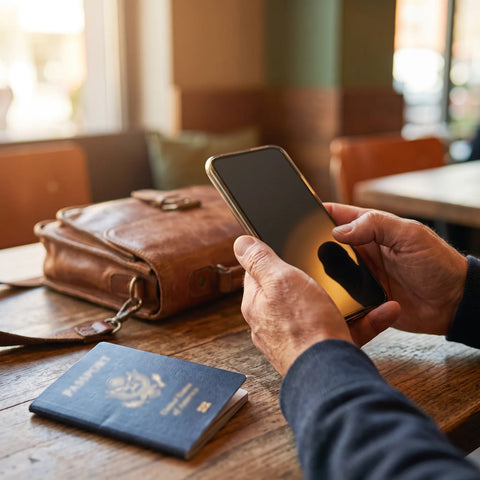
In short: the Benin eSIM gives you 4G internet as soon as you land in Cotonou, without having to find a store or register your passport. Coverage is solid in the south (Cotonou, Porto-Novo, Ouidah) and more patchy further north. For one or two weeks of travel, 3-6 GB is usually more than enough, and activation can be done from home in a minute.
Internet in Benin: what to expect
Direct answer: in Benin you will have good 4G connection in Cotonou, Porto-Novo and main cities, and more irregular coverage in rural inland areas. With a Benin eSIM, you connect to the local network as soon as you land, without buying a physical SIM or registering your passport in a store, and with Spanish support if anything goes wrong during your trip.
Benin's official capital is Porto-Novo, but the economic heart and real gateway is Cotonou, where Cardinal Bernardin Gantin International Airport is located. The country's mobile connectivity has improved significantly in recent years: 4G is now the norm in major cities, with enough speed for maps, messaging, social media, and light video calls without constant interruptions. Outside urban areas and on the way to Ganvié, the northern parks, or Ouidah's historic center, the signal drops to 3G or disappears at times, which is quite common throughout West Africa and not exclusive to Benin.
If you've never used an eSIM and want to understand the technology before buying anything, you should read what a virtual eSIM is exactly and how it differs from a traditional physical card. In two sentences: it's a digital profile installed via QR, it doesn't take up your physical SIM tray, and you can have several active lines on the same phone.

Coverage and signal availability
Coverage is concentrated in the south of the country, which is also the most populated strip and where almost all tourism is concentrated. In Cotonou, Porto-Novo, Abomey-Calavi, and Ouidah you will have stable 4G most of the time. Towards the north (Parakou, Natitingou, Pendjari National Park) the network becomes scarcer and it is advisable to download maps in advance, because there is not always room for on-the-fly improvisation.
What to expect depending on the area:
- Cotonou and metropolitan area: Solid 4G, suitable for everything, including video calls.
- Porto-Novo and Ouidah: Reliable coverage in urban areas, slightly weaker in the outskirts.
- Southern highway axes: Decent signal, with occasional ups and downs between towns.
- North and national parks: 3G or no signal at all for long stretches; download maps before setting off.
Traveler tip: Before heading to Ganvié (the so-called "African Venice," on Lake Nokoué) or to the north of the country, download offline maps and share your route with someone. On the water and on the most remote tracks, the signal is intermittent, and it's not wise to depend on finding coverage exactly when you need it.
To avoid running out of data on longer stretches, it's a good idea to apply some tricks to save data with your eSIM while traveling and always carry a backup battery, because intermittently searching for coverage consumes more power than it seems.
Local operators in Benin
Benin's mobile market is dominated by two large private operators, plus the expanding state-owned operator. Travel eSIMs rely on the networks with the best coverage in each area to provide you with the most stable connection available at every point of your journey, without you having to worry about which one to choose.
| Operator | Network type | Strength |
|---|---|---|
| MTN Benin | Extensive 4G | Best overall coverage in the country |
| Moov Africa Benin | 4G in cities | Good presence in the south |
| Celtiis (state-owned) | Expanding | Growing public network |
The advantage of an eSIM is that you don't have to choose or compare SIMs in a Cotonou store within hours of landing: the profile automatically connects to the network with the best signal available at any given time. If you're wondering what the real difference is between this and using your Spanish operator's roaming, we break it down in detail here: eSIM vs roaming, complete comparison.

How many GB do you need for your trip
For a typical one- or two-week trip to Benin with normal tourist use (maps, WhatsApp, social media, and photos), a reasonable reference is 3-6 GB. If you plan to make a lot of video calls, work on the go, or share your connection with a laptop via hotspot, go for 10 GB or better yet, choose a rechargeable plan that you can top up as you go.
Estimation by traveler profile:
- Essential (maps, messaging, some email): 1-3 GB for one week.
- Tourist (social media, photos, some video): 4-6 GB for one or two weeks.
- Intensive (video calls, hotspot, daily content uploads): 10 GB or rechargeable plan.
| Trip duration | Light usage | Normal tourist usage | Intensive usage |
|---|---|---|---|
| 3-5 days | 1-2 GB | 2-3 GB | 5 GB |
| 1 week | 2-3 GB | 3-4 GB | 8 GB |
| 2 weeks | 3-4 GB | 5-6 GB | Rechargeable |
In Benin, there isn't as much reliable public Wi-Fi as in more touristy destinations in other regions, so in practice, you'll mostly be relying on your eSIM during the day. If you connect your laptop to hotel or cafe Wi-Fi networks for work, it's a good idea to review some basic concepts of privacy and VPNs when traveling, as open networks at airports and accommodations are not always trustworthy.
eSIM vs local SIM vs roaming in Cotonou
You could buy a local SIM upon arrival, but in Benin, that means finding an official operator's store, presenting your passport for mandatory registration (a common requirement in the region), and manually configuring the APN in a language you might not master. With an eSIM, you skip these three steps: you arrive with internet already working from the moment you turn on your data.
Quick comparison:
- eSIM: ready before you fly, activated in a minute, no paperwork or queues, Spanish support if something gets stuck.
- Local SIM: can be cheaper per GB if you're staying for a long time, but requires a physical store, passport registration, and some French, which is the official language.
- Roaming from your Spanish operator: outside the European Union, the cost can easily skyrocket and exceed several euros a day; it's advisable to deactivate it and not rely on it as your main plan.
For a short or medium stay, the eSIM clearly wins for convenience and for not being cut off upon arrival, which is when you need it most: for a taxi, the hotel, and to announce that you've landed safely. If you're settling in Benin long-term, a local SIM with a Beninese number eventually makes economic sense; meanwhile, the eSIM perfectly covers the start of your trip. And before taking off, don't forget to check exactly what data roaming is and deactivate it on your Spanish line to avoid surprises on your bill.
Who travels to Benin (and why an eSIM fits)
Benin is not yet a mass tourism destination, and that is reflected in the profile of those who travel there. There is cultural tourism attracted by Ouidah and the Voodoo route, travelers who combine the country with a wider circuit through West Africa, and also professional movement: Cotonou is a commercial port in the sub-region, with delegations and business meetings where there is no room to arrive without coverage.
If you're traveling for work, with back-to-back meetings or needing to be available by email from the first minute, you'll be interested in our guide on eSIM for business trips and corporate events, designed precisely for that type of agenda. And if your profile is the opposite - traveling calmly, avoiding high season and taking advantage of calmer rates and weather - you might also be interested in the approach of our guide for those who travel in low season, with tips that apply just as well to a destination like Benin.
Common mistakes almost nobody tells you about
Beyond the obvious (passport, entry documentation, or the yellow fever certificate, usually mandatory to enter Benin), there are small details that make a difference on the ground and that almost no guide mentions:
- Installing the eSIM at the departure airport is useless if you don't activate it in time. Many people install the profile, leave it "saved" and forget to activate data upon landing. Activate it the moment you land, not before or after.
- The operator name you see on screen may change during the trip. It's normal for your phone to switch between MTN and Moov depending on the area; it's not a fault, it's the eSIM searching for the best available signal at that exact point.
- The mandatory registration of physical SIMs with a passport is a measure that exists precisely to curb fraud, but for a tourist with only a few days, it eats into travel time; this is the main reason why so many people prefer an eSIM in destinations like this.
- Not all "unlocked" phones have an eSIM. Just because your device is unlocked doesn't automatically mean it has an integrated eSIM chip; it's advisable to check your phone settings or the technical specifications before buying, and not assume that just because the model is recent, it has it.
- French is dominant in paperwork and on the street. English is understood in very touristy areas, but for paperwork, signs, and conversations with motorcycle-taxis, French is the norm; having a downloaded translator saves more than one bad time.
Practical tips on the ground
Benin is generally a safe country to travel in its southern strip, but it is always advisable to get up-to-date information on the situation in the northern area (near the borders with Niger and Burkina Faso) before venturing into that part of the country. In terms of digital matters, with these tips you'll be on the safe side:
- Download offline maps of Cotonou, Ouidah, Abomey, and your specific route before you lose coverage, not when you've already lost it.
- French is the official language: have a translator downloaded in case local support or someone on the street doesn't speak English.
- Save data by playing video in low quality and uploading copies of photos only when you have reliable Wi-Fi.
- Carry a power bank: GPS, searching for coverage, and the country's heat consume battery faster than usual.
If you're going to travel by motorcycle-taxi (zémidjan) or negotiate prices in a market, having your phone with data and a translator handy makes your life much easier and avoids unnecessary misunderstandings.
How to activate your Benin eSIM
Ideally, you should get everything ready from home, without last-minute rush at the airport. You buy the Benin eSIM, receive the QR code, install the profile with your usual Wi-Fi, and leave it prepared to activate as soon as you land in Cotonou. As soon as you hit the tarmac and turn on the data, the connection usually appears within a minute.
Steps to follow:
- Check that your phone is eSIM compatible and unlocked (you can see this in your phone settings or the manufacturer's technical specifications).
- Purchase the Benin eSIM and receive the installation code by email.
- Install the profile from home, using Wi-Fi, to avoid using data or depending on mobile coverage.
- Upon landing in Cotonou, activate the eSIM data and deactivate roaming on your Spanish SIM so it doesn't interfere.
If this is your first time using this technology, we'll guide you step-by-step in our guide on how to install an eSIM, with screenshots for iOS and Android. With Spanish support available, if anything gets stuck during your trip, you won't have to resolve it in English or French from an internet cafe.
Frequently asked questions
Does internet work well in Benin with an eSIM?
Yes. In Cotonou, Porto-Novo, and the southern cities, you'll have stable 4G, sufficient for maps, messaging, social media, and light video calls without many interruptions. In the north and rural areas, the signal drops to 3G or disappears at times, so it's advisable to download offline maps before leaving the main urban centers.
What operators does the eSIM use in Benin?
The main operators in the country are MTN Benin, with the best overall coverage, and Moov Africa, with a good presence in the south. There is also Celtiis, the state-owned operator, which is expanding. The eSIM automatically connects to the network with the best signal at each point, without you having to choose or configure anything manually.
How many GB do I need for a trip to Benin?
For one or two weeks of tourism with maps, WhatsApp, social media, and photos, 3-6 GB is usually more than enough. If you make many video calls or share your connection with a laptop, 10 GB or a rechargeable plan is better. In Benin, there is little reliable public Wi-Fi outside of hotels, so plan to rely mostly on your eSIM during the day.
Is an eSIM better, or should I buy a local SIM in Cotonou?
For a short or medium stay, the eSIM clearly wins: you arrive with internet, without having to search for a store or register your passport, and with Spanish support. A local SIM might be cheaper per GB if you stay for a long time, but it requires an official store, mandatory registration, and some French. Many travelers use an eSIM upon arrival and only consider a local SIM if they extend their stay.
Do I need to deactivate roaming on my Spanish line if I use an eSIM in Benin?
Yes, it's advisable to deactivate it before you fly. If you leave roaming active, your Spanish operator may continue trying to connect and generate charges, while the local eSIM handles the data. Deactivating roaming and leaving only the eSIM active for data is the safest and most economical combination.
Can the Benin eSIM be used for regular calls?
Travel eSIMs are primarily designed for data, not to replace your usual call and SMS line. For calls, you can continue to use your Spanish number through apps like WhatsApp or Telegram with Wi-Fi or eSIM data, which is what the vast majority of travelers do nowadays.
Is it safe to travel to Benin?
The southern strip of the country, where Cotonou, Porto-Novo, and Ouidah are located, is considered a safe destination for tourism. The northern area, near the borders with Niger and Burkina Faso, requires consulting updated official recommendations before traveling. Having your phone connected with maps and a translator handy provides extra peace of mind on the ground, especially if you are traveling alone.
Conclusion
With a Benin eSIM, you arrive in Cotonou already connected: taxi, map, messaging, and translator working from minute one, without searching for stores or registering your passport at any counter. Solid coverage throughout the south, a couple of well-calculated GB depending on your trip type, and downloaded maps for the interior are all you need to avoid relying on luck. Prepare your Benin eSIM before you fly and land in Cotonou with internet in your pocket.