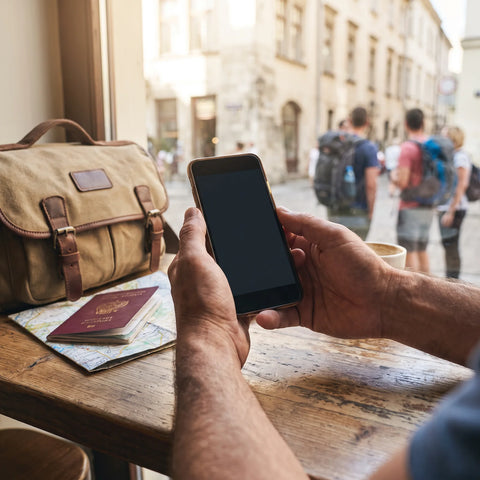
Landing at Galeão or Guarulhos and having mobile internet before leaving the baggage claim carousel is what separates a smooth trip from one full of scares. With a PuraSIM Brazil eSIM, you connect to local networks as soon as you get off the plane, without changing your physical card and, above all, without paying your carrier's exorbitant rates. In this guide, I'll tell you why you need data in Brazil, what coverage you'll find from Rio to the Amazon, and how to get everything ready in a minute.
Why you need data in Brazil from minute one
Brazil is a continent-sized country: over 8.5 million square kilometers and distances measured in flight hours, not car minutes. Arriving connected isn't a luxury; it's essential for getting around. Without data, you can't order an Uber or a 99 (the two dominant transport apps in the country), open Google Maps to avoid getting lost in the wrong favela, or confirm your hostel reservation via WhatsApp, which in Brazil is practically the operating system for daily communication.
The reality is that many businesses, taxi drivers, and guides only respond via WhatsApp, so without a connection, you're left out of the loop. An eSIM solves this even before you hit the streets: you activate it in advance from home, and when you land, your phone automatically connects to the Brazilian network. You save yourself the queue at the airport's SIM card counter, the passport forms, and the uncertainty of whether a local SIM will work. If you want to better understand the technology behind it, I recommend reading what an eSIM is before continuing. With PuraSIM, you have 200+ destinations available and 24/7 Spanish support, so any questions can be resolved while you stroll through Copacabana.
Coverage and mobile networks: Vivo, Claro, and TIM
The Brazilian mobile market is mainly divided among three major operators: Vivo (the most extensive network with the best coverage in rural areas), Claro (strong in large cities and with good 4G/5G speeds), and TIM (very competitive in the Northeast and inland). A quality eSIM relies on these local networks through wholesale agreements, so you connect to the best available signal without having to choose an operator yourself.
5G is already active in major capitals (São Paulo, Rio, Brasília, Belo Horizonte, Salvador), and 4G coverage is very solid along the entire coast and in tourist areas. Where things get complicated is in the deep interior, the Amazon, and some stretches of highway between states, where the signal can drop to 3G or disappear. Even so, for 95% of a typical trip, you'll have plenty of data.
| Operator | Strong point | Where it excels |
|---|---|---|
| Vivo | Greater geographical reach | Rural and inland areas |
| Claro | 4G/5G speed | Large cities |
| TIM | Good balance of price/coverage | Northeast and coast |
The advantage of an eSIM over a single-operator local SIM is clear: you don't bet everything on one network. If Vivo is weak in an area but Claro is good, the service will seek the optimal connection. This gives you peace of mind in a country where coverage varies so much from state to state.

How many GB to get depending on the type of trip
Calculating your data is easier than it seems if you think about your daily routine. A trip to Brazil usually combines constant maps, messaging, social media, and some streaming at the hotel. The good news is that almost all hotels, hostels, and cafes offer WiFi, so your eSIM mainly covers on-the-go use. Here's a realistic guide based on traveler profile.
- Short getaway (5-7 days): 3-5 GB will be plenty if you use WiFi for long videos.
- Two-week trip: Between 8 and 10 GB for maps, WhatsApp, photos, and daily browsing.
- Full month or digital nomad: 15-20 GB or a plan with ample data, especially if you work online.
- Trip with lots of video or connection sharing: Add 2-3 GB extra for the hotspot feature.
One advantage of PuraSIM is that you can share your hotspot connection with your partner or laptop at no additional cost, so if two people are traveling, a more generous plan on a single phone sometimes makes sense. If you're still in doubt, this guide on how much data I need for travel will help you refine your calculation based on your apps. And remember: you can always start with a moderate plan and recharge if you run short, because data doesn't magically evaporate halfway through your trip.
How to activate your eSIM with the QR code
Here's the magic: installing an eSIM is a one-minute task and requires no technical knowledge. The process is almost identical on any compatible modern mobile (iPhone XS or later, most Samsung Galaxy, Google Pixel, and high-end Xiaomi). Ideally, you should install it at home, with WiFi, before flying, and leave the activation for when you land.
Romi's tip: install the eSIM using your home WiFi, but DO NOT activate it until you arrive in Brazil. That way, the data counter starts exactly when you need it, not before.
The step-by-step is simple:
- Purchase your plan on PuraSIM and receive the QR code instantly via email.
- On your mobile, go to Settings > Mobile Data > Add eSIM (or "Add data plan").
- Scan the QR code with the camera and confirm the installation.
- Upon arrival in Brazil, activate the data for that line and select data roaming enabled for that eSIM.
If your mobile doesn't read QR codes or you prefer to do it manually, PuraSIM also provides the manual installation data. To understand in detail the difference between installing and activating, it's helpful to review what an eSIM is. And if you get stuck at any step, 24/7 Spanish support will guide you through chat as you do it, without strange technical jargon or endless waits.
Connectivity by zones: from Rio to the Amazon
Brazil offers such diverse destinations that connectivity varies considerably depending on where you go. In large cities like Rio de Janeiro and São Paulo, you'll have plenty of 4G and 5G: you can livestream from Christ the Redeemer or check the São Paulo subway map without interruption. In Salvador de Bahía, the cultural capital of the Northeast, urban coverage is excellent, and you'll only notice weaknesses in small towns in the Bahian interior.
The Northeast beaches (Jericoacoara, Pipa, Porto de Galinhas) usually have good signal in tourist centers, although in isolated dunes and coves, it's advisable to download offline maps just in case. In Foz do Iguaçu, next to the waterfalls, coverage is solid on the Brazilian side and in the city, perfect for sharing photos of Devil's Throat instantly.
The exception is the Amazon: in Manaus you will have normal urban coverage, but as soon as you go deep into the river or jungle lodges, the signal disappears. There, not even the best eSIM can do miracles: download everything before you leave and enjoy the disconnection.
My practical recommendation is to always download offline maps of the region before moving to remote areas. For urban and coastal itineraries, which are the majority, an eSIM gives you an experience identical to that of a local. If your route combines Brazil with a neighboring country, take a look at the eSIM for Argentina, because many travelers link Foz with Buenos Aires on the same trip.
Language, currency, and safety: what you should know
Beyond connectivity, traveling to Brazil with data makes it easier to handle three key daily issues. The first is language: Portuguese is spoken in Brazil, not Spanish, and although you'll be somewhat understood, having internet allows you to use a real-time translator to read menus, signs, or talk to a taxi driver. Portuñol works for the basics, but a translator in your pocket will get you out of many tight spots.
The second is currency: the Brazilian Real (BRL). With data, you can check the exchange rate instantly before withdrawing money or paying, avoid surprise fees, and use local payment apps. The third, and most important, is safety: in large cities, it's advisable to move carefully, not display your phone in crowded areas, and request transportation via app instead of hailing taxis on the street. Being connected helps you share your real-time location with a trusted person and always have emergency contacts handy.
- Language: Have a downloaded translator; Brazilian Portuguese has its own accent and idioms.
- Currency: Pay with card when possible and check the exchange rate with real-time data.
- Safety: App-based transport, discreet mobile use, and shared location with a family member.
Prices: roaming from your operator versus eSIM
This is where your wallet feels the difference. Traditional roaming from your Spanish operator outside the European Union is usually very expensive: we're talking about rates that can reach several euros per megabyte if you don't contract a specific bonus, or daily bonuses of 5 to 15 euros that accumulate day after day. On a two-week trip, that's easily more than 100 euros just for data, and often with uncomfortable speed limits. If you want to understand how that bill works, read what roaming is.
A PuraSIM eSIM changes the rules: plans starting from $1.49, transparent rates you see before paying, and no surprises when you get home. There are no surprise bills or per-minute charges. Let's compare a typical fourteen-day scenario in Brazil:
| Option | Approximate cost (14 days) | Drawbacks |
|---|---|---|
| Operator roaming (daily bonus) | €70-150 | Expensive, speed limits, bill surprises |
| Local SIM at airport | €15-30 | Queue, passport, changing your physical SIM |
| PuraSIM eSIM | From a few euros | None: QR in 1 minute, no roaming |
The eSIM wins in convenience and price. You connect without changing your physical card, so you keep your usual WhatsApp number for verifications and regular messages. If you're traveling to several countries, also check out the international eSIM, which covers entire regions with a single plan. Ready to connect? Choose your eSIM for Brazil and relax.
Frequently asked questions
Does the eSIM work as soon as I land in Brazil?
Yes. If you installed it before traveling, you just need to activate the data for that line upon landing, and your phone will connect to the Brazilian network (Vivo, Claro, or TIM) in a matter of seconds. You don't need WiFi for it to connect once activated.
Do I keep my WhatsApp number with the eSIM?
Absolutely. The eSIM only provides data: your physical SIM and your Spanish number remain on your phone. WhatsApp will continue to work with your usual number, so you won't lose chats or verifications.
Can I share data via hotspot?
Yes, PuraSIM plans allow you to share your connection via hotspot at no additional cost. This is ideal if you're traveling with your partner or need to connect your laptop to work from a café in São Paulo.
Is my mobile compatible with eSIM?
Most mobiles from 2018 onwards are: iPhone XS and later, mid-to-high-end Samsung Galaxy, Google Pixel, and many Xiaomi. Check in Settings if the "Add eSIM" option appears. If you have doubts, 24/7 Spanish support will confirm it for you.
Will I have coverage in the Amazon?
In Manaus and other Amazonian cities, yes, with normal urban coverage. But deep in the jungle or river, any operator's signal disappears. Download offline maps and guides before venturing out and take the opportunity to truly disconnect.
What happens if I run out of data halfway through my trip?
You can top up or buy a new plan from the app or website at any time, without having to visit a store. You receive the new QR instantly by email and remain connected without interruptions.
Conclusion
Traveling to Brazil connected is much easier and cheaper than your operator wants you to believe. With a PuraSIM Brazil eSIM, you have internet from minute one, coverage on the best local networks (Vivo, Claro, and TIM), the ability to share via hotspot, and zero surprise bills when you return home. You just need to choose your GBs according to your trip, install the QR in a minute, and activate the data upon landing. No queues, no changing your SIM, and no abusive roaming. This way, you can focus on what matters: the Northeast beaches, the rhythm of Rio, or the Iguazu Falls. Choose your eSIM for Brazil and pack your bags with the peace of mind of always being connected. To plan your route, also consult official Brazil tourism.