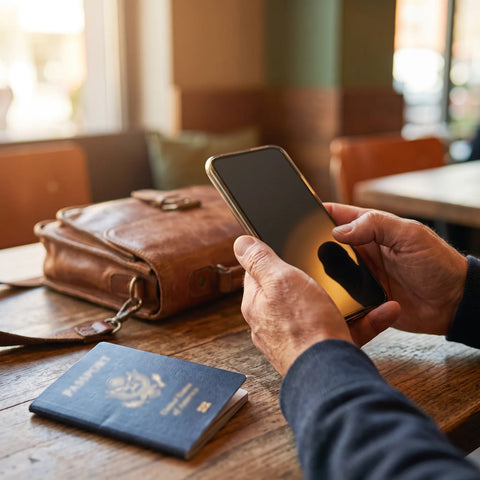
Crossing the pond to explore Argentina is one of those unforgettable trips: the tango of San Telmo, the roar of Iguazu Falls, the glaciers of Patagonia, and a Malbec-fueled asado in Mendoza. But with so many miles to cover, staying connected is key, and that's where an Argentina eSIM makes your life easier: you download your plan before leaving home, land in Ezeiza, and have data working as soon as you turn on your phone, with no airport queues or bill surprises. In this guide, we'll tell you why it's a good idea, which networks cover the country, and how to activate it in a minute.
Why you need data in Argentina
Argentina is a huge country, the eighth largest in the world, which means you'll be moving around a lot: internal flights, long-distance buses, and car journeys lasting several hours. Staying connected isn't a luxury; it's an essential tool to avoid getting lost. With data on your phone, you can open maps in real-time, hail a taxi via an app when cash is scarce, translate a menu, check bus schedules that change without warning, and let loved ones know you've arrived safely after a twelve-hour flight.
Arriving with a connection also saves you the first headache of your trip. Buying a local SIM as soon as you land means finding a kiosk, presenting your passport, registering the line (prepaid registration is mandatory in Argentina), and hoping the activation works: a process that can take a long hour with jet lag. With an eSIM, everything is sorted from your sofa at home: you buy the plan, receive the code, and just scan it. The moment your plane touches down, you turn on your phone and you're already browsing, ready to book your transfer to the city center or notify your accommodation. To better understand the technology, we recommend reading what an eSIM is before you travel.
Coverage and networks: Claro, Movistar, and Personal
Mobile connectivity in Argentina is supported by three major operators: Claro (part of América Móvil), Movistar (Telefónica), and Personal (Telecom Argentina). Together, they cover almost the entire country, and a good travel eSIM relies on their networks to give you signal wherever there's an antenna. In large cities and tourist areas, 4G LTE coverage is the norm, and 5G is already being deployed strongly in Buenos Aires, Córdoba, Rosario, Mendoza, and other provincial capitals following spectrum auctions in recent years.
It's wise to have realistic expectations depending on where you go. In the Buenos Aires metropolitan area and major tourist destinations, the signal is strong and fast. But Argentina has vast expanses of Patagonian steppe, Andean puna, and desert routes where the population is sparse and, therefore, so are the antennas: on the famous Route 40, in sections of deep Patagonia, or climbing to glaciers, it's normal to lose coverage for long stretches. No eSIM or local SIM can work magic where there's no network. Therefore, the recommendation is clear:
Always download offline maps of your route (Google Maps and Maps.me allow this) before venturing into Patagonia or the northwest. It’s the difference between staying oriented and being stranded in the middle of nowhere.
If you want to delve deeper into how these international connections work, check out our guide on what roaming is and why eSIM replaces it with an advantage.

How many GB you need based on your trip
The million-dollar question. Properly calculating your gigabytes prevents you from running out mid-trip or paying too much for data you won't use. As a general reference, moderate use (maps, messaging, social media, and some browsing) averages around 1 GB every 2 or 3 days. If you upload many stories, make long video calls, or stream frequently, multiply that figure generously. The good news is that with PuraSIM, you can choose the plan that suits your style, and if you run out of data, you can top up in seconds.
To give you a quick idea based on the duration of your stay, this indicative table will serve as a guide:
| Type of Trip | Duration | Recommended Data |
|---|---|---|
| City break (BA only) | 4-5 days | 3-5 GB |
| Classic route (BA + Iguazu or Mendoza) | 7-10 days | 8-10 GB |
| Grand South Tour (including Patagonia) | 2-3 weeks | 15-20 GB |
| Long trip or digital nomad | 1 month or more | 20 GB or top-up plan |
Remember that hotspot is included in PuraSIM plans, so you can share your connection with your tablet, laptop, or travel companion at no extra cost. If you're unsure about the numbers, our guide how much data I need for travel goes into much more detail by usage type.
How to activate your eSIM with a QR code step by step
Activating an eSIM is much simpler than it seems, and with PuraSIM, the entire process takes barely a minute. First, check two things: that your phone is compatible (almost all iPhones from the XS, Pixels from the 3, and most recent mid-to-high-range Samsung, Xiaomi, or Motorola devices are) and that it's unlocked from your carrier. Once that's done, follow these steps:
- Purchase your Argentina plan on PuraSIM and you'll receive a QR code by email within minutes.
- Connect to Wi-Fi at home or your hotel and open your phone settings.
- On iPhone, go to Settings > Mobile Data > Add eSIM; on Android, go to Settings > Connections > SIM Manager > Add eSIM.
- Scan the QR code we sent you. Your phone will automatically download the profile.
- Assign it a clear name (e.g., "Argentina") and leave your usual line as the default for calls and messages.
A golden tip: install the eSIM before leaving home, using your trusted Wi-Fi, but don't activate it until you arrive in Argentina. Most plans start counting from the first connection to an Argentine network, so you install it calmly in your home country and "turn it on" upon landing by activating data roaming for that eSIM line. This way, you don't lose a single day of your plan. If it's your first time, you might be interested in our international eSIM guide for details on any destination.
Connection by region: Buenos Aires, Iguazu, Patagonia, Mendoza, and Bariloche
Not all of Argentina is connected equally, so it's worth knowing what to expect in each key area. In Buenos Aires, the connection is excellent: fast 4G throughout the city, growing 5G, and Wi-Fi in many cafes, hotels, and shopping centers. Here you can navigate with transport apps, pay for the subway with the SUBE card, and share your Caminito photos without a problem. Iguazu Falls, in Misiones, has good coverage in Puerto Iguazu and at the park entrances, although inside the walkways, amidst so much jungle and water, the signal might falter: download the park map just in case.
Things change as you head south. Patagonia is the most demanding region: in El Calafate and El Chalten you’ll have reasonable urban connection, but as soon as you venture towards the Perito Moreno Glacier, the Fitz Roy trails, or the mythical Route 40, the signal disappears for miles. Bariloche, in the Lake District, offers good coverage in the city and the Cerro Catedral area, although in more remote mountain and lake circuits, it also cuts out. Mendoza, on the other hand, is very well connected in the capital and most wineries along the wine route, where you can book tastings and share your favorite Malbec live. The golden rule repeats: connected city, disconnected deep nature, so prepare your offline maps.
Practical tips: pesos, dollar blue, and vast distances
Beyond connectivity, there are three Argentine particularities that are good to know. The first is currency and inflation. Argentina has experienced years of high inflation, so prices change frequently and it's best to check everything at the moment. The Argentine peso devalues, and this is where the famous "dollar blue" comes in: for a long time, there was a gap between the official exchange rate and the parallel market rate. Today, the most practical thing for travelers is to pay with international cards (which usually apply a favorable exchange rate) or carry cash dollars and euros to exchange at authorized houses. Informing yourself of the daily exchange rate before traveling will save you headaches.
The second is to always have some cash in pesos: taxis, tips, fairs, kiosks, and small towns often don't accept cards, and ATMs charge high commissions for foreign cards and limit the amount per withdrawal. The third, and no less important, are the gigantic distances: from Buenos Aires to Ushuaia there are more than 3,000 kilometers, and many journeys in the south can only be reasonably covered by plane. Plan internal flights in advance and always have your eSIM data ready to manage bookings, check-ins, and last-minute changes from your phone. Having reliable internet turns a logistically complex trip into something much more manageable.
Prices: traditional roaming vs. eSIM
Here's the difference your wallet will notice. Traditional roaming outside the European Union is where Spanish operators really hit you: Argentina is outside the European flat rate, so connecting with your usual company can cost you several euros for each megabyte or daily rates of around 10-15 euros per day. On a two-week trip, we're talking about a bill that easily shoots up over 100 or 150 euros, sometimes without you realizing it until the bill arrives.
A travel eSIM plays in a different league. With PuraSIM, plans for Argentina start from $1.49, you know exactly what you're paying before you leave, there are no hidden charges or bill surprises, and you forget about roaming surprises forever. Let's compare them at a glance:
| Aspect | Traditional Roaming | PuraSIM eSIM |
|---|---|---|
| Price | €10-15/day or per MB | From $1.49, fixed plan |
| Activation | Call your operator | QR in 1 minute |
| Spending control | Difficult, bill post-paid | Total, paid in advance |
| Hotspot | Sometimes limited or extra | Included |
| Support | Variable | In Spanish 24/7 |
PuraSIM covers 200+ destinations worldwide with the same philosophy, so if your trip combines Argentina with neighboring countries, you might also be interested in our guides for eSIM for Brazil and the case of Chileans traveling abroad. Ready to connect? Choose your eSIM for Argentina and stop worrying.
Frequently asked questions
Will my eSIM work throughout Argentina?
It will work wherever there is coverage from Claro, Movistar, or Personal networks, which cover practically all cities, towns, and tourist areas. In remote stretches of Patagonia, the puna, or Route 40, the signal may disappear, just like with any local SIM, simply because there are no antennas. Download offline maps for those journeys.
Can I still use my home country number?
Yes. The eSIM coexists with your physical SIM, so you keep your home country number to receive calls and SMS (for example, bank verification codes) while using the eSIM data for browsing. However, keep your usual line with data roaming deactivated to avoid incurring charges.