What is an eSIM and how does Movistar use it in Argentina?
An eSIM is a digital chip already integrated into the mobile phone: instead of inserting a physical card, a profile with the line's data is downloaded by scanning a QR code. Movistar Argentina, like other local operators, uses it to activate mobile lines for customers who already live in the country and have an Argentinian identity document.
The concept often confuses two very different types of people: those who live in Argentina and want to switch from a physical card to a digital profile with their current operator, and those who are traveling to the country for a few weeks and want to have mobile data as soon as they land. The technology is the same in both cases, but the process, requirements, and ultimate goal are completely different. This article explains both paths so that everyone can identify which one applies to them.
Before proceeding, it is important to understand the basic concept: if you have never used one, this explanation of what an eSIM is addresses fundamental technical questions (which phones support it, how to install it, what happens if you change phones) before delving into the specific case of Argentina.
Which companies offer eSIM in Argentina?
The mobile operators providing service within Argentina are Movistar, Personal, and Claro, and all three primarily serve residents: people with Argentinian documents who contract a line for daily use in the country. Which of their plans support eSIM and under what conditions may vary, so if your intention is to contract a local line for living or staying for an extended period, it's best to confirm directly with each operator before proceeding.
There is a second group, separate from local operators: travel eSIM providers, specifically designed for those entering the country for a limited time and not looking to become a customer of an Argentinian company. PuraSIM is one of them, and its operation does not depend on the commercial network of Movistar, Personal, or Claro individually, but on data agreements that allow mobile use from the moment you set foot in the country.
| Provider type | Who it is for | What is needed to contract it |
|---|---|---|
| Movistar, Personal, Claro (local operators) | Residents or people with extended stays in Argentina | Argentinian identity document, line activation, in-store or operator app process |
| Travel eSIM (like PuraSIM) | Tourists and travelers passing through, of any nationality | Purchase online before or during the trip, without a local address or prior local line |
How to get a Movistar Argentina eSIM if you live in the country?
If you are already a resident and have an Argentinian identity document, the usual way to switch your Movistar line to an eSIM profile is through the operator's own channels: the account management application, the physical store, or Movistar's customer service. The process replaces the physical card with a digital profile, but the line, plan, and phone number remain the same.
The important thing here is to understand that this process assumes you are already a Movistar customer or are eligible to be one: that is, you have legal identity in the country and plan to stay long enough for it to make sense to open an account with a local operator. For someone who is just passing through, that first requirement is already a barrier.

How to request an eSIM from Movistar step-by-step?
Generally, the process for requesting an eSIM from a local operator like Movistar follows a similar logic in most countries, although the exact details of each app or store may change:
- Verify that the mobile phone is eSIM compatible (most mid-range and high-end models from recent years are).
- Start the process from the operator's app or in a physical store, presenting your identity document.
- Choose the data and minute plan corresponding to the line.
- Receive a unique QR code for that line.
- Scan the code from the phone settings to install the profile.
- Activate the line, which generally replaces the previous physical SIM if one existed.
This path makes sense when the goal is to have a stable line in the medium or long term. It is not intended for someone who arrives in Buenos Aires on a Thursday and leaves two weeks later: the process, waiting time, and identity requirements are designed for a different type of user.
How to buy a Movistar eSIM if you are not an Argentinian resident?
Here arises the question that actually drives much of the searches for "eSIM Movistar Argentina": someone who is traveling to the country and, unknowingly, assumes that the local operator is the only way to get mobile data upon arrival. In practice, contracting a Movistar line without being a resident and without an Argentinian document is usually not a simple or quick process, because the process is designed for customers who plan to stay.
The alternative that many travelers are unaware of —and that precisely solves this need— is an international travel eSIM. It is purchased online before leaving home, does not require an Argentinian document or residence in the country, and is activated as soon as you arrive at your destination. It does not replace Movistar as the reference operator for someone living in Argentina, but it fulfills the function that the traveler truly seeks: having mobile data working without going through a line activation process.
For someone who will only be in the country for a couple of weeks, becoming a customer of an Argentinian operator usually ends up being more hassle than a solution.
Those who want to better understand this difference between relying on a local operator in roaming mode and using an eSIM designed for travelers can review this comparison between eSIM and traditional roaming, which explains why international roaming is usually more expensive and less predictable.
Local eSIM vs. travel eSIM: what's the difference?
The confusion between both products is understandable because they share the same technology (a digital profile installed via QR), but they respond to different needs. The following table summarizes the most important differences when deciding which one is appropriate depending on the situation.
| Aspect | Local eSIM (Movistar or other Argentinian operator) | International travel eSIM |
|---|---|---|
| Identity requirement | Argentinian document, generally DNI | None: purchased with name and email |
| Where to contract it | Physical store or operator app, within the country | Online, from anywhere, before or during the trip |
| Argentinian phone number | Yes, includes line with local number | No: data only, no dedicated voice number |
| Intended validity for | Continuous use, month to month | Duration of the trip, from a few days to several weeks |
| Ideal for | Residents or people with long stays in Argentina | Tourists and business travelers passing through the country |
If you also have doubts about whether an eSIM or a traditional physical SIM is better for you in general (beyond the Argentinian case), this comparison between eSIM and physical SIM elaborates on it in more detail.
A specific example: two weeks between Buenos Aires, Bariloche, and Mendoza
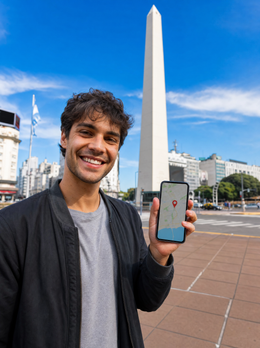
Let's consider a typical trip: someone flying from Mexico, Colombia, or the United States to Buenos Aires, spending a few days in the city, taking a domestic flight to Bariloche to explore Patagonia, and ending the trip in Mendoza before returning home. In total, fourteen days.
If this person were to search for "eSIM Movistar Argentina" thinking they needed to become a customer of the local operator, they would encounter a process designed for a different user profile: line activation, an Argentinian document, perhaps a visit to a physical store at a time during their trip when the last thing they want to do is spend hours on administrative procedures.
The simplest path for this case is different: buy the travel eSIM before leaving home, with a compatible phone, and leave it installed (but not activated) until landing in Ezeiza. From there, the person has mobile data to move around Buenos Aires, plan the flight to Bariloche, use maps and translation in Patagonia, and stay connected in Mendoza without relying on the Wi-Fi signal of each hotel. None of this requires becoming a customer of an Argentinian operator or processing local documentation: the travel eSIM for Argentina is activated directly from the phone.

How to activate a travel eSIM for Argentina in practice?
The process of installing a travel eSIM is shorter than activating a line with a local operator, precisely because it does not include identity procedures or long-term contracts. In general terms:
- Purchase the eSIM online before the trip, with Wi-Fi or data available.
- Install the profile by scanning the QR code received by email, ideally before leaving home.
- Leave it installed but not activated until arriving in Argentina.
- Activate it upon landing, which takes approximately 1 minute.
- Verify that the phone has data usage enabled for the newly installed eSIM line.
A fact that few travelers take advantage of: since it is a second digital line and not a replacement for the physical SIM, the phone has dual active lines. This allows you to continue receiving bank verification text messages or home app messages (those one-time codes that arrive via SMS) on your usual line, while all data consumption —maps, messaging, social media— runs on the eSIM. This combination avoids losing access to bank accounts due to not having the original line active, without needing to configure anything special.
For those who want to confirm before traveling if their specific phone supports eSIM, it is advisable to check this list of eSIM compatible phones, because not all models —especially those unlocked from markets where eSIM arrived later— support it.
What a travel eSIM for Argentina covers and how long it lasts?
A travel eSIM designed for Argentina is not limited to that single destination: when purchased as part of a catalog with coverage in more than 200 destinations, the same purchase and activation logic applies to the rest of the itinerary if the trip includes other countries in the region.
| Feature | Detail |
|---|---|
| Provider coverage | More than 200 destinations, including Argentina |
| Activation time | Approximately 1 minute once in the country |
| Activation period | Up to 180 days from the moment of purchase |
| Available support | 24/7, via email and WhatsApp, in several languages |
The 180-day period is especially useful for those who purchase in advance: you can sort out the eSIM weeks before your flight and activate it only upon arrival, without the clock starting to run from the purchase. And if the trip includes layovers or stages in other countries before or after Argentina, there is no need to contract a different eSIM for each leg.
Frequently asked questions
Do I need to be an Argentinian resident to get a Movistar eSIM?
To activate your own line with Movistar in Argentina, the process is designed for people with an Argentinian identity document. If you are only visiting the country, an international travel eSIM solves your data needs without this requirement.
Can I buy a Movistar eSIM before traveling to Argentina?
Activating a line with a local operator like Movistar generally needs to be completed within the country and with an Argentinian document. A travel eSIM, on the other hand, is purchased online from anywhere before your flight and is ready to be activated upon arrival.
What is the difference between an eSIM and a physical SIM in Argentina?
An eSIM is a digital profile installed via a QR code, without the need for a physical card or visiting a store. A physical SIM is the traditional card that needs to be inserted into the phone. Both can be used for the same type of service; the eSIM simply avoids the physical process.
Is my phone compatible with eSIM?
It depends on the model and, in some cases, whether the phone was unlocked from a region where eSIM was already available. Before purchasing, it's advisable to check your phone settings or a list of compatible models.
Can I use WhatsApp and Google Maps with a travel eSIM in Argentina?
Yes. Once activated, the travel eSIM provides access to mobile data like any conventional line, which includes messaging, maps, social media, and all other apps that use an internet connection.
Do I need Wi-Fi to activate the eSIM upon arrival in Argentina?
To install the profile (scan the QR code), it is advisable to have Wi-Fi or data available, which is why it is recommended to do so before leaving home. The final activation, once the profile is installed, does not depend on having Wi-Fi at the airport.
What happens if I have a problem with the eSIM during my trip?
For any installation or activation issues, support is available 24/7 via email and WhatsApp. This guide to common eSIM problems also reviews the most frequent causes and how to resolve them before contacting support.
Are Movistar eSIM and travel eSIM the same product?
No. Both use the same digital profile technology, but Movistar offers a local line for residents, while a travel eSIM is specifically designed for tourists who need data during a short stay, without identity verification or long-term commitment.
Conclusion
If you were searching for "eSIM Movistar Argentina" because you live in the country and want to switch your line to a digital profile, the way is through Movistar's own channels, with your Argentinian identity document handy. But if what you really need is to have mobile data working during a trip to Argentina, without becoming a customer of any local operator or going through line activation procedures, an international travel eSIM is the option specifically designed for that case: you buy it before you leave, activate it upon arrival, and it doesn't depend on having residence in the country.
To take the first step, this eSIM installation guide explains the complete process from purchase to first connection, and the general eSIM travel guide helps plan the rest of your itinerary if your trip doesn't end in Argentina. When you're ready, you can directly check the eSIM for Argentina and activate it as soon as you land.