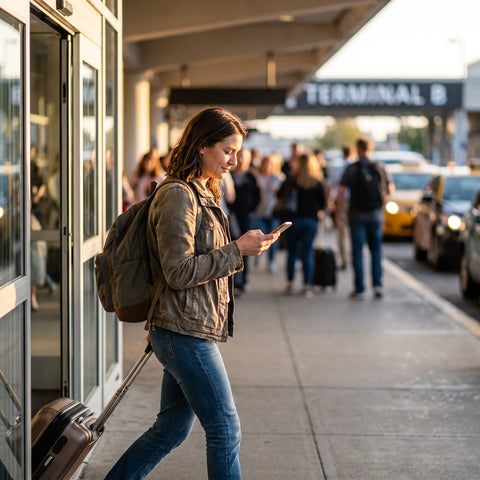
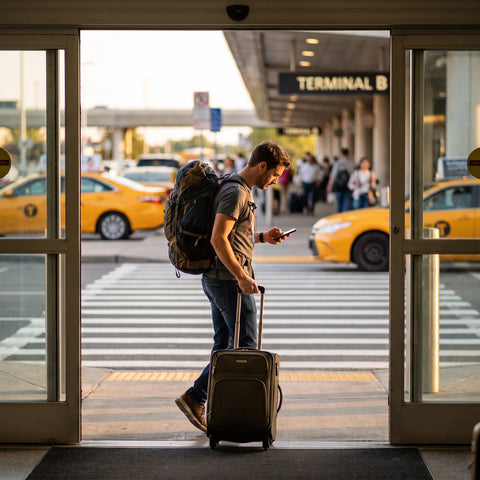
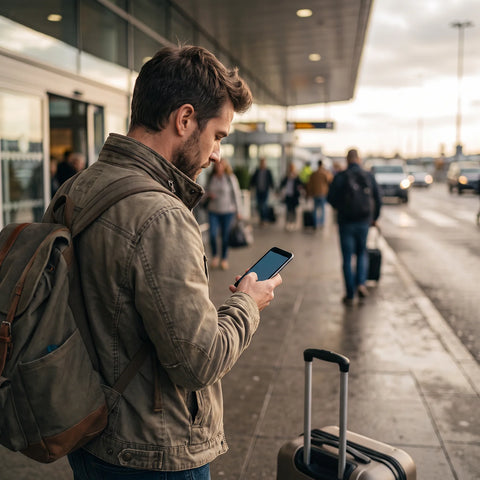
In short: If you are Chilean and plan to travel abroad, an eSIM for Chileans helps you avoid roaming from Entel, Claro, or Movistar Chile, which activates in expensive daily blocks with limited data. You install the profile before leaving Chile, land with internet already working, and you decide how much to spend, without surprises on your bill when you return.
Why Chilean roaming is not worth it outside the country
Chile has one of the most robust mobile networks in South America: almost total 4G coverage in urban areas, reasonable prepaid plans, and, in major cities, 5G already operational. The problem arises precisely when you need it most: upon landing in Madrid, Miami, or Lima, that network disappears, and you enter the realm of international roaming.
Entel, Claro Chile, and Movistar Chile offer roaming packages, but they work in daily blocks with a low data cap, and once you consume it, the speed plummets or the cost skyrockets per additional megabyte. For a trip of a couple of weeks, especially if you use Google Maps, upload photos, or make video calls, this model is not designed for you: it's designed for the business traveler who checks email once a day.
PuraSim's eSIM works differently: you pay for a fixed data plan before traveling, you know exactly what you've contracted for, and you activate it when you land. There are no silent automatic renewals or surprise charges the week after you return. It's the difference between traveling with peace of mind and constantly checking how many MB you have left throughout your trip.
What an eSIM is and how it differs from a physical SIM card
An eSIM is a chip integrated into the phone's circuit board, with no physical tray. Instead of buying a plastic card and inserting it with a clip, you install a digital profile by scanning a QR code or tapping a link. If you've never used one and want to first understand why traditional roaming works the way it does, you should review what data roaming is before continuing; it clarifies why your Chilean operator charges you by daily blocks instead of by actual usage.
The practical advantage for a Chilean traveler is twofold. First, your Chilean line remains active in the other slot of your phone (or virtually, if your device supports two eSIMs), so you can continue to receive bank SMS or verification codes without losing your number. Second, you don't have to rely on finding a store that sells SIM cards at your destination airport, or on the counter having stock, or on queuing with your passport in hand after twelve hours of flight.
If your device is a bit old or you're not sure if it accepts eSIM, you can still compare the digital option with the traditional one in our guide on international SIM vs. eSIM, which explains cases where a physical SIM card still makes sense.
eSIM vs. roaming vs. local SIM: comparison
Before deciding, it's worth looking at the three options side by side. There's no single answer for all trips, but for most Chileans traveling for tourism or work, the balance clearly tips one way.
| Criteria | Entel / Claro / Movistar Roaming | Local physical SIM | PuraSim eSIM |
|---|---|---|---|
| Price | Skyrockets in daily blocks; easy to overspend without realizing | Variable depending on the country; must be paid at destination | Fixed plan; you contract it before traveling and know what you're paying |
| Activation | Automatic upon landing (sometimes without warning) | Must be purchased and activated at destination | You install it in Chile, activate it when you arrive |
| Keeps your Chilean number | Yes | No, while using the local SIM | Yes, as a second data line |
| Need to queue at the airport | No | Normally yes | No |
| Expense control | Low, easy to get a surprise bill | Medium | High, fixed and prepaid plan |
| Ideal for | One or two-day trips with minimal usage | Long stays in a single country | Tourism, work, or multiple consecutive countries |
That said, it's important to be honest: if you're going to Buenos Aires for a weekend and your Chilean operator includes roaming at no extra cost in neighboring countries, check your own plan's conditions before contracting anything. For that short getaway, you might not need to buy an eSIM. Where the eSIM truly makes a difference is on trips of a week or more, with normal use of maps, social media, and messaging, and especially when you're visiting more than one country on the same itinerary.
Is my cell phone compatible?
Not all devices support eSIM, and this is the first thing to check before buying anything. Compatibility depends on the model and, in some cases, on whether the device arrived in Chile "unlocked" or tied to an operator.
| Brand | eSIM Models (indicative) | Where to check on the device |
|---|---|---|
| iPhone | From iPhone XS/XR onwards | Settings → General → About → look for "EID"; if it appears, your device supports eSIM |
| Samsung | Recent Galaxy S and Galaxy Z series | Settings → About phone → SIM status, or by dialing *#06# |
| Google Pixel | From Pixel 3 onwards (depending on version and region) | Settings → Network & internet → SIMs |
| Motorola / Xiaomi | Newer mid-to-high-end models | Varies by model; check technical specifications or dial *#06# |
An important nuance for the Chilean market: some devices that arrive through unofficial channels (brought from the United States, for example) may have the eSIM function factory-locked, even if the model itself supports it. If you bought your cell phone outside the official channel in Chile, it's worth checking with the code *#06# before assuming it will work.
How to activate it before leaving Chile
The process is the same no matter how you look at it, but it's best to do it calmly at home and not at the last minute at the airport with saturated public Wi-Fi.
- Confirm compatibility and that the device is unlocked. If your cell phone came with an Entel or Claro plan, it may require prior unlocking; check with your operator.
- Choose your plan based on your destination and trip duration. For two or three weeks in Europe with normal use, a mid-range plan is usually sufficient; if you're going to upload many photos or video call frequently, step up a level.
- Receive the QR and scan it with Wi-Fi. On iPhone: Settings → Cellular Data → Add eSIM. On Samsung: Settings → Connections → SIM card manager → Add mobile plan. Do this with your home Wi-Fi, not at the airport.
- Configure data priorities. Set the eSIM as the default data line at your destination and your Chilean line only for calls and SMS, to prevent roaming from activating accidentally.
- Activate it upon landing, not before. Most plans start running with the first data usage, not with installation. Install in Chile, but let the counter start fifteen minutes after getting off the plane.
If you want step-by-step instructions with screenshots for your specific model, we have a dedicated guide on how to install an eSIM that covers iPhone and Android separately.
Which eSIM to choose depending on your destination
Chileans traveling abroad don't follow a single pattern, but some routes are particularly common. Here's what to consider depending on where you're going.
- Spain, especially Madrid and Barcelona. This is the most common European destination for Chileans, partly due to the established community there. If your itinerary stays within Spain, adjust your plan to that single country; if you also cross into France, Italy, or Portugal, a comprehensive Europe eSIM plan is more suitable, covering the entire region without having to change profiles at each border.
- United States (Miami, New York, Los Angeles). With strong air connections between Santiago and several US cities, this is one of the destinations with the most Chilean traffic. A USA eSIM plan will sort out maps, Uber, and reservations from the first minute at the airport.
- Peru, with Machu Picchu as a magnet. Many Chileans take the route to Cusco and Machu Picchu as a short getaway. In high-altitude sections, the signal often cuts out, so it's advisable to plan connectivity before ascending, not when you're already on the train.
- Colombia, with Cartagena, Medellín, and Bogotá as the points of the triangle. Another rising destination among Chilean travelers, especially due to increasingly frequent direct flights between both countries.
- Easter and long weekends. If your trip falls during a long weekend or Easter, airports and public Wi-Fi will be more saturated than usual; install the eSIM in advance and don't leave activation until the last minute.
- "If I install an eSIM, I lose my Chilean line." False. The eSIM is added as a second line; your Chilean number remains active for calls and SMS while the eSIM handles data. You don't have to choose between them.
- "I need to activate it as soon as I buy it." No. You can buy it and install it weeks in advance from home; the only thing that needs to wait until landing is data consumption, which is what usually starts the plan's counter.
- "All modern cell phones have eSIM." This is not true. There are recent models, especially those entering Chile through unofficial channels, with the function factory-locked. Check *#06# before buying any plan.
- "With unlimited data on my Chilean plan in Chile, roaming will also be generous." There's no relation between the two. International roaming is governed by different agreements and almost always comes with a much lower daily cap than your local plan, no matter how generous the latter is.
- "Buying the eSIM at the destination airport is more convenient." On the contrary: that's when you have the worst Wi-Fi coverage, when you're most tired, and when there's the most pressure to decide quickly. Installing it at home, calmly, is what truly saves real time.
- "If my trip is short, it's not worth it." It depends. For a weekend in a neighboring country with a free roaming agreement from your operator, you might not actually need anything else. But if the short trip is to Europe or North America, then it is worthwhile, because roaming outside the region is usually the most expensive of all.
And for the opposite case, if you have family or friends visiting Chile from abroad, that's a different scenario (they need data here, not you outside), and for that, there's the Chile eSIM plan, designed for those landing in Santiago, Valparaíso, or the north, not for the Chilean who is leaving.
How not to run out of data halfway through your trip
The most common mistake isn't buying too little data, it's not knowing how much data your phone actually uses. Google Maps with real-time navigation, uploading stories to Instagram, and WhatsApp video calls are, in that order, what drains a data plan fastest while traveling.
Before you leave, download offline maps of the main cities on your route: in Barcelona, for example, the signal in the narrow streets of the Gothic Quarter gets saturated on weekends with the number of tourists connected at once, and having the map already downloaded saves your walk even if coverage falters for a while. The same applies in the medina of any historic city with covered or very dense streets.
Another simple trick: disable automatic app updates and photo backups over mobile data, and leave them only for when you have Wi-Fi at the hotel. It's the most silent data leak there is, and travelers rarely realize it until the plan runs out two days earlier than expected. We review this and more tricks in how to save eSIM data on your trip, including how to manage your privacy on public Wi-Fi networks in airports and hotels if you're going to do banking or online transactions while traveling.
Myths and what almost no one tells you
There are several ideas circulating about eSIMs that need clarification before they prevent you from trying them.
Frequently asked questions about eSIM for Chileans traveling abroad
Which Chilean cell phones are compatible with eSIM?
Most iPhones from XS/XR onwards, recent Samsung Galaxy S and Z models, and several mid-to-high-end Motorola, Xiaomi, and Google Pixel models. If your device arrived in Chile through an unofficial channel, check with the code *#06# to ensure the eSIM function is not factory-locked.
Can I keep my Entel, Claro, or Movistar number while using the eSIM?
Yes. The eSIM is installed as an additional line for data; your physical Chilean SIM continues to function in the other slot for calls and messages, so you still receive verification codes from banks and apps without losing your number.
Do I need to activate the eSIM before leaving Chile or upon arrival at my destination?
Install it in Chile calmly, with home Wi-Fi, but let it activate with the first data usage once you are at your destination. This way, you avoid being without a signal as soon as you get off the plane and don't start the plan's counter prematurely.
Does the eSIM work for multiple countries on the same trip?
Yes, if you choose a regional plan like the one for Europe, which covers multiple countries on the continent without having to change profiles at each border. For trips to a single country, a specific plan for that destination is usually more suited to your actual usage.
What happens if I run out of data halfway through my trip?
You can top up or buy an additional plan from the same app or panel, without needing to find a physical store. To avoid reaching that point, disable automatic updates and photo backups over mobile data, and download offline maps of the cities you plan to visit.
Do I need a contract or minimum commitment with PuraSim?
No. Plans are prepaid: you buy the one you need, use it during your trip, and there's no automatic renewal or subsequent commitment. If your next trip is to a different destination, you simply buy the corresponding plan when you need it.
Is an eSIM worthwhile if I'm only going to a neighboring country for a weekend?
Not always. If your Chilean operator includes roaming at no additional cost in that specific country, check your plan's conditions before spending on something you might already have covered. The eSIM is more noticeable on trips of a week or more, or when the destination is outside the region and traditional roaming costs skyrocket.
Is your next trip taking you out of Chile? Choose your plan according to your route and land already connected, without relying on your operator's roaming or finding a SIM card at your destination airport.