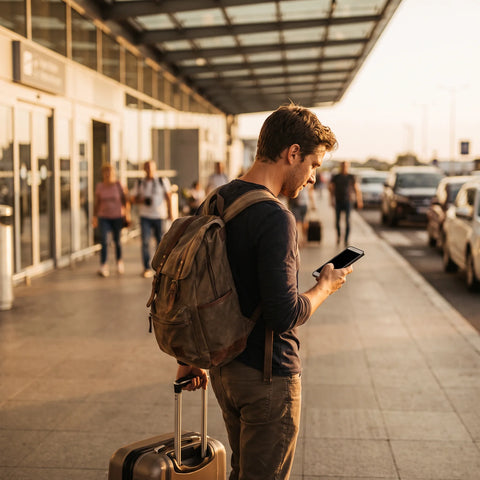
In short: a Venezuelan eSIM abroad is the most practical way to have mobile data as soon as you land: it is installed before leaving Venezuela, activates automatically upon arrival, and avoids the exorbitant roaming charges of Venezuelan operators. It doesn't replace your usual number: it keeps working for calls and SMS while the eSIM handles data.

If you're leaving Venezuela, you know the drill: you arrive at your destination, turn on your phone, and within minutes, you get a roaming activated notification. You might not even use it because the price deters you, so you spend the first day of your trip glued to the airport Wi-Fi, trying to let your family know you've landed safely. There's a solution that many Venezuelans in the diaspora already use without a second thought: a local eSIM installed before boarding the plane, which starts working automatically the moment your phone connects to a network at your destination.
This guide gets straight to the point: what exactly an eSIM is, how to install it from Caracas, Maracaibo, or wherever you are before traveling, how much data you need depending on your destination, and, most importantly, when it IS and isn't worth it.
What is an eSIM and why is it so well-suited for Venezuelan travelers?
The eSIM is a digital SIM card integrated into the phone itself. There's no plastic to insert or tray to open with a clip: it's installed by scanning a QR code, and in less than five minutes, your phone has a second active data profile. What's important for those traveling from Venezuela is that your physical SIM from your Venezuelan operator remains untouched: you continue to receive calls to your usual number, you still get your bank and verification SMS, and you don't touch it at all.
This fits particularly well with a very specific pattern of the Venezuelan diaspora: trips with stops in several countries (e.g., Panama or Colombia before continuing to the United States or Europe), stays that sometimes extend longer than expected, and the need to keep the Venezuelan number alive so that family can still reach them through the usual means. The eSIM solves the data part without affecting any of that.
Why roaming from Venezuela becomes exorbitant as soon as you leave the country
Venezuelan operators don't have competitive roaming agreements with most international destinations, so as soon as you activate data outside the country, the cost skyrockets, and on top of that, the speed often drops to 3G or less. It's common for people not to even activate it: many travel "unconnected," relying on hotel and cafe Wi-Fi, and that creates precisely the friction you want to avoid on the first day of your trip, when you most need Google Maps or an Uber to get out of the airport.
Before comparing figures you can't verify yourself (roaming prices change by operator and country, so always check the current rate with your Venezuelan company before leaving), remember the main idea: paying per megabyte for roaming almost never outweighs buying a local data package for a fixed price, with real 4G/5G speed from minute one.
How to activate your eSIM before leaving Venezuela: step-by-step process
What makes the difference compared to roaming is that you can get everything ready from home, with Wi-Fi, before going to the airport. The general process is this (here's the complete step-by-step installation guide if you want the details by operating system):
- Check if your phone supports eSIM. iPhone XS or higher, Samsung Galaxy S20 onwards, Google Pixel 3 or higher, and most high-end models from recent years are compatible. If the phone is factory unlocked from Venezuela and hasn't been brought in "locked" by an operator, there's usually no problem.
- Purchase the plan for your destination with a couple of days' margin before your flight, not on the last night: this gives you time to resolve any questions with support.
- Install the profile from the email you receive with the QR code. This is done from Settings → Mobile Data → Add eSIM, and it takes a couple of minutes.
- Keep it installed but not activated until you land. The plan's validity countdown doesn't start upon installation, but upon the first data use, so there's no rush or risk of "wasting" extra days by installing it early.
- Upon landing, activate it manually in Settings and confirm that the data line is on the eSIM, not on your Venezuelan SIM (this prevents your operator's roaming from activating by mistake).
With this resolved, you'll leave the arrivals area with Maps, WhatsApp, and other apps working without relying on airport Wi-Fi or finding a local operator module with a queue.

The most common destinations for the Venezuelan diaspora and what you need in each
Not all trips from Venezuela require the same plan. It varies greatly whether you're staying a week visiting family or if you're moving more permanently and need stable data from day one while sorting out paperwork, a bank account, or accommodation.
United States
It is one of the destinations with the most movement of the diaspora, both for visits and long stays. If your plan includes tasks (appointments, banks, transport apps) from day one, it's advisable to arrive with active data instead of relying on airport Wi-Fi while waiting for a local SIM card. You have the specific plan on eSIM for the United States.
Spain
Another very frequent destination, both for the already established Venezuelan community and for those using Spain as a gateway to Europe. Urban coverage is solid in large cities; where it can fail is in rural areas inland or in the Madrid and Barcelona subways in the deepest sections, so have your route map downloaded before going underground. Check the eSIM Spain plan.
Colombia
Due to its proximity and the large Venezuelan community established there, Colombia is a recurring destination, often as a stopover to another country or as a final destination. Coverage in Bogotá, Medellín, and Cartagena is generally good, although it's advisable to be careful in mountain areas where the signal drops easily. We have a specific guide on eSIM in Colombia (Medellín, Bogotá, and Cartagena) with details by city.
Rest of Europe
If your route is not only Spain but includes several European countries (Italy, Portugal, France...), do not buy a plan per country: it will be more expensive and more complicated to manage several eSIMs at once. Look for a regional plan that covers several countries with the same data profile, without reinstalling anything when crossing borders.
| Type of trip from Venezuela | Typical duration | Approximate GB* | When to extend |
|---|---|---|---|
| Short family visit (US, Spain, Colombia) | 5-10 days | 5-10 GB | If you're making long daily video calls |
| Tourism with multiple cities | 10-15 days | 10-15 GB | If you're sharing a hotspot with another traveler |
| Relocation / initial long stay | 30 days or more | 15-20 GB or top-up plan | Almost always: paperwork, maps, and remote work add up quickly |
| Short layover en route to another country | 1-3 days | 1-3 GB | Rarely need more for a transit |
*Approximate based on moderate use of maps, messaging, and social media without intensive streaming. PuraSim plans allow top-ups if you run short.
eSIM, roaming, or physical chip: what's the real difference?
It's easy to confuse the three terms, so let's clarify quickly: roaming means your own Venezuelan operator charges you for using a foreign network (expensive and slow, as we've already seen); a local physical chip means buying a plastic SIM upon arrival, which involves finding a store, waiting in line, and in many cases, identification paperwork that as a Venezuelan can be complicated if you don't have all your documents with you; and an international eSIM is a digital profile you install from home that requires neither a store nor a queue. If you want a complete breakdown with the advantages and disadvantages of each option, we have a dedicated comparison in eSIM vs. roaming.
If you've never used an eSIM and it sounds complicated, it's not: in what is a virtual eSIM, we explain the concept from scratch, without assuming you know anything about telecommunications.
Staying in touch with family in Venezuela without relying on your Venezuelan data
One of the most constant uses of the eSIM by the Venezuelan diaspora is not Google Maps, it's WhatsApp. With active data at your destination, video calls with family in Venezuela work just as well as if you were at home, with no international call cost because everything goes through data. An important nuance that many don't know: leaving your Venezuelan operator's data roaming activated can incur charges without you realizing it if you don't deactivate it properly; with an eSIM, that risk disappears because the data line lives in a completely separate profile.
A practical tip that almost no one mentions: before leaving, notify your Venezuelan bank of your travel dates and countries. It's common for cards to automatically block for security reasons when detecting movements abroad, and resolving it from outside, without data, is much slower and more stressful than doing it two minutes in advance from home.
Tricks to make your GB last longer
If you're on a tight plan, there are adjustments that add up more than they seem: disable automatic app updates on mobile data, lower WhatsApp and Spotify playback quality, and download offline maps of the area before moving around in case there are sections with poor coverage (narrow streets, underground parking lots, mountainous areas). We have a complete guide of tricks to save data on a trip with an eSIM with specific settings by operating system.
A warning about public Wi-Fi that almost no one tells you about
While you wait for your eSIM to activate or if you run out of data, it's tempting to hop on the free Wi-Fi at the airport or hotel. These are open networks, without real encryption, and that's where most credential thefts happen during travel. If you're going to do online banking or move money from abroad, it's better to use your eSIM data instead of public Wi-Fi, or add an extra layer of protection: we explain it in eSIM and VPN: privacy in your travels.
What almost no one tells you about eSIMs for Venezuelans
- Your phone may need to be "clean" from a Venezuelan operator. Some phones purchased through a local operator in Venezuela come with restrictions that can interfere with the installation of a second eSIM. If yours is like this, install the profile before leaving and check that it activates without errors; if it fails, contact support before your flight day, not at the airport.
- The profile name matters more than it seems. When installing the eSIM, give it a clear name like "Travel Data" and disable calls and SMS on that profile. If you don't, the phone may try to use the eSIM for calls and generate unexpected charges.
- The plan countdown doesn't start at purchase. Many people don't buy the eSIM in advance for fear of "running out of days" before traveling. This is not the case: validity counts from the first data use, so you can buy and install it a week in advance without losing anything.
- Not all airports have reliable Wi-Fi for on-the-go installation. If your plan is to buy the eSIM at your destination because "there's Wi-Fi at the airport anyway," have a backup plan: some airports have saturated networks or require registration with a local phone number, which you obviously don't have yet.
When NOT to buy an international eSIM
To be honest: if your layover is only a few hours and you won't leave the airport transit area, you don't need anything, the airport's own Wi-Fi is usually enough. And if your destination is a single country where you'll be staying somewhere with reliable Wi-Fi the whole time (for example, at a relative's house with a good connection) and you'll hardly go out, it might be better to wait and assess on the spot whether you really need constant mobile data. An eSIM makes sense when you're on the move, not when you're staying put in a place with plenty of Wi-Fi.
Frequently asked questions
Does the eSIM work the same on all phones I bring from Venezuela?
It depends on the model and whether it's unlocked. Most mid-range and high-end phones from recent years are eSIM compatible, but some phones purchased through a local operator may have restrictions. Check compatibility in Settings before purchasing the plan.
Can I have both the international eSIM and my Venezuelan SIM active at the same time?
Yes, that's exactly the strong point of the eSIM: you can have both lines active at the same time, one for data (the eSIM) and the other for calls and SMS with your usual Venezuelan number.
What happens if my flight has a layover in another country before the final destination?
If the eSIM only covers the destination country, you won't have data during the layover unless you use airport Wi-Fi. If your itinerary includes several countries, consider a regional or multi-country plan instead of a single-destination one.
Do I need Wi-Fi to install the eSIM or can I do it with mobile data?
You can install it with mobile data, but it's most convenient and reliable to do it with Wi-Fi before leaving Venezuela, when you have plenty of time and don't depend on current coverage.
Can the eSIM be used to make and receive calls to Venezuelan numbers?
Data plans do not include traditional calls. To talk to Venezuela, use WhatsApp, Telegram, or FaceTime, which work perfectly through eSIM data at no additional international cost.
Can I buy the eSIM when I'm already at the destination instead of before traveling?
Yes, as long as you have access to Wi-Fi to install it. Even so, it's more convenient to have it resolved before leaving so you don't have to rely on airport Wi-Fi exactly when you need it most.
What should I do if the eSIM doesn't connect when I land?
Check in Settings → Mobile Data that the data line is assigned to the eSIM and not your physical SIM, and try to manually select the network instead of automatic. If it still doesn't work, support is available to help you with your order number handy.
Install your eSIM before your flight and activate it as soon as you arrive, no queues or surprising roaming charges.
See eSIM plans →