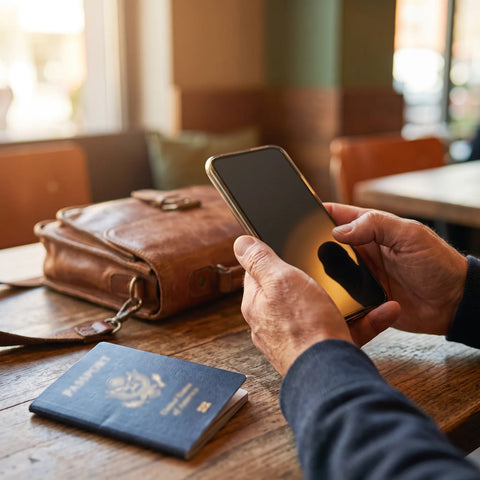
In short: the eSIM for Santiago de Chile gives you active mobile data from the moment you land at Arturo Merino Benítez airport, without having to search for stores or deal with passport formalities. 4G/5G coverage is solid in the city center, Providencia, and Las Condes, and weakens in the underground Metro, on Cerro San Cristóbal, and on mountain routes towards Farellones.
What is an eSIM and why it changes your trip to Santiago
An eSIM is a SIM card that doesn't physically exist: it's a digital profile installed on your mobile by scanning a QR code. There's no need to open the phone's tray, no need to look for a pin to remove your Spanish operator's SIM, and it won't get lost or bent at the bottom of your backpack. For a trip to Santiago de Chile, the difference is noticeable right away: you leave the baggage claim area at SCL airport, activate your data, and you already have Google Maps, Uber, or Cabify working before deciding whether to take an official taxi or the metro to get to the city center.
The key is to install the profile before leaving home, using Wi-Fi, and activate it once you're in Chile. This way, you avoid the queue at the airport phone store and your Spanish operator's roaming charges, which skyrocket in South America as soon as you cross passport control. If you want to understand the technical difference from traditional roaming, we explain it in detail in eSIM vs roaming, and if you've never installed one before, the complete step-by-step guide is in how to install an eSIM.
Coverage in Santiago de Chile: what to expect neighborhood by neighborhood
Santiago is about 520 meters above sea level, so forget about altitude sickness that you might experience in Cusco or La Paz: here, the problem is never altitude, it's the topography and building density. In the historic center, Providencia, Ñuñoa, and Las Condes, 4G and 5G coverage is consistent throughout the day, even during peak hours with crowded subways and streets. This is where you'll spend most of your time if you're staying near Plaza Italia or Costanera Center.
Where the signal starts to fail is in very specific places: inside the Santiago Metro, coverage disappears between stations (there's Wi-Fi on some platforms, but not inside the tunnel), so download your route map or the song you want to listen to before going down. Going up Cerro San Cristóbal by funicular or cable car, the signal weakens as you gain altitude over the city, and at the Virgen lookout, it might drop to 3G. If you're out at bars on a Friday or Saturday in Barrio Bellavista, on Pío Nono, the network gets saturated due to the number of people connected simultaneously: it's not a fault of your eSIM, it's the same local network slowing down for everyone.
A detail almost no one mentions: Santiago is in a seismic zone, and it's normal to feel some slight tremors during your stay. This doesn't affect data coverage at all unless it's a major earthquake, in which case all networks—yours and any Chilean neighbor's—will be equally saturated for a while.
Operators in Chile: which one is best for your eSIM
In Chile, the major operators with their own networks are Entel, Movistar, and Claro, along with WOM, which usually offers more aggressive rates but a somewhat less consistent network outside the Metropolitan Region. For staying in Santiago and its surroundings, the first three provide very similar results: well-deployed 4G/5G network throughout the city. The difference is more noticeable if you go on excursions to less populated areas, where Entel is usually the benchmark for geographical coverage.
| Operator | In Santiago capital | Outside the Metropolitan Region |
|---|---|---|
| Entel | Very good, reference network | The most consistent in rural and mountain areas |
| Movistar | Very good | Solid in intermediate cities |
| Claro | Good | Adequate in urban centers |
| WOM | Good, aggressive pricing | More irregular outside the capital |
With an international data eSIM, you don't manually choose which Chilean operator you connect to: the profile automatically connects to the available network with the best signal at any given moment, just like your Spanish mobile does when you change areas.
How many GB you need depending on your trip type
Actual consumption depends on whether you'll be working remotely with video calls, if you only need Maps and WhatsApp, or if you'll be uploading stories all day. As a guide per traveler profile:
| Duration | Profile | Main use |
|---|---|---|
| 3-5 days | Classic city break | Maps, social media, messaging, some WhatsApp calls |
| 7-10 days | Santiago + excursions (Valparaíso, Cajón del Maipo) | Above plus constant GPS navigation on the road |
| 15-30 days | Route through Chile or digital nomad | Work video calls, streaming, high-quality photo uploads |
If you have doubts about how to make your data last without running out mid-trip, we have practical tips—downloading offline maps, limiting automatic app updates, activating system data saving—in how to save data with an eSIM on a trip.
How to activate your eSIM upon arrival at Santiago Airport (SCL)
Arturo Merino Benítez Airport has free Wi-Fi in the arrivals area, so technically you could wait until you're there to install the profile. We don't recommend it: immigration and baggage queues are already enough stress without relying on a congested airport network. The process that works best is this:
- Buy the eSIM for Chile on purasim.com before leaving Spain, using your home Wi-Fi.
- Install the profile by scanning the QR code: it takes a couple of minutes and doesn't delete your Spanish line.
- Leave the profile installed but don't activate mobile data yet, so it doesn't start counting days prematurely.
- Upon landing in Santiago, with your phone's airplane mode deactivated, go to Settings → Mobile Data and activate the eSIM data line (on iPhone, you can leave the Spanish line just for calls and SMS).
- The journey from the airport to the city center takes between 25 and 40 minutes depending on traffic, whether by taxi, Uber, or the Centropuerto bus: plenty of time to have your Cabify order ready before leaving the terminal.
eSIM, roaming, and physical SIM: what's best in Santiago
| Option | Cost | Process | When it activates |
|---|---|---|---|
| Roaming from your Spanish operator | Skyrockets outside the EU; check exact rate with your operator | None, it's already active | Upon landing, without doing anything |
| Chilean physical SIM | Local price, reasonable if you're staying several weeks | Buy in store with passport, activate in person | Only after the process, during business hours |
| PuraSIM eSIM | Check current price on the eSIM for Chile page | Installation via Wi-Fi before leaving home | The moment you activate it, without queues or paperwork |
If your Spanish operator has a specific and cheap plan for South America that you've already checked, compare it before deciding: eSIM almost always wins in convenience, but don't assume it's always the cheapest without checking your own rate. And if your layover in Santiago is only a few hours in transit to Patagonia or Easter Island and you're not leaving the airport hotel, free Wi-Fi might be enough: don't buy anything extra.
What almost no one tells you before traveling to Santiago with an eSIM
Data eSIMs usually don't include calls or SMS. This is the trap most travelers fall into: they arrive thinking they'll be able to call a Chilean with their new number and can't, because the plan is data-only. The real solution is to keep your Spanish line active only for calls (without data, to avoid roaming charges) and use WhatsApp or VoIP calls with the eSIM for everything else. You don't need more to book a table, order an Uber, or talk to your Airbnb host.
Not all unlocked phones have eSIM. Some mid-to-low-range models, especially versions sold outside Europe or the United States, don't have the eSIM chip even if the rest of the specifications are identical. Check this in Settings before buying, not at the airport.
Installing is not the same as activating. You can have the profile installed weeks before your trip without consuming a single day of your plan: days only start counting from when you manually activate mobile data, so you can do it calmly weeks in advance from home.
Winter smog doesn't affect the signal, but it does affect the city. If you travel between June and August, on windless days, central Santiago is covered by a visible layer of pollution, especially when looking towards the mountain range. This is only a matter of landscape and air quality; the data network works exactly the same.
Wi-Fi in Bellavista and Lastarria is not always reliable. Many establishments advertise free Wi-Fi, but the password changes, it gets saturated, or it simply doesn't work on weekends. If you have an active eSIM, you don't depend on asking for the password in every cafe.
Beyond Santiago: day trips that stay connected
Almost no traveler stays only in the capital. If you head towards Valparaíso and Viña del Mar (an hour and a half by highway), coverage remains stable for almost the entire journey, with some weaker sections on the curves before descending to the port. If you go to Cajón del Maipo, the signal is good up to San José de Maipo and weakens the further you go towards El Volcán or Baños Morales: download the route map before leaving Santiago. And if you go skiing in Farellones or Valle Nevado, above 2,800 meters, coverage is cut off in several sections of the winding road: normal, it's a mountain area with very few people around.
If your route continues to Peru or Colombia, the same data logic applies throughout the region: you can see how coverage behaves in eSIM for Peru and Machu Picchu. And if you want to understand why traditional roaming skyrockets as soon as you leave the European Union, we explain it in what is data roaming. For a broader view of how to get around with data throughout the country, we also have the guide to internet in Chile.
Frequently asked questions about eSIM for Santiago de Chile
Do I need an unlocked phone to use an eSIM in Santiago?
Yes. If your phone is locked to your Spanish operator, you won't be able to add an eSIM profile from another company even if the model is compatible. Ask your operator to unlock it before traveling; it's free and usually doesn't take long if you've already completed your contract period.
Can I use the eSIM to make phone calls in Chile?
Data plans like PuraSIM do not include traditional calls or SMS. To talk to hotels, taxis, or local restaurants, use WhatsApp or VoIP calls with active data; for emergencies or contacts who only have your Spanish number, leave that line active without data.
Does the eSIM work inside the Santiago Metro?
Between stations, no, because you are underground and no data network reaches there, neither yours nor a Chilean's with a local SIM. There is public Wi-Fi on some platforms. Download what you need before going down.
How many days in advance can I install the eSIM without it activating?
As many as you want. Installing the profile does not consume days from your plan: the counter only starts when you manually activate mobile data, so you can do it weeks in advance from home.
What happens if I run out of data before finishing my trip in Santiago?
You can buy another plan or extend your current one from the website, without needing to go to any store. It's useful to monitor your consumption during the first few days to estimate if your initial plan matches your actual usage rate.
Can the same eSIM be used if I continue my trip from Santiago to Mendoza or Buenos Aires?
It depends on the plan you buy: some are designed only for Chile and others offer multi-country coverage in South America. Check the exact coverage of the plan before buying if your route crosses into Argentina.
Is an eSIM worth it if I'm only on a layover at Santiago airport?
If your layover is only a few hours and you don't leave the terminal, probably not: the airport has free Wi-Fi and it's enough for basic needs. An eSIM makes sense as soon as you plan to move around the city or need reliable data outside the airport Wi-Fi.