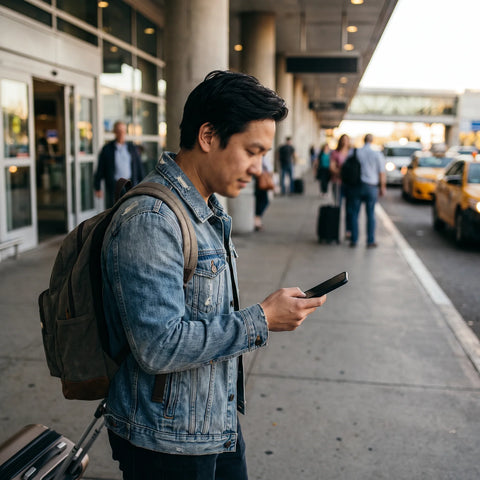
In short: the eSIM for Cuba is a different ball game compared to other destinations: the island has a single state operator (ETECSA) and mobile data access for foreign visitors is limited, slow, and often unstable outside of tourist areas. Before buying any eSIM, understand how connectivity really works there — the best solution might not be an eSIM, but rather a combination of paid WiFi and a NAUTA card.
Why Cuba doesn't work like other destinations
If you've used an eSIM in Portugal, Thailand, or Mexico, you'll arrive in Cuba with expectations that the island won't meet. This isn't a problem with PuraSIM or any specific eSIM provider; it's the country's structure. Cuba has only one telecommunications operator, ETECSA (commercially known as Cubacel for mobile), which is state-owned. There's no competition, no MVNOs, and international roaming agreements with foreign operators are much more limited than in the rest of the continent.
Adding to this is the US embargo, which continues to indirectly affect digital services: some apps and platforms block or restrict access from Cuban IPs, and certain banks and payment gateways do not operate with the island. This isn't something you can solve with a SIM card, but it's good to know before traveling.
So, does an eSIM work in Cuba?
The honest answer is: it depends, and with important nuances. Technically, ETECSA has enabled data roaming for international visitors for some years now, and some eSIM profiles can register on their network. But the reality on the ground is different: the speed is low even in Havana, coverage quickly declines outside the tourist core, and service is often cut without warning — sometimes for maintenance, sometimes due to specific government restrictions during times of social tension. If your plan is to work remotely, make reliable video calls, or rely on constant GPS maps as you would in Rome or Lisbon, Cuba will frustrate you.
Coverage by area: what to really expect
Mobile data coverage in Cuba is concentrated in urban and tourist areas. Outside of these, things change a lot:
- Havana (Vedado, Old Havana, Miramar): this is where it works best, with reasonably stable 4G signal in the center. Even so, it's common for speed to drop during peak hours when half the city connects at once.
- Varadero: hotels in the area usually have their own WiFi (paid, separately managed), and mobile coverage in the town is acceptable, but don't expect smooth operation outside the tourist core.
- Santiago de Cuba, Trinidad, Cienfuegos: irregular coverage. In Trinidad, for example, the signal in the historic center is weak because the cobblestone streets and low colonial houses do not aid propagation; as soon as you move two blocks from the main square, you'll notice drops.
- Rural areas and Viñales: coverage is scarce or non-existent in much of the valley. If you're going on tobacco field tours, assume you'll be disconnected for several hours.
This pattern — good in the tourist center, weak a few blocks away — is different from other destinations where an eSIM homogeneously covers the entire country. Here, it's advisable to plan with this discontinuity in mind, assuming there will be stretches without coverage between one tourist area and the next.
Park WiFi, NAUTA card, and mobile data: the three real options
In Cuba, there are three ways to connect, and each has its own logic:
NAUTA cards (ETECSA WiFi)
These are scratch cards with a username and password that provide hourly WiFi access in public parks, squares, and hotels with enabled zones. They can be bought at ETECSA offices (there's one at the airport) or, unofficially, from street vendors at the entrances to parks with WiFi — something you'll see as soon as you arrive, as they are easily recognizable by people looking at their phones in groups around a bench. Access is only while you are within the radius of the WiFi hotspot; it's not mobile data.
Mobile data with ETECSA SIM or eSIM
You can buy a physical tourist SIM upon arrival (with passport) or, in some cases, activate an eSIM profile compatible with roaming on their network. This is the most convenient option on paper, but the one that gives you the least control: you don't choose the operator, there's no alternative if the service fails, and the actual speed is far below what you're used to in Europe.
Hotel WiFi
International hotels (chains like Meliá or Iberostar) usually offer paid WiFi, sometimes with better stability than the mobile network because they have their own satellite or dedicated link. If your accommodation offers it, it's usually the most reliable option for important tasks: uploading documents, making an occasional video call, or confirming a flight.
| Option | Actual Coverage | Management | When it makes sense |
|---|---|---|---|
| NAUTA Card (WiFi) | Only within the WiFi hotspot radius (parks, hotels) | Physical purchase, no app | Long stays, occasional use several times a day |
| SIM/eSIM ETECSA | Urban, irregular outside the center | In-office process or digital profile | If you need data while moving around the city |
| Hotel WiFi | Only within the accommodation | Included or paid at reception | Important tasks, video calls |
| Roaming from your Spanish operator | Depends on the agreement, often not covered | Automatic if there's an agreement | Check with your operator beforehand: Cuba is not always included |
When it DOESN'T make sense to buy an eSIM for this trip
Let's be clear here, because this is the part almost no one tells you honestly: if your trip to Cuba is for a week, staying in Varadero with a getaway to Havana, you'll probably be better off with NAUTA cards bought on the spot than with a data eSIM. The reason is simple: you're paying for a mobile data service that, in practice, will perform like slow public WiFi in most situations where you actually need connectivity (at the hotel, in the restaurant, in the square). Buying mobile data in GB to move around "like in any other country" doesn't fit how the internet is actually used in Cuba.
Where an eSIM does make sense is for the parts of the trip that aren't Cuba: if you're flying with a layover in Madrid before catching the direct flight to Havana, or if your route passes through Miami or Mexico City before entering the island, then it's advisable to be connected from landing with an eSIM for Spain or an eSIM for the United States depending on the segment, and leave Cuban connectivity to be resolved on-site with NAUTA or hotel WiFi.
How to prepare before landing
Regardless of which option you choose, there are steps you should take before boarding the plane:
- Download offline maps of Old Havana, Trinidad, and any rural areas you plan to visit. Google Maps allows you to save entire areas offline, and in Cuba, you'll need it more than once.
- Notify your bank that you're traveling: many cards issued by US-based banks simply don't work in Cuba due to the embargo, so confirm with your bank and bring cash (Euros, which exchange well) as backup.
- Save an offline copy of hotel reservations, travel insurance, and return flights. With intermittent connectivity, you don't want to rely on opening your email when asked at a checkpoint.
- If you're going to use an eSIM or ETECSA SIM, install the profile or activate the line before you actually need it — the eSIM setup process takes a couple of minutes if you follow the steps calmly, but it's better to do it with comfortable WiFi than on the street with no coverage.
- Have a VPN installed and tested before leaving home. Some platforms and apps have restricted access from Cuba, and you might not always be able to download the VPN once you're there.
What almost no one tells you about connecting in Cuba
Beyond the theory, there are details that are only learned by experiencing them or researching them thoroughly:
- The single currency changes less than you think in the digital realm. Since the 2021 monetary reform, the CUC disappeared and only the CUP circulates, but for paying for internet, NAUTA, or data roaming, ETECSA usually operates with rates calculated in hard currency for foreigners. Don't confuse the "Cuban pesos" price you see on local signs with what you'll actually pay as a tourist.
- NAUTA card resellers at park entrances are not a scam in most cases: it's the usual way many Cubans earn a margin by reselling cards they bought in the ETECSA queue. They charge a bit more than the official price to save you the queue, which can be long.
- WiFi gets saturated at specific times, especially in the evening, when entire families connect in the square to video call relatives outside Cuba. If you need to upload something heavy or do something serious, do it mid-morning.
- Some messaging apps work, others don't work as well. WhatsApp works reasonably well even with a weak connection because it compresses well; video calls from heavier platforms suffer much more with local latency.
- Access can be restricted without notice during times of tension. This has happened before, on specific dates of protests or sensitive anniversaries. It's not common, but if you're traveling on such dates, don't count on guaranteed connectivity that day.
How many days of stay change the strategy?
For a short getaway (a weekend in Havana or Varadero), the most practical approach is usually to manage it with a couple of NAUTA cards bought upon arrival and hotel WiFi: the volume of data you'll need is low, and it's not worth managing a mobile data profile for such little use. For longer stays, with travel between several provinces, it does start to make sense to combine a mobile data line (SIM or eSIM compatible with ETECSA) for the basics — maps, messaging — with NAUTA cards as backup during long stops. In either case, the criterion for calculating how many GB to reserve is the same as we apply in any destination with limited data: prioritize messaging and offline maps, and leave streaming and heavy uploads for hotel WiFi.
Spanish Roaming, eSIM, and Local SIM: The Comparison That Really Matters in Cuba
In most destinations, the comparison between roaming from a Spanish operator and a local eSIM is easily resolved: the eSIM wins in cost and speed. In Cuba, the calculation is different, because neither option yields a result comparable to what you have at home. Before deciding, confirm with your Spanish operator if Cuba is even included in your data roaming plan: many EU roaming plans completely exclude the island, so you might not even have that option active upon landing. If you're looking for a physical alternative instead of digital, the classic international chip versus eSIM has a nuance here: in Cuba, buying a physical ETECSA SIM at the airport is usually simpler to manage than looking for a compatible eSIM profile, precisely because of the recent and limited support for digital roaming on the island.
Frequently asked questions
Does an eSIM work in Cuba?
It can work if the profile is registered on ETECSA's network, but coverage is limited outside urban and tourist areas, speed is low, and service is cut with some frequency. Don't expect the same reliability as in other destinations.
Is the NAUTA card or mobile data better?
For short stays and occasional use (maps, messaging at specific times), the NAUTA card is usually more cost-effective. For needing connectivity while moving around the city, mobile data is more practical, though more expensive and less stable.
Does my Spanish roaming plan work in Cuba?
Not always. Many roaming plans from European operators do not include Cuba within their standard coverage. Check with your operator before traveling instead of assuming you will have the same coverage as in the EU.
Can the internet be used freely in Cuba?
Access has improved significantly compared to a decade ago, but there are still occasional restrictions and some platforms with limited access from Cuban IPs. Having a VPN installed and tested before traveling is a reasonable precaution.
How many GB do I need for a trip to Cuba?
It depends on how much you will rely on mobile data versus WiFi. If your plan is to mainly use NAUTA cards and hotel WiFi, little mobile data as backup is sufficient; reserve it for maps and messaging, not for streaming.
Where do I buy a NAUTA card or ETECSA SIM?
At ETECSA offices—there's one at Havana airport—and unofficially from resellers in parks with public WiFi. The physical tourist SIM is bought by presenting your passport.
What if my flight has a layover in Madrid or Miami before Cuba?
That leg can benefit from a normal eSIM, with the same reliability as in any other destination. Activate it for the layover and manage Cuban connectivity separately, once on the island.