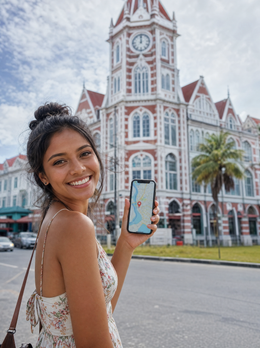

In short: A Guyana eSIM gives you mobile data as soon as you land at Cheddi Jagan (Timehri), with no roaming charges or queues for a physical SIM. Coverage is strong in the coastal strip (Georgetown, Linden, New Amsterdam) with Digicel and GTT, but the jungle interior—Kaieteur, Iwokrama, Rupununi—has almost no signal, so plan offline downloads before venturing into the jungle.
Guyana eSIM: what it is and when it's worth it
Guyana is not a transit destination. Those who travel here usually go to Georgetown for work—the oil boom has filled the city with business flights—or are looking for Kaieteur Falls, the Rupununi savannah, or the Iwokrama protected forest. In either case, arriving without data is a real problem: there's no Uber like in other capitals, the taxi from the airport is better negotiated with Google Maps in hand, and the hotel Wi-Fi doesn't always cover the journey there.
A Guyana eSIM solves exactly that: you install the profile from Spain before you leave, and as soon as the plane lands at Cheddi Jagan International Airport (Timehri, about 40 minutes south of Georgetown), you activate the data from Settings. No roaming from your Spanish operator—which in Guyana can skyrocket without warning—and no searching for a Digicel store in the city with your luggage in tow.
Real coverage by area: coast yes, interior no
Guyana has a peculiarity that should be understood before buying any data plan: almost all the population and almost all mobile coverage are concentrated in a narrow strip along the Atlantic. The interior—Amazon jungle, savannah, mountains—occupies the vast majority of the territory and has virtually no telecommunications infrastructure.
- Georgetown and surroundings: Reasonably good 4G coverage in the center, Kitty, Stabroek, and commercial areas. In peripheral neighborhoods and at night, the signal can occasionally drop to 3G; this is common in a city with frequent power outages that also affect some antennas.
- Coastal corridor (Linden, New Amsterdam, Anna Regina, Corriverton): Stable coverage in urban centers, weaker as you move away from the main road.
- Lethem and the border with Brazil: Something curious happens here: the mobile sometimes connects to a Brazilian tower in Bonfim, across the line. If you travel by land to or from Brazil, don't be surprised to see the name of a Brazilian operator in your status bar for a few minutes.
- Jungle interior (Kaieteur, Iwokrama, Rupununi, Kanuku): Very limited or directly null coverage outside the few settlements with their own towers. Ecotourism lodges—Karanambu, Surama, Atta—usually have satellite Wi-Fi in the common area, but don't count on mobile data while hiking in the jungle.
The practical takeaway is this: if your trip is Georgetown and little else, the eSIM will work consistently for you. If you're going into the interior for several days, the eSIM will serve you at the starting and return points, but during the excursion you'll be disconnected just like with any other card—no SIM, local or international, fixes that, because there are no antennas.
Digicel vs GTT: the two operators in Guyana
The Guyanese mobile market is simple because there are only two real players: Digicel Guyana and GTT (Guyana Telephone & Telegraph, the historic one). Both provide 4G service on the coast; neither has widespread commercial 5G today. The PuraSIM eSIM automatically connects to the available network with the best signal, without you having to manually select an operator or worry about roaming agreements.
| Operator | Where it's strongest | Technology | Jungle interior |
|---|---|---|---|
| GTT | Georgetown, coastal corridor | 4G | Testimonial coverage |
| Digicel Guyana | Georgetown and main urban centers | 4G | Testimonial coverage |
You don't need to memorize which one is better in each neighborhood: that's precisely the job the eSIM does for you, jumping to the network with the best signal at any given moment. What's important to know is that neither operator will give you coverage where there's no antenna installed, so no data plan—no matter what you're selling—is magic in Kaieteur or in the middle of the savannah.
How much data plan you need depending on your trip
There's no magic number of GB, it depends on what you're going to do with your phone. If your stay is short and urban—all over Georgetown, business meetings, a restaurant in Kitty or Stabroek Market—with navigation, maps, WhatsApp, and email, consumption is moderate: look, go for it, and be generous, because running out halfway through the trip and having to extend your plan is more inconvenient than having some megabytes left over. If you're also going to make long video calls or stream at the hotel, add some extra margin.
If your plan includes an excursion to the interior—Kaieteur, Iwokrama, Rupununi—your actual data consumption during those days will be low simply because you won't have a signal most of the time; in that case, it's advisable to size the plan for the city days, not for the entire trip, and use the lodge's satellite Wi-Fi for the bare essentials. For the current details of GB and plan duration that best fits your itinerary, check the product sheet at purasim.com; there you'll find it updated without us having to guess a figure here that might become outdated.
eSIM or physical SIM in Guyana?
If you're comparing buying a local SIM card in Georgetown versus activating an eSIM before you leave, the difference isn't in coverage—both use the same Digicel or GTT towers—but in management. Buying a physical SIM in Guyana means finding a store or point of sale (not always obvious outside the airport and city center), sometimes showing your passport for registration, and losing your Spanish line number while you have it in, with the risk of missing verification SMS from banks or apps.
The eSIM avoids this hassle: the profile is installed via QR from home, with Wi-Fi, and remains on standby until you arrive. You can keep your physical Spanish SIM active for calls and SMS while using the eSIM only for data, something a physical card change doesn't allow on a phone with a single tray. The downside, the only real one, is that you need an eSIM-compatible and unlocked phone; if your mobile is old or locked to your operator, the local physical SIM is still the option.
That said, be honest with yourself about how much you're going to use your phone: if your plan is a short stopover in Georgetown for a day before continuing your journey, you probably don't need to buy anything and the hotel and airport Wi-Fi will suffice for the essentials.
How to activate your eSIM before landing in Guyana
- Purchase the eSIM for Guyana at purasim.com before leaving Spain.
- Install the profile via QR code while you have Wi-Fi at home or at the departure airport—no need to wait until Guyana.
- Leave it installed but deactivated during the flight.
- Upon landing at Cheddi Jagan, activate the mobile data for that line in Settings → Mobile Data and select the eSIM as your data line.
- Confirm data roaming is activated for that eSIM (even if the plan is local, some mobiles mark it as roaming).
If you've never installed an eSIM, it's advisable to first review how to install an eSIM step by step and what the difference is between an eSIM and a physical SIM, as the process varies slightly between iPhone and Android.
What almost no one tells you about traveling to Guyana
- Guyana is not French Guiana. This is the most common mistake when searching for eSIMs for this destination: Guyana is an independent English-speaking republic, capital Georgetown; French Guiana is an adjacent French overseas department, with Cayenne as its capital, and uses completely different infrastructure and operators. If your flight lands at Cayenne-Félix Éboué instead of Cheddi Jagan, you need the French Guiana eSIM, not the Guyana one.
- Power outages are part of the landscape in Georgetown. Guyana's electrical grid suffers frequent blackouts, and when it happens, a nearby antenna may lose coverage for a while until the backup generator starts. This is not a failure of your eSIM or the operator: it's the local infrastructure. Have a power bank handy.
- The interior isn't "weak coverage," it's zero coverage. Don't confuse Georgetown with all of Guyana. If you're going to Kaieteur Falls, a lodge in Rupununi, or up the Essequibo River, assume you'll be completely disconnected during that stretch. Download offline maps, your accommodation reservation, and important WhatsApp conversations before leaving the city.
- In Lethem, your mobile might "go" to Brazil without you noticing. This is a typical border town effect: the signal from a Brazilian tower in Bonfim might be stronger than the local Guyanese one. If you see charges or messages from a network other than Digicel or GTT in that area, that's exactly what it is, not an error.
- Business hotels in Georgetown assume you have your own Wi-Fi. With the oil boom, many serviced apartments and hotels catering to business travelers have opened; Wi-Fi is usually decent, but for getting around the city, hailing a taxi, or finding a place to eat, mobile data is still more practical than relying on external networks.
If your route continues beyond Guyana
Guyana is often combined with stopovers: many flights to Georgetown pass through Miami, Panama, or Trinidad. If your itinerary includes an overnight stay in the United States before or after, you might want to consider the eSIM for the United States instead of leaving your Spanish operator's roaming active during the stopover. And if the trip continues to another South American country, also check out our guide to eSIM for Colombia, with an urban coverage logic very similar to Georgetown's.
For those who will be several days without reliable Wi-Fi in the interior, it's worth reading how to save data on a trip with an eSIM beforehand: small adjustments (deactivating automatic updates, lowering streaming quality, downloading offline maps) that make a difference when your only coverage window is the departure city.
And if you're still debating between roaming from your Spanish operator and a local eSIM, the comparison is detailed in eSIM vs roaming, and the concept of data roaming itself is explained in what is data roaming.
Frequently asked questions about eSIM in Guyana
What coverage does the eSIM have in Guyana?
Good in Georgetown and the coastal corridor (Linden, New Amsterdam, Anna Regina), where GTT and Digicel operate in 4G. In the jungle interior—Kaieteur, Iwokrama, Rupununi—coverage is very limited or nonexistent, regardless of the operator or type of SIM you use.
What is the best eSIM for Guyana?
The one that automatically connects to the network with the best available signal between GTT and Digicel, without you having to configure anything manually, and that you can install before leaving Spain to arrive with active data. That's exactly what PuraSIM's eSIM for Guyana does.
Do I need a physical SIM or will an eSIM work in Guyana?
If your mobile is eSIM-compatible and unlocked, the eSIM is more convenient: you install it from home and avoid searching for a physical store or registering your passport in Georgetown. A local physical SIM is only worthwhile if your phone doesn't support eSIM.
Does the eSIM work in Georgetown?
Yes, it's the area with the best coverage in the country, with stable 4G signal from both operators in the center and commercial districts.
Is there data coverage at Kaieteur Falls or the Rupununi savannah?
No, or very rarely. These are interior areas without mobile phone infrastructure. Some ecotourism lodges offer satellite Wi-Fi in common areas, but don't expect mobile data during the journey or the excursion.
Is Guyana the same as French Guiana?
No. They are two distinct, neighboring territories: Guyana is an independent English-speaking republic (capital Georgetown, Cheddi Jagan airport); French Guiana is an overseas French department (capital Cayenne). You need the corresponding eSIM for each, they are not interchangeable.
How do I activate the eSIM before arriving in Guyana?
Install the profile via QR with Wi-Fi before leaving Spain, leave it deactivated during the flight, and upon landing at Cheddi Jagan, activate it from Settings → Mobile Data by selecting that line for data.