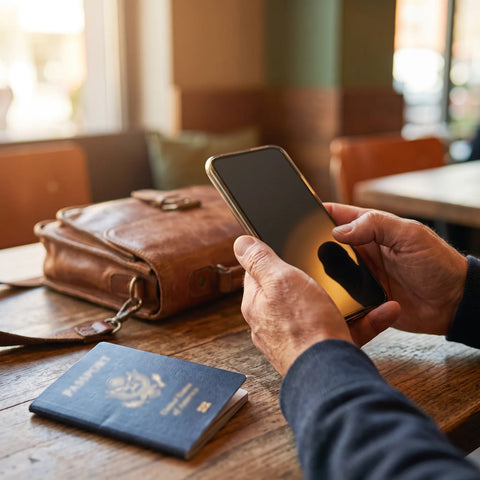
In short: Puerto Rico uses US networks (Claro, Liberty Mobile, and T-Mobile), with excellent coverage in San Juan and along the coast, but for your regular carrier it's still international roaming. A Puerto Rico eSIM activated before you fly gives you data from the moment you land at Luis Muñoz Marín Airport, with a fixed price and your usual number untouched for SMS and calls.
Why Puerto Rico isn't just another destination
Puerto Rico is an unincorporated territory of the United States: US dollar currency, +1 dialing code, airports with TSA checks like any domestic US flight. That confuses a lot of people, who assume their phone "already works the same as in the US." And they're partly right: the telecom infrastructure is the same as in Miami or New York. The problem isn't the network, it's what your regular carrier charges you for using that network from outside the EU.
For Movistar, Vodafone, Orange, or any carrier based in Spain, Puerto Rico doesn't count as "national territory" or as an EU roaming zone, so it triggers international roaming rates — the same ones they'd apply in Mexico or Morocco. If your plan doesn't include data outside Europe, usage is billed per megabyte and the meter keeps running.
The eSIM solves this at the root: you buy a data plan specifically for the island, install it calmly at home, and only activate it when you land. The cost is fixed before you leave, with no surprises on your card statement when you get back. If your trip combines San Juan with a stop on the mainland, check our eSIM for the United States guide first, because not all "USA" plans automatically include the island.

Coverage and local carriers (Claro, Liberty, T-Mobile)
The three carriers that split the island's market are Claro Puerto Rico, Liberty Mobile (which absorbed the former AT&T network), and T-Mobile. Between them, they cover almost all of the San Juan metro area with 5G, plus Bayamón, Ponce, Caguas, and Mayagüez, and maintain stable 4G on most highways and beach areas.
Things change inland: the Cordillera Central, much of the Panoramic Route, and El Yunque rainforest have stretches with weak or no coverage. A quality eSIM connects to the best available network at each spot instead of relying on a single carrier, so in practice you're usually better connected than with a physical SIM from one company.
Practical tip: inside El Yunque, on the smaller cays, and on stretches of the west coast (near Rincón and Aguadilla), it's normal to lose signal for minutes at a time. Download offline maps of the area before you go in and don't rely on real-time GPS.
Buying a local physical SIM is possible at Luis Muñoz Marín Airport (SJU) or at any Claro or Liberty store in the San Juan area, but it means waiting in line, showing your passport, and sometimes a clumsy activation in English with your phone already in hand. The eSIM skips all that: you buy and install it from the comfort of your couch, and in Puerto Rico you just turn it on.
How many GB you need for your trip
Actual usage depends on how you travel, not how long the flight is. If you use your phone for Google Maps, WhatsApp, and uploading a photo to stories, you'll be fine with very little. If you work remotely from the Airbnb balcony or go live from Flamenco Beach, the bar goes up quite a bit.
| Traveler profile | Days on the island | Recommended GB |
|---|---|---|
| Short getaway (maps + messaging) | 3-5 days | 3 GB |
| Standard tourist (social media + photos) | 7-10 days | 5-8 GB |
| Heavy user (video, tethering, remote work) | 10-14 days | 15 GB or unlimited plan |
A trick that cuts down usage a lot is to rely on the hotel or Airbnb wifi for large downloads, photo backups, and app updates, saving your mobile data for when you're out. Hotels in Condado and Isla Verde usually have plenty of wifi; more rural accommodations on the west coast, not so much.

eSIM vs local SIM vs roaming
All three options give you internet in Puerto Rico, but they don't cost or hassle the same. Roaming from your regular carrier is by far the most expensive and least predictable option; a local SIM is usually cheap per gigabyte but takes time and paperwork; eSIM is the comfortable middle ground.
| Option | Cost | Convenience |
|---|---|---|
| Roaming from your regular carrier | Cost skyrockets if your plan doesn't include data outside the EU | Zero setup, but unpredictable bill |
| Local SIM (Claro/Liberty) | Cheap once purchased | Line, passport, swapping the physical SIM, activation in English |
| PuraSIM eSIM | Fixed price per plan, you know it before you fly | Installed at home, ready when you land, no need to touch your physical SIM |
The advantage you notice most day-to-day is that you keep your regular number active to receive bank SMS or important calls, while data runs on the travel plan on a second line. To understand the difference between these options, we have a dedicated comparison of eSIM vs traditional roaming, and if you want to understand why roaming gets so expensive outside the EU, check out what data roaming actually is.
How to activate your eSIM step by step
Activating an eSIM for Puerto Rico takes less than a minute and is done from home, not in the airport queue. The most common mistake is waiting until you're at SJU with no decent wifi to install it for the first time; avoid that.
- Buy the plan that fits your travel days and the GB you need.
- You receive the QR code by email right after purchase.
- Scan it from Settings > Cellular > Add eSIM (or the equivalent menu on Android).
- Leave the eSIM installed, but only turn on data when you land in Puerto Rico.
If this is your first time installing one, check our general guide on how to install an eSIM, which answers the typical iPhone and Android questions before they pop up. And while you're at it, set your regular line to "data roaming off" so it doesn't accidentally activate as soon as your phone picks up a US network.
If you've never used an eSIM and aren't sure how it differs from a physical SIM, start with what is a virtual eSIM before buying.
Zone-by-zone tips: San Juan, El Yunque, Vieques, and Culebra
Puerto Rico is best enjoyed with reliable data: booking a table in Old San Juan, checking the ferry schedule to Culebra, translating a menu on the go, or saving a route before heading into a trail in El Yunque. Each area has its own coverage logic.
In Old San Juan, with its narrow cobblestone streets and tall colonial facades, coverage is excellent and 5G is fast, although GPS sometimes struggles between the stone walls of Calle Fortaleza or Calle San Sebastián; it's not a network issue, it's the street geometry itself. In Condado and Isla Verde, the hotel area, you won't have any signal problems.
For El Yunque, the only tropical rainforest in the US national forest system, download the route before entering: inside the forest there are long stretches without coverage, especially near the waterfalls farthest from the visitor center.
If you're going to Vieques or Culebra, have all the ferry logistics (schedules, departure terminal in Ceiba) downloaded in advance, because coverage on the sea crossing is intermittent and on the island itself the signal can be weaker than in the "metro area". It's still worth it: the bioluminescent bay in Vieques and Flamenco Beach in Culebra are among the best the island has to offer, signal or not.
To call home, use WhatsApp or a video call over data instead of an international call; you'll save yourself a nasty surprise on the bill. And if you notice your data usage is higher than expected, apply these tips to save data while traveling.
Myths and what almost nobody tells you
"It's US territory, my US eSIM will work". Sometimes yes, sometimes no. Some eSIM plans designed for the US do include Puerto Rico because technically it's a domestic network for American carriers; other plans from European providers limit coverage to "continental USA" and leave the island out. Check it in the plan description before buying, don't assume just because you see "United States" in the name.
"The whole island has strong 5G". That's true in San Juan and the metropolitan area, but not in the Cordillera Central or much of the Ruta Panorámica, where sometimes there isn't even stable 4G. If you're driving through the interior, don't rely on live GPS alone for your itinerary.
"Just buying a SIM at the airport solves it". The Claro or Liberty counter at SJU has a queue during peak flight arrival times, and if your phone isn't factory-unlocked or you don't have your passport handy, activation can drag on just when you're most eager to get to the hotel.
A detail that almost nobody mentions: Puerto Rico is in a hurricane zone from June to November, and even if you don't get a direct storm, occasional heavy rains can knock out power to some antennas for hours, causing temporary coverage drops in certain neighborhoods. It's not a reason not to go, but it's another reason to have maps and reservations downloaded in advance rather than relying on live data.
When NOT to buy an eSIM
If your trip combines a long stay on the mainland (New York, Orlando, Miami) with a short hop to San Juan for a couple of days, first check if your eSIM for the United States plan already covers the island: buying two separate plans when one will do is throwing money away.
If you're staying at an all-inclusive resort in Condado or Isla Verde and barely leave the hotel, the property's Wi-Fi plus a minimal plan for when you're out might be enough; you don't need the biggest plan just "in case".
And if your regular carrier has a premium plan that does include data in the US and its territories at no extra cost (they exist, though they're a minority), compare it before buying anything: you might already have the problem solved and not know it.
Frequently Asked Questions
Do I need an eSIM for Puerto Rico if it's already a US territory?
Yes, in most cases. Even though the networks are American, for your regular carrier Puerto Rico is not domestic territory or an EU roaming zone, so it's billed as international roaming unless your plan explicitly includes data outside Europe. A local eSIM avoids that charge and gives you a fixed price upfront.
Does the US eSIM also work in Puerto Rico?
It depends on the specific plan. Some include the island by default because carriers treat it as domestic network; others exclude it and only cover the mainland. Check the plan's coverage before buying if you're combining both destinations.
How much does roaming in Puerto Rico cost with my regular carrier?
There's no single figure: it depends on your plan and whether it includes data outside the EU. What is constant is that if it doesn't, the cost per megabyte of international roaming adds up fast. Check the current rate with your carrier before you travel, or avoid the problem altogether with a fixed-plan eSIM.
Which carrier has the best coverage in Puerto Rico: Claro, Liberty or T-Mobile?
All three cover the San Juan metro area and the main cities well. The real differences show up in rural and mountain areas, where none is perfect. That's why an eSIM that uses the best available network at each location usually gives better results than tying yourself to a single carrier.
Can I use the eSIM in Vieques and Culebra?
Yes, although coverage on those islands and on the ferry route is more patchy than in the San Juan metro area. Download ferry schedules, maps and reservations before you board, because at sea the signal often drops for stretches.
When should I activate the eSIM data?
Install it at home on wifi before you fly, but only activate the data when you land in Puerto Rico. That way you avoid the plan starting to count before time and you can calmly check that the installation went smoothly.
Can I make regular calls with the eSIM?
The travel eSIM is designed for data, not for traditional voice lines. To talk, use WhatsApp, FaceTime or any internet call over that data. Your regular number stays active for receiving SMS and calls if you keep that line on without roaming data.
Conclusion
Puerto Rico has American-grade networks, postcard beaches and spots like El Yunque, Vieques or Culebra that are worth it even if the signal drops for a while. The only thing that can spoil your trip is the roaming bill when you get back home. With an eSIM installed before you leave home, activated only when you land at SJU, you have data from the first minute, a fixed price, and your regular number safe for what matters. Prepare your Puerto Rico eSIM calmly and stop worrying about the bill when you get back.