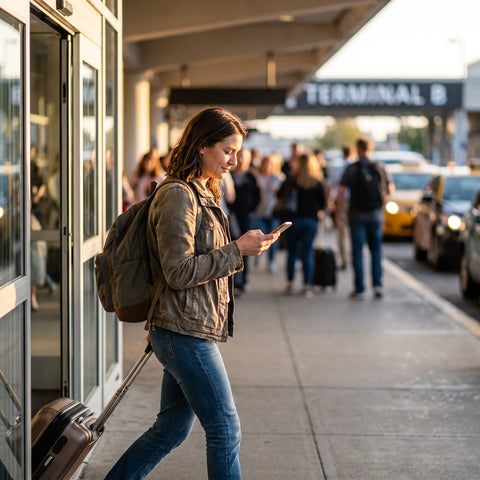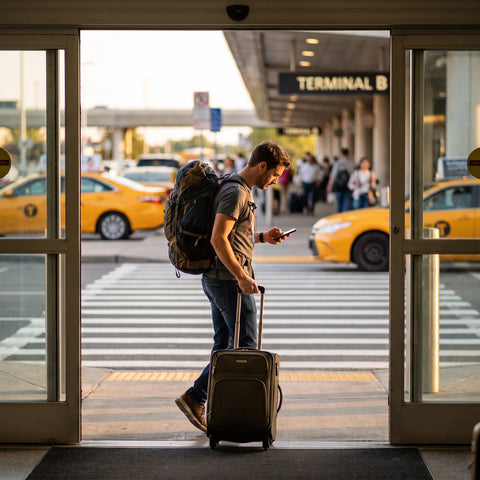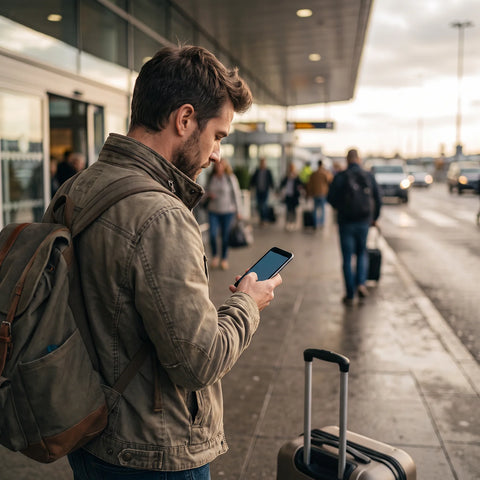
In short: For Argentine travelers, the eSIM for Thailand is purchased and installed from Buenos Aires before departure, it activates automatically upon landing in Bangkok, and avoids expensive roaming from Movistar, Personal, or Claro. You need a phone with eSIM (iPhone XS or newer, Galaxy S20 or newer) and WiFi for installation; the rest is automatic.
The flight from Buenos Aires to Bangkok is not short: unless you find a rare direct route, it's typical to fly with a long layover in Doha, Dubai, Amsterdam, or Istanbul, totaling between 20 and 30 hours door-to-door. This is plenty of time to calmly install the Thai eSIM, without the pressure of doing it with the slow Wi-Fi at Suvarnabhumi Airport while the immigration line moves behind you.
This guide is specifically designed for the Argentine traveler: what happens with your local carrier, which phones bought in Argentina (official or brought from Miami, Chile, or Paraguay) are compatible, how to make the most of your flight layover, and what you'll actually encounter in Thailand once connected.

Argentine Roaming in Thailand: Why it's Best to Avoid It
International roaming packages from Argentine carriers for Asia are usually among the most expensive in their catalog, and Thailand is no exception. Before signing up for anything with your carrier, check the fine print: there's almost always a very low daily data cap, after which the speed drops to an almost unusable crawl for Google Maps or video calls.
There's another issue that affects Argentines more than other travelers: some credit and debit cards issued in Argentina apply additional perceptions or surcharges to foreign currency spending, and this includes contracting roaming from your phone if it's billed in dollars. Before activating any international data package, it's worth checking twice which bank issues your card and what surcharge it applies to overseas purchases.
The real alternative is a local eSIM for Thailand: a data profile you buy online, install from your home in Buenos Aires (or wherever you are) and activate only upon landing. You pay for the GB you'll use, without relying on your Argentine company's roaming and without surprises on your card statement when you return.
How an eSIM works for your trip to Thailand
The eSIM is a digital SIM integrated into the phone itself: there's no physical card to insert or lose in a pocket. It's installed by scanning a QR code and, from that point on, it coexists with your physical Argentine SIM without overriding it.
The process for a traveler leaving Argentina is as follows:
- You purchase the data plan for Thailand on purasim.com before traveling.
- You receive the QR code by email.
- You install the eSIM profile using WiFi, at home or at Ezeiza airport, in about five minutes.
- During the flight, the eSIM remains installed but inactive: it consumes nothing.
- Upon landing in Bangkok, Phuket, or Chiang Mai, you activate it and already have local data.
- Your Argentine line continues to function in parallel for calls and SMS, exactly as you left it.
This means you won't be queuing at a True Move or AIS stand at the airport — those queues exist, and at four in the morning, the arrival time for many flights with layovers in the Gulf, they are not exactly fast. You get off the plane, activate data, and can already order a Grab to the hotel.

What phone you need (and why this isn't always obvious in Argentina)
In Argentina, there are three mobile phone purchasing circuits: official carrier sales, general retail, and devices brought from abroad by travelers or resellers (Chile, Miami, Paraguay). This matters because not all models in circulation have eSIM enabled, even if the internal hardware is identical to international versions.
As a general reference: iPhones from XS onwards come with eSIM in practically all variants that reach Argentina. With Samsung and other Android brands, it's advisable to check model by model, because some versions designed for certain markets come without the eSIM chip, even if the rest of the specifications are the same. Before buying the plan, go to Settings → Mobile Data (or the equivalent menu) and look for the "Add eSIM" or "Add data plan" option. If it appears, your device is compatible.
If your phone doesn't support eSIM, all is not lost: you can buy a local physical SIM upon arrival at any 7-Eleven or airport counter in Thailand, although that forces you to go through the process at the moment, in English or Thai, and often with the queue we wanted to avoid.
How many GB you need for Thailand according to your travel itinerary
The amount of data you need depends more on your itinerary than on the number of days in isolation. A trip focused on Bangkok and Chiang Mai, with decent WiFi in hotels and cafes, is not the same as an island tour (Koh Phi Phi, Koh Lipe, Koh Tao) where the accommodation's WiFi is often weak and you end up using mobile data for everything, including family video calls.
For a typical two-to-three-week trip combining city and islands, with Google Maps active almost all day, WhatsApp with photos, and an occasional video call to Argentina, a 15-20 GB plan is usually more than enough. If you're going to work remotely or upload a lot of content to social media in real-time, it's advisable to go for a larger plan or be clear that you can top up without losing your number or reinstalling anything.
| Option | Cost | Activation | Keeps your Argentine number | Typical speed |
|---|---|---|---|---|
| Roaming with your Argentine carrier | Cost skyrockets, especially after the daily cap | Automatic, nothing to install | Yes | Usually drops to 3G after exhausting the daily cap |
| Local physical SIM upon arrival | Local Thai price, but you lose time with the process | At the airport or a store, with queuing and on-the-spot processing | No, changes the number for that slot | Local 4G/5G |
| PuraSim eSIM for Thailand | Price of the chosen GB plan, no surprises | Before traveling, installed and ready to activate upon landing | Yes, in parallel | Local 4G/5G |
How to install the eSIM before your Buenos Aires-Bangkok flight
With a several-hour layover in Doha, Dubai, or Amsterdam, you have plenty of time to do this calmly at the connection airport itself, using the free WiFi offered by most of these terminals:
- Check compatibility: in Settings, verify if your device supports an additional eSIM profile.
- Purchase the plan on purasim.com choosing Thailand and the GB according to your itinerary.
- Install the profile by scanning the QR code that arrives by email, using any available WiFi.
- Give it a recognizable name ("PuraSim Thailand") and configure it for data only, not for calls or SMS.
- Leave it inactive during the flight and activate it only upon landing, in Settings → Mobile Data.
To know in detail what steps each operating system follows, the guide on how to install an eSIM step-by-step works just as well for this trip as for any other destination.
Myths and what almost no one tells you about staying connected in Thailand
Myth: "If I install the eSIM before leaving, the plan starts to run out." False. The countdown for most data plans by day starts with the first actual data usage, not with the profile installation. You can have the eSIM ready a week before your trip without losing a single GB.
Myth: "The free WiFi at Suvarnabhumi Airport is enough to get started." It exists, but during peak international flight arrival times, it gets saturated, and some points require you to register with a Thai phone number that, obviously, you don't have yet. Arriving with the eSIM already activated avoids depending on that network.
Myth: "Signal on the islands is as good as in Bangkok." Not always. In Bangkok and Chiang Mai, 4G/5G coverage is solid in almost every corner. On smaller islands or during trekking sections in the north (areas near Pai or Mae Hong Son), the signal might drop at times. Download offline maps of the area before moving, not when you're already lost looking for a waterfall.
Hidden gem: Bangkok's public transport is your best ally for not spending too much data. The BTS Skytrain and MRT have stable coverage at almost all stations, so you can stop browsing while on the platform and resume your map only when you exit, a simple trick that extends any GB plan.
Hidden gem: check your card's surcharge before, not after. Many Argentine travelers only find out the real cost of an overseas purchase when they see their statement. If you're paying for the eSIM plan with a card, a minute of online banking before the trip saves you surprises.
When NOT to buy a Thailand eSIM: If your trip is just a short technical stopover in Bangkok without leaving the airport, you don't need anything, as you'll have free WiFi there. And if your plan also includes Singapore or Malaysia in the same itinerary, you might be better off with a regional plan that covers all three countries instead of buying a different eSIM for each one.
Beyond Connectivity: Tips for the Argentine Traveler
With data sorted, there are a couple of things specific to having an Argentine passport that are worth keeping in mind:
- Notify your bank about your trip. It's common for anti-fraud systems to block Argentine cards due to sudden spending in Thailand. A prior notice, although it may seem minor, prevents you from being left without a functioning card in a Bangkok 7-Eleven.
- Bring some cash in dollars to exchange. Although you can pay almost everything with a card or QR (PromptPay is omnipresent for locals, not always available for tourists), cash still rules in markets, temples, and rural transport.
- Save your passport, travel insurance, and reservations on your phone, in addition to paper copies. With the eSIM active, you have access to these documents even if the accommodation's WiFi fails just when you need it for a check-in.
- Use the layover to adjust to the time difference. If your flight has a layover in Doha or Dubai, those idle hours are the ideal time to install the eSIM, review your itinerary, and download offline content calmly, instead of doing it with the nervousness of arrival.
To understand the fundamental difference between paying for roaming and using a local eSIM, it's also worth reading the eSIM vs. roaming comparison, and if you want the technical details of what data roaming is exactly and why it costs what it does, it's explained in what data roaming is.
If your route isn't limited to Thailand and you're crossing into Singapore or Malaysia on the same trip—something quite common among Argentines making the long jump to Southeast Asia—check out the eSIM Singapore, Malaysia, and Thailand plan, which covers all three destinations with a single profile instead of buying a different eSIM for each country. And if you're going to maximize your data usage, this guide of tricks to save data on your travel eSIM has concrete ideas that work just as well in Bangkok as in any other destination.
For a more general overview of connectivity in the country—not just the specific travel angle from Argentina—the guide to internet in Thailand is a good complementary reference.
With the eSIM active from landing, the trip from Buenos Aires to Bangkok no longer has that initial blind stretch that so many long flights have: you arrive, activate data, and the rest of the trip begins without the friction of searching for external WiFi or queuing at a phone stand at four in the morning.
Frequently Asked Questions
Can I use the PuraSim eSIM throughout Thailand, including the islands?
Yes, the eSIM works on the local network throughout the country. Coverage is strongest in Bangkok, Chiang Mai, and major tourist areas; on smaller islands or rural stretches in the north, there may be occasional outages, which can happen with any line, local or foreign.
What happens if the phone I bought in Argentina doesn't have eSIM?
Some models, especially certain mid-range versions, do not come with an eSIM chip, even if they look identical externally to the international model. Check in Settings → Mobile Data if the option to add an eSIM plan appears. If it doesn't, the alternative is to buy a local physical SIM upon arrival in Thailand.
My flight from Buenos Aires to Bangkok has a long layover, can I activate the eSIM there?
You can install it during the layover using the airport's WiFi, but it's advisable to leave it inactive until you land in Thailand to avoid consuming the plan ahead of time. Installation and activation are distinct steps.
Can I make free video calls to Argentina with the eSIM active?
Yes, via WhatsApp, FaceTime, or similar apps, which work through the eSIM's data with no additional cost for the call itself. They consume data like any other app, so keep that in mind when calculating how many GB you need.
Can I pay for the eSIM with an Argentine card without problems?
Yes, the payment is processed like any online purchase abroad. Before buying, it's advisable to check with your bank what surcharge your card applies to foreign currency transactions, so you're not surprised on your statement.
If I also visit Singapore or Malaysia, should I get a different eSIM for each country?
Not necessarily. If your itinerary combines Thailand with Singapore and/or Malaysia, a regional plan covering all three countries is usually more practical than installing and activating a different profile at each border.
What do I do if I run out of GB halfway through my trip?
You can top up the same plan without reinstalling anything or losing the assigned number. If you notice you're running low, it's best to top up before you completely run out of data, especially if you're about to move to an area with unreliable WiFi.
Activate your eSIM before leaving Argentina and arrive connected from the very first moment.