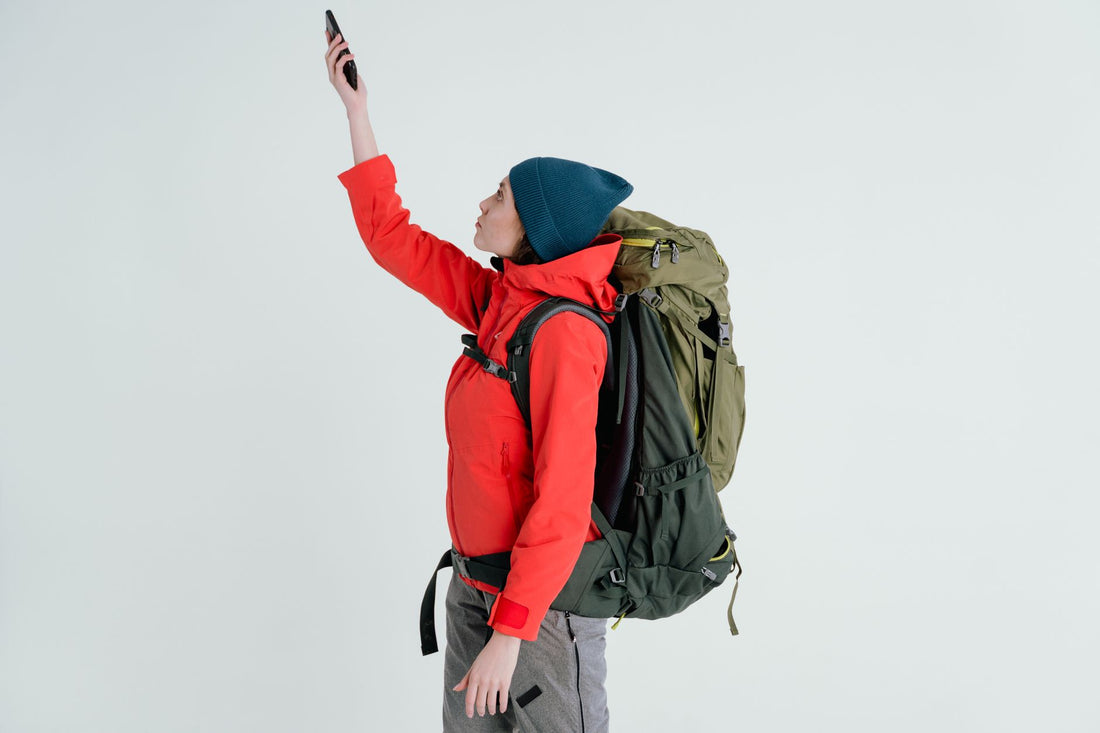
In short: rural and mountain coverage with an eSIM depends on the country's network, not the eSIM technology itself: a multi-network eSIM offers more signal options than a local SIM tied to a single operator, but in gorges, dense forests, or remote trails, no plan can replace a satellite device.
It's the doubt that assails anyone before embarking on a hiking trail, a mountain pass road, or a village of fifteen houses: will I have data when the asphalt and buildings disappear? The short answer is that eSIM coverage in rural and mountain areas behaves the same as physical SIM coverage, because both use the same antennas. What changes is the plan you choose and how many networks it can use. Here we debunk myths, explain what factors matter outside the city, and give you tips to reach your destination with internet, without roaming, and without stress.
Does eSIM provide less coverage in the countryside than a physical SIM?
No, and it's worth making that clear from the start because it's the most common confusion. An eSIM is a SIM card in digital format: it's stored on the phone's chip instead of on a plastic card, but the process of searching for an antenna, connecting to a tower, and receiving data is identical. If there's coverage from an operator in a mountain village or a mountain pass, the eSIM receives it just like a physical card from that same operator would.
The myth arises from mixing the technology with the specific plan you purchase. The eSIM does not add or remove signal range; the plan does matter, because it determines which network or networks you can connect to in each country. A plan tied to a single operator with little rural presence will leave you without bars more often than one capable of hopping between several networks. If you're still unclear on the basic concept, this review of what an virtual eSIM is exactly will provide context before you continue. The problem is never "eSIM yes or eSIM no," but what antennas are deployed on that ridge and whether your plan can use the best one.

What determines signal strength outside the city
When you leave the urban core, three factors determine whether you have data: the density of the operator's antennas, the frequency band they use, and the topography of the terrain. None of these have to do with whether you have an eSIM or a physical SIM.
Frequency band matters more than network generation
There's a belief that 5G is always better than 4G. In the city, yes, because it offers greater speed. In the countryside, the frequency band outweighs the "4G" or "5G" label: low bands, between 700 and 800 MHz, travel much further and penetrate forests, slopes, or stone walls better than the high frequencies of urban 5G. An operator that deploys its rural antennas in a low band will give you greater range in the mountains, even if its advertised maximum speed is lower.
Antenna density depends on the operator's network model
Not all operators have the same physical network. Traditional operators tend to maintain extensive proprietary infrastructure, including rural coverage inherited from when landlines reached every village. Virtual operators, who lease capacity, focus first on cities. Therefore, for an area with a lot of countryside, it's worth looking at which networks the plan uses, not just the price per gigabyte; this is also the basis for comparing eSIM versus traditional roaming.
Topography trumps all else
Signal travels essentially in a straight line from the antenna. A mountain, a slope, or a deep gorge blocks that line just like a wall. That's why in the same meadow, one mobile phone might have three bars while another, with a different operator, has none: each operator's antennas are in different places, and only one has a direct line of sight to that spot.
Practical tip: in the mountains, a boxed-in valley or the north face of a peak can leave you without coverage, even if there's plenty of signal a kilometer away in a straight line, on the other side of the ridge. It's not a problem with your eSIM, it's geometry.
The multi-network advantage of eSIM in rural areas
This is where a good travel eSIM works in your favor. Many plans are not tied to a single local operator: they can rely on several networks in the country, and the phone automatically chooses the one with the best signal at any point along your route. If operator A doesn't reach that valley but operator B does, your phone connects to B without you having to do anything.
Compared to buying a physical SIM from a single operator, the difference is significant: with a local SIM, you depend exclusively on that company's coverage, while with a multi-network eSIM, you carry several connection options in the same profile, without changing cards. This is especially noticeable on routes that constantly change terrain: from the coast to the interior, from a valley to a mountain pass. It's also why this type of plan works well on a trek to Machu Picchu in the Andes or a journey through the interior of Australia or New Zealand, where the outback alternates with urban centers separated by hundreds of kilometers.
| Route situation | Local SIM (1 network) | Multi-network eSIM |
|---|---|---|
| Village with a single operator providing coverage | You might be left without a signal | Connects to the available network |
| Route crossing several areas with different coverage | Irregular coverage, no margin | Jumps to the best network in each section |
| Country change during a mountain crossing | You need to buy another SIM | Still works if the plan covers that region |
| Area with two operators of unequal coverage | You depend on having chosen correctly when purchasing | You don't need to choose correctly: try several |

Mountains, valleys and blind spots: what to really expect
Even with the best multi-network eSIM on the market, physics doesn't negotiate. In high mountains, you will find blind spots: deep gorges, north faces far from any inhabited valley, remote refuges, or long-distance trails where there simply is no antenna, from any operator, that reaches. No card can fix the absence of infrastructure.
The useful thing is not to expect constant coverage, but to know where it is reasonable to have it. As a general rule, you usually have data in:
- Villages and inhabited areas, even if small.
- Ski resorts and their access areas.
- Popular viewpoints and tourist spots with crowds.
- Main roads and busy mountain passes.
- Peaks with direct line of sight to an inhabited valley.
And you usually lose it in deep gorges, dense sloping forests, and hiking sections far from any road. Plan accordingly: download offline maps before you go, don't assume you'll have internet all the time, and calculate carefully how much data you'll need if you're going to spend several days in a large natural area.
How to prepare your eSIM before heading to the mountains
Most connection problems in rural areas are not about coverage, but about preparation. These steps make the difference between arriving calmly and arriving blindly.
Install and activate the eSIM with Wi-Fi, never at the last minute
An eSIM is installed by scanning a QR code, and that process requires internet, usually Wi-Fi. Do it calmly before leaving home, never at the entrance of the refuge. If it's your first time, follow the step-by-step guide on how to install an eSIM.
Leave data roaming activated as your primary line
Once installed, activate data roaming on your eSIM and set it as your default line. If you're not sure what this setting means, it's a good idea to review what data roaming is beforehand, so you don't accidentally deactivate it halfway through your route.
Take care of the battery, as it drains much faster in mountain cold
Searching for signal in weak coverage areas consumes battery, and high-altitude cold makes them perform worse. Activate power saving mode, lower brightness, and carry an external battery if you're going to be out all day.
Let the phone reconnect on its own when leaving the blind spot
If you lose coverage in a valley, the phone will regain it as you gain altitude or leave the area out of sight of the antenna. A trick that works: activate airplane mode for a few seconds and deactivate it when you feel there might be a signal, to force a search from scratch.
Little-known tip: if you're traveling in a group and everyone has their own eSIM, compare which operator each line has before you leave. With different operators, it's more likely that someone in the group will have a signal at each point, and you can notify each other or share data via hotspot.
Comparison: eSIM, local SIM, and home operator roaming in rural areas
Before deciding how to connect on your next rural trip, this table summarizes the practical differences between the three most common options.
| Option | Typical rural coverage | Cost outside your country | Ease of use |
|---|---|---|---|
| Home operator roaming | Depends on agreement with a single local operator; can be limited | Can exceed several euros per day if you don't have a specific plan | Automatic, but it's advisable to check conditions before leaving |
| Local physical SIM purchased at destination | Good if you choose the right operator; none if you don't | Usually economical, price varies by country | You have to find the point of sale and change the physical card |
| Multi-network travel eSIM | More options as it can use several networks in the country | Varies depending on plan and contracted data | Installed before leaving, no physical card or stores |
To better understand why traditional roaming can become expensive, it's worth reviewing its terms before a long trip through rural areas.
Myths and common errors about rural coverage with eSIM
These are the beliefs most often repeated among travelers, and it is advisable to debunk them before they lead you to make a bad decision.
Myth: "more GB in the plan means more coverage"
These are different things. Gigabytes refer to how much data you can consume; coverage refers to whether there's a signal where you are. You can have unlimited data and still not have a single bar in a gorge. Focus on which networks the plan uses, not just how many GB it includes.
Myth: "5G will always give me better coverage than 4G"
This is one of the most expensive mistakes: in rural areas, 4G on low bands usually reaches further than high-frequency 5G. Don't rule out a plan just because it "only" offers 4G in that region.
Error: activating the eSIM just when entering an area without coverage
If you try to scan the QR code when you're already in a mountain village without Wi-Fi, it's too late: installation requires internet. Activate it in advance.
What almost no one tells you: check the operator's coverage map, not just the country's
Most operators publish their own coverage maps, which are more detailed than any generic comparison. If your route passes through a specific area, checking that map before you leave gives a more realistic idea than trusting that "there's generally good coverage in that country."
What almost no one tells you: privacy matters on Wi-Fi in shelters and small towns
When mobile coverage fails, it's common to resort to public Wi-Fi in a shelter or village bar, networks with little to no security. To access banking or any personal account, it's a good time to use a VPN in addition to your eSIM: we cover this in the guide on privacy and VPN when traveling with eSIM.
When eSIM is not enough
For the vast majority of rural and mountain trips, a well-chosen multi-network eSIM is more than sufficient: villages, inhabited valleys, ski resorts, mountain pass roads, and most hiking trails with access from populated areas. But there are scenarios where no mobile network reaches, no matter how many operators you switch: multi-day treks through uninhabited areas, high mountain expeditions, or offshore navigation.
In such cases, the solution isn't to look for another SIM, but to carry a satellite device, like a beacon or a satellite messenger, designed for emergencies where no antenna is available. The eSIM remains your best option for everything else, the vast majority of a trip's actual itinerary. Choose your plan based on the destination and terrain, not just the price.
Frequently asked questions
Does an eSIM work in small towns and rural areas?
Yes, as long as there is coverage from an operator in that town. The eSIM uses the same antennas as a physical SIM. Additionally, a multi-network plan can connect to several operators in the country, increasing the chances of getting a signal in small rural areas.
Is there any eSIM that gives more coverage in the mountains than others?
No eSIM "creates" coverage where there are no antennas, but plans that rely on multiple networks in the country are more likely to find a signal than a local SIM tied to a single operator. The difference is in the plan, not in the eSIM technology.
What do I do if I lose signal in the middle of a route?
Don't worry: your phone will reconnect automatically as soon as you leave the blind spot or gain altitude. To speed it up, activate and deactivate airplane mode. And always carry downloaded offline maps of the route, in case the section without coverage is longer than expected.
Does eSIM use more battery searching for signal in rural areas?
Yes, in weak signal areas the phone consumes more battery searching for an antenna, but this happens with any SIM. Activate power saving mode, lower the brightness, and if you're going to be out for hours in the cold, carry an external battery.
Can an eSIM be used for remote work from a rural house?
If the area has reasonable 4G or 5G coverage, yes, even as a backup for the house's Wi-Fi. It is advisable to check the actual coverage of that specific location beforehand and contract a plan with ample data in case the fixed connection fails.
Do I need a different eSIM for each country if my route crosses mountain borders?
Not necessarily. Many travel eSIM plans cover several countries in the same region, which is very useful for mountain routes that cross borders, such as mountain ranges shared between neighboring countries. Check the geographical coverage of the plan before purchasing it.
Conclusion
The eSIM does not provide less coverage in the countryside than a physical SIM: it provides exactly the same as the network you have underneath. What does change in your favor is choosing a multi-network plan, which gives you more options to get a signal in towns, valleys, and mountain passes than tying yourself to a single local operator. Outside the city, plan for blind spots with offline maps, conserve battery, and don't rely on continuous internet in remote sections.
Choose your eSIM according to the destination and terrain: if your route takes you through the Alps, the Pyrenees, or any European rural area, check out our eSIM for Europe. Whatever the country, land with internet, without roaming, and without stress, wherever the signal reaches.