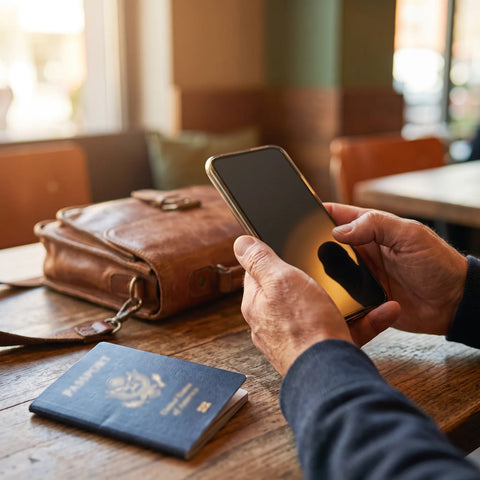
In short: an eSIM Honduras gives you mobile data as soon as you land in San Pedro Sula or Tegucigalpa, without having to look for a Claro or Tigo store or load lempira credit. It's installed before you fly, activated upon arrival, and covers everything from the cities to the Bay Islands, cheaper than your Spanish operator's roaming.
What an eSIM is and if it works in Honduras
An eSIM is a digital SIM card integrated into the mobile phone itself: there's no plastic to insert, just a profile that's downloaded by scanning a QR code. If it sounds like a strange novelty, here's a more complete explanation of what a virtual eSIM is and how it differs from the traditional physical SIM.
And yes, it works in Honduras. It connects by network agreement to the antennas of local operators, so you have internet as soon as you land in San Pedro Sula or Tegucigalpa, without looking for a store or showing your passport. You only need an eSIM-compatible phone and to have installed it before leaving home, which takes a couple of minutes with Wi-Fi.
The big advantage over a physical chip is that you skip the entire process. In Honduras, buying a local prepaid SIM involves finding a Claro or Tigo store, sometimes registering the number, and loading credit in lempiras cash. With the eSIM, that step disappears: you buy the plan online, receive a QR, and in a minute you're browsing. If you're traveling with little time or have a layover en route to the Bay Islands, that detail is appreciated much more than it seems on paper. Plus, you keep your Spanish number active to receive WhatsApp or bank verification SMS while data runs on the eSIM.

Coverage and local operators (Claro and Tigo)
Mobile coverage in Honduras is solid in urban and tourist areas, and more irregular in the mountainous interior. The two major operators are Claro Honduras and Tigo, which share almost the entire market and support the 4G/LTE network to which your eSIM connects. Your travel eSIM relies on the best available network in each area, so you don't depend on a single operator or on having chosen the right chip upon arrival.
Main cities
In Tegucigalpa, San Pedro Sula, and La Ceiba, you'll have stable 4G, more than enough for maps, messaging, social media, and video calls. This is the most reliable coverage in the entire country, so if your trip mainly moves between these three cities, you won't have any connection surprises.
Bay Islands: Roatán and Utila
In tourist destinations like Roatán, Utila, and the Copán area, the signal is usually good near urban centers, although in remote beaches or jungle trails it can drop to 3G or disappear for a while. This is normal in Central America: the orography and distance from the mainland dictate more than the operator's technology. If you're coming from another destination in the region, the coverage logic is similar to what's explained in the guide to eSIM for Colombia, another Latin American classic with coast, mountains, and remote areas coexisting on the same trip.
Copán and archaeological zones
In Copán Ruinas, coverage in the town is good, but within the archaeological site itself, it can fail due to dense vegetation. This is not an operator issue, but an environmental one: the same happens with any SIM, local or foreign.
Tip: download offline maps of Roatán, Utila, and Copán before leaving the coverage area. This way, you'll reach your destination even if the 4G weakens on the road trip or ferry.
eSIM vs local SIM vs roaming
You have three ways to get data in Honduras, and not all of them cost or bother you the same. Your Spanish operator's roaming is by far the most expensive; a local SIM is cheap but inconvenient to get; and the eSIM hits the sweet spot: moderate price and zero paperwork. To understand why traditional roaming is so expensive outside the European Union, it's worth reviewing exactly what data roaming is and how operators charge for it.
| Option | Estimated cost | Convenience | Active Spanish number |
|---|---|---|---|
| Spanish Roaming | High (can exceed several euros per day outside the EU) | High (you do nothing) | Yes |
| Local SIM Claro/Tigo | Low | Low (store, registration, cash in lempiras) | No, you change numbers |
| Travel eSIM | Medium-low | Very high (QR, a couple of minutes) | Yes, with dual SIM |
For a one- or two-week trip, the eSIM wins in terms of comfort-price without forcing you to give up your usual line. If you want to see the full comparison, with more detail on how real spending is calculated, we elaborate on it in eSIM vs roaming.

How many GB you need for your trip
The million-dollar question. It depends on how much you use your phone: looking at Google Maps for a while each day is not the same as uploading diving videos from Utila every afternoon. As a realistic reference for Honduras, these are typical consumptions per traveler profile.
- Basic use (1-2 GB/week): WhatsApp, occasional maps, some emails. Ideal for those who rely heavily on hotel Wi-Fi and only need data to get around outside.
- Medium use (3-5 GB/week): daily maps, social media, music streaming, some short video calls. The most common profile among independent travelers.
- Intensive use (7-10 GB or more): sharing internet with a laptop, uploading photos and videos from the Bay Islands, constant browsing for work or to not miss any part of the road.
If in doubt, aim slightly high: topping up or extending on the fly is easy, but running out of data in Roatán while looking for a taxi at night is not so easy. You can also reduce actual consumption without changing your plan by applying some simple tricks we gathered in how to save data with eSIM on your trips.
Estimated prices per day
eSIM plans for Honduras are structured by GB and days of validity. These amounts are indicative to give you an idea of the usual range; the final price always depends on the specific plan you choose and should be checked before purchasing.
| Duration | Suggested Data | Traveler Profile |
|---|---|---|
| 3-5 days | 1-2 GB | Layover or quick trip to Copán |
| 7 days | 3-5 GB | Beach week in Roatán or Utila |
| 15 days | 8-10 GB | Long trip across the country |
| 30 days | 15 GB or more | Long stay, diving and remote work |
Compared to roaming outside the European Union, which can exceed several euros a day depending on your operator and rate, a travel eSIM designed for the entire stay usually costs what you would spend in just a couple of days of traditional roaming. The difference is especially noticeable if your trip lasts more than a week, and even more so if you plan to combine Honduras with another country in the region.
How to install it step-by-step
Installing the eSIM is quick and it's best to do it at home, with Wi-Fi, before flying. This way, you land in Honduras with your data ready to activate as soon as the plane touches down. The process is practically identical on iPhone and Android, and requires no special technical knowledge.
- Buy your plan and receive the QR code by email instantly, without waiting.
- On iPhone: Settings → Mobile Data → Add eSIM → Use QR Code. On Android: Settings → Connections → SIM Manager → Add eSIM.
- Scan the QR and give it a recognizable label, for example "Honduras", so as not to confuse it with other lines.
- Upon arrival, activate data roaming only for the eSIM and deactivate it on your Spanish line to avoid charges.
If you've never installed one before or want to see the process with step-by-step screenshots, we have a dedicated guide on how to install an eSIM that covers different mobile models and the most common errors when scanning the code.
Common mistakes and what almost no one tells you
Most guides stick to the basics. Here are some details that do make a difference on the ground in Honduras and are rarely explained clearly.
Installing the eSIM at the airport is the number one mistake
Many people wait until they land to scan the QR and discover, already in the arrivals hall, that the airport Wi-Fi isn't working well or that they need data to download the profile. Always install it before leaving home, with stable Wi-Fi. Roaming activation is done upon arrival, but the profile installation should be done beforehand.
Not all "modern" phones are compatible
Some operator-unlocked models come with the eSIM function factory-locked, especially some terminals purchased outside Europe or resold as unlocked without being entirely so. Before buying your plan, check your phone settings to see if the "Add eSIM" option appears; if not, it's better to confirm it before traveling than to discover it in Honduras.
Dual SIM consumes more battery than you expect
Having two active lines at once, the Spanish one on standby and the eSIM browsing, makes the phone search for signal twice. In areas with weak coverage, such as the mountainous interior, this can impact battery life. A little-known trick: set your Spanish line to "data off, calls and SMS only" mode instead of leaving it fully active, this way you save battery without missing important notifications.
Hotel Wi-Fi is not always faster than your eSIM
In many accommodations in Roatán or Utila, shared Wi-Fi is slower than mobile data, especially in the afternoon when more guests are connected at the same time. If you need to upload something quickly, try your eSIM before wrestling with the hotel's router password.
Privacy on public networks does matter
Even if you have your own data, it's common to still use airport or restaurant Wi-Fi out of habit. If you're going to do any sensitive transactions, like online banking, it's advisable to protect yourself and not expose your data on open networks that you don't control.
Tips for traveling connected in Honduras
Beyond data, here are some practical tips to ensure your connectivity doesn't fail you at any point of your trip, especially if you're moving between the Caribbean coast and the country's interior.
- Bay Islands: on the ferry to Roatán or Utila, the signal cuts out at times; download tickets, reservations, and boarding passes before embarking.
- Copán Ruinas: there's coverage in the town, but it can fail within the archaeological site. Have an offline map downloaded beforehand.
- Cash and banking app: with the eSIM and your Spanish number on dual SIM, you'll still receive your bank's verification SMS without relying on roaming.
- Public Wi-Fi: use it wisely; with your own eSIM data, you avoid connecting to dubious open networks in airports and hotels.
- If you continue your trip after Honduras: if your route continues to the United States, check out the eSIM for the United States before leaving, so you'll have data in your next destination without managing it from the connecting airport.
- Upon returning home: if you want to have data ready as soon as you land in Spain, or simply activate it as a secondary line for when you travel again, check out the eSIM Spain.
This covers the points where connectivity usually gives trouble in Honduras. Spanish-language support is available for any questions that arise during the trip, before or after installing the eSIM.
Frequently asked questions
Does the Honduras eSIM work in Roatán and Utila?
Yes. The eSIM connects to the network of local operators, which cover the tourist centers of the Bay Islands. In very remote beaches or in the open sea during the ferry journey, the signal may drop, which is normal in island areas with any operator. In towns and diving areas, you will have data normally most of the time.
Do I need to register the eSIM with my passport like a local chip?
No. Unlike a Claro or Tigo prepaid SIM, which sometimes requires in-store registration, the travel eSIM is activated with a simple QR code. No passport is needed, no need to go to any office, nor to load credit in cash. You buy online and in a couple of minutes you're browsing.
Can I continue using WhatsApp with my Spanish number?
Yes. WhatsApp is associated with your phone number, not with the SIM that carries the data at any given time. With the eSIM browsing and your Spanish line on dual SIM, you keep WhatsApp, Telegram, and your bank's SMS working without changing anything in your account.
How many days of validity should I choose?
Choose a plan that covers your entire stay with a small margin. If you're staying for 8 days, get one for at least 10 to be on the safe side. Topping up or extending on the go is usually easy, but it's more convenient to leave home with plenty of validity already covered.
Is there 5G coverage in Honduras?
The bulk of the network in Honduras is 4G/LTE, more than enough for maps, streaming, and video calls. 5G is still limited and concentrated in very specific areas of large cities, so don't count on it for your itinerary. For travel, 4G is more than enough.
What happens if I run out of data halfway through my trip?
You can top up or buy another plan from your phone at any time, without needing to find a physical store. This is one of the advantages over a local SIM: if you miscalculated the GBs, the problem is solved in a couple of minutes and you stay connected without long interruptions.
Can I use the Honduras eSIM if my trip includes another country?
It depends on the specific plan: some cover only Honduras and others are designed for several countries in the region. If your route combines Honduras with destinations like Colombia or Peru, check before buying if the plan is country-specific or regional, so you don't run out of data when crossing the border.
Conclusion
Traveling to Honduras with an eSIM saves you the queue at the operator's store, passport registration, and roaming bills upon return. You have data from the airport, keep your Spanish number active, and adjust GBs to your type of trip, whether it's diving in Utila or ruins in Copán. Activate your Honduras eSIM before flying and land already connected, with Spanish support in case any questions arise during your trip.