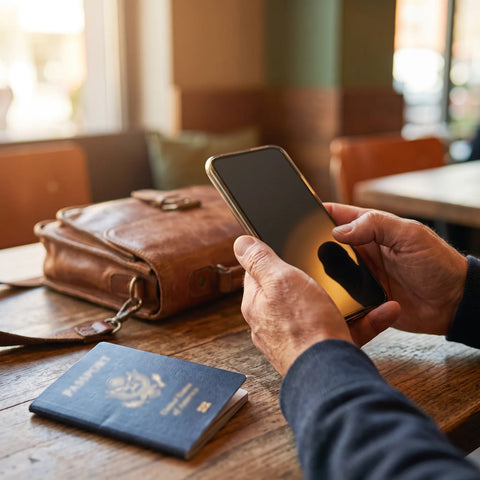
In short: an eSIM for au pairs gives you internet as soon as you land, without queues or contracts, and works alongside your Spanish SIM so you can keep your usual number. It's ideal for your first few weeks abroad; for the rest of the year, you can combine it with a local line if your host family or bank requires it.
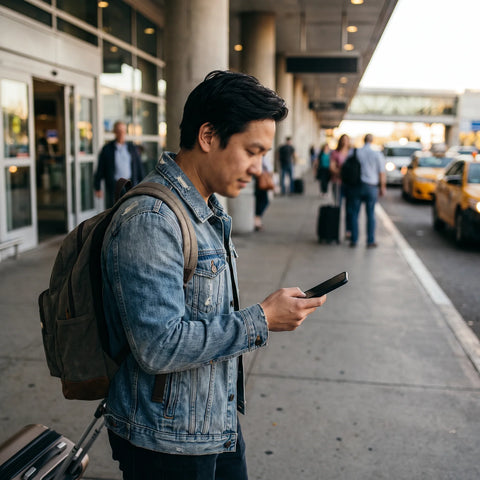
Going abroad as an au pair is a huge leap: you'll be changing country, language, and family for months, sometimes an entire year. The last thing you want on your first day is to argue with a salesperson in a language you don't yet master, with your luggage in tow and jet lag setting in. With an eSIM for au pairs, you have mobile data from the moment you arrive at the airport, without stepping into a shop or signing anything. You land with internet, no roaming, no stress, and you can calmly decide what to do with your long-term line once you're settled in with your host family.
In this guide, we'll review how an eSIM works, how to keep your Spanish number active, how much data you'll need, the most common au pair destinations, and the mistakes almost all au pairs make the first time they leave Spain.
What is an eSIM and why is it so well-suited for an au pair year?
An eSIM is a digital SIM card: instead of a physical card that you insert into your phone's tray, it's a profile that is downloaded and installed via a QR code. If you've never used one, we explain it in detail in what an eSIM is and how it works. The important thing for you is this: your modern phone can simultaneously have your physical Spanish SIM and a data eSIM from the country where you'll be living. Two lines, one phone, without carrying a second mobile or constantly swapping cards with a paperclip.
The other piece worth understanding before you leave is the difference between roaming and actual data roaming. Roaming is what your Spanish operator does when it "borrows" coverage from a foreign network for your usual line, and outside the European Union, this often skyrockets the price per megabyte within a few days. We explain this in what data roaming is and in the comparison eSIM versus roaming. A travel eSIM, on the other hand, contracts local data from the destination country directly, so you don't depend on your Spanish company's rates or get unpleasant surprises on your bill when you return.
Is an eSIM suitable for an entire au pair year, or just for the trip?
Yes, with nuances. A travel eSIM is designed primarily for your first few weeks: immediate internet for the translator, map, WhatsApp, and first-day tasks, without depending on anyone. For a long stay, it's common for au pairs to combine: use the eSIM upon arrival to avoid being without coverage for even a day, and later consider a local line if a bank, an app, or your host family requests a local number.
The advantage of this approach is arriving already connected. You buy the eSIM before leaving Spain, install it calmly from your sofa at home, and activate it when you get off the plane. Within minutes, you have data in your new country. Then, once you're with the family and without rushing, you decide if a local line is worth it or if you can manage with eSIM recharges for the rest of your stay.
Your Spanish number while you're away
Here's the key that many au pairs aren't clear about: the eSIM occupies a different slot than your physical Spanish SIM, so you can have both active at the same time. You keep your Spanish number for bank SMS, verification codes, or calls from your family, and you use the eSIM data for browsing, chatting, and video calls. This is the configuration that works best to avoid losing your Spanish digital life precisely when you need it most.
The practical trick is to leave your Spanish line only for SMS and occasional calls, with mobile data turned off on that line, and always browse using the eSIM. This way, you keep your usual number without surprises on your bill. Before you fly, ask your bank to activate email alerts in addition to SMS: if your Spanish line loses coverage in some corner of the country where you live, you'll still receive your access codes.
Calling home without breaking the bank
Homesickness is cured by talking to your loved ones, and today it's practically free. With eSIM data, you can make video calls and send messages without spending on international calls:
- WhatsApp and video calls: free over data, ideal for seeing family every week.
- Regular calls to a Spanish landline or mobile: it's better to use internet calling apps or Wi-Fi calling, to avoid paying your Spanish operator's international call-per-minute rates, which are usually much more expensive than talking over data.
- Voice messages: perfect when there are several hours of time difference with Spain.
If your phone allows it, activate Wi-Fi calling at your host family's home to make regular calls over the internet instead of using minutes from your Spanish line. Also check your app settings before you leave: there's nothing worse than discovering on day two that WhatsApp is still waiting to verify your number by SMS and your Spanish line has poor coverage where your family lives.
How much data do you need per month as an au pair?
A year abroad translates to a lot of mobile phone use: maps to find your way, a translator at all hours, social media, and long video calls home. As a monthly guide, here's what an au pair typically spends according to their routine:
| Usage profile | Data per month (approx.) | What it covers |
|---|---|---|
| Basic | 5-8 GB | Maps, WhatsApp, messaging and some social media |
| Medium | 10-15 GB | Daily social media, weekly video calls home, music streaming |
| Intensive | 20 GB or more | Video, series and long video calls outside the family's Wi-Fi |
Since you'll have Wi-Fi available at your host family's home and many other places, your actual mobile data consumption is often less than you imagine. Even so, overestimate for your first month, which is usually the busiest. Learn to stretch your data with these tips for saving data abroad, especially if your plan has a specific monthly limit.
Typical au pair destinations and their eSIMs
The most popular destinations for Spanish au pairs are usually the United States, Ireland, and several countries in Central and Northern Europe, almost always due to the language and the program's tradition. In all cases, the approach is the same: contract the eSIM before leaving Spain and arrive with data already enabled.
- United States: The most classic destination for Spanish au pairs. It's a huge country where you'll need reliable internet from the arrival airport to the city where your family lives, sometimes with several hours of travel. You'll have extensive coverage with eSIM for the United States, designed for long stays.
- Ireland and other European destinations: Very popular due to English and proximity to Spain. If your program takes you to several countries on the continent, or you take advantage of your days off for trips around Europe, a regional eSIM that covers different destinations with the same plan, such as the eSIM for Europe, will be worthwhile.
If your program includes long weekends or holidays across the continent, plan your eSIM with plenty of time rather than leaving it to the last day before your flight.
How to install your eSIM before flying
Installation is the part that causes the most nerves, and it's the simplest if you do it with time. Do it at home, with Wi-Fi and without rushing: buy the eSIM, receive a QR code, and your mobile downloads the profile in a couple of minutes. The important thing is not to activate it yet, but to leave it installed and only activate the data once you are at your destination, so you don't use up your plan prematurely. You can find the step-by-step instructions in how to install an eSIM.
Before purchasing, check two things: that your mobile model is compatible with eSIM and that your line is unlocked, meaning it doesn't exclusively depend on a specific operator. With that sorted, all that's left is to choose the data plan that best fits your usage profile and the duration of your program.
Plan for your first day at your destination
A smooth arrival depends on getting everything ready in Spain before you leave. Here's the plan we recommend to any au pair starting their year abroad:
- Before flying: Buy and install the eSIM for your destination country from home, with Wi-Fi and no rush. It will be saved, but not activated, until you turn it on.
- Still at home: Check your phone's compatibility, configure WhatsApp, and download offline maps for the area where your host family lives.
- Upon landing: Activate the eSIM and deactivate mobile data on your Spanish line to avoid roaming charges. Within minutes, you'll have internet working.
- At the host family's home: Connect to their Wi-Fi for long video calls and reserve the eSIM data for when you're out and about.
By following this order, you avoid the most stressful moment of any long trip: arriving in a new country, without mastering the language, and without a way to ask for help because you don't have internet.
Common au pair myths and mistakes with eSIMs
There are quite a few recurring mistakes. They go beyond the obvious, so it's worth reading them before your flight.
Activating the eSIM too soon
One of the most common mistakes is installing the eSIM in Spain and activating it the same day "to test if it works." Many plans start counting their validity days from activation, not from installation. If you activate it before flying, you might run out of data precisely when you need it most. Install with plenty of time, but only activate when you land.
Relying 100% on family Wi-Fi for connectivity
Many au pairs assume that the home Wi-Fi will solve everything. In practice, you spend a lot of time out and about during the first few weeks: taking children to school, language classes, getting to know the city. That's where the eSIM makes a real difference, not on the sofa where Wi-Fi already works anyway.
Not protecting privacy on unknown networks
Over the months, you'll end up connecting to Wi-Fi networks in cafés, libraries, or the homes of other au pairs you meet along the way. It's wise to be careful about what data you share on public or unreliable networks, especially if you plan to do any banking from your mobile. We've dedicated a separate guide to this in privacy and VPN when traveling with an eSIM.
Thinking you have to change your Spanish operator permanently
You don't need to cancel your Spanish line before leaving. With an eSIM, you have data at your destination, and your Spanish number remains active for important matters, on the same card as always. Many au pairs complicate things by looking for special international rates when the solution is already in their pocket: two lines, one phone.
Not calculating the first month well
The first month of any year abroad is, almost always, the one with the highest data consumption: everything is new, everything needs to be looked up and translated. If you calculate your plan thinking of a "quiet" month, like month six or seven, it's easy to fall short precisely when you need it most. Start with a slightly more generous plan and adjust downwards later.
Frequently Asked Questions
Can I keep my Spanish number while being an au pair?
Yes. The eSIM occupies a different slot than your physical Spanish SIM, so you can use both at the same time on the same mobile. Keep your Spanish number for bank SMS and verification codes, with data turned off on that line, and always browse with the eSIM to avoid roaming charges.
Does the eSIM last me the whole au pair year?
Travel eSIMs are usually sold for specific days, weeks, or months, and many are reloadable. For a full year, it's normal to top up the plan or combine it with a local line after some time. Initially, the eSIM is the quickest way to stay connected without paperwork.
How do I call home without spending a lot of money?
Use WhatsApp, video calls, or voice messages via eSIM data: it's practically free. For regular calls to a Spanish phone, use Wi-Fi calling or internet calling apps, because international operator rates can be very expensive per minute.
How much data do I need per month as an au pair?
It depends on your routine, but between 5 and 15 GB per month covers most au pairs, as you usually have Wi-Fi at your host family's home most of the time. If you make a lot of video calls away from home or watch videos without Wi-Fi, estimate 20 GB or more for the first month.
Do I need a local number in the country where I am an au pair?
Not always. For daily use, data is sufficient. A local number is only necessary if a bank, a specific app, or the host family requests it. In that case, you can contract a local line later and continue using the eSIM for data.
Can I use the eSIM and my physical SIM simultaneously without them getting mixed up?
Yes, that's exactly what travel eSIMs are designed for. Your phone manages both lines separately, from the dual-SIM settings: you choose which one uses data and which one is only for calls and SMS. There's no risk of numbers getting mixed up.
What if my phone is not compatible with eSIM?
If your model does not support eSIM, you will need a local or travel physical SIM instead. Check your phone's settings or the manufacturer's specifications to see if it has this feature; most mid-range and high-end models from recent years already include it as standard.
Conclusion
Going abroad as an au pair is already adventure enough without arriving without internet in the country where you'll be living for the next year. With an eSIM for au pairs, you land connected from the very first minute, keep your Spanish number for important matters, and talk to family whenever you want, almost for free. Prepare your eSIM before flying, activate it upon landing, and let it be the first thing you sort out for your year abroad, not the last thing you remember after your luggage is checked.