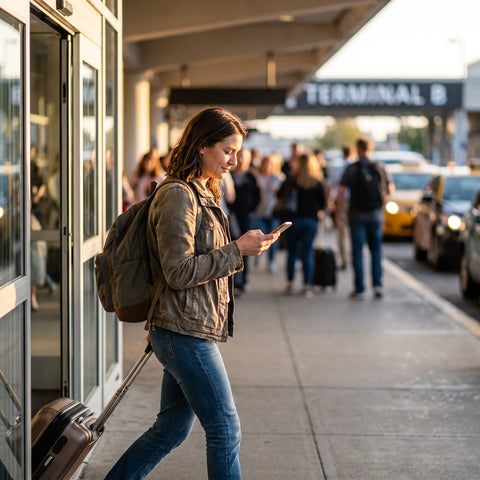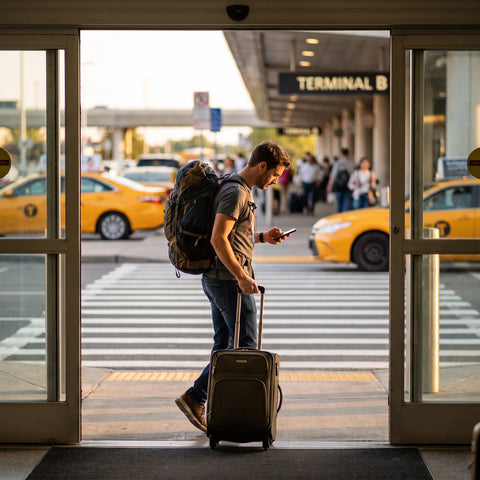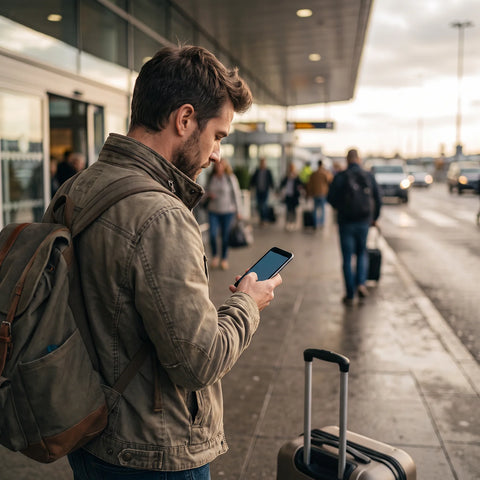
If you work from anywhere, your connection stops being a luxury and becomes your office. An eSIM for digital nomads gives you internet as soon as you land, without looking for local stores or changing cards every time you cross a border. For those who live from country to country, being connected in five minutes is not convenience: it's being able to bill that same day.
Why a digital nomad needs an eSIM
When your work life fits into a backpack, every hour without a connection is an hour without working. An eSIM is a digital card that is installed inside your phone without any physical component: you scan a QR, the profile is activated, and you have data. For a digital nomad, this changes the rules, because you can buy the plan for your next destination from your sofa, get it ready, and activate it just as you land.
The difference compared to a traditional SIM card is huge when you change countries often:
- No queues or stores: no need to look for a place to buy a SIM with your passport in hand.
- Zero surprising roaming charges when using your home plan abroad.
- Activation in 1 minute by scanning the QR, even before you travel.
- You keep your usual number and WhatsApp in the other slot.
With PuraSim, you have coverage in 218 destinations and prices starting from $0.85, so the cost of always being connected is no longer an excuse. The eSIM is not about saving a couple of euros: it's about not losing a single day of work looking for Wi-Fi. If you're starting from scratch, it's a good idea to read what an eSIM is and how it works before you start.
Multi-country, regional, and global plans
The digital nomad's biggest pain point is fragmentation: one plan for Spain, another for Thailand, another for Mexico. The beauty of a modern eSIM is that you can choose the coverage that fits your travel pace instead of buying individual country plans. This is where regional and global plans become your best friends.
At PuraSim, you can choose from three approaches depending on how you travel:
| Plan Type | Ideal for | Usage Example |
|---|---|---|
| Local (1 country) | Stays of several weeks in the same place | A month working from Lisbon |
| Regional | Routes across a continent or area | Southeast Asia hopping between 4 countries |
| Global | Someone who doesn't know where they'll be next month | A plan covering dozens of destinations at once |
The key is not to overdo it or fall short. If you're staying in one country, a local plan is cheaper; if your plan is to cross borders frequently, a regional or global plan saves you the hassle of installing profiles every three days. Choose the plan based on your travel style, not just the price per gigabyte. To refine your decision by region, it helps to compare with our guide to the best eSIM for travel in 2026, and if your base is Europe, check out the 30-day Europe eSIM plan.

How much data do you need for remote work?
Working connected consumes much more data than just scrolling Instagram on the beach. An hour-long video call can eat up close to 1 GB, and if you have back-to-back meetings, upload heavy files, or livestream, your gigabytes will fly. That's why a nomad's data calculation is nothing like a weekend tourist's.
A realistic reference for hourly consumption to give you an idea:
- Video calls (Zoom, Meet): 0.5-1.5 GB/hour depending on quality.
- Email, chat, and cloud documents: very little, just a few MBs.
- Uploading and downloading large files: depends on the size, but adds up quickly.
- Background music or podcasts: about 0.1 GB/hour.
- HD video streaming: up to 3 GB/hour (save this for your accommodation's Wi-Fi).
Quick nomad rule: count between 1 and 2 GB per intense workday with video calls, and double the margin if you plan to hotspot your laptop.
If you work daily, high-volume or unlimited plans are much more worthwhile than constantly topping up small packages. It's better to have too many gigabytes than to cut off a client meeting mid-sentence. To pinpoint your exact needs, take a look at how much data I need for travel, where we break it down by usage profile.
Hotspot: connect your laptop without relying on Wi-Fi
This is the feature that separates a "tourist" eSIM from one designed for work: the hotspot. Sharing your phone's connection with your laptop is what turns your phone into a portable office, and not all digital cards allow it in the same way. At PuraSim, hotspot is included, so you can use your laptop when the cafe Wi-Fi fails.
Why this is non-negotiable for a digital nomad:
- Public Wi-Fi is slow and insecure: your own connection is faster and more private.
- Work from anywhere: a train, a park, an airport with downed Wi-Fi.
- Don't depend on accommodation: if the Airbnb promises fiber but then it's sluggish, you have a plan B.
- Backup for critical deliveries: when there's a deadline, you don't want to risk it.
A tip: hotspot consumes your data, so keep that in mind when choosing your plan (check the gigabyte section above). For a nomad, a hotspot is not an extra: it's the difference between being able to work or not in a new country. Before using a hotspot all day, it's useful to know how an international eSIM works and what your plan covers.
Coverage by continent and long stays
Living on the road means your "coverage map" matters more than anyone else's. Staying a week is not the same as settling down for three months, and actual coverage changes depending on the continent and the local operator the eSIM connects with. The good news is that with 218 destinations, you have room to plan long routes without gaps.
Broadly speaking, this is what a nomad encounters by region:
- Europe: dense coverage and very competitive regional plans for basing yourself here.
- Southeast Asia: the classic nomad circuit; regional plans covering several countries consecutively.
- Latin America: ideal for long routes hopping between countries with a regional plan.
- North America: large data volumes and good stability for video calls.
For long stays, watch the plan duration: many packages are for 7, 15, or 30 days, so if you stay longer, a 30-day plan or timely renewal is in your interest. Plan your coverage for the entire route, not destination by destination, and you'll avoid getting stranded halfway through your trip. If your base will be Europe for a good while, the 30-day eSIM plan for Europe is usually the most convenient starting point.
Having multiple eSIMs at once without going crazy
A huge advantage that almost no one utilizes: your phone can store multiple eSIM profiles at the same time, even if you only use one for active data. For a nomad, this is gold, because it allows you to have your current and next destination already prepared, in addition to your home line for calls and messages.
A typical setup that works very well on the go:
| Slot / Profile | Purpose |
|---|---|
| Physical home SIM | Your usual number, bank SMS, WhatsApp |
| eSIM for current country | Active data for work and browsing |
| eSIM for next destination | Installed and ready to activate upon landing |
Changing profiles is done in two taps from your phone's settings, without restarting or touching anything physical. However, remember to activate only the eSIM you want for data to avoid consuming from the wrong plan. Having your next destination already installed is the trick that makes every landing stress-free. If you use messaging a lot, make sure you clearly understand how to use WhatsApp with an eSIM so your notifications don't get mixed up between profiles.
Tips to save money while traveling
When travel is your lifestyle and not a one-off vacation, small savings add up month after month. The eSIM already eliminates expensive roaming, but there's room to stretch your budget even further without sacrificing a good connection for work.
These are the savings you really notice at the end of the month:
- Buy the plan by route: a regional plan is usually cheaper than adding individual local plans.
- Reserve HD for accommodation Wi-Fi and save mobile data for work.
- Adjust video call quality: lowering from HD to standard saves a lot of gigabytes.
- Download maps and files on Wi-Fi before heading out.
- Take advantage of global plans if you cross many borders in a short time.
The most expensive mistake a nomad makes is not overpaying for data, but running out of it and having to desperately buy a super expensive package at the airport.
With prices starting from $0.85 and 24/7 Spanish support, adjusting your plan to your real consumption is easy, and if something goes wrong, you have someone to ask in your language. True saving isn't buying the cheapest option, but buying exactly what you'll use. You can see all eSIMs and compare volumes before deciding.
Practicality: number, WhatsApp, and invoices
Beyond data, there are three things a digital nomad cannot afford to lose: their usual number, their WhatsApp, and the ability to justify expenses. Fortunately, a data eSIM doesn't affect your primary line, so you'll still receive bank SMS and verification codes on your home number.
Here's how your daily life looks with this setup:
- Keep your number: the eSIM provides data; your home SIM still handles your calls and SMS.
- WhatsApp unchanged: your account is linked to your number, so it stays the same wherever you are.
- 2FA verification safe: security SMS arrive on your usual line.
- Expense justification: save the proof of purchase for each plan for your self-employment accounting.
For freelancers, having the receipt for each eSIM organized by trip makes life much easier when classifying connectivity as a business expense. Traveling connected and in good standing is perfectly compatible: you just need to keep your receipts and maintain your number intact. If you want to understand the technical side before your first jump, review the international eSIM guide.
Conclusion
If you work while traveling, a good eSIM (or several) is as important as your laptop. With regional or global plans, you maintain your connection at every border, share data via hotspot, and keep your usual number. Explore PuraSim's plans and choose the one that fits your route.
Frequently asked questions
Is an eSIM useful if I change countries every few weeks?
Yes, and that's its major advantage. You can have the current country's plan active and the next destination's plan already installed, ready to activate upon landing. With regional and global plans, you cover several countries without reinstalling anything every time you cross a border.
Can I connect my laptop to the eSIM for work?
Yes. At PuraSim, hotspot is included, so you can share your phone's connection with your laptop or tablet. Keep in mind that this consumption comes from your data plan, so choose an appropriate volume if you plan to use your laptop heavily.
Do I lose my number and WhatsApp when using a data eSIM?
No. A data eSIM does not affect your primary line: your number, SMS, and WhatsApp remain the same on your home SIM. You only change which profile you use for mobile data, and messaging remains linked to your usual number.
How much data do I need if I work remotely daily?
For an intense workday with video calls, estimate between 1 and 2 GB daily, and double that margin if you use a hotspot for your laptop. If you livestream or upload heavy files, you'll benefit from a high-volume or unlimited plan to ensure you don't run out.
How long does activation take and what do I need?
You only need an eSIM-compatible mobile and to scan the QR code you receive after purchase. Activation takes about 1 minute, and you can prepare it before you travel so you have data as soon as you land. If you have any doubts, Spanish support is available 24/7.