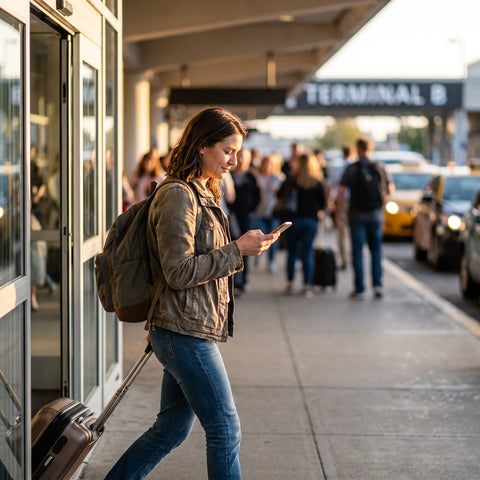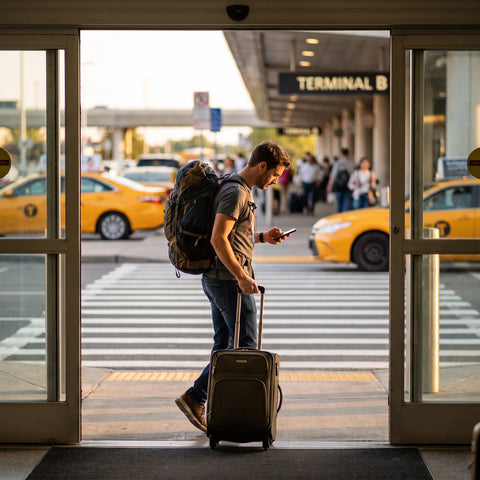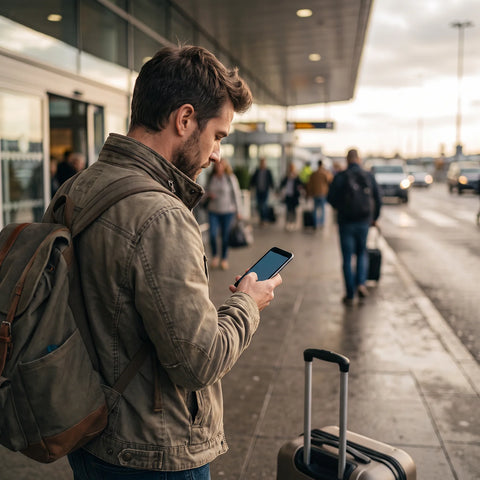
In short: an eSIM for remote work gives you your own stable data connection for video calls, without relying on accommodation Wi-Fi. With 4G or 5G coverage at your destination, a generous data plan, and hotspot activated for your laptop, you no longer risk crucial meetings dropping.
Remote working while traveling sounds idyllic until your face freezes mid-important meeting. An eSIM for remote work is precisely the insurance to prevent that moment: your own stable data when the apartment or cafe Wi-Fi fails you. In this guide, we'll look at what your connection really needs to handle video calls, how many GB a remote workday consumes, how to set up a reliable backup, and what to consider if you're combining remote work with tourism.
Why travel Wi-Fi isn't enough for work
Hotel, apartment, and cafe Wi-Fi is convenient but unreliable for work: it gets saturated during peak hours, drops without warning, and is often a shared network with dozens of people. For a work video call, this means interruptions and frozen screens precisely when you need to speak. An eSIM gives you an alternative under your control.
The problem isn't having "some" internet, but having stable internet at the exact moment you need it. It doesn't matter how beautiful the cafe with sea views is if its connection can't handle an hour-long Google Meet. And relying solely on someone else's Wi-Fi ties you to being where there's a good signal, not where you want to be.
With a data eSIM, you carry your own connection with you. If the accommodation Wi-Fi is weak, you use the eSIM's mobile data and continue working without interruptions. It's the difference between spending the morning looking for a network and sitting down to work wherever you fancy. If you want to know when it's worth activating a local eSIM and when your Spanish operator's roaming is enough, here's the complete comparison between eSIM and roaming.

What a stable video call really needs
For a smooth video call, you don't need a giant connection: about 2-4 Mbps stable upload and download is enough. More important than maximum speed is stability and low latency. A 4G or 5G eSIM with good coverage more than suffices if the destination's network is decent.
The key is that word: stability. A network that is super fast but drops every ten minutes is worse for work than a more modest and constant one. That's why an eSIM, relying on the country's mobile networks (the same ones locals use), usually provides a more consistent experience than a saturated public Wi-Fi.
Tip before a key meeting: make a two-minute test call via the eSIM from the location you'll be connecting from. Checking the signal beforehand is worth more than any promise of speed. And keep your laptop charged in case you need to move.
If you're still not sure how the technology works internally, here's an explanation of what a virtual eSIM is and why you don't need a physical card for a stable connection.
How many GB a remote workday consumes
The biggest fear is running out of data mid-week. Video calls consume the most, so it's good to estimate with a margin. This table gives you a realistic reference of daily usage depending on how you work.
| Activity | Approximate Consumption | Note |
|---|---|---|
| Video call (1 hour) | 0.5-1.5 GB | Depends on video quality |
| Email, chat, and browsing | 0.1-0.3 GB/day | Light office use |
| Cloud and large files | Variable | Better over Wi-Fi when you can |
| Typical mixed day | 1.5-3 GB/day | 2-3 meetings + normal work |
For one or two weeks of intense remote work, a 20 GB plan or more provides peace of mind, and many destinations offer top-up plans if you run short. A tip that saves a lot: lower video quality to standard when high-definition viewing isn't essential. To squeeze every GB to the maximum during intense workweeks, these tips for saving data with an eSIM will come in handy.

eSIM as a backup network when Wi-Fi fails you
The smartest way to use an eSIM for remote working isn't to always replace Wi-Fi, but to have it as an instant plan B. You work with the accommodation's Wi-Fi for daily tasks, and as soon as it starts to fail in the middle of a meeting, you switch to the eSIM's data in seconds without completely cutting the call.
This "dual network" setup is what separates stressed remote workers from calm ones. You never depend on a single connection. And since the eSIM coexists with your Spanish SIM, your usual number remains available for urgent calls while the eSIM handles data.
- Wi-Fi for heavy tasks: large downloads, cloud uploads, updates.
- eSIM for critical tasks: video calls and moments when you cannot fail.
- Quick switch: keep eSIM data ready to activate on the fly.
Sharing eSIM internet with your laptop
Here's a detail many people overlook: almost all remote work is done on a laptop, not a phone. For this, you need to share the eSIM's data via hotspot. Most plans allow it, but it's advisable to confirm before purchasing to avoid surprises.
With the hotspot activated, your laptop connects to your phone as if it were a pocket router. This is the most common way to remote work with an eSIM: phone with data, laptop connected to the phone via Wi-Fi, and work. Keep in mind that sharing consumes phone battery, so have your charger handy during long workdays.
Before you get to that point, make sure your eSIM is properly installed: here's a step-by-step guide to installing an eSIM without last-minute surprises. And if you work a lot from Asia, a classic nomad destination, check out our guide to eSIM for South Korea (Seoul and Busan), two cities with very fast and reliable mobile networks for video calls.
Remote work and tourism on the same trip
The beauty of remote work is also making the most of the destination: you work in the morning and sightsee in the afternoon. The same eSIM serves both purposes, so you don't have to juggle between a "work" card and a "tourist" card. A single data plan covers your workday and your route maps.
If your plan is for a long stay or for a "digital nomad," choose your GBs thinking in full weeks, not individual days, and consider a top-up plan. For inspiration on how to set it up well, you have our guide to eSIM for Colombia (Medellín, Bogotá, and Cartagena), one of the favorite destinations for those who remote work for several consecutive weeks. And remember: choose the plan according to the country or region where you will actually be, not where your company is headquartered.
With this combination, remote working while traveling stops being a gamble and becomes routine: a stable connection for work and plenty of data to enjoy the place when you close your laptop.
Remote teams and cloud work: what changes with an eSIM
If you're not traveling alone but coordinating a remote team—or simply you and your partner are working from the same apartment with two laptops and each with their own video call—the logic changes a bit. Each person needs their own eSIM and their own data plan: sharing a single connection via hotspot between multiple devices with simultaneous video calls is the fastest way to ensure none work well. With over 200 destinations in its catalog, each team member can be equipped with an eSIM for the exact country they are in, without relying on a single physical card that has to be passed around.
Regarding cloud work and 5G: if your daily work depends on heavy cloud tools—a remote desktop (VDI), a cloud development environment, video rendering on external servers—what will hurt you most is not the maximum download speed, but latency and disconnections. 5G helps here, but it's not essential: a stable 4G in a city with good coverage can handle a remote desktop without a problem. What is a silent enemy is a network that constantly fluctuates in intensity, because any VDI or remote connection session suffers much more from that than from a slightly lower but constant speed. Before deeming a destination good for intensive cloud work, test the connection with the actual application you'll be using, not just by opening any random website.
Myths and what almost no one tells you about remote working with an eSIM
Myth 1: "a four- or five-star hotel always has plenty of Wi-Fi." Not true. The larger and fuller the hotel, the more devices compete for the same network, and this is noticeable precisely during the hours when everyone is on video calls: mid-morning and early afternoon. A small hostel with few guests sometimes offers better Wi-Fi than a resort with five hundred rooms. Don't trust the stars: if you can, ask before booking if the network is dedicated fiber or shared with the entire building.
Myth 2: "eSIM is slower than a physical SIM." There is no technical difference between the two: an eSIM connects to exactly the same local operator network that a physical card would use. The feeling of slowness almost always comes from elsewhere: weak coverage in that specific area, or the phone still latched onto your Spanish operator's automatic roaming instead of the eSIM's local data.
What almost no one tells you: activate the eSIM and test it before leaving home, not at the destination airport with your suitcase and 12% battery. Also, while you have reliable Wi-Fi, download the apps you'll actually need for work (company VPN, video call client, password manager): in some destinations, app stores are very slow with mobile data, and if you need technical support from your company in the middle of the night in local time, the time difference is already working against you without adding a partially installed app.
Another subtle detail: if you're going to handle sensitive company information from networks you don't control, having your own data isn't enough. Combine the eSIM with an active VPN for work traffic; in this guide on eSIM, VPN, and travel privacy, we explain how to set it up with hardly any noticeable speed impact. And if you're still debating between taking a local physical chip or switching directly to an eSIM, here's the comparison between international chip and eSIM to help you decide wisely.
And an honest truth that needs to be said: if you're going to be in a city for three days with office or coworking Wi-Fi available and your Spanish operator already includes EU roaming at no extra cost, you don't need to buy anything. An eSIM makes sense when you leave the European Union, when roaming prices skyrocket, or when you genuinely need that reliable backup network because the crucial video call cannot fail.
Frequently asked questions
Can an eSIM handle work video calls?
Yes, as long as the destination has good 4G or 5G coverage. A stable video call needs about 2-4 Mbps constantly, and an eSIM relying on local networks usually provides this more consistently than a saturated public Wi-Fi. Make a test call before the important meeting.
How many GB do I need for a week of remote working while traveling?
A mixed workday with two or three video calls uses between 1.5 and 3 GB per day, so for a week of intense remote work, a 20 GB plan or more is advisable. Lower video quality when you can and use the accommodation's Wi-Fi for heavy downloads.
Can I connect my laptop to my phone's eSIM?
Yes, via hotspot: your phone shares the eSIM data and your laptop connects as if to a pocket router. Most plans allow this, but confirm before purchasing. Keep in mind that sharing consumes a lot of phone battery.
Does the eSIM only serve as a Wi-Fi backup or for working all day?
For both. Many use it as a backup (using Wi-Fi and switching to data when it fails), and others remote work directly with it. If you're going to depend on the eSIM all day, choose a generous GB plan and, if it's a long stay, a top-up one.
Can I use the same eSIM for work and tourism?
Yes. A single data plan covers your morning video calls and your afternoon route maps. You don't need two different cards: you choose the plan according to the country or region where you will be and use it for everything during your trip.
How does an eSIM work when you're abroad?
An eSIM is a digital profile installed on your phone via QR or link, with no physical card to insert. Once activated at the destination, the phone connects to the local mobile network—the same one locals use—and provides you with data using its own data line number, while your Spanish line remains available for calls and SMS if your phone supports dual SIM. There's no need to change cards or look for a store upon arrival.
Can an eSIM be used for remote working from Mexico?
Yes. Mexico is a common destination for those who remote work for several weeks, with cities like Mexico City, Guadalajara, or Playa del Carmen well covered by 4G and 5G networks. What is worth monitoring is coverage if you stay outside the urban center: in beach areas away from the tourist core, the signal can drop, so check it as soon as you arrive instead of assuming it will be equally good everywhere.
Conclusion
Remote working while traveling works when you have a connection that doesn't leave you stranded during a key video call: an eSIM gives you that reliable, personal network, either alone or as a Wi-Fi backup, with plenty of GBs for work and tourism. Confirm that your plan allows hotspot use and adjust it to your weeks. Prepare your data eSIM before you leave and remote work from wherever you want without relying on someone else's Wi-Fi.