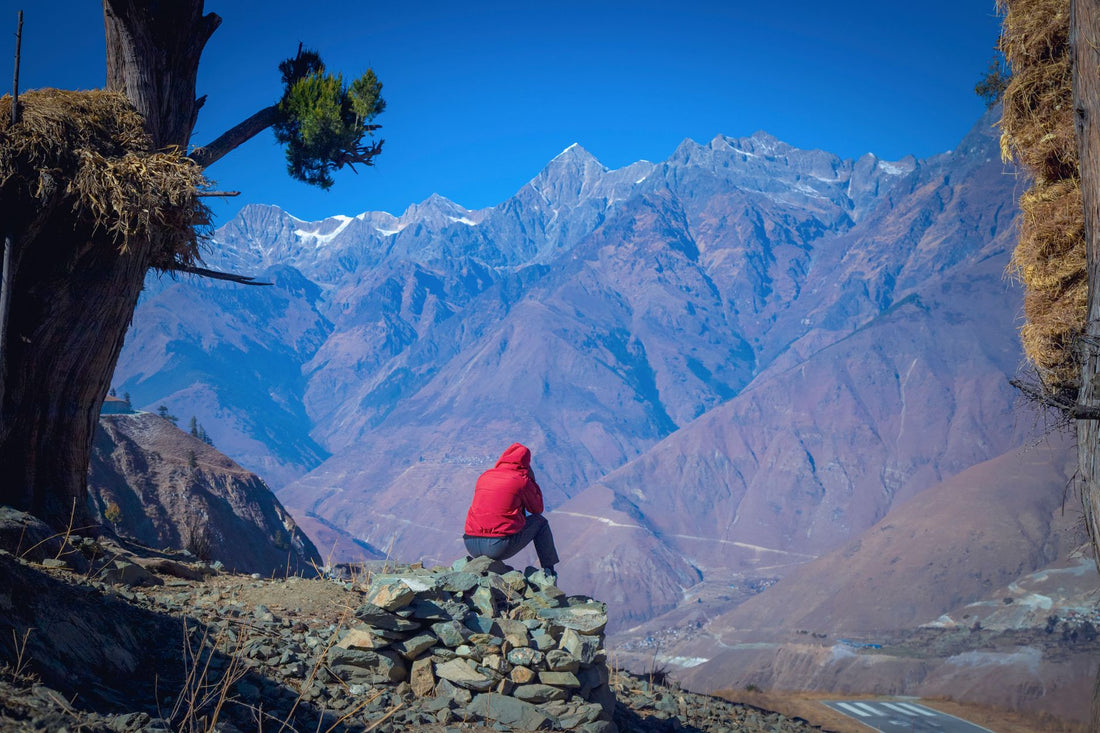
In short: an eSIM for high-mountain trekking gives you the same data as a local SIM from the country, activated before you leave home: it doesn't extend coverage where there isn't any. It works well in villages, base camps, and shelters; it disappears in gorges and summit sections, so you need a backup plan (satellite, offline maps, contact points) for those sections.
Is there actual coverage in the high mountains?
The short answer: sometimes, and less than you think. In the high mountains, there's coverage in villages, base camps, and some passes with a direct line of sight to a repeater in the valley, but it disappears in gorges, north faces, and remote sections. An eSIM gives you the same signal as the country's local network; it doesn't extend coverage where there isn't any, no matter how generous the data plan you've paid for.
The key is that an eSIM connects to the network of the operator with the best coverage in the area, just like a physical SIM purchased there would, and in the mountains, that's usually the dominant national operator or one that has agreements with the army or border police. That's why, before relying entirely on your phone, it's good to know what to expect route by route.
In popular trekking destinations (Himalayas, Andes, Kilimanjaro), there are more antennas than you imagine near the approach villages, precisely because these villages thrive on mountain tourism and operators have invested there. The problem comes on summit days, exposed passes, and narrow gorges, where the connection is intermittent or directly nonexistent, no matter how high you hold your phone looking for a bar.

Coverage by massif: Himalayas, Andes, Kilimanjaro, Alps, Pyrenees, and Rockies
Each massif is its own world, and it's worth differentiating between major international treks and mountain routes that are closer to home if you start from Spain. Here's what you typically find in each area:
| Route / Massif | Typical coverage | Where signal is lost | Resource |
|---|---|---|---|
| Everest Base Camp and Annapurna (Nepal) | Good in Namche Bazaar and valley villages | Last stage to base camp and high passes | Check your operator's coverage before leaving |
| Inca Trail and Huayhuash Range (Peru) | Good in Cusco and the Sacred Valley; intermittent on route | Sections between passes over 4,000 meters | Complete eSIM Guide for Machu Picchu |
| Kilimanjaro (Tanzania) | Surprisingly good up to mid-mountain | Above Barranco Camp | Verify local operator coverage before ascent |
| Alps (Mont Blanc, Dolomites) | Very good; many refuges with Wi-Fi | Sections of technical high mountain and glaciers | eSIM Europe |
| Pyrenees and Picos de Europa (Spain) | Generally good, except isolated passes | Confined areas of Picos de Europa and Pyrenean massifs | eSIM Spain |
| Rockies and Sierra Nevada (USA, John Muir Trail) | Irregular; very extensive national parks | Most of the route, especially in Yosemite and Sequoia | eSIM United States |
In the Alps, you have by far the best coverage of the major mountain ranges: refuges with paid Wi-Fi and signal on most passes, although it's advisable to carry some cash because not all refuges accept card payments for Wi-Fi. And within the European Union, your own Spanish rate usually includes roaming at no extra cost in France, Italy, or Switzerland; if you're going to be outside the EU on the same trek, an eSIM comes into play there.
If your plan is a traverse through New Zealand—the Tongariro Alpine Crossing or the Milford Track, for example—coverage behaves similarly to the Andes: good at the access points and practically nil on the track itself. You can check the details in the eSIM guide for Australia and New Zealand before organizing your trip.
Field fact: On Kilimanjaro, many people manage to send a message from Uhuru Peak (5,895 m) due to the line of sight towards Moshi, but don't count on it for anything critical. It's an anecdote that mountaineers repeat, not a guarantee.
How an eSIM works for trekking
The big advantage of an eSIM in the mountains is logistical: you activate it before leaving home, with Wi-Fi, and land with data ready in a minute. No need to look for a SIM store in Kathmandu or Cusco with your backpack on and no sleep from the flight.
Install it but schedule it to activate on the day you arrive at your destination, so you can use all your plan days on the ground instead of wasting them flying. If you've never installed one, the step-by-step is in how to install an eSIM, which prevents the classic mistake of activating the plan too early and burning days without using them.
On the trail, use the eSIM in towns and base camps to check in, share your location, and consult the weather forecast, which in the high mountains can change the next day's route. When you lose coverage, your phone will constantly search for a network and drain your battery in a few hours: that's where airplane mode comes in, which we'll discuss below. If you're used to using roaming from your Spanish operator and want to understand why an eSIM is usually better for long treks, the comparison of eSIM vs. roaming explains it in detail.

Backup plan when there's no signal
No eSIM replaces a safety plan. In the high mountains, mobile connection fails exactly where you'd need it most: on the exposed pass, in the gorge without a line of sight, on a day of dense fog. Always carry a backup:
- Satellite beacon or communicator (like Garmin inReach or similar) for SOS and messages when there's no mobile coverage of any kind.
- Offline maps downloaded in advance; the eSIM is useful precisely for downloading them with Wi-Fi the night before, not for consulting them in real-time on the trail.
- Agreed contact points with your family: "if I don't write by 6:00 PM, notify the accommodation or agency."
- A local guide or agency for technical routes; their radio or satellite phone doesn't depend on the commercial mobile network.
The eSIM shines on the approach and descent, when you regain signal and want to confirm you're okay, book the next accommodation, or arrange a transfer. For those moments, having your own data instead of relying on a teahouse's Wi-Fi is golden. If your trek includes camping nights between stages, it's also important to understand how the eSIM behaves without fixed coverage or hotel Wi-Fi, which has a lot in common with moving through rural areas with the eSIM already installed and without relying on traditional roaming.
Battery and data: surviving several days without power
On a multi-day route without an outlet, battery life is your most scarce resource, and searching for a signal without finding it is what drains it fastest. A strategy that works in practice:
- Airplane mode by default in sections without coverage; activate it only on passes or in villages to send messages and turn it off again immediately.
- 10,000-20,000 mAh power bank and, if you're going for many days or the route doesn't pass through any village with electricity, a small foldable solar panel.
- Lower screen brightness and disable background updates; video and cloud photo syncing devour data and battery simultaneously.
- Download everything with Wi-Fi before leaving: maps, route guides, music, or podcasts for nights in the refuge.
With limited data, prioritize text and location over heavy photos or videos that upload themselves to the cloud as soon as they detect Wi-Fi. The tips for how to save data with an eSIM on a trip apply equally well in the mountains, where every megabyte and every battery point count twice as much as in a city with outlets everywhere.
Myths and what almost no one tells you
There are several ideas circulating among mountaineers about coverage and eSIMs that aren't entirely accurate. It's worth debunking them before you leave:
- Myth: "If there's good coverage in the valley, there will be good coverage higher up too." Not true. Mountain coverage depends on the line of sight to the repeater, not the straight-line distance. You can have four bars in the village and zero on a pass less than a kilometer away, simply because a ridge is in the way.
- Myth: "An international eSIM extends coverage compared to a local SIM." False: it connects you to the same network that any SIM purchased in the country would use. The difference is in activation convenience, not antenna range.
- Hidden gem: manually force 3G/2G network if 4G/5G won't connect. On many phones, you can set the network type in the settings. Lower 2G/3G frequencies travel further and penetrate irregular terrain better than 4G/5G, albeit at a slower speed; in areas of weak coverage, this can be the difference between sending a text message or sending nothing at all.
- Hidden gem: refuge Wi-Fi doesn't consume your eSIM data. In the Alps and some Pyrenean refuges, activate the refuge Wi-Fi with airplane mode on and Wi-Fi enabled: you can still send messages via Wi-Fi without spending a single megabyte of your plan and without your phone constantly searching for a mobile network in the background, which is what consumes the most battery.
- Myth: "Turning off the phone saves the same amount of battery as putting it in airplane mode." Almost, but not entirely: if you need GPS for the offline map, turning off the phone forces you to wait for a full startup each time, whereas airplane mode with active GPS (yes, you can combine them on most phones) gives you instant location without searching for a network.
When you do NOT need an eSIM for your trek
It's important to be honest about this, because not every trek needs a new eSIM. If you're doing a day trip near a tourist city with known good network coverage—for example, a hiking excursion in the Swiss Alps departing from Zermatt or Chamonix with a return on the same day—your Spanish plan probably already covers you at no extra cost within the European Union, and buying something additional would be a waste of money.
It also won't do you any good on routes that run entirely through areas without any villages or borders with coverage from any operator for several consecutive days, such as certain remote sections of the Karakoram or deep Patagonia. There, the problem isn't which eSIM you choose: it's that there's no antenna to be found, and what you really need is a satellite communicator and a rescue plan, not mobile data. Spending money on a generous data plan for an area with no coverage at all is a common mistake for those planning a trek from home without checking the actual terrain.
Checklist before heading out on the trail
Actionable summary so you don't forget anything. Prepare this at home, with Wi-Fi and calmly, not at the airport:
- Country eSIM installed and tested, with data scheduled to activate on arrival day.
- Route maps and guides downloaded in offline mode.
- Power bank charged to one hundred percent (and solar panel if the route warrants it).
- Satellite communicator or, at a minimum, a clear check-in plan with your family.
- Local emergency contacts and your travel insurance saved without needing a connection.
- Network manually set to 2G/3G in the settings app if you're going to be in areas with known weak coverage.
If you're still debating between an eSIM and a physical SIM bought at the destination airport, keep in mind that an eSIM helps you avoid precisely that: queuing with your trekking backpack and no sleep.
Golden rule for the connected mountaineer: the eSIM is for being reachable, not for relying on it. Plan as if you won't have a signal and celebrate every extra bar that appears.
Frequently asked questions
Does an eSIM work at Everest Base Camp?
In Namche Bazaar and the villages of the Khumbu Valley, there is usually decent coverage. Above a certain altitude, the signal becomes intermittent, and at base camp, it is weak or directly nonexistent. Count on it for the approach, not for summit days.
Is there a signal at the summit of Kilimanjaro?
Surprisingly, many mountaineers manage to send a message from Uhuru Peak thanks to the line of sight towards Moshi. It's not reliable or constant, so don't use it for anything critical; always carry a backup satellite communicator.
Does an eSIM give me more coverage than a local SIM?
No. An eSIM connects to the same networks as local SIMs; if the operator doesn't have an antenna in that area, there will be no signal with either. Its real advantage is convenience: you activate it from home in a minute without looking for stores at your destination.
How do I save battery if I'm going to be several days without power?
Keep your phone in airplane mode in sections without coverage, because searching for a signal without finding it is what drains the battery fastest. Activate it only on passes or in villages to send messages, lower screen brightness, and carry a large power bank or a solar panel if the route is long.
Can I use a single eSIM for a traverse through several Alpine countries?
Yes. Within the European Union, an eSIM for Europe covers France, Italy, Switzerland, and other countries without changing plans, ideal for cross-border traverses like the Tour du Mont Blanc.
Is it worth buying data if my trek is only one day long?
It depends on where you are and your plan. If it's within the European Union and your Spanish operator includes free roaming, you don't need anything extra. If it's outside the EU, even a short excursion can be expensive with traditional roaming, so an eSIM with a small plan is worthwhile there.
What happens if my phone can't find a network and airplane mode doesn't help?
If there's no antenna in the area, no phone setting will create coverage out of thin air. In those sections, airplane mode saves battery, not provides a signal; safety is provided by the satellite communicator and the agreed-upon contact plan in advance, not the phone.
Conclusion
In the high mountains, an eSIM keeps you reachable in villages, base camps, and refuges, but real safety comes from your backup plan, satellite communicator, and a cool head when the signal disappears. Prepare everything at home, manage your battery diligently, and enjoy the route knowing you're covered where it truly matters. Choose your destination's eSIM from PuraSim, with over 200 destinations in the catalog and 24/7 email and WhatsApp support in all languages, and head to the mountains with the peace of mind of being connected when there is a network.