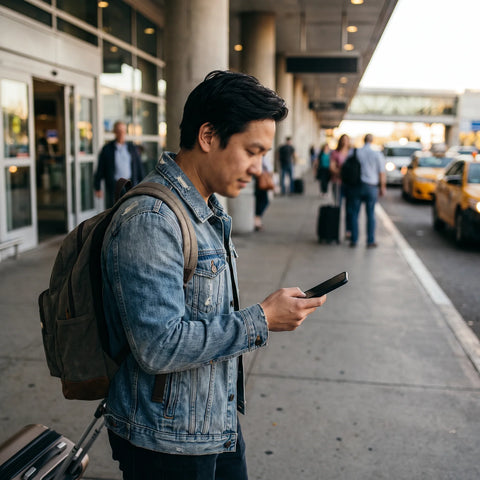
In short: for a trip to Warsaw, a 3 to 5 GB eSIM for Poland is plenty: install it at home using Wi-Fi, get it ready, and as soon as you land at Chopin Airport, you'll have data without having to search for a store or touch your physical SIM card. It covers the entire city—Old Town, Praga, the business district—and is cheaper than daily roaming.
Arriving in Warsaw without a data plan means one thing: twenty minutes at the terminal struggling with airport Wi-Fi while trying to figure out which train to take. With an eSIM for Warsaw, you avoid that hassle. It's actually an eSIM for all of Poland—they're not sold by city, but by country or region—so you'll have coverage with the same line in the historic center and on a day trip to Krakow or Wrocław.
In this guide, we'll get straight to the practicalities: how much data you need for a weekend, neighborhood-by-neighborhood coverage, what to do as soon as you land at Chopin, and the most common mistakes when traveling to Poland for the first time.
What exactly is an eSIM and why is it a good fit for a trip to Warsaw?
An eSIM is a digital SIM card installed as a profile inside your phone, without a physical tray or a store to visit. If you've never used one, it's best to first understand what a virtual eSIM is. The advantage for a short trip like a getaway to Poland is twofold: you don't lose your Spanish number (you'll still receive bank SMS if you keep your physical SIM active) and you don't have to rely on finding a store open on a Sunday in Warsaw.
If you've been comparing options, you've probably encountered the question of international physical SIM vs. eSIM. For a short trip, the eSIM almost always wins: it installs in minutes, doesn't occupy your usual SIM tray—you can have both lines active at the same time—and you don't have to return it when you get back.
Warsaw is the city, but you buy the eSIM for the whole country
This is where many people get confused. There isn't a "Warsaw eSIM" that only covers the capital and turns off when you cross the M1. What you buy is an eSIM valid in Poland and the rest of Europe, and it works the same in the Warsaw metro as it would if you decided to take a train to Krakow or cross the border to Prague for a day. For you, as a traveler, this is an advantage: the same line serves you if you extend your route.
The question that really matters isn't "does it cover Warsaw?"—of course it does, it's the capital and has the best coverage in the country—but how many GB you need and whether a single-country plan or a regional one is better. If your trip is only to the Polish capital, a small, low-GB plan is the most cost-effective. If you're going to visit two or three countries on the same route, then a regional plan is worthwhile instead of a different eSIM at each border.
As soon as you land: Chopin Airport and Modlin Airport
Most flights from Spain land at Chopin Airport (WAW), about 10 km from the city center. Low-cost airlines—especially Ryanair—usually use Modlin (WMI), which is 40 km away and requires taking a shuttle bus to the city. Both have airport Wi-Fi, but it's typical terminal Wi-Fi: it requires email registration, gets saturated when several flights land at once, and won't work once you go outside to wait for the bus.
The real trick isn't technical, it's about timing: install the eSIM at home, using your Wi-Fi, a few days before you fly. The profile needs internet to download, so doing it at the airport with limited data is the worst option. Leave it installed without activating data, and upon landing in Warsaw, turn off airplane mode and activate roaming only for that line. From Chopin, the SKM/S2-S3 train takes about 20 minutes to reach the city center, and bus 175 follows the same route on the surface; with data, you can already buy a ticket on the municipal transport app without relying on the station's Wi-Fi.
A nuance that many people miss: almost all data plans start counting days from the first connection to a network, not from when you buy the plan. Install the eSIM at home at your leisure, but don't activate data until you land in Poland: this way, you won't waste plan hours while you're on the plane or packing your bag.
What the coverage is like, neighborhood by neighborhood
Warsaw has, by far, the best mobile infrastructure in Poland: it's home to the headquarters of the four major operators (Play, Orange, T-Mobile, and Plus), on whose networks travel eSIMs rely. In the Old Town, the Royal Route, the Praga district on the right bank of the Vistula, or Łazienki Park, 4G is abundant, and in much of the city center, 5G is already available.
That said, there are a couple of very specific places where the signal can be weak, and it's good to know this beforehand so you don't get caught with your map half-loaded:
- The metro between stations. As in almost any city, underground you lose coverage between stops on lines M1 and M2. This isn't a problem if you already have the map or route downloaded beforehand.
- The observation deck of the Palace of Culture and Science. The building is a massive Soviet concrete block, and in the elevator and parts of the interior, the signal cuts out for a moment. Go up, enjoy the views, and don't worry if your phone takes a few seconds to reconnect when you exit.
- Interiors of museums with thick walls, like parts of the Warsaw Rising Museum. Here, it's better to rely on the museum's own Wi-Fi, if offered, rather than the mobile network.
One helpful detail that almost no one does: download the offline map of Warsaw before leaving the hotel each day. Not because you'll run out of data, but because in those specific spots with weak coverage, it responds instantly while your phone reconnects. To make the most of your GBs, take a look at these tips for saving data with your eSIM: disabling automatic updates and lowering the upload quality of photos makes a real difference on a short trip.
How many GB do you need for your trip to Warsaw?
It depends on how you travel, but to calculate without getting confused, think about three uses: maps and transport, social media and messaging, and some content (photos to the cloud, a short video). This table is an approximate reference, not an exact science:
| Type of trip | Duration | Approximate GB | What it covers |
|---|---|---|---|
| Express getaway | 2-3 days | 3 GB | Maps, WhatsApp, social media without excessive video |
| Long weekend | 4-5 days | 5 GB | The above plus photos and short videos to the cloud |
| Full week | 7 days | 8-10 GB | Normal daily use, some video calls |
| Remote work or multiple devices | 10+ days | 15 GB or more | Long video calls, hotspot for laptop or tablet |
If you're tight on GB, most travel eSIMs can be topped up from your phone without buying a new plan from scratch, so there's no need to over-provision out of fear of running short. And if you're traveling as a couple or group and plan to share a connection, expect to spend much more than what's in the table: using your phone as a hotspot for another device multiplies consumption, especially if someone uses Google Maps in the rental car in addition to the phone already using it for walking navigation.
How to activate your eSIM step-by-step
The process is identical on iPhones and recent Android phones, and you only do it once per trip:
- Buy the eSIM before leaving home and receive the QR code via email.
- With Wi-Fi (essential for this step), go to Settings > Mobile Data/Mobile Network > Add eSIM and scan the QR.
- Give the line a name, for example "Poland," so you don't confuse it with your Spanish line.
- Leave the line installed but do not activate data until you land.
- Upon arriving in Warsaw, turn off airplane mode, activate data roaming only on the eSIM line, and confirm that the primary phone for calls/SMS is still your Spanish line.
If this is your first time installing an eSIM, we explain it with screenshots in our guide on how to install an eSIM. And before buying anything, take a minute to check if your device supports eSIM: very basic models or those older than five years sometimes don't, and it's better to know in advance than at the boarding gate.
Myths and common errors with eSIM in Warsaw
These are the most common misunderstandings about eSIMs on a trip to Poland, and it's good to debunk them before flying:
"With hotel and airport Wi-Fi, I'll manage"
This works until you need your phone on the street: ordering an Uber from the station, checking a schedule outside the museum, or having Google Maps guide you from the old town to a restaurant in Praga. Public Wi-Fi solves specific moments, not an entire day on the move.
"If I buy an 'all-Europe' eSIM, it covers me the same and is cheaper"
Not always. If your trip is only to Warsaw, a country-specific plan usually offers a better price per GB than a pan-European one. A regional eSIM makes sense when you genuinely cross borders, not as a default option.
"The eSIM changes my phone number"
No. The eSIM adds a new data line; your Spanish number remains the same if you keep your physical SIM active. This is the most common confusion among those who have never used one.
"I can activate it on the plane to be well-prepared upon landing"
The exact opposite of what's advisable: the day counter for many plans starts with the first connection to a network, so activating it early offers no advantage and can actually reduce plan hours.
"With eSIM, I no longer need to download anything offline"
Coverage in Warsaw is good, but not perfect: on the metro, in the elevator of the Palace of Culture, or in museums with thick walls, you will lose signal for a few seconds. Having the map downloaded is common sense in any city.
eSIM, roaming with your Spanish operator, or physical SIM: what's best in Poland?
Poland is in the European Union, so in theory, roaming with your Spanish operator is "included" at no extra cost within your contract limits. In practice, many tariffs limit the GB you can use while roaming, even if you have unlimited data in Spain, and if you exceed it, the cost skyrockets. It's advisable to check the exact terms of your tariff before assuming that roaming covers you the same as at home; to understand it well, you have our guide on what data roaming is and this direct comparison between eSIM and roaming.
Here's the honest truth: if your plan already includes ample EU roaming data and you're only staying for a weekend, you might not need to buy anything. The eSIM makes clear sense when your plan severely limits roaming, when you want to reserve your Spanish line only for calls, or when you extend your trip outside the EU on the same route. Don't buy an eSIM just for the sake of it if your operator already covers your weekend without added cost.
A physical prepaid SIM purchased there is the other alternative, but it means finding a Play or Orange store, waiting in line, showing your passport, and losing your Spanish number while it's in use, unless you have dual physical SIMs. For a short stay, that time lost in procedures outweighs any savings.
If your route continues beyond Warsaw
Warsaw works well as a base for two or three nights, but it's common to combine it with Krakow, a trip to Auschwitz, or a hop to Prague. If your itinerary includes more than one country, as we mentioned earlier, a regional plan is better than a new eSIM at each border. Also, take the opportunity to review how to protect your connection on unknown Wi-Fi networks in hostels or cafes with this guide on eSIM, VPN, and travel privacy: in Eastern Europe, it's still common to find open Wi-Fi without a password.
Whatever your next destination, PuraSIM has over 200 destinations in its catalog, so the same account serves you for Poland and the rest of your route. And if something goes wrong with activation, 24/7 support is available in all languages via email and WhatsApp to resolve it without relying on Wi-Fi to write a ticket from the hotel.
Frequently asked questions about eSIM in Warsaw
Do I need a specific eSIM for Warsaw, or will a Poland eSIM work?
There isn't an eSIM that covers only Warsaw. You buy an eSIM for Poland, which covers the capital and the rest of the country with the same line. It's the right choice whether you stay only in the city or visit Krakow or Gdansk on the same trip.
How many GB do I use on a weekend in Warsaw?
With maps, messaging, and social media without excessive video, an average tourist uses between 2 and 4 GB over two or three days. 5 GB is more than enough; you'll only need more for video streaming, long video calls, or sharing your connection.
Does the eSIM work as soon as I land at Chopin Airport?
Yes, as long as you've installed it beforehand with Wi-Fi. As soon as you turn off airplane mode and activate roaming for that line, your phone will connect to a Polish network, and you'll have data for a taxi, the S2/S3 train, or to notify someone via WhatsApp that you've arrived.
Can I still use WhatsApp and receive SMS with my Spanish number?
Yes. The eSIM only adds a data line; your number and apps will continue to function normally if you keep your physical SIM active. You can leave it for bank SMS and use the eSIM solely for browsing in Poland.
Is there 5G coverage in Warsaw with a travel eSIM?
Yes, in much of the city center and the most touristy areas, because travel eSIMs rely on local operators who are already deploying 5G in the capital. On the metro between stations or in buildings with very thick walls, it may temporarily drop to 4G.
Is an eSIM or my Spanish tariff's roaming better for me in Poland?
It depends on your tariff. If it already includes ample or unlimited EU roaming data and you're only staying a few days, you might not need to buy anything. If your tariff severely limits roaming GBs or you prefer to reserve your Spanish line only for calls, the eSIM is worthwhile.
Can I install the eSIM before leaving Spain and activate it only upon arrival?
Yes, and this is highly recommended: install it at home with Wi-Fi to have the profile ready, but do not activate data roaming until you land in Warsaw, because the day counter for many plans starts with the first connection to a network.
Conclusion
Warsaw is comfortable, affordable for what it offers, and has very good mobile coverage: a low-GB eSIM solves the getaway without relying on cafe and museum Wi-Fi. Install it calmly at home, activate it only when you land at Chopin, and don't worry about the rest. If your route continues through more countries in the area, check beforehand if a regional plan is more worthwhile than one just for Poland.