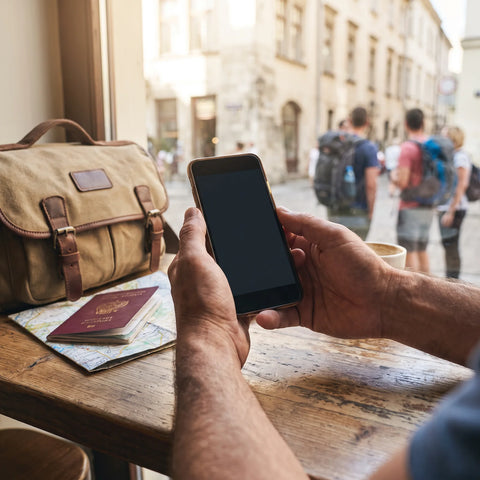
Traveling without roaming no longer means being without internet: it means stopping paying your operator's abusive rates and connecting for a fraction of the price. In this definitive guide, we review all the ways to have data abroad without bill shock, from eSIMs to mobile settings, with the real savings of each option. With the right strategy, expensive roaming ceases to be a problem in any destination.
What is roaming and why is it so expensive outside the EU?
Roaming is the service that allows you to use your Spanish line on another country's network. Within the European Union, it works at national prices ("roam like at home"), but outside the EU, your operator charges you roaming fees that can skyrocket to €10-20 per day or charge you per individual megabyte. That's when nightmare bills arrive.
The reason is simple: outside Europe, your operator has to pay the local network for allowing you to use their antennas, and they pass that cost on to you with a high margin. That's why the same GB can cost cents with an eSIM and several euros with traditional roaming. If you want to understand the concept in depth, we have a guide on what roaming is and another on how much international roaming costs. Knowing how it works is the first step to stop overpaying for it.

The 5 ways to travel without roaming
There are five ways to have internet abroad without activating your operator's roaming: travel eSIM, local SIM purchased at the destination, relying on available Wi-Fi, contracting a temporary roaming package, or combining several. The best option depends on the destination, the number of days, and how much convenience you want.
This table summarizes the alternatives at a glance so you can choose the one that fits your trip:
| Method | Convenience | Price | Ideal for |
|---|---|---|---|
| Travel eSIM | Very high | Low | Almost any trip |
| Local SIM at destination | Low | Very low | Long stays |
| Wi-Fi only | Medium | Free | Trips with a lot of hotel time |
| Operator roaming | High | High | Single days in the EU |
| Portable Wi-Fi (pocket) | Medium | Medium | Groups and families |
Below, we break down the main options so you know exactly how to use each one. The winning combination for most is an eSIM plus accommodation Wi-Fi.
Option 1: Travel eSIM (the most convenient)
An eSIM is a digital SIM card that you install on your phone without changing anything physical. You buy a data plan for the country or region you are visiting, install it before leaving home, and activate it upon landing. In one minute, you have internet at a local price, without airport queues or searching for a phone store.
It's the top choice for traveling without roaming because it combines the best of everything: low price, zero hassle, and immediate coverage. You keep your Spanish number active on your primary SIM for bank SMS or calls, and you use the eSIM only for data. You can see the savings compared to roaming in our eSIM vs. roaming comparison and learn the process in how to activate an eSIM.
An eSIM plan can start from ridiculously low prices per GB, compared to the €10-20 daily for roaming outside the EU. On a week-long trip, the difference is tens of euros.
Before buying, check if your phone supports eSIM: almost all iPhones from the XS onwards and recent mid-to-high-end Androids do. You can find the list and method in how to know if your phone is compatible with eSIM. If you're looking for a destination, start with our selection of the best eSIM for travel in 2026.

Option 2: Local SIM at your destination
Buying a physical SIM in the country you visit is the cheapest option in absolute terms, especially for long stays. Upon landing, you look for an operator store or an airport kiosk, buy the card with your passport, and insert it. You'll have data at a local price and, often, a local phone number.
The downside is the hassle: airport queues, registration paperwork (mandatory in many countries), language barrier, and losing your Spanish number while using it if your phone only has one slot. For short trips, it rarely compensates for the lost time. Also, if you travel through several countries, you would have to buy a SIM in each one. We compare the two options in depth in eSIM vs. local SIM so you can decide based on your situation.
Option 3: Smart Wi-Fi usage
Relying solely on Wi-Fi is free but requires organization. Hotels, cafes, airports, and many restaurants offer connection, and with good planning, you can cover a large part of your trip without spending data. The key is to prepare as much as possible before leaving the Wi-Fi zone.
To make it work, adopt these habits of a budget-conscious traveler:
- Download offline maps of your destination in Google Maps before leaving the hotel.
- Save routes, reservations, and tickets on your phone so you don't depend on the network.
- Use offline apps for translation, guides, and public transport.
- Activate Wi-Fi messaging and respond in batches when you have a connection.
Even so, public Wi-Fi has security risks and isn't always where you need it (a taxi, an excursion, a lost street). That's why Wi-Fi works better as a complement to an eSIM than as a sole solution. You can find more ideas in tips for saving data abroad.
Option 4: Roaming from your operator (when it pays off)
Your company's roaming isn't always the enemy: within the European Union, it works at national prices and is the most convenient option for a short European getaway. Outside the EU, however, it almost never pays off unless your operator offers a specific and cheap daily package for the destination.
The smart thing is to know your operator's exact rate before deciding. Each company has different conditions outside Europe, and some charge daily packages that accumulate quickly. Check yours:
- Movistar Roaming: Price and Alternatives
- Vodafone Roaming
- Orange Roaming in Europe
- Yoigo Roaming
- Digi Roaming
- O2 Roaming
- Simyo Roaming
- Pepephone Roaming
An important note: some operators apply "fair use policies" that limit how many GB you can spend on European roaming before starting to charge you extra, even if you are within the EU. And in destinations like the UK, Switzerland, or Turkey, which are outside the "roam like at home" zone, the bill goes up quickly; we detail this in if there is roaming in the UK and in if there is roaming in Switzerland. The general rule: within the EU, roaming is worth it; outside, it almost never pays off.
If your destination is outside the EU and your operator charges high daily packages, an eSIM almost always wins. To find out where roaming is "like at home," check which countries have free roaming and, if you prefer to block it entirely, how to avoid roaming step by step.
Mobile settings to avoid accidental spending
Many roaming bills don't come from actively using your phone, but from apps that connect automatically in the background as soon as you land. Before leaving the plane, it's a good idea to adjust a couple of settings so your phone doesn't consume roaming data on its own.
These are the steps that prevent surprises:
- Disable data roaming in your mobile network settings if you are not going to use your operator's roaming.
- Turn off background app refresh so apps don't download data by themselves.
- Disable automatic backups of photos and cloud services while traveling.
- Activate the eSIM as your data line and leave the Spanish SIM only for calls and SMS.
With the eSIM installed, your phone will use its data and won't touch expensive roaming. If you're unsure whether it's activated, see how to know if you have roaming activated and, to turn it off completely, how to disable roaming. A well-configured phone is half the battle won against roaming fees.
How much you really save
The savings are not theoretical. Let's take a 10-day trip to the United States with moderate data consumption. With roaming outside the EU, many operators charge daily packages that easily add up to €50 to €100 in total, or even more if you don't control your consumption. With an eSIM for the country, the same trip can cost a fraction of that amount.
The difference is especially noticeable in destinations outside Europe: Asia, America, and Africa, where traditional roaming is more expensive. To get an idea of the real cost per continent, we have comparisons by destination and guides like how much data you need for travel, which helps you buy the right plan and avoid overpaying. The practical conclusion is clear: except for short getaways within the EU, avoiding roaming with an eSIM almost always saves money.
Another factor people forget is cost control. With traditional roaming, the meter runs without you seeing it, and the bill arrives weeks later, when you can no longer do anything. With an eSIM, you know beforehand how much you're paying: you buy a fixed plan of X gigabytes for Y euros, and if you run out, you recharge or buy another, but you never get a surprise at the end of the month. That peace of mind, coupled with the savings, is why more and more Spanish travelers are leaving roaming only for weekend European getaways. If you're looking for the most economical option for your next trip, start with our selection of the cheapest eSIMs of 2026.
Frequently asked questions
How can I travel without roaming and still have internet?
The most convenient way is to use a travel eSIM: you install a data plan for the country before leaving, activate it upon landing, and browse at a local price. You keep your Spanish number for calls and SMS, and you use the eSIM only for data, so expensive roaming is not activated.
Can I disable roaming and still have data?
Yes. You can disable data roaming for your Spanish SIM and use an eSIM as your data line. Your phone will browse with the eSIM, which is at local prices, while your main line remains only for receiving important calls and messages without incurring roaming charges.
Is roaming free in all European countries?
National price roaming covers EU countries plus some in the European Economic Area. Outside this zone (e.g., UK, Switzerland, or Turkey), your operator may charge you roaming fees. It's advisable to check the specific country before traveling.
What is cheaper, an eSIM or buying a local SIM?
A local SIM is usually slightly cheaper in absolute terms for long stays, but it involves queues, registration, and losing your number. An eSIM is a little more expensive but much more convenient and almost always wins for short trips or multi-country travel, without hassle.
Can I just use Wi-Fi and not spend data?
You can, but it requires organization: download offline maps, save reservations, and respond to messages when you have a connection. The problem is that Wi-Fi isn't always where you need it (taxi, excursion, street). It works better as a complement to an eSIM than as a sole connection solution.
Does an eSIM work on any phone?
Not on all. Almost all iPhones from the XS onwards and many recent mid-to-high-end Androids support it. Very old or low-end models may not have it. Before buying the plan, check your phone's settings or our guide to see if your phone is compatible.
Conclusion
Traveling without roaming is easier and cheaper than ever: eSIM for convenience, local SIM for long stays, Wi-Fi as a complement, and operator roaming only for short EU getaways. Adjust your phone, choose the method based on your destination, and forget about roaming bills. With an eSIM installed before leaving, you land connected and without paying extra. Choose your destination and start traveling with data at local prices.