eSIM or Local Airport SIM: The Decision, No Frills
For most short trips, eSIM wins: you buy and activate it before you leave, no queues or counters. The local airport SIM makes sense when you need a local number for calls or verifications, when your phone doesn't support eSIM, or when you're staying for weeks.
Almost every comparison you find on Google talks about price per gig. That's not where this decision is made. The real scene is different: you land tired, with luggage, no local currency, the airport Wi-Fi asks for an SMS you can't receive, and there's a line at the counter. You're not comparing rates there. You're paying to get out of a jam.
That's why the useful question isn't which one is cheaper on paper, but which one fails worse when it fails. An eSIM you didn't install before leaving can be fixed with airport Wi-Fi. A physical card that stops working mid-trip forces you to find a carrier store in a city you don't know, in a language you probably don't speak.
The honest comparison isn't "which one costs less per gig," but "which one leaves me worse off if something goes wrong, and how much of my trip will it cost to fix it."
What follows is the full criteria, including the cases where the right answer isn't a travel eSIM. They exist, and they're more common than the sites selling this usually admit.
What an Airport SIM Really Costs
The price on the sign is almost never the final price. In between, things sneak in that you don't see until you're already paying:
- Minimum top-ups. At many airports, they don't sell you the plan you want, but the package they have ready for tourists in a hurry, with a minimum top-up you didn't choose.
- Currency exchange. If you pay by card and agree to be charged in your own currency, the exchange rate is set by the merchant's payment terminal, not your bank. If you pay cash, you first hit an airport ATM with its own fee.
- The location markup. What travelers report again and again is that the same type of plan was cheaper outside the terminal, or even at another spot in the same terminal. One of those stories, in Bangkok, describes exactly that: buying in a hurry at the first counter and later discovering that a few steps away the same thing cost less, plus having wasted a good while going from counter to counter with no result.
- Your time. The line at the counter costs you the first afternoon of your trip, which is the most expensive one of all.
There's one detail that's almost never mentioned: at the counter, you're not negotiating anything. They offer you a couple of options in a language that isn't yours, with no reference to local prices, and your suitcase resting on your leg. It's the worst possible context to make a purchase decision. The alternative, then, isn't just buying online: it's buying at ease, and that advantage doesn't show up in any price-per-gig table.
Passport registration and the self-deactivating SIM card
This is the point that causes the most surprises and the one that appears least in comparisons. In several countries you can't buy an anonymous local SIM: you have to register it in a person's name, with a passport, and sometimes with the lodging details. The process itself isn't dramatic, but it adds time, forms, and a photocopy of your document in the hands of a counter you know nothing about.
The second issue arrives months later. Many prepaid SIMs for tourists deactivate themselves due to inactivity or expire after a period from the last top-up. The savvy traveler who kept the card «for next time» discovers on the next trip that the number no longer exists, the balance has evaporated, or the card doesn't even connect to the network. Keeping last year's SIM isn't a plan.
And there's a third layer: the local rules about the phone itself. Some countries control which foreign devices can use a national card and for how long, and that can leave your phone without service mid-trip even if the card is fine. Turkey is the best-known case; if you're going there, it's worth reading beforehand what happens with eSIMs and foreign phones in Turkey and why it's best to sort it out before you fly.
Compared to that, a data plan bought before leaving has a boring but real advantage: no counter registration, no photocopied passport, and no physical card that expires in a drawer.
Decision table: what wins in your case
Putting it all together, here's how the three options you're really choosing between when you land stack up:
| What matters to you | Travel eSIM | Local SIM at the airport | Your carrier's roaming pass |
|---|---|---|---|
| When it's sorted | Before leaving home, at your leisure | Upon landing, in the queue at the counter | Before leaving, from your carrier's app |
| Language of the process | Yours | The counter's, and in a hurry | Yours |
| Local number for calls and verification | It doesn't provide one: they are data plans | Yes, that's its big advantage | No |
| Your usual number | Stays active on the phone's other line | Depends on whether you have a free slot or dual SIM | Stays active, it's the same |
| If something goes wrong | It's resolved in writing, without having to move | You have to go back to the counter, if it's still open | Depends on your carrier's customer service |
| Next trip | You buy the plan for the new destination on the same phone | The card has usually expired or deactivated | You purchase it again |
| Main risk | That your phone doesn't support eSIM | Overpricing, queue, and early deactivation | The bill, if the pass doesn't cover what you think it covers |
If your case is the first column, the next step is to choose a country: in the PuraSIM popular destinations catalog you'll find plans by country, covering over 200 destinations. And if you were torn between the first and third columns, that matchup has its own comparison: when your carrier's roaming works out better and when a travel eSIM does.
When the local SIM really is the best option
Now for the part that sales pages usually skip. There are scenarios where buying local is the right decision, and it's worth stating clearly:
Destinations where local data is very cheap and transparent
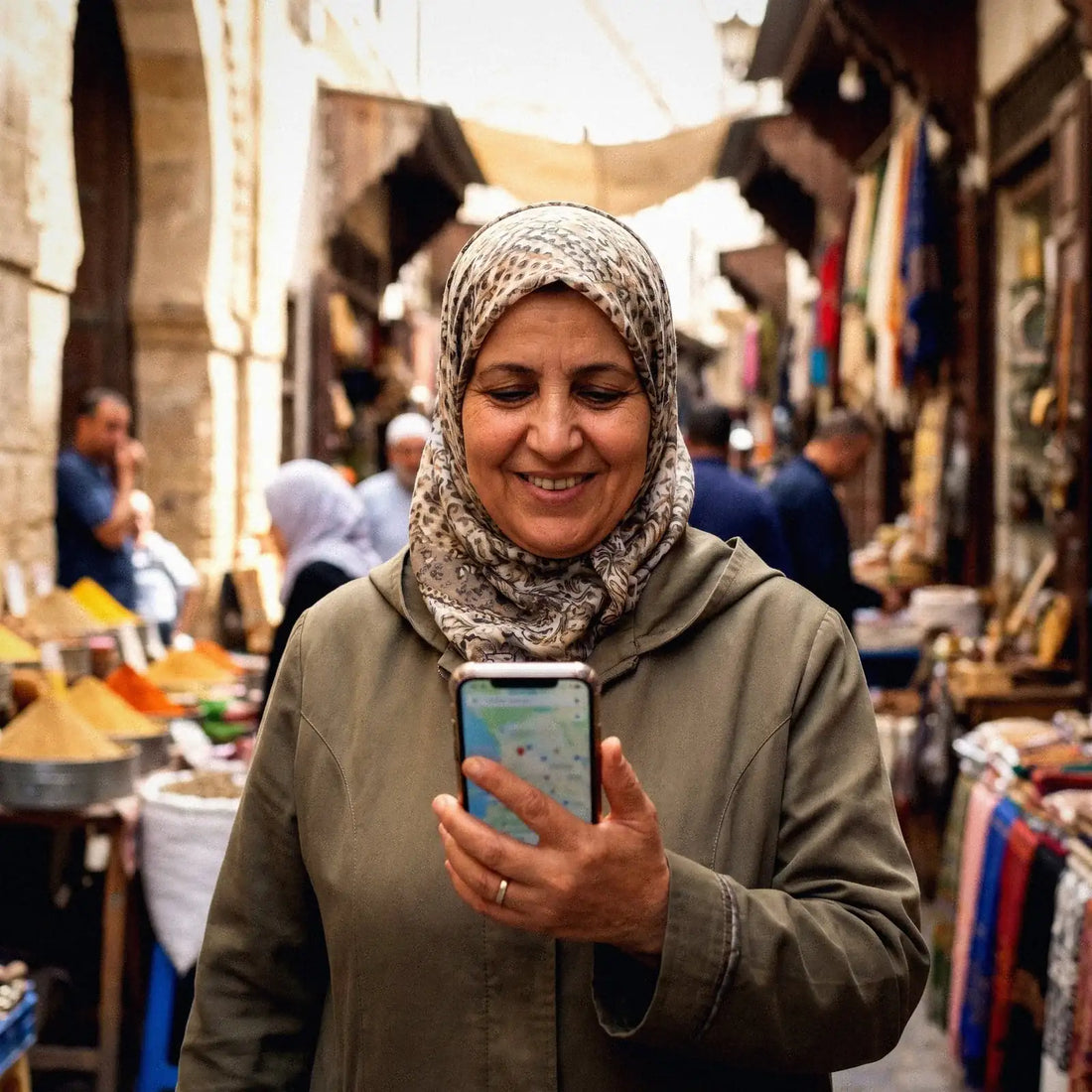
Morocco is the case that comes up most often in traveler conversations: anyone who knows the city knows that at any neighborhood shop you can get data at a very low price, and that at the airport the conditions are considerably worse than in the city. In a destination like that, a travel eSIM can't be sold on price. It's sold on convenience, on not spending your first morning looking for a store, and on having internet in the taxi from the airport to the hotel. If you don't value that, a local SIM from downtown is a perfectly reasonable option.
Long stays
For a month, a semester of studies, or a work season, a local resident plan almost always works out better than chained travel plans, and on top of that it gives you a local number for the bank, landlord, or doctor.
You need traditional voice calls
It's a more common need than it seems: someone who has to call their elderly parents every day and can't ask them to install a messaging app needs old-fashioned voice. Travel data plans don't cover that on their own. The honest options are two: an internet calling service that dials landlines and mobiles from your data plan, or directly a local card with minutes. If the second gives you more peace of mind, buy it.
Your phone doesn't support eSIM
If the EID doesn't show up anywhere, the debate ends. There's no trick or update that adds eSIM to a device that doesn't have it from the factory. In the next section you'll find how to check it in a minute, before paying anything.
You're going somewhere where your host network is weak
A travel plan works over the networks of the country's operators it has agreements with. In rural or mountain areas, the coverage of that specific network can be worse than that of the dominant local operator. When the destination is a small town and you're going to spend the whole trip there, asking someone who knows the area which operator really works is worth more than any comparison.
«What if I buy it and it doesn’t work when I arrive?»
This fear shows up in the exact same words on travel forums: buy it, then once at the destination, it doesn’t work. It deserves a concrete answer instead of a «don’t worry, it’s super easy». Here’s what actually tends to go wrong:
- Installing the profile without an internet connection. Installation requires internet. If you save the code for when you land and the airport wifi asks for an SMS verification, you’re stuck in a dead end. Install it before leaving home, on wifi.
- Not switching the data line. The profile is installed, but your phone still tries to use data from your regular line. You need to go into mobile data settings and select the new line.
- Leaving data roaming turned off on the new line. It sounds contradictory, but a travel plan works as a visitor on local networks, so that setting has to be on on the eSIM line and off on your usual one.
- Activating too early. If the plan counts days from activation and you turn it on before flying, you’re wasting days of use.
None of those four issues require a physical store. All four can be fixed from a settings screen, and if that doesn’t work, by messaging someone. That’s the real difference from a counter: PuraSIM’s support is 24/7 by email and WhatsApp, in English, so the fix fits into a taxi ride. There’s no phone support, and that’s clearer this way: you get help in writing.
Two facts that take the pressure off your schedule: activation takes about a minute, and you have 180 days to activate the eSIM from the moment you buy it. That means you can buy the plan today, leave it installed, and turn it on when the plane touches down.
Compatibility: how to tell if your phone supports eSIM
Before comparing plans, check this. It takes less time than reading a comparison and avoids the worst situation: paying for a plan your device can’t use.
| What to check | Where to find it | If it doesn’t show up |
|---|---|---|
| That your phone has eSIM | iPhone: Settings > General > About, look for «EID». Android: Settings > About phone > Status or SIM info | No EID means no eSIM. Your option is a physical SIM |
| Quick shortcut | Dial *#06# and check if an EID appears next to the IMEI | Some devices don’t show it there even if they have it: check Settings before ruling it out |
| That it’s unlocked | iPhone: Settings > General > About > «Carrier lock». Android: check with your carrier | A device locked to a carrier may reject profiles from others |
| Your specific unit, not the model | The manufacturer’s specs for your regional version | The same model can have eSIM in some markets and not in others: trust your device, not the commercial name |
One clarification that saves arguments: just because your phone is recent or high-end doesn’t guarantee anything. There are modern, capable devices sold in certain markets without eSIM, and humbler ones that do have it. The only proof that counts is the EID on your screen.
Data, calls, and your regular number
Here’s the structural advantage of eSIM, the one most people discover too late: your regular line doesn’t go anywhere. It stays installed, keeps receiving calls and SMS, and data runs through your travel plan. A physical airport card, on the other hand, forces you to remove your own if there’s no spare slot, with the classic risk of losing it at a hotel.
That matters a lot for one specific reason: your bank codes. If your bank sends verification keys by SMS to your home number, you need that line alive while traveling. The details on how to set this up without racking up a roaming bill are here: how to keep your number and keep receiving bank SMS while using a travel eSIM.
About data usage, another common question: do you have to keep turning data off when you’re not using your phone? There’s no need to live toggling the switch, but it’s wise to disable automatic backups, app updates over mobile data, and autoplay video on social media before you leave. That’s what eats a plan without you noticing, not checking the map.
And a warning about so-called unlimited plans, which travelers often recommend: unlimited almost never means full speed forever. They usually have a fair usage policy, and once you exceed a certain amount, the speed drops significantly. It’s still convenient if you’re just using maps and messaging all day, but read the fine print before relying on it for work or for sharing internet with the whole family.
What Almost No One Explains Before a Trip
Four points that rarely show up in comparisons and that change the decision more than the price.
A physical SIM card isn't automatically the safe choice. The bias says physical is more reliable. What travelers describe often contradicts that: one story that goes around, from Japan, is about buying an expensive SIM at the airport that stopped working after a few days, and ending the trip on an eSIM without any further issues. It's not lab data or a universal rule, but it helps dismantle the idea that plastic guarantees anything on its own.
Crossing borders changes the problem. A local SIM works for one country. As soon as your route includes two or three, or you pass through a border area, you start piling up SIMs or paying roaming on a card that doesn't include it. There's also the idea floating around of latching onto a neighboring country's network from a border town; it happens sometimes, but it's not a plan: you don't control it, and it can trigger charges you don't expect. For multi-country itineraries, the real comparison is between a regional plan and several local SIMs, not between eSIM and physical SIM.
The learning curve is a one-time cost. The first eSIM is daunting; the second one isn't. Preparing your next trip becomes a matter of a few minutes from your couch, which is the phrase that sums it up best: no more scrambling for physical SIMs inside the airport.
Watch out for "free." The data plans some credit cards or travel insurance policies give away might work for a weekend, but they're usually short and come with strict conditions. It's worth looking at them closely before relying on them: here's the breakdown of what free eSIMs included with some cards actually offer.
So you don't forget anything, here's the order of things:
| When | What You Do | Why It Matters |
|---|---|---|
| Days before | Check your EID and buy the plan for your destination | With 180 days to activate from purchase, there's no rush |
| The night before | Install the profile at home, on Wi-Fi | Installation needs a connection, and the airport doesn't always have one without SMS verification |
| When you land | Activate the plan, select the data line, and turn off data roaming on your regular line | This is the step that avoids surprise bills from your carrier |
| If something doesn't start | Use airport Wi-Fi and write via WhatsApp or email | Support responds 24/7 and in English, without going back to any counter |
| When you return | Switch data back to your regular line | Close out the trip with no lingering charges |
Frequently Asked Questions
What are the disadvantages of an eSIM?
There are three, and they're real. First: you need a compatible, unlocked phone, and not all are. Second: transferring the profile to another phone isn't as simple as moving a plastic SIM, so if your device breaks mid-trip, recovery depends on the provider. Third: travel plans are usually data-only, with no local number for traditional calls. If any of those three is a dealbreaker for you, a physical SIM is the better choice.
Which is better, eSIM or physical SIM?
It depends on the type of trip. For short or medium stays, multi-country trips, or late-night arrivals, eSIM wins because the problem is solved before you leave home. For long stays, destinations with very cheap local data, or when you need a local number for calls and verifications, a local physical SIM wins. And if your phone doesn't have an EID, a physical SIM is your only option.
How much does a SIM cost at the airport?
It varies so much by country and terminal that any specific number would mislead you. What can be said is how that price behaves: the airport counter is usually the most expensive point of sale in the country, with packages put together for tourists in a hurry and minimum top-ups you don't choose. Comparing is hard because you have no local reference and no time. If you're buying local, the sensible option is to do it in the city, not at the terminal.
Will they ask for my passport to buy a local SIM?
In several countries, yes, and in some, your accommodation details too. It's a legal requirement for line registration, not a whim of the seller. Practical consequences: you add time at the counter, leave a copy of your ID at a point of sale you don't know, and the line gets tied to your name. A data plan bought before you travel avoids that process entirely, though in exchange you don't get a local number.
Does the foreign SIM deactivate when I get home?
Many prepaid tourist SIMs deactivate due to inactivity or expire after a period from the last top-up, so keeping it for the next trip rarely works: when you return to the country, you find the number no longer exists or the balance is gone. With eSIM plans, the approach is different: you don't reuse an old plan, you buy one for the new destination on the same phone, without looking for a store or moving anything around.
My phone doesn't show any EID, can I do anything?
First check in Settings, because some devices don't show the EID when you dial the short code even though they do have eSIM. If it's not there either, there's no software fix: eSIM is a hardware component and no update can add it. Also keep in mind that the same model can be sold with eSIM in one market and without it in another, so trust what your device says, not the general spec sheet for the model.
Do unlimited plans actually work, or is it just advertising?
They work, with one condition that always needs stating: unlimited doesn't mean maximum speed indefinitely. These plans have fair use policies, and after a certain amount of usage, the speed drops noticeably. For maps, messaging, social media, and some video, they're usually more than enough. If your plan is to work with video calls all day or share internet with multiple devices, check the fine print before assuming it will hold up.
Can I still receive calls and SMS from my number while using an eSIM?
Yes, and it's one of the best reasons to choose eSIM. Your regular line stays on the phone while data goes through the travel plan, so bank codes and calls still come through. The important part is to turn off mobile data and data roaming on your regular line so it doesn't use data on its own; calls and SMS still come through just the same, because that setting only affects data. If you're traveling to the US, that specific case has its own quirks, explained in the guide on traveling to the US with an eSIM and still receiving SMS from your number.
Can I buy it now even if the trip is a few months away?
Yes. You have 180 days to activate the eSIM from the moment of purchase, so you can get it sorted when you book the flight and forget about it. The recommended approach is to install the profile at home, on Wi-Fi, and activate it when you land: activation takes about a minute. That way, on travel day you're not dependent on airport Wi-Fi or finding an open counter at whatever time your flight arrives.
The decision
Choose the travel eSIM if your phone shows an EID and is unlocked, the trip lasts a few days or weeks, you arrive at night or with limited connectivity, you cross more than one country, or your priority is not to waste the first afternoon standing in line. Install it at home over Wi-Fi and activate it when you land.
Choose the local SIM, and buy it in the city rather than at the airport, if you’re staying longer than a month, if the destination has famously cheap local data and you don’t mind spending the first morning on it, if you need a local number for voice calls or verifications, or if your device doesn’t support eSIM. In those cases we are not the right answer, and there’s no point pretending otherwise.
And if you're torn between an eSIM and the data package your own carrier sells you, that's a different calculation, with different pitfalls: it's covered in the comparison between your carrier's roaming package and a travel eSIM.
Whatever your case, decide before boarding. The only option that almost always goes wrong is arriving without having thought about it and sorting it out at the first counter you see with your suitcase in hand.