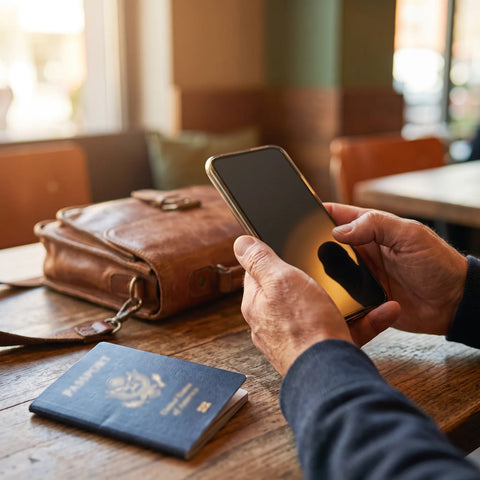
In short: An Israel eSIM gives you local data from the moment you land in Tel Aviv, Jerusalem, or Eilat, without roaming and without a physical SIM. It installs in minutes with a QR code and keeps your usual number active. For a typical 10-day trip, 8-10 GB covers maps, messaging, and social media without billing surprises.
Traveling to Israel is intense: in a few kilometers, you go from the hustle and bustle of Tel Aviv to the ancient history of Jerusalem and the surreal blue of the Dead Sea. The last thing you want is to land without internet, struggling with Ben Gurion Airport's WiFi while someone waits for you. With an eSIM, you land with internet, no roaming, and no stress. In this guide, we tell you what coverage to expect, how many GB you really need, how to activate it step-by-step, and the tricks almost no one tells you about.
No contracts, no waiting for a shipment, no surprises when you get home. Just local data ready when your plane touches down.
What is an eSIM and why it's so well-suited for Israel
An eSIM is a digital SIM that is already integrated into your mobile phone. Instead of inserting a plastic card, you download an operator profile by scanning a QR code. The result is the same as a lifelong SIM—data, and on some plans calls—but without handling anything physical and without having to find a store upon arrival.
For a destination like Israel, this convenience is particularly noticeable. The country is small and very traversable, with quick movements between cities, and you want to be connected from the first minute to get around, book, and communicate. A local eSIM gives you data at a local price from the moment you land, instead of relying on your operator's roaming, which can skyrocket in destinations outside the European Union.
Israel has one of the most developed mobile infrastructures in the region, with good 4G and 5G coverage in urban and tourist areas. This translates into a data experience very similar to what you have at home when you are in Tel Aviv, Jerusalem, or Eilat.
Israel eSIM vs. roaming: the real difference
International roaming from European and Latin American operators outside the EU can cost you several euros or dollars per day in Israel, sometimes with limited speed and the unpleasant surprise of the bill upon return. A local eSIM turns that equation around: you only pay for what you contract and browse at the maximum speed the network allows.
| Aspect | Traditional roaming | PuraSIM eSIM for Israel |
|---|---|---|
| Cost | Fixed daily rate, even if you barely use data | You only pay for the plan you contract in advance |
| Speed | Often limited, sometimes only 3G | 4G/5G where the local network allows |
| Activation | Automatic, but without spending control | Scan a QR in minutes |
| Bill | Risk of surprises upon return | Fixed price, no extra charges |
| Your number | Active, but consuming your plan | Remains active for calls and SMS |
That last point is key, and many people are not clear about it: with an eSIM, you don't give up your number. The eSIM occupies a virtual slot independent of your physical SIM, so you can continue to receive calls and messages on your usual line while data goes through the local eSIM. We delve into this in our comparison of eSIM vs. roaming, and if the concept of roaming sounds like Greek to you, here we explain what data roaming is.

Data coverage in Israel: what to expect
Coverage varies depending on where you are, as in any country. The good news is that the areas where you will spend most of your trip are very well served.
- Major cities (Tel Aviv, Jerusalem, Haifa, Eilat): Stable 4G and 5G, perfect for streaming, map navigation, social media, and video calls.
- Tourist areas of the Dead Sea and the coast: Generally good coverage in resorts and main access points; it can become patchy in isolated desert stretches.
- Negev Desert and rural areas: Signal can drop to 3G or disappear in remote spots. This is where downloaded maps make a difference.
- Intercity transport: Trains and buses between cities have variable coverage, good in urban centers and weaker in open stretches.
To maximize the signal, the eSIM connects to local networks with the best infrastructure through roaming agreements, automatically searching for the best available coverage at all times. You don't have to manually configure the operator: your phone chooses for you.
A practical note about the desert: if you plan to visit Masada, the Mitzpe Ramon crater, or routes through the Negev, don't assume you'll have data all the time. Plan those days with maps already downloaded and reservations saved on your phone.
How many GB do you need for a trip to Israel?
The million-dollar question. Short answer: for a typical trip of about 10 days, between 8 and 10 GB cover normal usage well. Long answer: it depends on how you use your phone. Here's a realistic breakdown by traveler profile.
| Usage Profile | What you do | Approx. daily consumption | For 10 days |
|---|---|---|---|
| Basic | Maps, messaging, occasional searches | 300-500 MB | 3-5 GB |
| Moderate | Social media, photos, continuous browsing | 800 MB - 1.5 GB | 8-15 GB |
| Intensive | Remote work, streaming, video calls | 2-4 GB | 20-40 GB |
For most travelers who constantly use Google Maps, share photos on Instagram, rely on WhatsApp, and do some searching, those 8-10 GB are more than enough. If you work remotely or make video calls daily, switch to the higher plan without hesitation.
What if you run short? Nothing dramatic happens: you don't suddenly lose coverage. You can top up data from your client panel and continue browsing in minutes, without buying a new eSIM. If you want to stretch every megabyte, check out our tips for saving data with your travel eSIM. You can see data and duration options in the eSIM plans for Israel.
How to activate your eSIM for Israel step-by-step
Activating an eSIM is as simple as scanning a QR code. No stores, no waiting. The whole process takes less than five minutes:
- Purchase your plan for Israel. You will receive a QR code and instructions by email.
- Install the profile: on iPhone, go to Settings → Cellular → Add eSIM; on Android, to Settings → Connections → SIM Manager → Add eSIM.
- Scan the QR code or enter the data manually if you prefer.
- Select the eSIM as the default data line so that browsing uses it.
- Activate data roaming in the settings for that eSIM: this is necessary for it to work on Israeli local networks (it doesn't charge you for roaming, it's just the technical setting).
Golden tip: install the eSIM with Wi-Fi at home, before you leave, and configure it to activate upon arrival. That way, when you land at Ben Gurion, all you have to do is turn on your phone. If it's your first time, follow our general guide on how to install an eSIM with step-by-step screenshots.
Before purchasing, check compatibility. Most iPhones from XS onwards, Samsung Galaxy from S20 onwards, and Google Pixel from 3 onwards support eSIM, but it's worth confirming. We explain how to do it in the guide on how to tell if your phone is eSIM compatible. Pay attention to an important detail: the phone must be unlocked (not carrier-locked) for the eSIM to work.
What almost no one tells you about connecting in Israel
Getting the right eSIM is half the battle. The other half are these details that rarely appear in guides and save you trouble:
- Shabbat changes the country's rhythm, not the network. From Friday evening to Saturday evening, many businesses, public transport, and services close, especially in Jerusalem. Mobile coverage continues to work, but having data becomes even more useful: for ordering a shared taxi, checking what's open, or getting around when public transport stops.
- Security control at Ben Gurion is meticulous. Having your phone with active data and accessible reservations speeds things up. Have screenshots of your accommodations and tickets in case they ask for them.
- Download offline maps before you leave. Google Maps and Maps.me allow you to save all of Israel or specific cities. It's your safety net for the desert and for Jerusalem's Old City, where wandering can confuse the GPS.
- WhatsApp and Telegram over data, not international calls. Calls through these apps consume very little compared to a traditional call. For high-quality video calls, use hotel Wi-Fi.
- Hotspot drains faster than you think. Sharing your connection with your laptop or tablet empties your plan very quickly. Use it only when you really need it.
- If you are crossing into Jordan (Petra from Eilat is a classic), remember that your Israel eSIM does not cover Jordan. You will need a separate plan; check our guide to eSIM for Jordan or a regional Middle East eSIM plan if you combine several countries.
With these habits and a well-sized data plan, your trip to Israel will have the connectivity you need without absurd expenses or hassles at the most inopportune moment.

Common mistakes to avoid
Three common pitfalls we see again and again, and how to avoid them:
- Buying at the airport in a hurry. Arriving and looking for connectivity on the fly is usually more expensive and inconvenient. Have your eSIM installed before flying.
- Not activating data roaming on the eSIM. This is the number one mistake: people install the profile but forget this switch and think the eSIM doesn't work. Activate it, and you're good to go.
- Choosing the smallest plan "just in case." Running out of data halfway through your trip is inconvenient. It's more comfortable to size it well from the beginning and, if necessary, top up. If you're unsure between sizes, our guide on how much data you need for travel helps you calculate.
Frequently asked questions about eSIM for Israel
When should I activate the eSIM for Israel?
You can install it on your phone before leaving home, using Wi-Fi. Most eSIMs for Israel are configured days in advance and activate automatically upon arrival at the destination, or manually when you want to start using them. Ideally, have it ready before flying to land already connected.
Is my phone compatible with eSIM?
Most smartphones manufactured from 2018-2019 are: iPhone XS onwards, Samsung Galaxy S20 onwards, Google Pixel 3 onwards, and many more. Check in Settings → General → About if your device lists "eSIM." Your phone must also be carrier-unlocked for the eSIM to work.
Can I keep my usual number while using the eSIM in Israel?
Yes. The eSIM occupies a virtual slot separate from your physical SIM. You can keep your usual SIM for calls and SMS and use the local eSIM only for data. You will continue to receive calls and messages on your usual number, but beware: receiving calls on your original line while outside your country can incur roaming charges from your operator.
What happens if I run out of data?
You won't suddenly lose coverage. You can purchase a data top-up from your client panel, and it will be applied in minutes, without changing your plan or installing a new eSIM. That's why it's wise not to obsess over getting the plan exactly right.
Does the eSIM work throughout Israel, including the Dead Sea and the desert?
It works on available local networks. In major cities and tourist areas, coverage is excellent (4G/5G). In the Negev Desert or remote rural areas, the signal may be more limited, so we recommend downloading offline maps for those stretches.
Does the Israel eSIM also work in Jordan or Palestine?
A plan for Israel is designed for Israel. If you are crossing into Jordan (for example, to visit Petra), you will need a plan that covers that country or a regional Middle East eSIM. Always check the plan's coverage before purchasing to ensure it includes all destinations on your itinerary.
Can I use the eSIM to share internet with other devices?
Yes, most plans allow you to use your phone as a hotspot for your laptop or tablet. Keep in mind that sharing a connection consumes data much faster, so size your plan to account for that extra usage if you plan to work from your computer.
In short: an eSIM for Israel is the most convenient way to land with internet, move easily between Tel Aviv, Jerusalem, the Dead Sea, and Eilat, and forget about roaming and surprise bills. Install it before flying, size your GB well, and enjoy your trip with the peace of mind of always being connected.