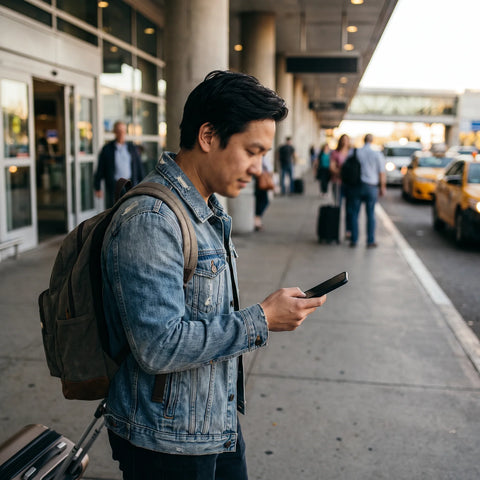
In short: For Argentinians traveling to Europe, the best way to get internet is an eSIM Europe: you buy and install it from Buenos Aires by scanning a QR code, land with active 4G/5G data, and avoid the extremely expensive roaming of Personal, Claro, or Movistar. A single plan covers almost the entire continent, and you pay a fixed price, with no surprises upon return.
Crossing the Atlantic already costs a lot, so you don't need your phone to ruin your budget as soon as you set foot in Barajas. And yet, it happens to thousands of Argentinians every year: they turn on roaming "just in case," use the map twice, and return with a bill that hurts more than jet lag. The good news is there's a simple, cheap solution that can be sorted out before leaving home. In this guide, we'll tell you everything about the eSIM Europe, designed specifically for Argentinian travelers: how it works, how convenient it is, how to install it, and details almost no one explains.
What is an eSIM and why is it useful for Argentinian travelers?
An eSIM is a digital SIM card. Instead of that plastic chip you insert into the tray, it's a profile that's downloaded into your phone. You scan a QR code, it installs in a couple of minutes, and your phone is ready to connect to the local networks of the country you're traveling to. You don't have to go to a store, you don't have to wait for a shipment, and you don't have to remove your Argentinian SIM.
For those traveling from Argentina, this has a huge advantage: you can leave your Personal, Claro, or Movistar line in place to receive WhatsApp and bank SMS, and use the eSIM only for data in Europe. Two lines coexisting on the same device. If you want to understand the technology well before proceeding, we have a complete explanation in what an eSIM is and how it works.
The other advantage is financial. You buy the plan in dollars before you travel, you know exactly how much you're going to spend, and you don't depend on the whims of your operator's international billing. For someone already dealing with exchange rates, the gap, and credit card activation for international use, having the internet cost locked in beforehand is a relief.
The problem of roaming for Argentinians
Argentinians traveling to Europe face a double challenge. On one hand, international roaming is charged in dollars and is usually expensive. On the other hand, buying abroad with an Argentinian card isn't always easy due to exchange restrictions and the authorizations required by banks.
The "traveler packages" offered by Personal, Claro Argentina, and Movistar Argentina for Europe are charged daily and with a quite limited fast data cap. The daily price can quickly add up: on a two or three-week trip, what you spend on internet alone can end up being an uncomfortable amount. And when your fast data package runs out, the connection slows down so much that it's barely useful for loading a map. Always check the current price with your operator, as rates change, but the logic remains the same: you pay a lot for little.
If you want to delve deeper into why roaming is so expensive and how it's billed, we have a separate explanation that clearly shows where those charges come from.
The eSIM solves this at its root. Instead of paying daily with limited data, you buy a block of data at a much lower price per GB, and use the same European network infrastructure. It's the same internet, at a different price.

eSIM vs. roaming: the honest comparison
Rather than discussing exact price figures (which depend on your operator, plan, and the moment), it's better to compare what each option gives you in the things that truly matter when you're on the other side of the ocean.
| Aspect | Argentinian operator roaming | PuraSIM eSIM Europe |
|---|---|---|
| Cost per GB | High; traveler packages are expensive for little data | Much lower; you pay for blocks of GB |
| Transparency | Risk of surprise bill upon return | Fixed price known before travel |
| Activation | Automatic, but with charges that start on their own | You decide when data starts running |
| Coverage | Local European networks | The same local European networks |
| Speed | 4G/5G up to the cap, then very slow | 4G/5G depending on the contracted plan |
| Installation | Nothing to install, but service needs to be activated | You scan a QR from home in minutes |
| Your Argentinian number | Remains active with roaming charges | You keep it separate, only for WhatsApp and SMS |
The conclusion is simple: coverage is practically the same because both use European networks, but with eSIM you have total control over spending. For a more in-depth comparison of the topic, we have eSIM vs. roaming, where we break down the advantages and disadvantages of each.
How many GB do I need for my trip to Europe?
This is the million-dollar question, and the answer depends on how you use your phone. If you're someone who has Google Maps on all day, sends endless voice messages on WhatsApp, and uploads stories every two hours, you'll need more data than someone who only checks email and looks up directions occasionally. This table gives you a realistic consumption reference by activity:
| Activity | Approximate Consumption | Traveler Profile |
|---|---|---|
| WhatsApp (text and audio) | Low | Everyone |
| Google Maps and navigation | Low to medium | Tourist who moves around a lot |
| Social media and stories | Medium | The one who documents everything |
| Video calls with Argentina | Medium to high | The one who misses family |
| Video/music streaming | High | Long trips, many hours on a train |
As a practical rule: for a two to three-week trip with moderate use, a plan of around 10 GB is usually comfortable. If you're going to make many video calls or stream, aim higher. And if you run short, it's okay: you can top up. To extend your data, there are concrete tricks that really work, and we've gathered them in how to save data with your eSIM.
Installation and activation step-by-step from Argentina
The entire process is done before leaving, using your home Wi-Fi. This way, you arrive in Europe with your eSIM ready and only need to activate it upon landing.
- Check compatibility. Your phone must support eSIM and be unlocked. In Argentina, devices purchased without a plan are usually unlocked; those tied to Personal or Claro might be locked. If in doubt, check the list of eSIM-compatible phones before buying.
- Request unlocking if necessary. In Argentina, operators are obliged to unlock your device when you request it, and it's free. Do it in advance, not the night before you travel.
- Buy the plan. Choose the Europe plan based on the days and GB you estimate you'll use. The purchase is made online in minutes.
- Install the eSIM. You'll receive a QR code. Scan it with your camera or from your phone's settings, and the profile will download automatically. For fine details, follow the guide on how to install an eSIM.
- Configure which line uses data. Keep your Argentinian SIM as your voice line and the eSIM as your data line. This way, you won't accidentally incur roaming charges.
- Activate upon arrival. The plan starts running with the first data usage in Europe. As soon as you land, turn off data for your Argentinian SIM, turn on data for the eSIM, and that's it: internet without roaming, without stress.
A key detail many overlook: deactivate data for your Argentinian line on your phone. The eSIM gives you internet, but if you leave roaming enabled on your local chip, the phone might still connect and generate charges. Two taps in the settings will save you that fright.
Europe, a favorite among Argentinians
Argentina has a historical link with Europe, especially with Italy and Spain, and this is reflected in the most frequently visited destinations. The good thing is that a single eSIM Europe plan covers almost all of them:
- Spain — Madrid, Barcelona, Seville, and the south. There are huge Argentinian communities, and many travel throughout the country. The metro, Renfe trains, and delivery apps constantly require data. If your trip is only to Spain, also check out the eSIM Spain plan.
- Italy — Rome, Milan, Naples, and Sicily. Many Argentinians go to reconnect with their Italian roots or to process citizenship, and for that, being connected is essential.
- France — Paris is an unmissable classic, and from there many continue to other cities.
- Portugal — Lisbon and Porto are increasingly popular, with good air connections from Buenos Aires.
- Germany, Netherlands, and Belgium — Cultural tourism, business, and frequent layovers.
- Greece and Croatia — Beach destinations that attract more Argentinians every season.
The beauty of the eSIM Europe is that you don't have to buy a SIM card for each country. If your classic itinerary is Spain, Italy, and France on the same trip, the same profile works in all three without changing anything. And if you plan a more ambitious route through many countries, the eSIM Europe 30 countries plan covers virtually the entire continent.

What almost no one tells you
Beyond the basics, there are details you only learn by traveling (or by reading someone who already made the mistake). Here are the most useful ones:
- The eSIM doesn't give you a European phone number. It gives you internet. To make calls, you use WhatsApp, FaceTime, or any voice-over-data app. If you expect to receive SMS with codes, those will go to your Argentinian SIM, which you should keep in, even if data is off.
- Install the eSIM at home, not at Ezeiza. The installation process needs internet (Wi-Fi), but activation happens later, once in Europe. Many believe that if they install it earlier, they "use up" the plan: false. Install it calmly from home, and data only starts running when you use it at your destination.
- Bank codes can be a headache. If your Argentinian bank sends you verification SMS to authorize payments, you need your local chip with signal. That's why the ideal setup is dual: Argentinian SIM for SMS and emergency calls, eSIM for all internet.
- Save the QR and installation data. If you change phones or need to reinstall, you'll be asked for that information. Take a screenshot and email it to yourself.
- European Wi-Fi isn't always your friend. Hotel and cafe Wi-Fi is usually slow and insecure. Having your own data prevents you from relying on public networks where your data is more exposed. If you're concerned about privacy, combine the eSIM with a VPN: we explain it in eSIM and VPN for safe travel.
- Notify your bank before leaving. Many Argentinian cards block international purchases for security reasons. Enable your card for international use before traveling, so you can pay for the eSIM and also top it up if you run short while there.
- Be aware of the time zone. Spain and France are several hours ahead of Argentina. With your eSIM, you can see the local time and coordinate well when to call home without waking anyone up at three in the morning.
How to pay for the eSIM as an Argentinian
This is the point that most holds people back, but it's actually simpler than it seems. PuraSIM accepts international credit and debit cards (Visa, Mastercard, American Express) and also PayPal. Argentinian cards enabled for international purchases work without a problem.
Payment is processed in dollars, so the final amount in pesos depends on the exchange rate applied by your bank or card at that moment. There is no fixed amount in pesos because the exchange rate fluctuates; that's why it's advisable to buy with the card that offers you the best exchange rate for international consumption. Many Argentinians use digital wallets like Wise or Revolut to manage their expenses in euros during the trip, and your eSIM is precisely what keeps you connected to manage them from your phone.
Always check the current plan price on the product page before purchasing, so you know exactly how much you'll pay. The advantage over roaming is that this number is fixed: you see it, you accept it, and there's no surprise bill afterward.
Frequently Asked Questions about eSIM for Argentinians in Europe
How do I pay for the eSIM as an Argentinian? Do you accept Argentinian cards?
Yes. PuraSIM accepts Visa, Mastercard, and American Express, as well as PayPal. Argentinian cards enabled for international purchases work without issue. The charge is made in dollars, and your bank applies the current exchange rate.
How much does eSIM Europe cost in Argentinian pesos?
There is no fixed price in pesos because it depends on the current exchange rate on the day of purchase. The plan is charged in dollars; check the current price on the product page, and your card will convert it to pesos according to the applicable exchange rate. Even so, it is much cheaper than what you would spend on roaming for the same amount of data.
Does the eSIM work in Spain with my Argentinian phone?
Yes, as long as your phone supports eSIM and is unlocked. Spain is one of the main destinations covered by the Europe plan, with good 4G/5G coverage in cities and tourist areas.
Can I use the eSIM to call Argentina from Europe?
The eSIM provides data, not a voice number. To call Argentina, you use WhatsApp, FaceTime, or any voice-over-internet app with your eSIM data. These calls have no additional cost beyond data consumption, which is low.
What happens if I run out of data while in Europe?
You can buy an additional plan or top up from the PuraSIM website using any available Wi-Fi. Activation is almost immediate, so you won't be disconnected for long.
Does a single plan cover several European countries?
Yes. The beauty of eSIM Europe is precisely that: the same profile works in dozens of countries on the continent. If your trip combines Spain, Italy, France, and another destination, you don't need to change SIM cards or buy one for each country.
Do I have to remove my Personal, Claro, or Movistar SIM?
No. That's the great benefit of the eSIM: it coexists with your physical chip. You leave your Argentinian line in (ideal for receiving WhatsApp and bank SMS) and use the eSIM only for data. Remember to deactivate data for your Argentinian SIM to avoid accidental roaming charges.
Traveling to Europe from Argentina already involves enough bureaucracy without adding internet problems. Sort it out before you leave: choose your eSIM Europe plan, install it calmly from home, and land connected from minute one in Barajas, Fiumicino, or Charles de Gaulle. No roaming, no surprise bills, and no stress.