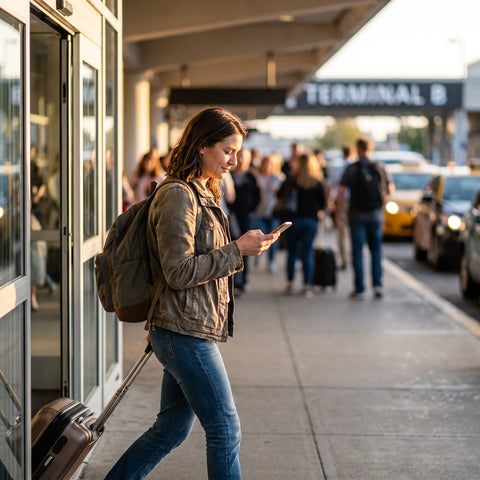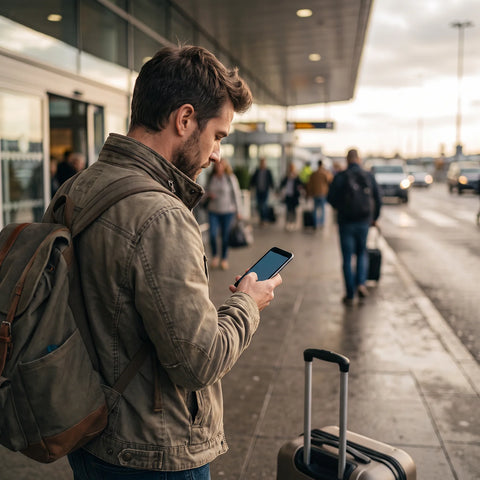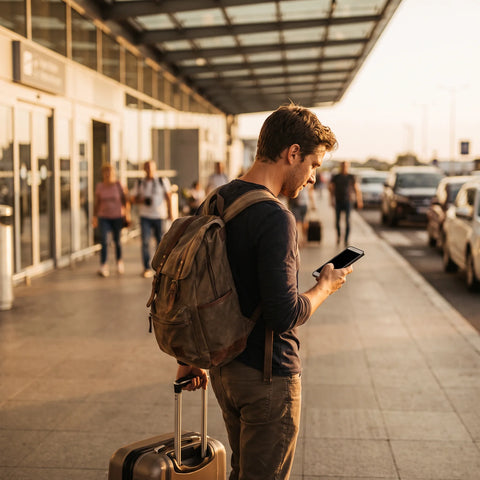
In short: using a dual eSIM for two countries on the same trip is totally possible. You install both eSIMs at home with Wi-Fi, label them clearly, and when you cross the border, you switch the data line to the second country's eSIM with two taps. No changing cards, no expensive roaming, and no restarting anything.
If your itinerary connects two countries — say, Thailand and Vietnam, or France and Italy — you're probably wondering if you can have two eSIMs for two countries on the same phone without going crazy. The short answer is yes. In this guide, I'll show you how to have both installed and switch between them in seconds, without changing cards or restarting anything. You'll land with internet in each destination, without roaming and without stress.
Can you have two eSIMs at once on the same phone?
Yes. Modern phones store several eSIMs in memory and allow you to have two active lines at the same time (e.g., the eSIM for country A and your home SIM), or to alternate between two data eSIMs with a couple of taps. The key is to understand a nuance: you can store many profiles, but only one carries mobile data at any given time. And you're the one who chooses which one.
The idea is simple. You install the eSIM for the first country before leaving and the one for the second country too, even if both remain stored. When you land in country A, you activate its plan; when you cross into country B, you switch the data line to the second eSIM. Your home number can remain active to receive bank SMS while you use the travel eSIM data. This is a typical scenario for someone visiting two destinations on a single ticket: a Thailand-Vietnam getaway, an Interrail trip through France and Italy, or a hop between two regions that don't share a plan.
If you've never used this virtual card format, it's worth understanding the basics first: an eSIM is a chip integrated into your phone that's activated with a code, without needing to insert plastic. Once that's clear, managing two at once is a matter of organization, not magic.
How many eSIMs fit on your phone (stored vs. active)
Here's the important nuance that almost no one explains well: you can store many eSIMs (eight, ten, or more depending on the model), but only have a limited number active at once. In practice, for a trip to two countries, you won't need more than two or three stored profiles.
Recent iPhones support several installed eSIMs and two active lines simultaneously; Android phones like Samsung Galaxy or Google Pixel have similar figures. It's advisable not to accumulate old profiles: every expired eSIM you leave inside takes up space and also clutters the menu when you're in a hurry. If you want details by brand, check out how many eSIMs an iPhone can have and, if you have doubts about your device, the guide on how dual SIM with eSIM works. For cases with three or more profiles at once, the logic is the same: store them in order and activate only the one that's needed.
A note on terminology to avoid confusion: "stored" means the profile is saved on the phone but turned off; "active" means the line is on and the phone recognizes it; and "data line" is the only one that, at that moment, browses the internet. You can have two active lines but only one of them using data. Understanding these three states saves you almost all the trouble.
Pre-trip tip: clean up before you go
Before traveling, delete old eSIMs from previous trips that you no longer use. This frees up space and, more importantly, prevents confusion when choosing the correct data line in the menu. A phone with four identical "secondary eSIMs" is a recipe for activating the wrong one at the worst possible moment.
How to install and organize two eSIMs step-by-step
The trick to avoiding stress is to install both at home, with Wi-Fi, and label them clearly. No rushing to scan a QR code at the second country's airport, in bad light, with your suitcase blocking the way.
- Buy the plan for country A and country B (or request the eSIM for each) in advance.
- Install both before traveling: scan or paste the activation code for each.
- Rename them with human-readable names: "Thailand Data" and "Vietnam Data," for example, instead of "secondary eSIM."
- Leave data roaming activated only on the eSIM of the country you are in at any given moment.
Labeling lines properly makes all the difference when you're in a hurry. If this is your first time with this format, the general step-by-step is in how to install an eSIM. Once they're in, switching the data line between one eSIM and another is a matter of two taps in the settings. Installation consumes a few megabytes of your home Wi-Fi; the data plan itself doesn't start counting until you activate and use the eSIM in its country.
A practical detail: when you install the second eSIM, your phone will ask which line to use for data and calls. Don't worry about getting it right at that moment; all of that can be changed later in the settings. The important thing is that both profiles are saved and well-named.
Switching eSIMs when crossing the border
When you go from country A to country B, the first country's eSIM no longer has useful coverage, and it's time to activate the second one. It doesn't happen automatically: you have to tell the phone which line is using data now. It's a thirty-second manual change, but manual nonetheless.
On iPhone, go to Settings > Mobile Data, choose the new country's eSIM as the data line, and activate its data roaming. On Android, it's equivalent within Connections > SIM (the exact name varies between Samsung, Pixel, or Xiaomi). It takes a few seconds to connect to the local network; if no signal appears immediately, toggle airplane mode on and off to force a new network search.
If you've bought eSIMs that cover only one country each, this manual change is mandatory. If your route chains several nearby destinations, you might prefer an eSIM designed for two countries or a multi-country eSIM that covers both with a single plan and without changing anything when crossing. Understanding what data roaming is helps you not leave it on where it shouldn't be.
Regional eSIM vs. two country eSIMs: which is better for you?
You don't always need two eSIMs. If the two countries are in the same region (two European countries, two in Southeast Asia), a regional eSIM covers both without changing anything when crossing the border. The decision depends on how much time you spend in each, whether they share a region, and the price of the plan. This table helps you decide at a glance:
| Scenario | Best option | Why |
|---|---|---|
| 2 countries, same region | 1 regional eSIM | Single plan, zero changes at the border |
| 2 countries, different regions | 2 country eSIMs | No single plan covers both well |
| Long time in one, short in another | 1 country eSIM + 1 small one | Optimize GB where you spend the most |
| Round-the-world trip or many destinations | 1 global eSIM | One profile for many countries |
| Short layover in a third country | Main destination eSIM | For a few hours, a separate plan is not worth it |
For long trips that touch many destinations, sometimes the most convenient option is a single eSIM that covers the entire area instead of installing country-specific plans one by one. If you want to delve deeper into this specific dilemma, there's a dedicated comparison at regional eSIM vs. country-specific eSIM. As a quick reference: for Europe, a multi-country Europe eSIM usually wins, while for a hop between two specific Asian countries, it might be better to combine the eSIM of each country separately.
Common myths and mistakes (what almost no one tells you)
Failures almost always come from having the data line pointing to the wrong eSIM or from leaving roaming active on both at the same time, which can cause the phone to connect to the wrong network. Let's look at real errors and some tricks you won't find in the brochure:
- Data on the incorrect eSIM: Check that "Mobile Data" points to the eSIM for the country you are in. This is the number one mistake and the easiest to fix.
- Double roaming: Leave data roaming activated on only one eSIM at a time. With both on, the phone might try to connect via the one that doesn't have coverage there.
- Confused WhatsApp: Your account is still linked to your real number, not the data eSIM. With two numbers and WhatsApp, you can separate your home number from your travel number if you really need to.
- Losing your number: If you want to keep receiving calls from your usual number, leave your home SIM in and see how to keep your same number while using the travel eSIM data.
The trick almost no one uses: disable calls and data on your home line before takeoff, and only leave SMS. This prevents an app or an update from using your home plan with expensive roaming while you think you're using the eSIM. Many people "spend" home data without realizing it simply because they forgot to touch that setting.
Another not-so-obvious detail: some phones reactivate roaming on the main line after a system update. If you're on a long trip, check your settings occasionally, not just on the day of the flight. And be careful with background data usage: photo backups are what eat up your plan the most without you noticing.
One last myth to debunk: no, having the second eSIM stored and inactive does not consume data or battery significantly. An off profile simply takes up a memory slot. Nothing starts counting until you turn it on and set it as the data line in its country. With the right line chosen and only one eSIM active at a time, the system is practically foolproof.
Frequently Asked Questions
Can I use two data eSIMs at the same time?
You can have both installed and active as lines, but only one carries mobile data at any given time. Switching which one browses is instantaneous from the settings, so in practice, you jump from one country to another in seconds without removing or scanning anything. What doesn't exist is both browsing at the same time, sharing the connection.
Does the second country's eSIM get used while I'm in the first?
No, as long as it doesn't have data roaming activated or isn't the selected data line. A stored and inactive eSIM consumes nothing; it only starts counting when you activate it and use it to browse in its country. That's why you can install it weeks in advance without fear.
Do I need to buy the second eSIM before traveling?
It's recommended. Installing both at home with Wi-Fi prevents you from relying on finding a connection at the second destination. The eSIM remains stored and doesn't consume anything until you activate it upon arrival, so buying it in advance has no extra cost or penalty. Improvising at the airport is what usually goes wrong.
Can I have my Spanish number and two travel eSIMs?
Yes, if your phone supports multiple eSIMs in addition to the physical SIM, or enough eSIM profiles. The usual practice is to keep your home number for SMS and calls and use one of the data eSIMs for browsing. Just remember to monitor which one is carrying the data at any given time so you don't use your home plan with roaming charges.
Is a regional eSIM better than two country eSIMs?
It depends. If the two destinations are in the same region, a regional eSIM saves you the manual switch at the border and is usually more convenient. If they are in different regions, two country eSIMs usually work better because each plan covers its territory well. Check the current price of each option before deciding.
What happens if my flight has a layover in a third country?
For a layover of a few hours, a separate plan usually isn't worth it: you'll use airport Wi-Fi or simply wait. If the layover is long or involves leaving the terminal, consider a cheap eSIM for that country or a regional eSIM that already includes it, so you don't remain incommunicado during the wait.
Does this work the same on iPhone and Android?
The concept is identical: store two profiles and choose which one browses. Only the names of the menus change. On iPhone, it's managed from Settings > Mobile Data; on Android, from the SIM or Connections section, which varies by manufacturer. In both cases, clearly labeling the lines and activating roaming only on the correct eSIM is what makes everything flow smoothly.
Conclusion
Carrying two eSIMs for two countries is totally viable: install them before you leave, label them clearly, and switch the data line when you cross the border. For routes within the same region, consider a regional eSIM that covers everything at once and saves you the manual switch. Whatever your case, with PuraSim you have the plan for each destination ready in minutes and Spanish-speaking support if something gets stuck. You'll land with internet in each country, without roaming and without stress.