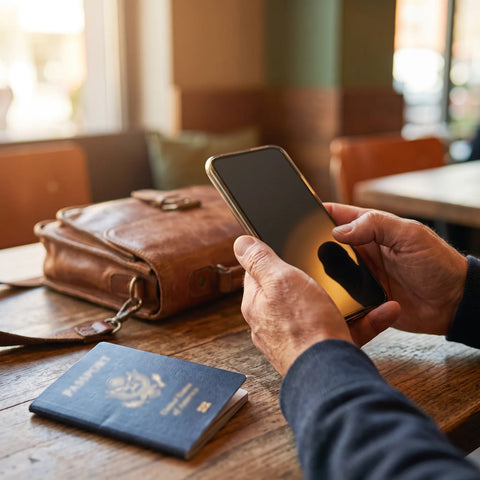
In short: An eSIM for Scotland gives you internet as soon as you land, with no roaming and no need to change your SIM card. It installs in 5 minutes with a QR code, connects to UK mobile networks, and for a typical 10-day trip through Edinburgh, Inverness, and the Highlands, 6-8 GB is sufficient. No contracts or surprise bills.
Traveling to Scotland is one of those experiences that stay with you: the mist over Loch Ness, the castles, the NC500 Route, Edinburgh's medieval alleyways. But landing without data can ruin the first few minutes. No Google Maps to navigate out of the airport, no way to let people know you've arrived, no way to look up directions to your hotel. The solution has been the standard among travelers for years: an eSIM for Scotland. You land with internet, without roaming, and without stress.
In this guide, we tell you everything you need to know before you go: what kind of coverage you'll really find in cities and in the Highlands, how many gigabytes you'll need depending on how you use your phone, how to activate it step-by-step, and connectivity tricks that almost no one tells you. No filler: useful, direct information.
What is an eSIM and why is it the best option for Scotland?
An eSIM is a digital SIM that's already integrated into your phone. Instead of inserting a physical card, you install a profile by scanning a QR code, and you're done. There's no plastic, no shipping, no need to find a store upon arrival. For a destination like Scotland, where your home carrier would charge you for roaming, having an instantly downloadable local data line completely changes the experience.
It's important to clarify something that confuses many people: Scotland is part of the United Kingdom. This means your eSIM connects to the same mobile networks that cover England, Wales, and Northern Ireland (the major British operators and their infrastructure). That's why, when you're looking for a plan, both a UK eSIM and a European regional plan will work perfectly for getting around all of Scotland.
The difference from traditional roaming is enormous. With your carrier's roaming, you might pay a fixed daily rate even if you barely use your phone, often with limited speed and the risk of a surprise bill upon return. With an eSIM, you only pay for what you contract in advance, at local speeds, and you know exactly how much you're going to spend. If you want to delve deeper into this comparison, we have an article dedicated to eSIM vs. roaming that breaks down the numbers.
Another key advantage: the eSIM works in a separate virtual slot, so you can keep your Spanish number active to receive calls and texts while using the eSIM only for data. You don't have to choose between being reachable and having cheap internet. You get both at the same time.
Data Coverage in Scotland: What You Can Really Expect
Let's be honest, because this is where many guides exaggerate. Coverage in Scotland is excellent in the areas where you'll spend most of your time, but it has real blind spots in the open wilderness. Knowing this beforehand will save you frustration.
In the main cities and tourist centers (Edinburgh, Glasgow, Inverness, Stirling, Aberdeen), you'll have stable 4G and 5G in many areas. It's an experience comparable to what you'd have in Spain: streaming, video calls, maps, and social media without a problem. In towns and on main roads, the signal is usually good, although it drops to 4G or even 3G in specific sections.
The story changes in the Highlands. Coverage there is patchy: Loch Ness and much of the NC500 Route have signal in the villages, but it's lost in the open mountains, deep valleys (the famous glens), and some Hebridean islands. This isn't a defect of a specific eSIM; it's the reality of the Scottish topography. No operator, neither local nor roaming, will give you 5G in the middle of an uninhabited moor.
| Area | Typical Coverage | What to Expect |
|---|---|---|
| Edinburgh, Glasgow, Aberdeen | 4G / 5G | Stable signal for everything: streaming, maps, video calls |
| Inverness and medium-sized cities | 4G, 5G in some areas | Very good in the city center; sufficient for all normal use |
| Towns and main roads | 4G / 3G | Generally good; some sections with weak signal |
| Highlands, glens, and rural NC500 | 3G / no signal in sections | Signal in villages, patchy in open mountains |
| Hebrides and remote areas | Variable | Coverage in inhabited centers; irregular outside |
| Ferries and rural trains | Intermittent | Take advantage of on-board WiFi when available |
The practical conclusion: for the vast majority of your trip, you'll have good connectivity. In the remaining sections, which are often the most spectacular part of the landscape, the key is to prepare with downloaded maps. We'll look at this further down.
How many GB do you need for a trip to Scotland?
The million-dollar question. The short answer: 6-8 GB for 10 days is more than enough for a traveler with normal usage. The long answer depends on how you use your phone, and this is where it's good to be realistic to avoid overpaying or running short.
Consumption skyrockets with video. Watching Netflix, uploading stories to Instagram, or making long video calls uses much more data than checking maps or messaging. Here are estimated daily consumption figures by profile:
| Usage Profile | What you do | Consumption/day | Suggested Plan (10 days) |
|---|---|---|---|
| Light | Maps, WhatsApp, some searching | 300-500 MB | 3-5 GB |
| Moderate | Social media, photos, continuous browsing | 800 MB - 1.5 GB | 6-8 GB |
| Intensive | Streaming, video calls, remote work | 2-4 GB | 15-20 GB or unlimited |
For a standard one- or ten-day trip with constant Google Maps, WhatsApp, Instagram, and some searching, 6-8 GB will be more than enough. If you work remotely or plan to make many video calls, go directly for the higher plan. And if you run short, it's not a dramatic problem: you can top up your data without losing coverage suddenly. An extra trick to extend your gigabytes is to learn how to save data with simple settings before you leave.
If your route combines Scotland with other countries (a getaway that includes London, Dublin, or the continent), a regional plan might be worthwhile. In that case, check out the Europe eSIM, which covers dozens of countries with a single profile.
How to activate your eSIM for Scotland step-by-step
Activating an eSIM is simpler than people imagine. The whole process takes less than five minutes and you don't need any special tools, just your phone and a WiFi connection for the initial installation.
- Purchase your plan before you travel. You'll receive a QR code with activation details by email.
- Install the profile: on iPhone, go to Settings → Mobile Data → Add eSIM; on Android, go to Settings → Connections → SIM Manager → Add eSIM.
- Scan the QR code or enter the details manually if you prefer.
- Select the eSIM as your data line so your phone uses that connection for browsing.
- Activate data roaming in the eSIM settings. This is a mandatory and perfectly normal step: it doesn't mean you're paying for roaming, it just allows the profile to connect to the local network.
The most convenient way is to install the eSIM at home, using your WiFi, a few days before your trip, and leave it ready to activate upon landing. That way, you'll be connected as soon as you arrive without having to struggle with menus at the airport. If it's your first time, this guide on how to install an eSIM will walk you through it with screenshots and model-specific details.
Check compatibility beforehand. Not all phones support eSIM, although most recent ones do. Compatible iPhones include models from the XS onwards, Samsung Galaxy from S20 onwards, Google Pixel from 3 onwards, and many others. To be sure, dial *#06# on your phone: if an EID number appears, your phone supports eSIM.
What almost no one tells you: myths and common mistakes
Beyond the basics, there are details that make the difference between a smoothly connected trip and an afternoon struggling with your phone. These are the most common.
Myth: "Activating data roaming means paying for roaming"
False, and it's one of the most common confusions. In the context of a travel eSIM, activating roaming simply tells your phone that it can connect to the destination country's network. The cost is already paid in your plan. If you don't activate this option, you'll be without internet, thinking something is wrong. Activate it without fear.
Mistake: expecting coverage in the middle of the Highlands
Many people plan a route along the NC500 or a trip to Glencoe assuming they'll have a signal for live navigation. You won't have it in the most remote sections, and it doesn't matter which operator you use. The solution isn't a more expensive plan; it's to download offline maps before you leave.
Mistake: buying the eSIM upon landing
Installing the profile requires internet, and the WiFi at Scottish airports is sometimes slow or requires registration. Buying and installing at home, with your WiFi, avoids this bottleneck. You arrive, activate, and you're good to go.
Hidden gem: WiFi is everywhere in cities
Scotland has a widespread culture of pubs, cafes, and libraries with free WiFi. In Edinburgh and Glasgow, you'll find open connections in much of the city center. Take advantage of it for heavy downloads (maps, episodes for the train, updates) and save your mobile data for when you're on the road. However, on public networks, it's advisable to protect your traffic; we explain why in our guide on eSIM, VPN, and travel privacy.
Hidden gem: the weather affects your battery and your plan
The Scottish cold and damp deplete your battery faster, and a phone searching for a signal in weak coverage areas consumes even more. Carry a power bank and, when you know you'll be out of coverage, put your phone in airplane mode: you'll save battery and prevent your phone from draining itself trying to find a network uselessly.
Local connectivity tips to make the most of your trip
With the right eSIM, you have the essentials. These habits help ensure that connectivity is never a problem, even in the wildest areas:
- Download offline maps of all of Scotland and your specific routes on Google Maps before you leave. You'll be able to navigate without data and without coverage, which is exactly what you need in the Highlands.
- Save content for journeys. Travel between destinations can be long and cross areas without a signal. Download music, podcasts, or an episode while you have WiFi.
- Use WhatsApp or Telegram for calls. Data calls consume very little compared to a traditional international call, and with your eSIM, they work at no extra cost.
- Share connection wisely. A hotspot for your laptop or tablet uses data quickly. Use it sparingly and check how much you've consumed in the settings.
- Know your base city. If you're flying into Edinburgh or Glasgow, check the specific guides for eSIM in Edinburgh and eSIM in Glasgow to fine-tune coverage and consumption based on your arrival point.
With a good plan and these habits, your trip through Scotland will have the connectivity you need exactly when you need it, without absurd expenses and without getting stranded in the middle of nowhere.
Frequently asked questions about eSIM for Scotland
Does the UK eSIM work throughout Scotland?
Yes. Scotland is part of the United Kingdom, so a UK eSIM plan covers the entire Scottish territory: Edinburgh, Glasgow, Inverness, the Highlands, and the islands, connecting to the available British mobile networks in each area.
When should I activate my eSIM for Scotland?
You can install the profile on your phone days in advance from home, using your WiFi, and leave it ready. Many plans activate automatically when they detect the network at the destination, or you can activate them manually when you land and want to start using data.
How many GB do I need for 7-10 days in Scotland?
For normal use (maps, messaging, social media, and photos), between 6 and 8 GB is more than enough for ten days. If you do a lot of streaming, video calls, or remote work, choose a 15-20 GB plan or an expanded data option.
Will I have coverage in the Highlands and the NC500 Route?
You will have a signal in towns and inhabited areas, but it will be lost in the open mountains, deep valleys, and some remote sections of the NC500. This is due to the topography, not the operator. Download offline maps before venturing into these areas.
Is my phone compatible with eSIM?
Most smartphones from 2018-2019 onwards are: iPhone XS and later, Samsung Galaxy S20 and later, Google Pixel 3 and later, and many others. To confirm, dial *#06# on your keypad: if an EID number appears, your phone supports eSIM.
Can I keep my Spanish number while using the eSIM in Scotland?
Yes. The eSIM operates in a separate slot from your physical SIM. You can keep your usual number to receive calls and texts, and use the eSIM only for data. This way, you're reachable and connected at the same time.
What happens if I run out of data during the trip?
You won't suddenly lose coverage. You can purchase a top-up from your customer panel and apply it in minutes, without needing to install a new eSIM or change your plan.