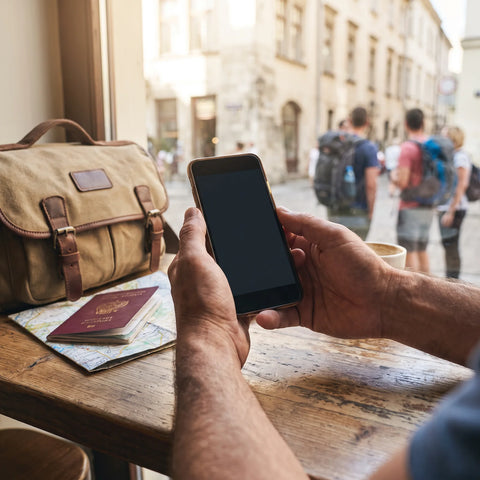
What is Movistar's eSIM Flag?
eSIM Flag is the commercial name Movistar uses for its travel eSIM: a digital profile installed on your cell phone to use mobile data in another country without buying or changing a physical card. It uses the same eSIM technology that dozens of other carriers and providers use worldwide.
The first thing to clarify is that "eSIM Flag" is not a different technology or an exclusive invention: it's a brand. Behind it is the same eSIM standard that cell phones have been factory-equipped with for several years. What changes from one provider to another is not the technology, but the coverage offered, whether or not you need a prior line with that carrier, how long the plan lasts, and what support you have if something goes wrong while you're abroad.
If you've come to this article specifically looking for opinions from people who have already used it, in eSIM flag opinions we've gathered what's being said about that specific experience. Here we'll stay at a more general level: how a travel eSIM works, what it's for, and how to decide which one suits you best depending on your route.
What is an eSIM and how does it differ from a physical SIM?
An eSIM (embedded SIM) is an identification chip soldered inside the cell phone from the factory, instead of coming on a plastic card that you insert and remove. Instead of receiving a piece of plastic, you receive a QR code or a link: by scanning it, the cell phone downloads and installs a "profile" with the data for that line, and from that moment on, it works exactly like a physical SIM for making calls, sending messages, or browsing, depending on what the plan includes.
The biggest practical difference for travelers is that a cell phone can store several eSIM profiles at the same time—your normal line plus one or two for travel—and switch between them from the settings, without opening any tray or carrying a spare physical SIM in your wallet. If you want to understand the concept from scratch, with its advantages and limitations compared to the traditional format, you can review what an eSIM is.
An important nuance: not all "eSIMs" are the same in terms of what they are used for. Some, like those typically from your home carrier, are designed as an extension of your normal line when you leave the country. Others, like international travel eSIMs, are designed from the ground up to cover multiple countries with a single profile, without requiring you to have a prior line anywhere.
How does an eSIM work when you travel?
When you arrive in another country with an eSIM installed, your cell phone searches for a local network with which your provider has an agreement and connects to it to give you data, similar to how traditional roaming works, but without needing an additional physical SIM or having to go through your home country's carrier to "activate roaming." The central difference with classic roaming is where the contract comes from: with roaming, you use your usual line connecting abroad, while with a travel eSIM, you contract a new, separate profile, only for those days.
This has a practical consequence: your usual phone number (for WhatsApp, for example) remains the same, because you normally don't turn off your main line; you just activate data via the new eSIM and leave the other in airplane mode or only for calls and messages if your phone allows it. This way, you avoid roaming charges from your home carrier while still having data for maps, travel apps, or video calls.
An eSIM is not a physical card with superpowers: it is a digital profile that your cell phone treats exactly like a normal SIM, with the same rules for coverage and data allowance as contracted. The magic is not in the technology, it is in not having to look for a physical store to solve it.
If you want to compare in depth when it's better to stick with your home carrier's roaming and when a separate travel eSIM is better for you, the detailed comparison is in eSIM vs. roaming.
Who can use eSIM Flag and what is it for?
As is the case with most travel eSIMs offered by telecom operators, they are usually conceived primarily as a complement for those who already have a line with that same operator in their country. This does not mean that it is impossible to use it otherwise, but the exact requirements—whether it is necessary to be a prior customer, what documents it requests, or what coverage it provides in your specific destination—depend on Movistar's current conditions at the time of contracting, and this changes over time.
We are not going to invent that detail for you or repeat figures that we cannot confirm in this article: the safest thing is that you verify it directly on the operator's official channel before buying, especially if your travel plan includes several countries or if you are not a regular customer of that brand in your home country.
What you can decide without depending on anyone is what type of solution suits you best according to your situation: if you are going to a single country and you are already a customer of an operator with good coverage there, an operator's eSIM can be convenient. If your trip crosses several countries, or if you do not want to depend on having a prior line anywhere, an international travel eSIM—specifically designed for that—usually fits better. We will return to this comparison in more detail in the table section, a little further down.

How to activate an eSIM step by step?
The general process is virtually the same regardless of the provider, because it is defined by the eSIM standard, not the brand. These are the usual steps:
- Confirm that your cell phone is eSIM compatible and unlocked (not carrier-locked).
- Purchase the plan and receive a QR code or activation link, usually by email.
- With your phone connected to Wi-Fi, go to "mobile data" or "cellular" settings and choose to add an eSIM.
- Scan the QR (or use the link, depending on the provider) and the profile will download and install.
- Name the new line so you don't confuse it with your usual SIM—for example, "Peru Trip."
- Activate the mobile data for that eSIM when you land or when you want the plan to start running, according to the provider's terms.
These general steps also apply to eSIM Flag, although the exact installation details may have Movistar's own variations that should be followed exactly as indicated by the operator at the time of purchase, not a generic guide like this one. If you want a visual step-by-step guide designed for any eSIM, you can find it in how to install an eSIM.
Which phones are compatible with eSIM?
Compatibility depends on the model and whether the phone is unlocked, not on the brand of eSIM you want to use. Generally, iPhones from the XS model onwards, most Samsung Galaxy S20 series and later, and several foldable models, and Google Pixels from 3 onwards are compatible. Many other manufacturers—Motorola, Huawei, some recent Xiaomi and Honor—also include eSIM in their high-end ranges, although it is advisable to confirm model by model as not all regional versions have it activated.
One point that is often overlooked: having an "eSIM" is not enough if the phone is locked to a specific carrier (common for devices purchased in installments or subsidized). A locked phone may reject eSIM profiles from other providers even if the hardware is compatible. If you have doubts about your exact model, there is a more detailed list in eSIM compatible phones.
A real example: ten days of travel with eSIM
To make it less abstract, imagine a typical trip: you leave Bogotá for Lisbon and Madrid, ten days in total, with plans to also spend a couple of days in Seville by train. Before buying the ticket, you already know that you will need data for maps, to book restaurants on the go, and to send photos via WhatsApp to your family.
With a travel eSIM, the process would be: you buy the data plan from your home, weeks in advance if you want, because usually the activation period starts when you use it for the first time, not when you buy it. You install the profile with Wi-Fi before leaving, so you don't depend on mobile data on that first day. When you land in Lisbon, you activate the eSIM and you already have internet without looking for a SIM store at the airport or worrying about the exchange rate at a foreign cash register. Since your plan covers several countries, you don't need to buy a new plan when crossing into Spain: the same profile continues to work.
That is precisely the difference compared to an eSIM designed only for one country or a specific operator: if your route crosses borders, each change of country can mean looking for new coverage, unless the plan you chose is already designed to cover the entire region.
Your carrier's eSIM vs. international travel eSIM
This table summarizes the most important differences when deciding, without going into figures that we cannot verify for each specific operator:
| Aspect | Your home carrier's eSIM (e.g., eSIM Flag) | International travel eSIM |
|---|---|---|
| Requires prior line with that carrier? | Depends on the carrier; usually intended as an add-on to an existing line | No, it's purchased and activated independently of any previous line |
| Coverage across multiple countries | Depends on the carrier's roaming agreements in each destination | Designed from the outset to cover multiple countries with a single profile |
| Billing | Usually integrated with your bill or plan in your home country | One-time payment for the data plan you choose, no ties to another line |
| Time to activate after purchase | Depends on the carrier's current terms and conditions | Can be up to 180 days from purchase, depending on the provider |
| Support while at destination | Depends on the carrier's customer service channel in each country | May include 24/7 support in multiple languages via email and WhatsApp, depending on the provider |
No option is absolutely better: if your trip is to a single country where you are already a customer of a carrier with solid coverage there, that route might be reasonable. If you cross borders or prefer not to depend on a prior line, it's worth looking at options specifically designed for international travel, like the one we review in the final section of this article.

What to check before contracting any travel eSIM
Regardless of the brand, there are specific questions that save you surprises. This table organizes them as a checklist:
| Criterion | What to ask before buying | Why it matters |
|---|---|---|
| Actual coverage | Does it exactly cover the countries in your itinerary, or just the main one? | Avoid running out of data when crossing a border mid-trip |
| Plan validity | Does the period run from purchase or from first use? | Determines if you can buy weeks in advance without losing validity |
| Network speed | Is it 4G/5G in your destination or only 3G? | Affects whether you can make video calls or only send messages |
| Support if something goes wrong | What help channel exists and in what language does it respond? | A connection problem abroad needs a quick response, not a form that no one answers |
| "Unlimited" with fine print | What fair use policy applies if it says "unlimited data"? | Almost no "unlimited" is truly without limits; it's good to know where the cap is |
| Your phone's compatibility | Does your exact model support eSIM and is it unlocked? | Avoid buying a plan that your device cannot install |
Common mistakes when using an eSIM abroad
The most frequent mistake is leaving the installation for the last minute, already at the destination airport, when public Wi-Fi is slow or non-existent. Installing the eSIM profile with stable Wi-Fi before leaving home completely avoids this problem, because activating mobile data (the final step) can be done later, without needing internet at that moment.
Another mistake is not checking if the plan covers each country on the route if the trip includes more than one, and only realizing it when crossing the border. And a less obvious, but real, one: accidentally deleting the eSIM profile while looking for space on the phone during the trip. Unlike a physical SIM, which you can reinsert, some eSIM profiles cannot be reinstalled with the same QR code a second time once deleted. Therefore, it is advisable to save a screenshot of the QR or activation code in your email or a note, not just trust that it will remain in your phone's photo roll.
If you want to review a longer list of common pitfalls and how to avoid them before your trip, it's compiled in common eSIM problems.
Frequently asked questions
Does Movistar's eSIM Flag work in any country?
Coverage depends on the roaming agreements Movistar has in each destination, so it's not automatic that it covers every country in the world. Before traveling, confirm with the official carrier channel if your specific destination is included.
Do I need to be a Movistar customer to contract eSIM Flag?
It is usually intended as a complement for existing customers, although the exact conditions depend on what the operator has in force at the time of purchase. It is advisable to confirm directly with them before assuming anything.
Can I have two active eSIMs on my phone at the same time?
Most eSIM-compatible phones allow you to store multiple profiles, although the number that can be active for data at the same time depends on the model. It's common to keep your main line for calls and messages, and a separate travel eSIM just for data.
What happens if my phone is not eSIM compatible?
If your model does not have eSIM or is locked to a carrier, no eSIM—whether from Movistar, another carrier, or an international travel eSIM—will be able to install. In that case, the alternative is still a local physical SIM or traditional roaming.
How long before my trip should I buy and install the eSIM?
Installing the profile can be done days or even weeks in advance as long as you have Wi-Fi, without consuming the plan. What you should check is when the validity starts: whether it's from the purchase or from the first use.
Does a travel eSIM replace my usual phone number?
No. Your main line remains installed and active for calls and messages (including WhatsApp), while the travel eSIM is used separately, usually only for mobile data.
What is the real difference between eSIM and classic international roaming?
Roaming uses your usual line connecting to a foreign network through your home carrier's agreements. A travel eSIM is a new and separate profile, contracted specifically for those days, which does not depend on activating anything on your main line.
In summary: what to do with this information
If you arrived looking for Movistar's eSIM Flag, you now know what it is in general terms: a travel eSIM under an operator's brand, subject to the conditions that operator has in force at any given time. To find out the exact details of price, country coverage, and requirements of that specific offer, Movistar's official channel is the correct source, not a generic guide.
What you can decide now, without depending on any particular operator, is what type of eSIM your trip needs: if you are crossing several countries, if you don't want to rely on being a previous customer of a specific brand, or if you prefer support available seven days a week while you are abroad. For these cases, PuraSIM offers travel eSIMs for more than 200 destinations, with activation in approximately one minute, up to 180 days to activate it from the moment you buy it, and 24/7 support in several languages by email and WhatsApp if something doesn't go as expected.
If this is your first time using an eSIM, it's a good idea to start with the basics before buying: the definitive guide to eSIM for travel summarizes the entire process from start to finish. And when you want to see specific options according to your destination, the international eSIM collection is the next step.